
Summary
- QwertyNet remains on Hungary's regulator-published list of fixed internet providers. Its live site advertises 10/10 Mbps wired access in Ujbuda, 4/4 Mbps wireless access in Budaors and 10/10 Mbps wireless access elsewhere, all with a 0.01/0.01 Mbps guaranteed floor.
- At 08:00 UTC on 15 July 2026, AS8536 originated two RPKI-valid IPv4 routes,
212.52.160.0/22and212.52.168.0/22, covering 2,048 addresses and visible to all 326 IPv4 peers in the RIPE RIS snapshot. No originated IPv6 space was observed. - RIPE saw only one adjacent network, AS28924, on every public path into AS8536. QwertyNet's published RIPE policy object names only AS28924 in its import and export clauses. AS28924 has other observed connections and a BIX membership, but no public evidence establishes physically independent QwertyNet handoffs or a tested alternate upstream.
- Network operation is supported at a Medium level. Physical access topology, transit commit, customer count, radio and fibre inventory, backup power, spares, crew depth and failure-time usable capacity remain Weak because none is quantified in current public material.
The smallest number on the page is the binding one
QwertyNet's live Hungarian homepage compresses the customer proposition into three rows. Wired internet in Ujbuda is shown at 10 Mbps down and 10 Mbps up. Wireless internet in Budaors is shown at 4/4 Mbps. A third wireless category, labelled only as elsewhere, is 10/10 Mbps. Every row has the same guaranteed download and upload rate: 0.01/0.01 Mbps.
That floor is ten kilobits per second in each direction. It is one-thousandth of the advertised 10 Mbps rate and one-four-hundredth of the Budaors wireless rate. The arithmetic does not mean customers normally receive ten kilobits. Nor does it cancel a separate quality commitment. The public terms say QwertyNet will provide 95 per cent of the nominal package bandwidth during 95 per cent of the access period. But the ten-kilobit floor matters because the same document defines guaranteed speed as the minimum the operator undertakes to deliver at the subscriber access point.
The distinction is especially important for a small business buying symmetry and a fixed address. Email, remote administration, payment terminals, cloud backups, voice calls and remote cameras may all work comfortably at the nominal rate. At ten kilobits, modern encrypted sessions can become unusable long before the line is technically absent. Availability is therefore not a binary question. A route can remain announced, the customer radio can remain powered and a few packets can still cross the network while the application the customer pays for has effectively stopped.
The general terms posted by QwertyNet are dated 1 July 2021. Their tariff appendix offers a basic fixed-address plan at an average 10/10 Mbps for HUF8,000 a month, a business plan at 20/20 Mbps for HUF12,000 and a Business Plus plan at 90/90 Mbps for HUF24,000, all before applicable tax and all with the same 0.01 Mbps minimum. Those are unusually concrete numbers, but their age matters. They prove what the public contract said in 2021, not what a new subscriber will necessarily be quoted in 2026.
The live homepage and the old tariff also describe different slices of the offer. The homepage distinguishes wired and wireless access by place. The tariff distinguishes basic, business and business-plus packages by speed and address use. There is no current order form joining access technology, exact address, installation method, price and package. A buyer should obtain that combination in the individual contract rather than assume the 2021 appendix and the live three-row table form one complete current catalogue.
This is why the story begins with 0.01 rather than 90. The nominal number describes what the product is meant to feel like. The minimum, measurement method, repair clock and physical route describe what the customer can rely on when the network is stressed.
Current operation is stronger than the public sales material
The commercial pages are sparse and old, but two authoritative systems show that QwertyNet is not merely a preserved name. Hungary's National Media and Infocommunications Authority, the NMHH, included QwertyNet Kereskedelmi es Szolgaltato Kft. and company number 01-09-681986 in its fixed-internet provider list updated on 30 January 2026. The authority describes the list as informative rather than legally binding, but says it is based on the register of electronic communications networks and providers. That is strong evidence of current regulatory presence.
The Internet edge is live as well. RIPEstat's publication-date routing snapshot recorded AS8536 at 08:00 UTC with two IPv4 prefixes, 2,048 announced addresses and visibility from 326 of 326 IPv4 RIS peers. Its first-seen field reaches back to an AS8536 route in August 2000. The announced-prefixes view shows both current /22 routes continuously visible from 1 July through 08:00 UTC on 15 July.
Those two systems answer different questions. The regulator list says the named company remains part of Hungary's fixed-access provider population. RIPE says the autonomous system is actively originating public address space. Neither proves that service is orderable at a particular street, that every customer is online or that the infrastructure can survive a failed pole, radio, switch or power feed.
The ageing website should therefore be treated neither as conclusive proof of weakness nor as a complete current offer. Its HTTP metadata showed that the main HTML file was last modified in January 2022. The terms PDF was created in July 2021. The terms direct readers to www.qwertynet.hu/adatlap for package-specific standard description sheets, but that path returned a not-found response when checked. The PDF also prints company number 01-09-681896, while the 2026 NMHH list and a public municipal customer imprint use 01-09-681986. One transposed pair of digits does not invalidate the network; it does show why a current signed contract and current technical schedule matter.
There is a useful positive signal in the company's own presentation. The homepage says QwertyNet has provided internet service since the early 1990s and offers remote or on-site fault handling, domain registration, DNS, web and email hosting, network design, construction and maintenance. The public team panel names a managing director, an administration contact and a technical specialist. These claims fit the profile of a small local operator whose value lies in continuity and direct help rather than a mass-market portal.
They are still self-description. The page gives no subscriber count, current installation queue, completed fault statistics or audited uptime. The proper conclusion is narrower: QwertyNet has a current regulatory and routing footprint, while the customer and physical layers are described mainly by a contract document that is five years old.
Two routes make AS8536 compact, visible and entirely IPv4
AS8536's public estate is easy to enumerate. RIPE's registration for 212.52.160.0/22 calls the block QWERTYNET-HU, covers 1,024 addresses and associates it with QwertyNet's maintainers and contacts. The registration for 212.52.168.0/22 covers another 1,024 addresses and retains the historical label PROLIN-HU. The second label should not be converted into a current corporate relationship. It is registration history, not a map of ownership or service.
Both routes were authorized correctly on the publication date. RIPEstat's RPKI checks returned valid for 212.52.160.0/22 and 212.52.168.0/22, with AS8536 as the authorized origin and an exact /22 maximum length. That is worthwhile operational hygiene. A network enforcing route-origin validation can reject an unauthorized origin for those announcements.
RPKI cannot make the customer link work. It does not power a rooftop radio, detect water in a cable joint, reserve transit bandwidth, repair a router or keep a technician available. It authenticates an origin relationship. The 326-of-326 visibility figure is similarly strong but bounded: it says RIS collectors could see a path to the routes, not that all addresses answered or all applications behind them were healthy.
No IPv6 space was originated in the same snapshot. PeeringDB's operator-maintained AS8536 profile also declares no IPv6 support, although its zero count for IPv4 prefixes is plainly stale beside the live RIPE observation. The distinction matters for procurement. A customer needing native IPv6 should ask for a service-specific allocation and test it. It should not infer dual-stack service from the age of the company or from the general word internet.
Two /22s are also not 2,048 customers. Addresses can be assigned to subscriber routers, servers, mail systems, name servers, network equipment, shared services or reserves. A fixed address may serve an entire office through network address translation. A hosting server may carry many domains. Private address space can support customers without consuming one public address each. The routed total is useful as the upper-level address estate, not as a subscriber, revenue or spare-capacity counter.
The address set does reveal some operating functions. Public DNS places mail.qwertynet.hu and QwertyNet's authoritative name servers within the 212.52.160.0/22 route. The domain's MX also points into that block. This means an AS8536 reachability incident can affect more than retail browsing: it may reach operator email and authoritative DNS functions, depending on the exact failure. The public website itself resolves elsewhere, in AS28924 address space, creating a partial separation that may preserve the information page when AS8536 is unreachable. It is not a substitute for an out-of-band status channel or phone service.
The compact route estate is therefore both reassuring and cautionary. It is easy to observe, fully visible and RPKI-valid. It also concentrates the public identity of access, mail, DNS and hosting into a small IPv4 footprint whose internal failure domains are not disclosed.
Every observed path crossed the same autonomous-system boundary
The clearest resilience constraint sits one hop outside QwertyNet. RIPEstat's AS-neighbour snapshot found one neighbour for AS8536: AS28924. Its power score was high and the relationship appeared on paths from 708 IPv4 peers. The route-policy object maintained in the RIPE Database names only AS28924 in AS8536's published policy: the import clause accepts ANY from AS28924 and the export clause announces AS8536 to AS28924. That syntax records operator-maintained policy intent; it does not establish that a full table was received, that a session was active at the snapshot or how many physical circuits carried it.
The BGP-state snapshot contained hundreds of collector paths to the two routes. They arrived through different global networks farther away, but the final sequence was consistently AS28924 AS8536. This is strong evidence of one visible logical upstream boundary. It is not proof that only one cable, router or commercial contract exists. Two physical handoffs can carry the same pair of AS numbers, and private sessions may not appear in public collectors.
The inverse is also important: seeing one AS neighbour cannot be called redundancy. A second fibre to the same upstream can protect against one strand or port while leaving common metro duct, upstream router, power, account and policy risks. Two BGP sessions to one AS can disappear together. A customer evaluating QwertyNet needs to know whether AS8536 reaches AS28924 over one or more circuits, where the handoffs occur, whether the paths use separate ducts and active equipment, and whether both were exercised under failure.
AS28924 is not an empty dead end. RIPE identifies it as INTEGRITY-HU-AS, associated with INTEGRITY Informatics. On 15 July, RIPE observed AS28924 adjacent to AS29278 and AS62214 as well as AS8536. Its policy object lists several historical or configured IPv4 route suppliers, while the Budapest Internet Exchange member list lists Integrity and AS28924 as an open/free member. These facts suggest that QwertyNet can reach a broader network through AS28924.
They do not give AS8536 its own direct peering. BIX lists AS28924, not AS8536. PeeringDB returns no public exchange connection and no facility entry for QwertyNet. The fair topology is therefore: AS8536 originates two routes; AS28924 is the only visible adjacent AS; AS28924 has other observed connections and an exchange presence. Drawing a direct QwertyNet line to every BIX member would erase the operator boundary.
That boundary governs failure and bargaining power. QwertyNet can control its route announcements, customer edge and whatever handoff equipment it owns. AS28924 controls its side of the interconnection and its onward policy. BIX and other upstreams control still more distant components. A fault ticket may begin with QwertyNet and end with another operator. The 2021 terms acknowledge this by saying QwertyNet cooperates with other network providers during fault resolution and supplies the data needed to repair a problem.
For a small ISP, buying upstream aggregation can be economically rational. Direct exchange ports, facility contracts, routers, optics, monitoring and 24-hour operations all have fixed costs. The trade is concentration. A single visible provider boundary reduces the public evidence for independent rerouting and makes the quality of the upstream contract, physical delivery and escalation path central to the local service.
BIX reach is not the same thing as a QwertyNet exchange port
Peering language can make a small network sound more diverse than it is. An exchange such as BIX is a shared switching environment where members can exchange traffic under their own policies. Membership can shorten paths and reduce paid transit for traffic exchanged there. It does not guarantee that every downstream autonomous system has its own port, router or independent fibre to the exchange.
QwertyNet's PeeringDB profile illustrates the distinction. The profile names QwertyNet Kft., AS8536 and an open peering policy, but discloses no traffic level, no geographic scope, no exchange connections, no facilities, no public looking glass and no route-server URL. It was last updated in July 2022. The empty exchange and facility sections should not be treated as proof of absence because PeeringDB is self-maintained and incomplete. They do mean no operator-declared public record supports a QwertyNet port speed or building.
Integrity's BIX row is stronger for the next layer. It is an exchange-maintained member entry for AS28924. Yet it still does not disclose the port speed, QwertyNet's traffic share, AS8536's transit commit, the route from QwertyNet access nodes to the handoff or the headroom available during an incident. The member address in Szekesfehervar is a company contact location, not proof that all BIX hardware or QwertyNet traffic sits there.
The public AS paths also show AS29278 between much of the wider internet and AS28924 on the publication date. AS29278 is one of AS28924's observed neighbours. This does not establish a single global route in the physical sense; collector paths vary by vantage point and policy. It does reinforce the need to separate layers. QwertyNet's customer sees one provider. AS8536 sees AS28924. AS28924 sees other networks. Those relationships may each traverse several fibres, switches and facilities, none of which can be recovered from AS numbers alone.
A useful resilience disclosure would name the failure domains without revealing sensitive detail: two handoff sites, two last-mile carriers, separate building entries, distinct routers and power feeds, plus the capacity available on either path after one fails. A dated failover result would be stronger still. No such disclosure was found for AS8536.
Until then, the evidence supports reachability, not route independence. AS8536 was visible everywhere RIPE looked. That is an operating fact. The same collectors saw one last autonomous-system boundary. That is a concentration signal. Whether the concentration is logical only or physical as well remains unanswered.
Five named service areas are not an access-network map
The QwertyNet terms name Budapest District XI, Budapest District XII, Budaors, Torokbalint and Erd as service areas. The homepage narrows two product labels further: wired internet in Ujbuda, the common name for District XI, and wireless internet in Budaors. This is enough to establish a south-western Budapest and neighbouring-municipality service context. It is not enough to draw a fibre or radio network.
The terms say access can arrive through a leased-line data network or other local networks. At the subscriber site, the technical prerequisites can include a UTP or Wi-Fi endpoint, data-transmission equipment and a computer. They place the provider's responsibility boundary at the network-facing connection on the user's router and say the customer normally obtains its own terminal equipment, although QwertyNet can supply and install equipment for a separate fee.
Those sentences define interfaces, not assets. They do not say whether wired Ujbuda access uses owned fibre, leased copper, Ethernet over another carrier, building LANs or a mixture. They do not name a pole route, duct, splice point, cabinet, aggregation switch or handhole. The Budaors wireless label does not identify a tower, rooftop, frequency band, channel width, line-of-sight path, sector count or backhaul. It would be wrong to place a radio mast on a map simply because a wireless product exists.
The headquarters and customer-service office at Orlay utca 4 in District XI is similarly bounded evidence. QwertyNet's homepage, terms, RIPE organisation record and NMHH listing all connect the company to that address. An office can hold staff, spares, routers, servers or none of them. No public statement identifies it as a network operations centre, access hub, data centre, tower or upstream handoff. A map should mark it only as the registered and customer-service location.
Power follows the undisclosed assets. A rooftop radio may depend on building mains and a small local supply. A switch in a basement may share the building's power and flood exposure. A street cabinet may have no long-duration backup. A core router may sit in a professionally powered facility. Each possibility creates a different outage. The public material gives no UPS runtime, generator arrangement, battery maintenance date or priority-restoration agreement for any QwertyNet site.
The correct public map is therefore modest: five named service geographies, one office address, two logical IPv4 routes, one visible AS handoff and one upstream BIX membership. Exact customer coverage, fibre paths, radio sites, facilities and power zones remain unplotted. This is not an accusation that they do not exist. It is the boundary between a service description and evidence of physical resilience.
Installed capacity disappears between the tariff and the transit edge
QwertyNet publishes several customer-facing rates but no aggregate capacity. The 2021 terms say a basic subscriber receives a fixed address for one computer and average 10/10 Mbps, while business plans rise to 20/20 and 90/90 Mbps. The homepage gives technology-and-place rates of 10/10, 4/4 and 10/10. These are service units. They do not reveal how many units can be sold at once.
The terms contain two operational targets that would matter if paired with measurements. First, they say an access point whose average utilization exceeds 75 per cent will be expanded. Second, they say there is no network-traffic measurement. The Hungarian wording may distinguish charging or user-traffic measurement from equipment utilization monitoring, so it should not be treated automatically as a contradiction. A buyer should ask how the 75 per cent threshold is measured, over what interval, at which interface and how quickly expansion occurs.
The terms also set targets of 10 milliseconds latency, 5 milliseconds jitter and 0.5 per cent packet loss, with compliance said to be demonstrated by a provider-issued declaration. No current declaration, test endpoint, measurement geography or publication-date performance series was found. Ten milliseconds to a local test point is a different promise from ten milliseconds to an international application. The package-specific form in the terms distinguishes domestic and international exchange paths, but the linked public data-sheet path is unavailable.
At the core, the known numbers are addresses and routes. Two /22s provide 2,048 public IPv4 addresses. They do not reveal used addresses, subscriber ports, wireless sectors, backhaul megabits, router capacity or transit commit. PeeringDB does not disclose a traffic band or any port. The RIPE route collector does not measure payload traffic. A globally visible route can carry a few kilobits or several gigabits; visibility alone cannot decide.
Installed capacity is different again from usable capacity. A 1 Gbps radio or fibre port may be lit but constrained by an upstream commit. A spare port is not useful without compatible optics, fibre and configuration. A second radio sector cannot restore customers outside its line of sight. A backup router cannot help if it shares the failed power supply. A transit circuit can be independent commercially yet share a duct with the primary path.
Sold and reserved capacity are entirely undisclosed. There is no public subscriber count, busy-hour utilization, oversubscription policy, committed information rate, spare-address pool, standby bandwidth or restoration reserve. Even the small 2021 tariff cannot support a revenue estimate because current prices, customer mix and orderability are unknown.
The capacity conclusion is consequently split. Customer service rates are concrete but dated. Current route operation is concrete and time-stamped. The capacity joining access points to the internet, and the spare capacity available after a failure, is not quantified. A procurement decision should not convert 2,048 addresses or a 90 Mbps tariff line into an installed-network total.
Wired and wireless access fail in different ways
The Ujbuda wired label suggests a physical path from a building to an aggregation point. The path may include in-building cabling, a basement switch, a building entry, a leased circuit, an aerial span or underground plant. A cut or failed switch can isolate one customer, one building or a larger branch depending on topology. Without a route map and device inventory, the affected set cannot be estimated from the product name.
The first recovery question is ownership. If QwertyNet owns the access cable, its staff or contractor must locate and repair the fault, obtain building or street access and provide compatible material. If another carrier supplies the leased segment, QwertyNet controls the customer ticket and escalation but not the field schedule. The terms explicitly contemplate cooperation with other network providers, which makes supplier demarcation a practical rather than theoretical issue.
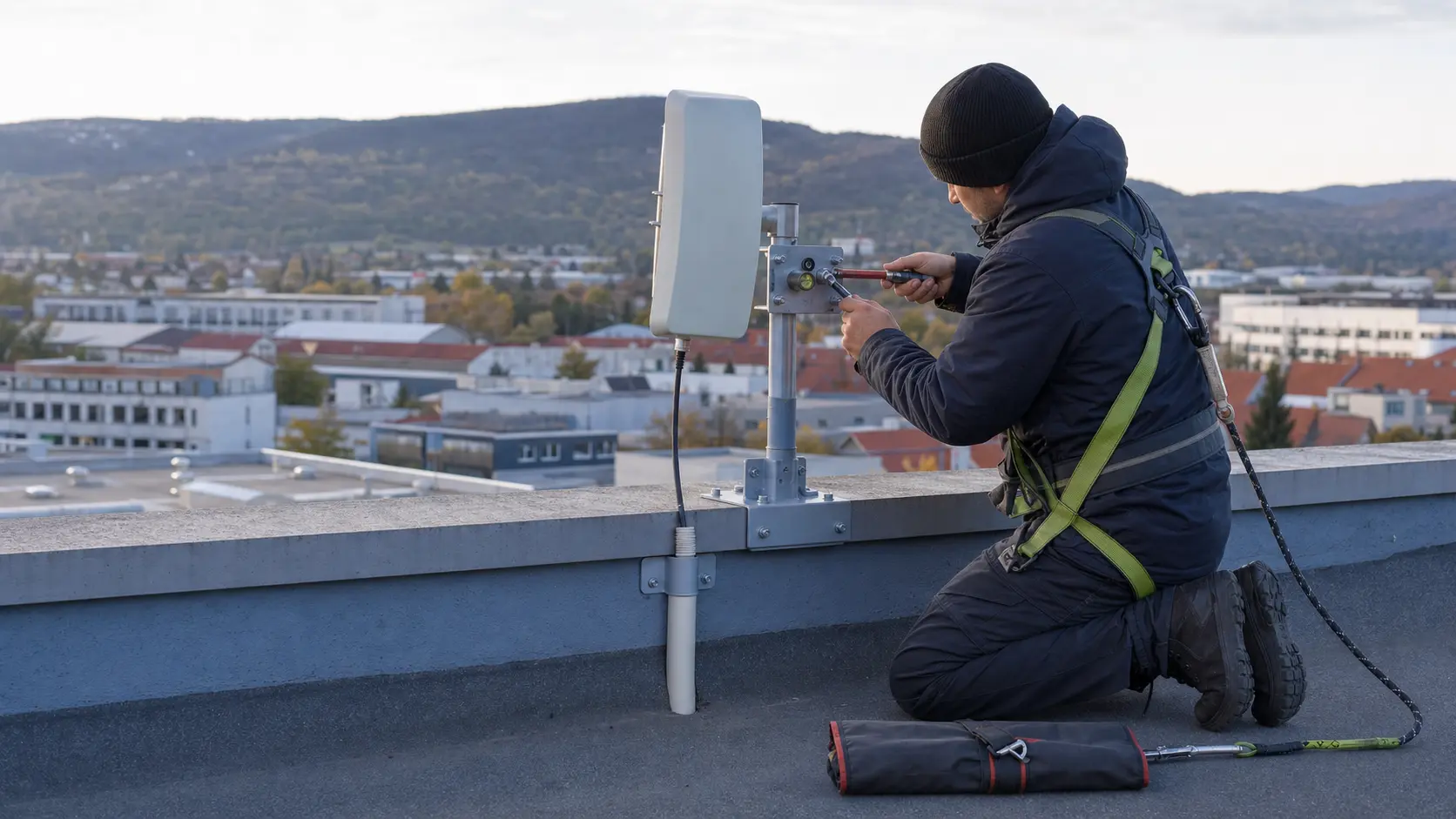
Wireless Budaors access introduces another chain. A subscriber radio needs line of sight or a workable reflected path, mounting, alignment, cabling, weatherproofing and power. The serving access point needs its own structure, radio, backhaul and power. Wind, water ingress, interference, construction in the path, a failed power injector or a misaligned mount can degrade service without withdrawing AS8536's routes. The public 4/4 Mbps label says nothing about sector load or fade margin.
Customer-premises equipment is a shared diagnostic boundary. The terms put the formal responsibility point at the customer's router connection and say the provider does not ordinarily supply the terminal as part of service. A dead router supply, damaged Ethernet cable or misconfigured customer device can look like an ISP outage. Conversely, a powered router with a working local Wi-Fi signal can hide an upstream failure from a user who equates bars with internet access.
Local power can make a nominally diverse path common. A customer router, wireless radio, building switch and rooftop relay may all fail when the same property loses electricity. A second internet route offers little value if the office has no backup for its own equipment. QwertyNet publishes no power design, and customers should not assume provider backup extends to their premises.
The sole visible AS neighbour creates a broader failure. If AS28924 stops carrying AS8536, both QwertyNet /22s can disappear from the wider routing table even while local access plant remains intact. If the AS session remains up but congestion occurs on a handoff or farther upstream, routes may stay perfectly visible while useful throughput falls. That is where the low guaranteed floor, busy-hour measurement and transit headroom meet.
Each layer has a different repair owner: the subscriber for its equipment and power, QwertyNet for assets and configurations it controls, a building owner for access, an infrastructure landlord or carrier for leased plant, and AS28924 for its side of the upstream path. Resilience comes from making those boundaries explicit before the outage, not from treating internet service as one indivisible cable.
A three-day repair target depends on a very small public support surface
The terms say QwertyNet will make every effort to repair registered faults within its responsibility in three days. They say fault resolution begins immediately after a report and that the company cooperates with other network providers. The ordinary service desk is listed as open from 10:00 to 16:00 Monday through Thursday and 10:00 to 15:00 on Friday, closed at weekends. Urgent technical help outside those hours is assigned to the managing director through a direct number.
Hungary's regulator describes the modern consumer rule as a 72-hour repair period. Its summary of the communications rules says a consumer can acquire termination rights if a fault remains unresolved for another 15 days after that 72-hour period, among other repeated-failure conditions. The same NMHH guidance says provider switching should be coordinated so the outage is no more than one working day. Those rules post-date the July 2021 QwertyNet terms and should be read with the current individual contract.
The human scale is visible but not measurable. The homepage presents three named roles: managing director, administration and technical expert. A commercial-data aggregator reports two average employees in 2025, but that figure is not a retrieved official filing and may exclude owners, contractors or shared staff. It is best treated as a signal that the public operating footprint is small, not a definitive headcount.
Small teams can provide excellent service. The same person may know every building, radio and customer history, avoid call-centre handoffs and bring the correct spare on the first visit. That local knowledge is part of the product. Concentration appears when several incidents arrive together, when the key engineer is unavailable, when a tower requires two-person safety work or when a supplier escalation outlasts the local diagnosis.
The public material gives no on-call rota, contractor list, concurrent incident capacity, spares inventory, field vehicle coverage or mean time to restore. It does not say whether the three-day target runs in calendar or working time for every contract, what clock stops while waiting for site access, or how a mass outage is prioritized. It also does not publish historical compliance against the target.
A business buyer should convert local support from a friendly promise into an operating schedule. Who answers at 02:00 on Sunday? Who can access the rooftop, cabinet or upstream facility? Which faults can be repaired remotely? Where are spare radios, power supplies, switches and optics held? What happens if the sole primary engineer is unavailable? Which supplier ticket priority attaches to the customer's service?
The answers need not require a large team. They require named coverage, compatible spares and escalation rights. Field repair is capacity: it is consumed by distance, diagnosis, access windows and simultaneous faults just as bandwidth is consumed by traffic.
Hosting and DNS widen the affected customer set
QwertyNet is more than an access label. Its homepage advertises domain registration, DNS operation, web and email hosting, network design, construction, maintenance and server-room work. The 2021 tariff prices domain registration, primary and secondary DNS, extra mailboxes, website operation and a web server operated at the provider's site. The company can therefore sit in several dependency chains for one customer at once.
A public example makes the scope concrete. The official website of Barbacs municipality identifies QwertyNet as its hosting provider and gives the same company number and Orlay utca address used by the 2026 NMHH list. That statement does not prove the municipal website currently sits in AS8536, and its DNS should not be used to infer a QwertyNet facility. It does show that a public body has named QwertyNet for a hosting role, so failures can affect information publishing as well as access subscribers.
QwertyNet's own DNS arrangement separates some functions. The main website resolves to 193.178.119.104, a RIPE-registered INTEGRITY address originated by AS28924. The mail host, MX and two authoritative name servers resolve into AS8536's 212.52.160.0/22. This arrangement may allow the public website to remain reachable during some AS8536 incidents while email or DNS is impaired. It may also create shared dependence on AS28924, which is both the visible upstream and the network hosting the public page.
Two name-server addresses inside one originated /22 do not prove DNS resilience. They may be on separate hosts, racks and power feeds, or they may not. The addresses 212.52.160.1 and 212.52.161.1 at least occupy different /24 portions of the /22, but that is addressing, not physical separation. A customer using QwertyNet DNS should ask where the servers and secondary copies run, which upstream paths serve them and whether delegation survives loss of AS8536.
Email creates a related support problem. If customers use provider-hosted addresses to report an outage and the mail platform shares the failed route, both service and ticket channel can disappear. The phone number and externally hosted public page may remain useful, but no dedicated external status page is published. The NMHH guidance says a departing internet customer who also takes email should be able to request continued access or forwarding for at least six months, another reason to document mailbox ownership and portability.
The broad service portfolio helps explain micro-ISP economics. Connectivity can lead to recurring DNS, hosting, administration and on-site support. It also means one small operator can become the access provider, domain contact, mail host and systems administrator for the same organisation. That can simplify accountability during normal operation while increasing the value of independent backups, secondary DNS, alternate contact details and tested migration procedures.
The economics reward local knowledge and hide recovery reserve
QwertyNet's posted HUF8,000, HUF12,000 and HUF24,000 monthly tiers are modest absolute sums for symmetric access with a fixed address, even before allowing for their 2021 date. The service is not marketed like mass residential gigabit. It appears aimed at customers who value a reachable local operator, static addressing and adjacent technical help.
The same economics constrain what can be kept idle. A second carrier circuit, spare router, stocked radio, backup battery, climbing contractor and 24-hour rota all cost money whether or not a fault occurs. A small subscriber base spreads those fixed costs across fewer bills. The rational design may use an upstream aggregator, shared facilities, cross-trained staff and on-demand field partners. None is inherently poor engineering. The risk arises when the customer buys business continuity without knowing which reserves are actually funded.
The third-party business signal is consistent with a micro-provider. Companywall, which says its figures draw on Hungary's justice ministry and other sources, reports 2025 revenue of about HUF24.6 million, after-tax profit of HUF3.6 million and two average employees. Those numbers were not verified against the underlying filed report, so they cannot carry the assessment. They suggest scale, not network performance. Revenue also says nothing about contractor labour, leased infrastructure, related-party services or owner work.
At the posted HUF12,000 business price, HUF24.6 million would be equivalent to roughly 171 such monthly subscriptions before tax if all revenue came from that one product. It plainly does not: QwertyNet advertises hosting, DNS, administration, construction and other services, and prices and customer mix may have changed. The calculation is useful only to show why deriving a subscriber count from revenue would be false precision.
The company may also receive operating leverage from AS28924 and INTEGRITY. RIPE records show cross-maintenance and sponsorship links, the public website sits in INTEGRITY address space, and AS28924 carries AS8536 to the wider internet. These are technical and registry facts, not proof of common ownership or a particular commercial bargain. They may provide scale that is invisible in QwertyNet's own headcount. The contract should identify which responsibilities and service levels are backed by suppliers.
For customers, the bill buys more than bits. It buys access to an engineer, a fault escalation path, an address, a route and perhaps hosted services. The resilience value cannot be judged from monthly price alone. A cheap secondary connection on a physically separate mobile or fibre path may be more valuable than a higher nominal rate on the same failure domain. Conversely, a well-maintained local line with fast knowledgeable repair can outperform a larger provider's nominally diverse but slow support process.
Regional ISP economics therefore make disclosure especially important. The customer does not need proprietary cost data. It needs to know which redundancy is installed, which capacity is reserved, which work is contracted and what happens when two failures compete for the same person or spare.
What an evidence-based resilience test would ask
The first test is the access path. For a wired Ujbuda address, the customer should request a route sketch from premises to the first aggregation point, with ownership and repair responsibility for each segment. It should identify whether a second path shares the building entry, riser, pole line or duct. For wireless Budaors service, the equivalent asks for serving-site identity, line-of-sight margin, backup coverage, backhaul, power runtime and a replacement plan for both subscriber and access radios.
The second test is the upstream. QwertyNet should state how many active circuits and BGP sessions connect AS8536 to AS28924, where they terminate, whether they use separate carriers and physical routes, and what usable capacity remains after the largest circuit fails. If there is another private or standby upstream not visible to RIPE, a controlled failover result can establish it without publishing sensitive routing details.
The third test is congestion. A current package schedule should define offered, normally available and minimum speeds, domestic and international measurement points, busy-hour methodology and escalation. The 75 per cent expansion threshold needs an interface, sample window and action time. Customers should test from their router boundary rather than only over local Wi-Fi, preserving time-stamped results that can distinguish access loss from application delay.
The fourth test is power. The provider should identify backup at each QwertyNet-controlled active site in the customer's path and the maintenance date of batteries or generators. The customer should separately power its router, radio, switch and essential applications. Claimed route diversity should be retested during a controlled local power removal where safe.
The fifth test is repair capacity. A service schedule should name fault-report channels, 24-hour escalation, site-access arrangements, contractor coverage, spare-equipment classes and the compensation or termination mechanism after missed deadlines. The three-day public target is a maximum repair window, not an expected restoration time for a business that stops trading after an hour.
The sixth test covers hosted dependencies. Customers should inventory domains, authoritative DNS, mailboxes, websites, server administration and credentials held by QwertyNet. They should maintain independent domain access, secondary contact methods and restorable data copies. A test should show that DNS can be changed and mail or web service restored without relying on the failed access line or an unavailable individual.
Finally, the evidence should be dated. The live routes describe 15 July 2026. The regulator list describes January 2026. The tariff and general terms describe July 2021. None should be silently substituted for another. A current quotation and service schedule can preserve the useful specificity of QwertyNet's public material while replacing stale or missing details.
A live network with an unpriced recovery margin
QwertyNet can prove more than its thin website initially suggests. It is present on the regulator's current fixed-provider list. AS8536 is active, long-lived, fully visible in the IPv4 collector snapshot and protected by valid route-origin authorizations. Two routes, public DNS, mail infrastructure and a real hosting reference show an operating surface rather than an empty registration.
The proof stops at the physical and recovery layers. There is no public access map, fibre length, tower list, exchange port, transit commit, customer count, utilization series, power design, spare pool or crew-capacity statement. The only visible autonomous-system neighbour is AS28924. Its own BIX and upstream connections improve the onward picture but do not demonstrate an independent QwertyNet path.
That makes the final assessment deliberately split. Network operation is Medium: current regulator, routing, RPKI, DNS and customer evidence align. Physical resilience and failure-time usable capacity are Weak: the decisive assets and reserves are undisclosed, and the available customer terms are dated.
The most revealing public number is still 0.01 Mbps. It does not predict ordinary performance. It exposes the distance between a line remaining technically alive and a customer remaining operational. Closing that distance requires evidence of alternate paths, powered equipment, compatible spares and people who can reach the fault before a local connectivity bill becomes a business-continuity loss.