
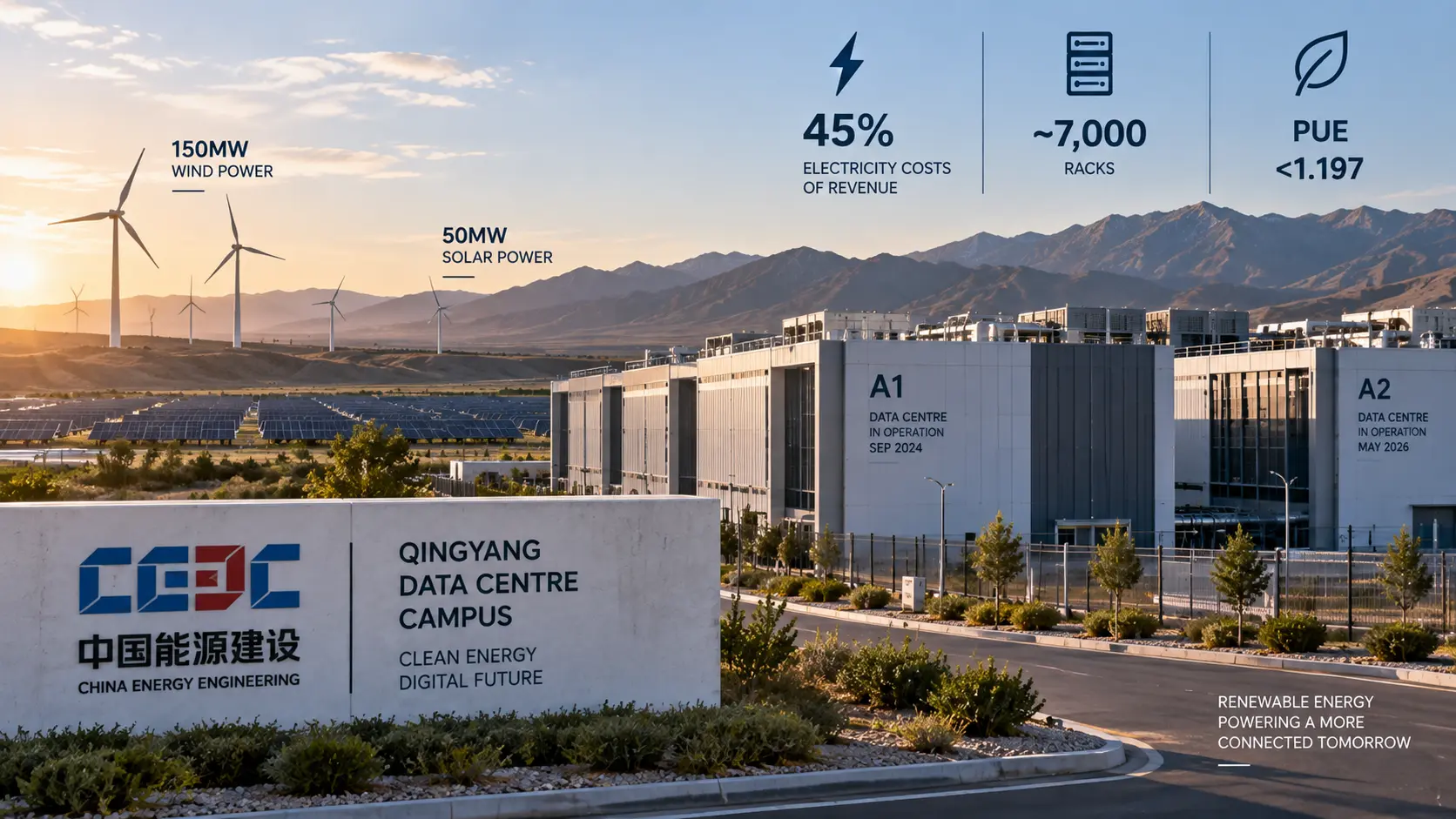
- China Energy Engineering says electricity costs equal about 45% of revenue at its Qingyang data-centre project
- The campus pairs renewable generation with a sub-1.197 PUE claim, but customer power-pricing terms remain undisclosed
The fact
China Energy Engineering said electricity costs account for about 45% of revenue at its Qingyang data-centre development in Gansu, according to information released after an investor visit on 8 September. Fixed-asset depreciation accounts for about 40% of revenue. The figures describe ratios to project revenue rather than shares of total operating costs.
The project represents an investment of about 5.5 billion yuan and includes 150MW of wind and 50MW of solar generation. Its data-centre design covers around 7,000 racks with total planned IT power of approximately 60MW. The company says the site uses long-term green-power arrangements and that annual average power usage effectiveness can fall below 1.197.
PUE compares total facility energy with the energy consumed by IT equipment. It measures the additional energy required for cooling, power conversion and other supporting infrastructure, but does not show the price paid for electricity. The renewable project uses the public grid through a virtual green-power connection rather than operating as an isolated power system. The A1 data-centre building entered service in September 2024, while A2 began operating in May 2026.
The assessment
A customer comparing Qingyang with another data centre needs to assess energy efficiency and electricity pricing separately. PUE shows how much facility energy is required around the IT load, but it cannot tell a buyer what each kilowatt-hour costs or how that charge enters the service contract.
The 45% figure is useful, but it is an operator-level ratio, not a customer price. It could move as electricity use, tariffs, revenue or rack occupancy change. A customer comparing Qingyang with another site would still need to look at the contract itself: how power is charged, whether those costs are passed through, and what load and PUE assumptions sit behind the quoted price.
For BTW readers, the procurement question is whether an efficient power design translates into a competitive all-in charge under the customer's actual workload. Renewable generation and a low PUE can support that outcome, but contract terms and operating measurements are needed to show how much of the benefit reaches the buyer.
What to watch
Watch for actual facility and IT energy consumption as more Qingyang capacity is occupied, alongside changes in the electricity-cost ratio. Customer pricing disclosures, including fixed, indexed or pass-through power charges, would show whether the campus's efficiency and renewable-power arrangements translate into lower delivered costs.
Member Briefing
Deeper Profile Context
Sign in with the right membership level to unlock the full briefing and source notes.
Only for Strategic Circle
Strategic Circle
Open to all readers. Unlock profile briefings after joining and signing in.
Join Strategic CircleOnly for Leadership Alliance
Leadership Alliance
For qualified IP-asset owners and management; sign in to unlock alliance briefings.
Join Leadership Alliance