Summary
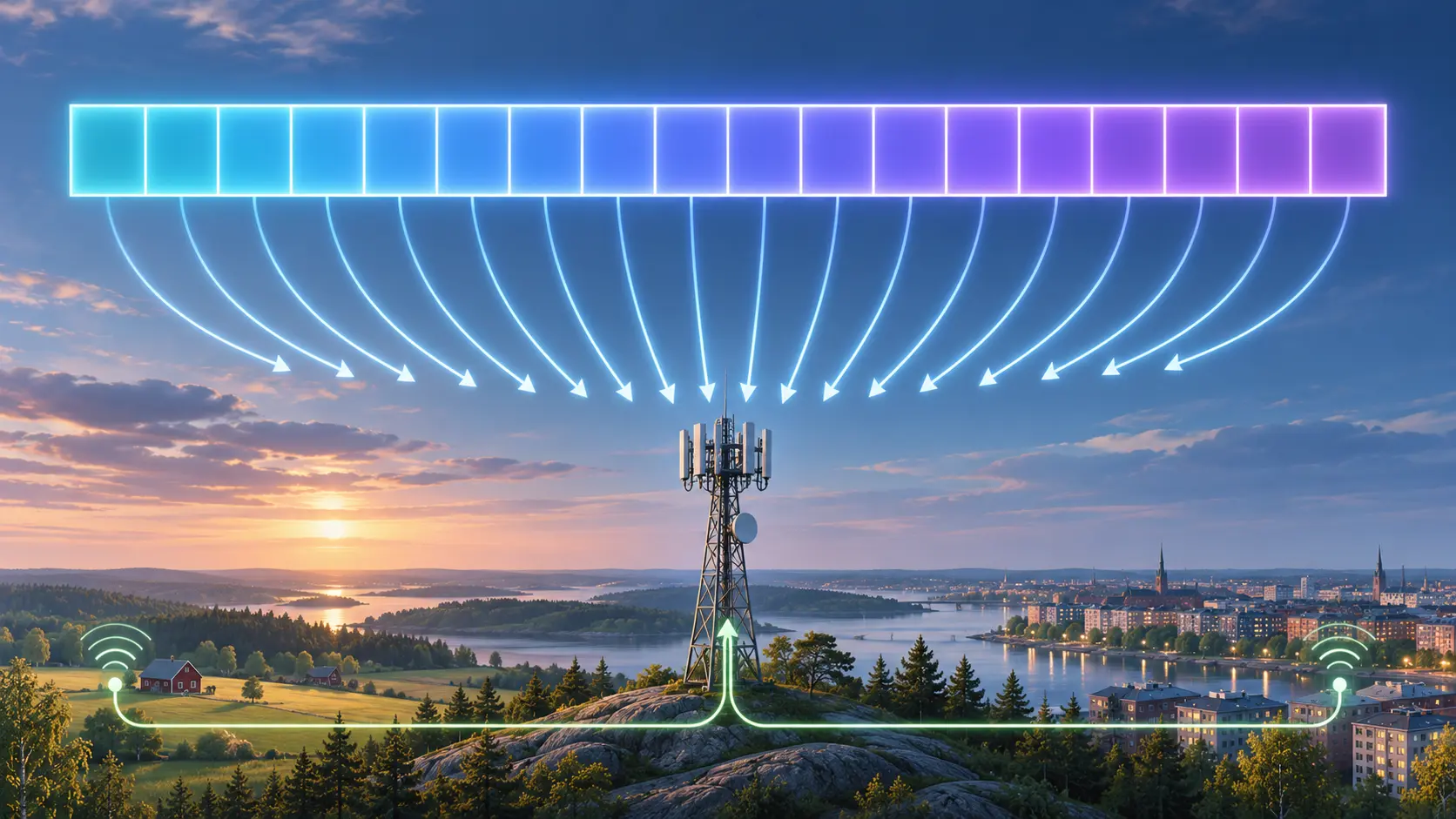
- Sweden's PTS is consulting on a 1427–1517 MHz auction: 90 MHz divided into eighteen national 5 MHz blocks, with a proposed licence term of 24 years and 10 months.
- The regulator proposes no coverage or build-out duty and no spectrum cap. Its reason for the first choice is physical: this band is downlink-only, so a network needs a separate uplink frequency to deliver a service.
An operator buying this spectrum would acquire half a conversation. The Swedish Post and Telecom Authority's October memorandum proposes auctioning 1427–1517 MHz as eighteen 5 MHz blocks. These are national permits and blocks may be combined. The band is harmonised for terrestrial downlink-only communications. To carry a customer's response, the operator must pair it with an uplink in another band. That dependency sits behind the rest of the auction design.
PTS proposes a permit term of 24 years and 10 months, arguing that a long term gives investors certainty. It aims to hold the auction in early 2028, provisionally the first quarter. The consultation announcement asks for comments by 26 November 2026; detailed rules and permit conditions are due for another consultation in the second quarter of 2027. The present document sets direction, not a reserve price or a winning licence.
The most consequential absence is a coverage obligation. PTS says the downlink-only band can add capacity and coverage to mobile networks, but cannot by itself supply the uplink needed for the kind of rollout targets the authority has used before. It therefore proposes no coverage or build-out condition. The buyer would take a long national capacity right without a promise to use this particular band to reach a named town or population threshold. Whether that capacity improves a service depends on the buyer's other frequencies and network investment.
PTS also proposes no spectrum cap. Its stated view is that Sweden's mobile retail market functions competitively: the four major operators' shares have moved closer together, customers can switch, and recent auction holdings permit different services. The competition claim is the authority's assessment, not a new market measurement in this memo. Removing a cap lets bidding determine concentration across the eighteen blocks. The auction's clock rounds would determine quantity and a later stage would place the blocks; PTS proposes to give block 1 to the winner of block 2. Final mechanics remain for 2027.
The investor's question is therefore sharper than “how much spectrum is for sale?” It is: who can combine a downlink-only national asset with existing uplink rights, finance its use, and pay for a term approaching a generation? PTS has put those conditions at the centre of the auction without writing them as coverage mandates. Comments on the proposed direction close on 26 November.
Member Briefing
Deeper Profile Context
Sign in with the right membership level to unlock the full briefing and source notes.
Only for Strategic Circle
Strategic Circle
Open to all readers. Unlock profile briefings after joining and signing in.
Join Strategic CircleOnly for Leadership Alliance
Leadership Alliance
For qualified IP-asset owners and management; sign in to unlock alliance briefings.
Join Leadership Alliance