
Summary
- The new single-rack configuration can gain capacity inside its cabinet, but cannot expand by adding racks.
- Host-level spreading and two network devices provide narrower protections than independent rack or site failure domains.
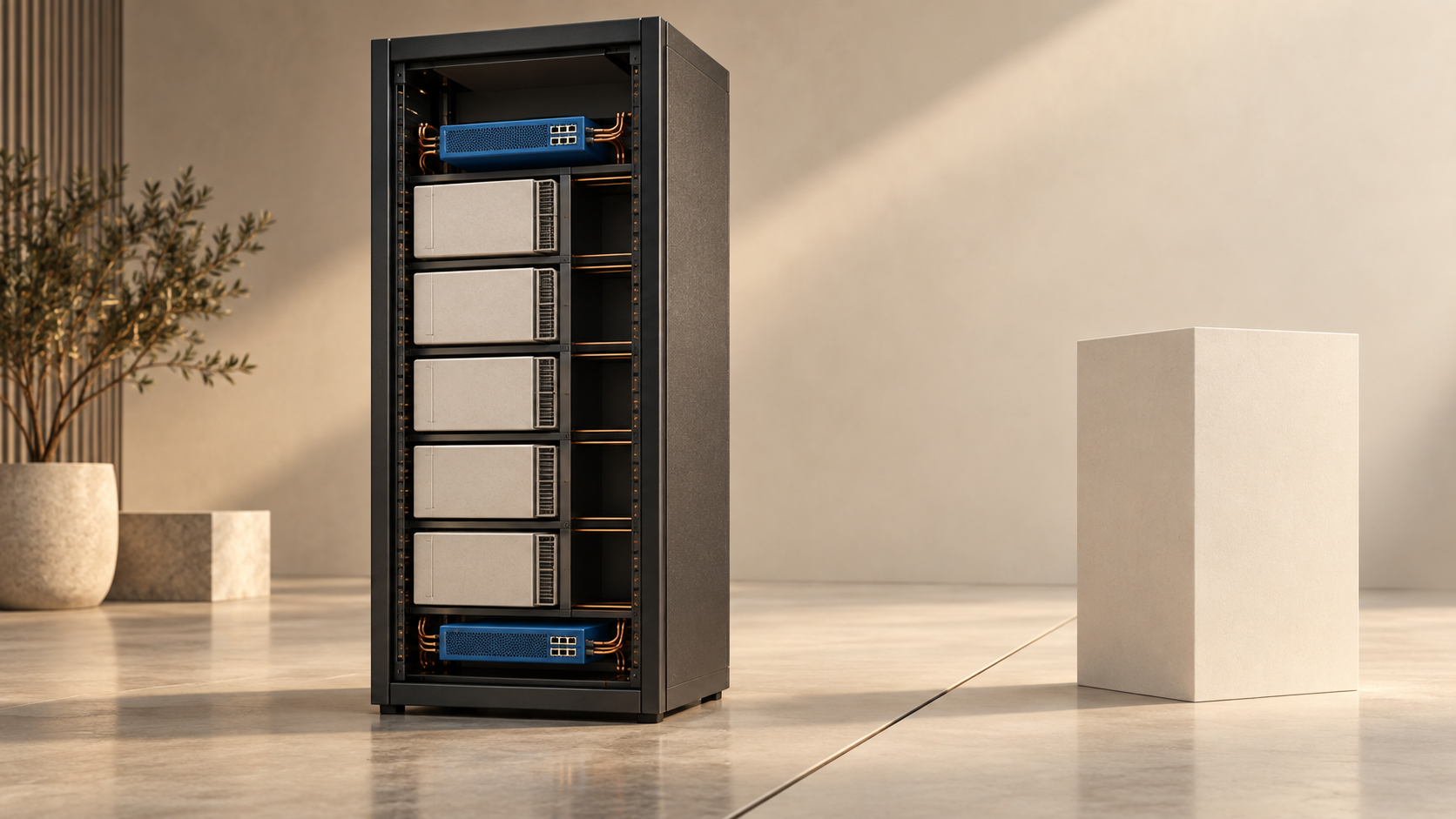
The most consequential part of a compact infrastructure offer may be what cannot be added later. AWS announced general availability of second-generation single-rack Outposts on September 10: one 42U unit integrating compute, storage and networking. Advertised capacity reaches up to 2,688 vCPU and 100 TB of EBS storage, not the installed capacity of every order. AWS announcement.
For a site short of room, removing the separate network rack is a concrete benefit. But the site guide places an equally concrete limit beside it: capacity may be added within the single rack; the configuration cannot scale out by adding racks. AWS says that boundary is acknowledged during ordering. Single-rack site requirements.
That changes the question from “Will today's workload fit?” to “What happens when the next workload does not?” It does not mean the customer can never build more infrastructure. It means that more infrastructure cannot quietly be assumed to be another rack appended to this same configuration.
Headroom has to be usable
There is a difference between an offering's maximum, capacity actually installed and capacity that remains useful for a particular workload. A buyer also has to decide how much of the latter to keep available for peaks or operational contingencies. Treating all spare capacity as immediately saleable or consumable can obscure that choice.
These are planning distinctions, not claims about guaranteed empty slots, an upgrade delivery time or a particular instance mix. The sources do not supply a universal expansion price or promise that any requested capacity is instantly available. The economic comparison therefore needs both the value of a smaller site footprint and the work triggered when the internal growth path is no longer sufficient.
Physical fit is not just cabinet width. Servicing clearance, airflow and electrical provision remain site inputs. Integrating equipment does not abolish the environment that keeps it operating. A procurement decision based only on advertised compute and storage ceilings leaves those inputs outside the calculation.
Redundancy exists at a particular level
The same care applies to resilience. The Outposts optimisation guide distinguishes spreading instances across hosts from spreading them across racks. A single-rack deployment can use the former. Different hosts reduce one kind of shared exposure without creating another cabinet or another site. Outposts placement guidance.
| Protection or option | Boundary that remains |
|---|---|
| More capacity inside the rack | No rack-by-rack scale-out of this configuration |
| Instances on different hosts | The common rack and site |
| A surviving network device | Reduced local-gateway bandwidth after its peer is impaired |
The last distinction is documented in the site guide: two network devices are present, but operation through one does not preserve the original local-gateway capacity. That is neither “no redundancy” nor “nothing changes during a failure”. The useful question is which work must continue acceptably under the reduced condition.
The announcement does not establish application uptime, a measured saving or a universal winner between single- and multi-rack designs. It offers a different combination of footprint and limits. A sound purchase makes both visible: the room saved now, the usable reserve kept inside, the degraded service that can be tolerated, and the next decision when the boundary is reached.
Member Briefing
Deeper Profile Context
Sign in with the right membership level to unlock the full briefing and source notes.
Only for Strategic Circle
Strategic Circle
Open to all readers. Unlock profile briefings after joining and signing in.
Join Strategic CircleOnly for Leadership Alliance
Leadership Alliance
For qualified IP-asset owners and management; sign in to unlock alliance briefings.
Join Leadership Alliance