
Summary
- OCI automates repeatable infrastructure actions through Terraform-based Resource Manager, event rules, recovery plans, security responders and configuration analysis, but those systems still require human-authored policy, permissions and failure handling.
- AI and hybrid deployments shift the constraint from software control to physical and commercial boundaries: supported shapes, regional inventory, service limits, reserved capacity, data location and application validation.
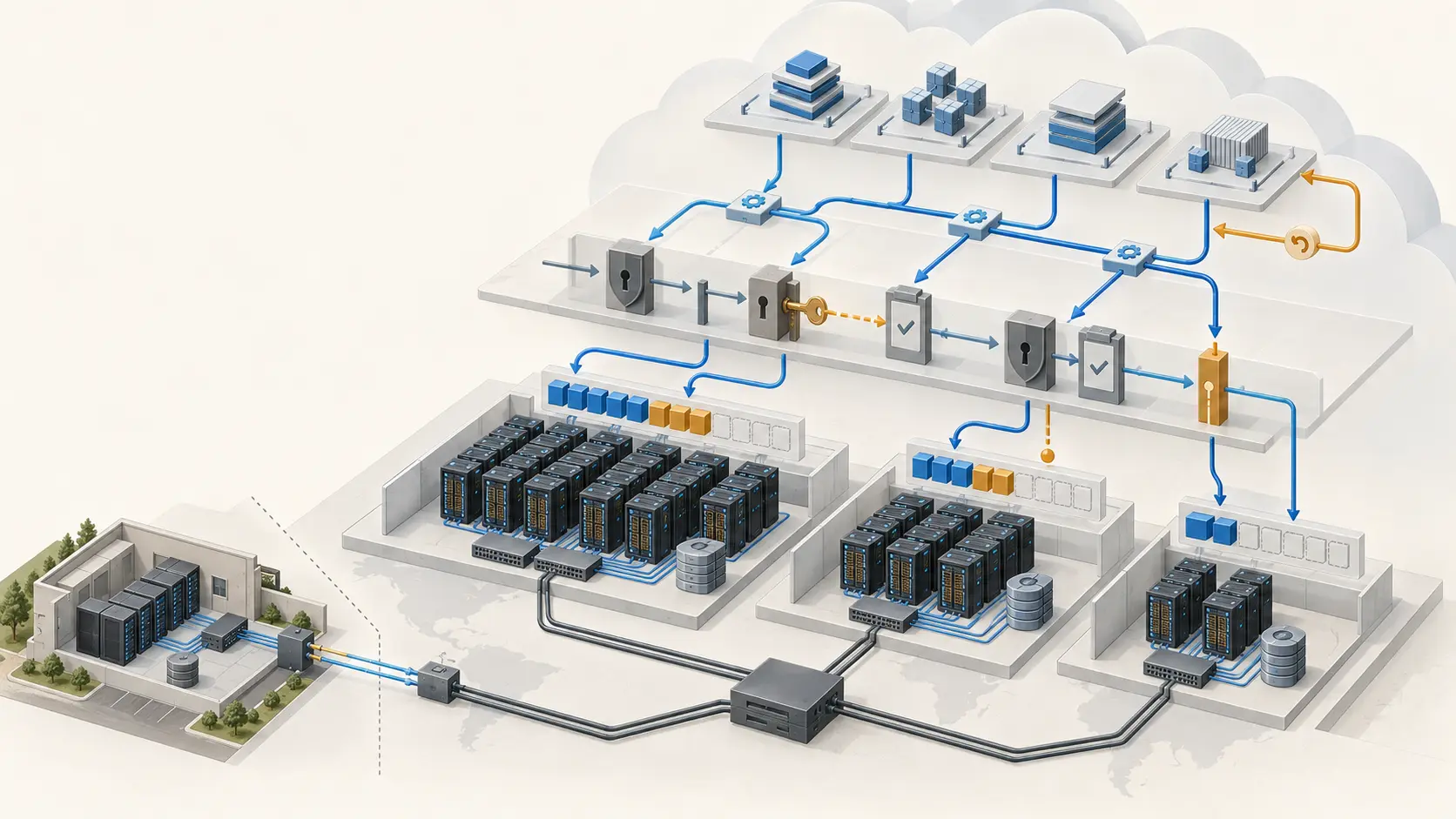
Oracle’s automation stack is best understood as a set of control surfaces rather than an autonomous operator. Resource Manager uses Terraform configurations and managed stacks to provision OCI resources, with plan, apply, destroy, import, state and job-management functions. The OCI Resource Manager documentation describes a way to replace repeated console work with declarative infrastructure. The OCI Terraform provider extends that model across a broad service catalog.
That distinction matters. Code can make a deployment repeatable, but it does not decide whether a proposed network, identity policy or storage layout is safe for a particular application. Teams still select modules, review plans, configure permissions and manage state. The mechanism reduces manual repetition; it does not remove design accountability or incident response.
OCI Events adds a second layer. Rules can match supported resource changes and send events to services such as Functions, Notifications or Streaming, creating triggers for remediation and workflow execution. In practice, this turns a state change into a possible operating procedure: a resource event can start a function, notify a team or feed another system. The Events service model also implies the boundary: only supported events are actionable, downstream logic must be designed, and retries or duplicate delivery require operational safeguards.
Other services expose the same pattern. OS Management Hub centralizes inventory, software sources, errata and scheduled jobs for supported Oracle Linux systems; Full Stack Disaster Recovery organizes resources into protection groups and recovery plans; Cloud Guard combines detector recipes with selected responder actions. Network Path Analyzer can evaluate whether a configured source and destination should be reachable by examining routes, security lists, network-security groups and gateways.
These are meaningful forms of automation, but each has a defined perimeter. Patch orchestration still needs testing and rollback. Recovery plans do not prove that an application will restart correctly. A security responder can act on a false positive if its conditions are poorly tuned. Path analysis can show configuration-level reachability, not latency, packet loss or application health. The operational gain is therefore conditional: the more accurately a company models dependencies and exceptions, the more useful the automation becomes.
AI infrastructure makes that conditionality more visible. OCI documentation describes cluster networks and instance pools for supported compute shapes, while the compute catalog specifies the CPU, memory, GPU, storage and networking characteristics that constrain placement. Oracle’s cluster-network documentation and compute-shape reference describe the building blocks for tightly coupled HPC and distributed AI workloads. An OCI HPC reference implementation shows how Terraform modules can combine compute, networking, storage and scheduler-related configuration.
But a reference implementation is not a managed AI platform. The customer may still own image management, scheduler operations, workload placement, storage pipelines, model serving and cluster lifecycle. A listed GPU shape is not a promise of immediate inventory in a chosen region. Service limits and quotas can require approval before a large deployment, while capacity reservations can reduce—but do not eliminate—the risk that the required shape is unavailable when an enterprise needs it. Oracle’s service-limit documentation makes the governance boundary explicit: a technically valid architecture may still be blocked by account-level controls or physical capacity.
Dedicated AI clusters address a different problem. They can provide reserved capacity and isolation for supported fine-tuning or hosting workloads, but that model is not the same as customer control of an underlying GPU fleet. Supported models, regions, cluster-unit sizing and commercial commitments determine whether the service fits a workload. The result is a trade-off between operational simplicity and fixed capacity or service dependence.
Hybrid products extend the same trade-off to location. Compute Cloud@Customer and OCI Dedicated Region are designed for workloads constrained by data residency, local latency, sovereignty or the inability to move every system into a public region. They can preserve a more consistent OCI operating model near the customer’s data, but they require hardware installation, capacity planning, connectivity and a narrower service catalog than the public cloud. Local deployment solves a location constraint; it does not erase migration, staffing or governance work.
Public adoption signals show why this architecture matters, but they should not be overstated. Oracle’s customer material describes Cohere using OCI GPU infrastructure for language-model training, while Oracle and OpenAI have announced cloud and AI-infrastructure relationships. Those sources demonstrate named commercial relationships and intended deployment roles, not independently audited utilization, cost or performance. Oracle’s financial disclosures and outside reporting also show that AI demand is a growth focus, but revenue growth does not identify which automation layer created the adoption or whether the economics will persist.
The evidence therefore supports a narrower conclusion. OCI’s adoption mechanism is not a single feature: it is the combination of declarative control, event hooks, operational services, specialized capacity and placement options. Its vulnerability is equally composite. Automation can make a flawed design repeatable; reserved capacity can make a dependency more predictable without making it cheap; and hybrid placement can satisfy sovereignty requirements while increasing physical and operational complexity.
For enterprise buyers, the useful test is to ask which manual decision is actually being removed, which exception remains, and which failure mode becomes more concentrated. OCI is strongest where teams can standardize infrastructure and accept Oracle’s control plane. It is less conclusive where workloads depend on scarce accelerators, bespoke application recovery, cross-cloud portability or independently verifiable performance.
Source set
The following links are the complete source set for this briefing:
- Cloud Guard
- Compute shapes
- Cluster networks
- Capacity reservations
- OCI Events
- Service limits
- Network Path Analyzer
- Resource Manager
- Dedicated AI Cluster
- Compute Cloud@Customer
- Full Stack Disaster Recovery
- OS Management Hub
- OCI HPC quickstart
- OpenAI Stargate announcement
- OpenAI and Oracle Stargate update
- OCI Terraform provider
- OCI Dedicated Region
- Oracle Cloud directory entry
- Oracle AI infrastructure
- Oracle Cohere customer disclosure
- Oracle OpenAI announcement
- Oracle Q1 FY26 earnings release
- Oracle Q4 FY25 earnings release
- Reuters on Oracle cloud growth
- Reuters on Uber cloud agreements
- SEC Oracle filings
- Synergy Research Group cloud market analysis
Member Briefing
Deeper Profile Context
Sign in with the right membership level to unlock the full briefing and source notes.
Only for Strategic Circle
Strategic Circle
Open to all readers. Unlock profile briefings after joining and signing in.
Join Strategic CircleOnly for Leadership Alliance
Leadership Alliance
For qualified IP-asset owners and management; sign in to unlock alliance briefings.
Join Leadership Alliance