
Summary
- AfNOG’s 2008 Unix System Administration participant roster records
Marie Paule Uwaseand Rwanda, while the same event’s certificate gallery recordsMarie-Paul Uwase. The gallery is an internal spelling bridge, not independent identity proof. - AfNOG’s 2010 archive lists
Marie-Paul Uwaseas an instructor and assigns that name five Unix, IPv4/IPv6 and log-management schedule entries. Those entries prove a scheduled role, not observed delivery, authorship, teaching quality or learner outcomes. - Contemporaneous records outside AfNOG align the name family with the National University of Rwanda, computer security and network research. The composite supports a high-confidence editorial linkage, but neither AfNOG roster contains a shared persistent identifier.
- A responsible audit preserves the exact variants, tests a same-name negative control, minimises personal data and separates identity linkage from causation. One resolved pair cannot establish a programme-wide student-to-instructor pattern or an AfNOG-caused career outcome.
The extra letter
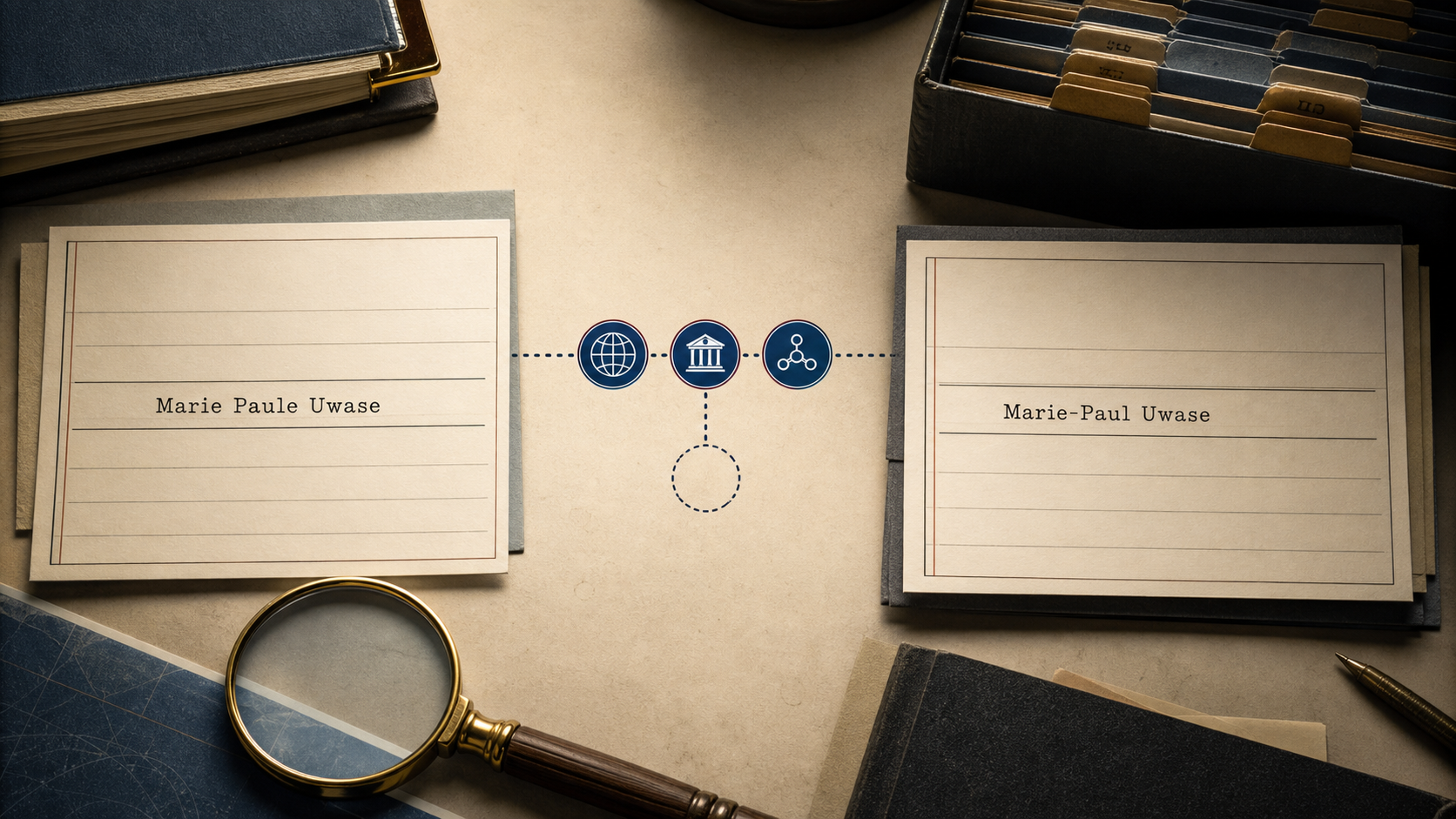
AfNOG’s public workshop archive exposes its evidentiary limit in a detail smaller than a word. Its 2008 roster and certificate gallery render one compound given name differently: the terminal e in Paule is present on the roster, while the gallery substitutes Marie-Paul and adds a hyphen. Because that second form appears again on a 2010 instructor page, the discrepancy is not decorative. It is the point at which a plausible return path becomes a record-linkage problem.
The 2008 AfNOG Unix System Administration roster lists Marie Paule Uwase, (Rwanda) among the participants. The record is compact. It supplies a name, a country and an event role in a specific workshop track. It does not supply an institution. It does not say whether the participant completed the workshop, passed an assessment or received a particular result. It has no persistent personal identifier. It says nothing about a later teaching role.
Elsewhere in the archive for the same event, the certificate-gallery index labels an image Marie-Paul Uwase. The individual gallery page repeats the form in its page title. The two representations differ in precisely the way an exact-string search handles poorly: Marie Paule becomes Marie-Paul. A space becomes a hyphen, and the terminal e disappears.
That would be a minor cataloguing curiosity if the later archive used the first form. It does not. AfNOG’s 2010 instructor roster lists Marie-Paul Uwase (Rwanda). The spelling on the 2008 certificate page therefore matches the spelling on the 2010 instructor page, while the 2008 participant roster does not. The temptation is immediate: a participant returned as an instructor two years later.
The records make that interpretation highly likely. Yet an appealing narrative and a responsible public claim are not the same thing. The archive supplies a research lead, not a self-authenticating lineage. Before joining the 2008 and 2010 entries, an editor has to ask what each page proves, which pages merely repeat one another, what independent records add, what identifier is missing, and what would defeat the proposed match.
The answer matters beyond one spelling. Technical communities frequently rely on practical recognition: colleagues know who attended, who later taught, and which variation of a compound name belongs to whom. Public reporting has a different obligation. A reader who was not in the room should be able to reproduce the reasoning without relying on insider familiarity, publishing personal contact data or treating a photograph as biometric evidence. The standard need not mimic a court or civil registry. It does need to show its work.
This case is unusually useful because the archive strengthens the match and limits it at the same time. The 2008 gallery creates a bridge between the two spellings. Yet because the gallery and roster belong to the same AfNOG-controlled source family, that bridge cannot serve as independent confirmation. The archive helps explain the variation, but repetition cannot turn its own captions into a unique identity key.
A record is not a person
The safest way into the case is to resist normalisation. It would be easy to rewrite every occurrence as Marie-Paule Uwase, choose the form most common in external records and proceed as though punctuation were typographical noise. That would erase the central evidence. The public pages do not use one stable string. They use at least three: Marie Paule Uwase, Marie-Paul Uwase and Marie-Paule Uwase. A government record reverses the order as UWASE Marie Paule. Those distinctions should remain visible because the problem is precisely how to interpret them.
A record is one institution’s representation of a person at a particular time. It may contain a transcription, a locally familiar word order, a field exported without punctuation, or a label typed for a gallery. None of those possibilities is established here, and none should be invented. We do not know why the compound given name changed. We do not know whether the 2008 roster and gallery caption were generated from the same database, copied from different forms or entered by different people. We do not have the original registration material or AfNOG’s identity-verification procedure. No public correction explains the variation.
The appropriate first move, then, is descriptive. The 2008 roster records Marie Paule Uwase from Rwanda as a participant in the Unix System Administration track. The same event’s gallery records Marie-Paul Uwase in a certificate context. Even that gallery evidence needs a narrow reading. It shows that the archive associated the caption with a certificate image. It does not disclose the assessment criteria, completion standard, or whether the displayed certificate represents a measured skill outcome. Calling the participant a “graduate” would import a status the roster and gallery do not establish.
Nor is the picture itself needed. The gallery’s caption and page title are enough to reproduce the spelling observation. Analysing the face would add privacy risk while offering a type of certainty the available image and method cannot responsibly provide. No facial comparison is part of this audit. The image is not identity proof; the text surrounding it is an archival variant bridge.
That distinction protects both accuracy and the person named. A public photograph can feel conclusive because people are accustomed to recognising faces. But recognition is not automatically reproducible, especially across old images, and using it here would transform an ordinary archive audit into an unnecessary biometric exercise. The question can be answered from less intrusive fields: exact name forms, country, institution, technical domain, chronology, event role and the presence or absence of persistent identifiers.
The 2010 record has the same limits. The instructor roster anchors a role on a dated first-party event page: Marie-Paul Uwase, Rwanda, one of six listed instructors for the 24–28 May workshop. On its own, the roster does not show how the person was selected, whether the entry changed before the event, or what occurred in the classroom. Its value is real but specific. AfNOG is authoritative about what its public programme listed; it is not automatically authoritative about cross-year civil identity, observed teaching quality or later career causation.
This is why source roles have to remain separate from source independence. The AfNOG pages are the best available anchors for AfNOG event roles. Their common ownership, however, means the 2008 roster, 2008 gallery, 2010 roster, 2010 outline and 2010 timetable are not five independent witnesses to identity. They form one first-party archival family with several internal views. Multiple pages can add detail, reveal inconsistency and make an assignment reproducible without multiplying the number of independent institutions behind the claim.
What five schedule entries add—and do not add
The difference between the 2010 roster and the detailed programme is not cosmetic. A bare instructor list can include people associated with a course without saying what they were expected to do. AfNOG’s detailed 2010 outline goes further. It assigns Marie-Paul Uwase to Hands-on UNIX, IPv4/IPv6 Basics, continued IPv4/IPv6 exercises, Log Management, and continued log-management work. Across Tuesday, Thursday and Friday, the public schedule contains five named entries. The summary timetable also associates her with the instructor code MP.
Those details materially improve the role anchor. They make the assignment testable at session level. The person was not merely included in a general acknowledgement or an undifferentiated staff list; the programme connected the name to recurring teaching slots and specific technical subjects. Unix practice, IP fundamentals and log management form a coherent operational curriculum. The entries therefore support the conclusion that the listed role was intended to be substantive.
But schedules describe plans. They are not observation logs. Five entries do not prove that every session occurred exactly as printed, that the named instructor delivered every minute, or that no substitution happened. The available public record includes no signed attendance record, instructor contract, correction or reliable replacement notice. No participant evaluations were found. The schedule does not establish who wrote the training materials, whether slides were inherited from a shared curriculum, how the instructor adapted them, or how learners performed.
The difference matters because a programme is a statement of intent, whereas delivery and outcome require observation. Here the archive supports the phrase “scheduled to teach.” Verifying what occurred in the room, how the teaching was judged or whether learners later deployed the material would require evidence of another kind.
The five entries matter most in comparative terms. If the 2010 page had only named Marie-Paul Uwase in an instructor column, the later role would be thinly specified. The detailed assignments make an honorary or purely nominal interpretation less plausible. They show that organisers planned a sequence of work under that instructor code. Yet they stop short of demonstrating delivery and effect. Stronger role evidence raises confidence in what was scheduled; it does not abolish the need for other evidence about what happened.
The course subjects also create a coherent bridge to outside records, but coherence must not become causation. A participant in the Unix System Administration track in 2008 and a scheduled Unix/IP/log-management instructor in 2010 fit a plausible technical trajectory. Contemporaneous records place a person in computer security and network research. Still, a plausible sequence is not proof that the first event produced the later competence or appointment. To make that claim would require evidence of learning, selection, prior skill, intervening work and decision-making that the public archive does not supply.
The timetable’s evidentiary role is therefore precise. It verifies a planned operating surface: AfNOG workshop organisers and an instructor network assigned a named person to five sessions. It does not establish an incorporated AfNOG legal body for the period; no such identity has been verified here. It does not turn organisers into an employer, a certification authority or the cause of a career. A schedule can be excellent evidence when the claim is kept at the schedule’s scale.
The independent bridges outside AfNOG
The strongest support for joining the 2008 and 2010 records comes from leaving the AfNOG archive. External sources do not repeat the event roles. Instead, they align the name family with an institution, a country context, a technical field and a chronology close to the workshop dates. That kind of corroboration is valuable because it is different from asking AfNOG to confirm itself.
The first bridge is almost contemporaneous with the 2008 event. A Sourcefire announcement preserved by SecLists, dated 15 May 2008, identifies Marie-Paule Uwase as a Bachelor of Science candidate in computer science at the National University of Rwanda and as part of the university’s security team. The hyphen is present and the terminal e remains. The date sits immediately before AfNOG’s May–June workshop period. The institution, computer-security domain and Rwanda setting form a strong contextual alignment.
It is important to say what this source does not do. It is not an AfNOG registration record. It does not place the named person in AfNOG’s classroom. The announcement came from Sourcefire and survives through a mailing-list archive; that preservation chain is not the same thing as an event roster. Its contribution is independent context: a person using the Marie-Paule Uwase form was publicly associated with NUR, computer science and security at the relevant time.
The distinction also corrects a common reporting shortcut. The 2008 AfNOG roster itself names Rwanda but no institution. The link to the National University of Rwanda comes from records outside that roster. Writing “the NUR participant on AfNOG’s 2008 list” without explaining the bridge would misattribute external information to AfNOG’s page. The composite may support the association editorially, but the source boundary should travel with the sentence.
A second bridge comes from Rwanda’s government record. Official Gazette no. 50 of 14 December 2009 lists UWASE Marie Paule as Research Assistant A in the National University of Rwanda’s academic and research staff annex. The underlying order was dated 20 October 2009, and the appointment entry carries an effective date of 1 November 2005. Here the surname appears first, the compound name is unhyphenated, and the terminal e returns.
The gazette is institutionally independent of AfNOG and places the name at NUR across the relevant interval. It also introduces a small apparent tension: the May 2008 security announcement described a bachelor candidate, while the gazette lists a research-assistant appointment effective in 2005. Those statuses could coexist. A student can hold a research role. But the sources do not explain the arrangement, and an editor should not manufacture a seamless biography to make the records look tidier than they are. The important point is contextual alignment without a hard contradiction.
A third contemporaneous bridge is technical rather than administrative. A Vrije Universiteit Brussel ETRO publication record lists Marie Paule Uwase on a February 2010 work about interactive tools for learning the basics of sensor networks. The record helps align the name, date and network-education domain with the 2010 AfNOG teaching assignment. Its displayed conference metadata is inconsistent, however, and it does not state an NUR affiliation. The safe use is narrow: author name, publication month, work title and technical domain, not the corrupted event description or an invented institutional line.
These three sources do the heaviest independent work. One places Marie-Paule Uwase in NUR computer science and security just before the 2008 workshop. One places UWASE Marie Paule among NUR research staff through the 2008–2010 interval. One places Marie Paule Uwase in network-related educational research shortly before the 2010 workshop. They differ in publisher and purpose. Their convergence does not create a civil-identity certificate, but it makes a coincidental pairing of the AfNOG entries substantially less plausible.
Later sources extend the contextual line without retroactively proving either event role. An NSRC bursary report uses Marie-Paule Uwase for a 2011 entry, gives Rwanda and describes her as an assistant lecturer at a university in Rwanda. An NSRC activity chronology uses Marie Paule Uwase (Rwanda) while describing a 2011 event on a 2012 page. NSRC supports AfNOG, so these records are adjacent rather than fully independent. The activity page’s chronology is awkward. They demonstrate continuing variation in the name form within the neighbouring technical community, not independent proof of the AfNOG match.
An independently published French-language Arduino BookSprint manual, produced in October 2011 and issued in December, credits Marie-Paul UWASE (Rwanda) and describes a university-teacher role along with free-software community involvement. The form without the terminal e therefore appears outside AfNOG too. The biographical line is a contributor description in a collaborative manual, not an employer file or civil registry, but it weakens the idea that Marie-Paul must be an AfNOG-only typo.
A 2012 VUB/IEEE publication record names Marie-Paule Uwase on work about routing algorithms in wireless sensor networks. A 2014 Digital Impact Awards Africa panel biography describes Marie-Paule Uwase as a doctoral candidate at ULB and an assistant lecturer at NUR. These later records help explain why NUR and Belgian university records can belong to a coherent chronology rather than representing an automatic conflict. They cannot identify the 2008 participant on their own, and they cannot be used to claim that AfNOG produced the academic work.
The result is not a biography assembled by accumulation. That would invite speculation about private life, institutional moves and career motives. It is a bounded identity test. The external records contribute only the fields necessary to ask whether the event entries plausibly belong to one person: name variants, Rwanda, NUR, computer science or network-related work, and dates. Everything else is surplus to the claim.
The identifier that arrives too late
Names are useful in conversation because humans combine them with context. As database keys, however, they are unreliable. Spacing, punctuation, word order and transcription change; two people can share an exact string; one person can appear under several strings. This is why systems such as ORCID emphasise unique, persistent identifiers, and why the Library of Congress authority-control framework accommodates variant name references. Neither system validates this particular match, and no ORCID identifier is asserted for the person in this case. They illustrate the missing function: a stable key can connect changing representations without pretending that spelling itself is identity.
No such key appears on both AfNOG event records. The 2008 participant roster has no handle that reappears on the 2010 instructor roster. The later public network registry does contain a useful chain. A current AFRINIC RDAP response for AS37010 connects the number resource to the organisation handle ORG-NUoR1-AFRINIC and the person handle MU1-AFRINIC. The organisation entity resolves to National University of Rwanda, while the person-handle entity displays Marie-Paule Uwase.
This chain shows what a persistent handle can add: an inspectable machine-readable association among a number-resource record, an organisation entity and a named contact entity. It also shows why later identifiers cannot be projected backward. MU1-AFRINIC is absent from the 2008 and 2010 AfNOG rosters. The RDAP responses are current records retrieved long after the workshops, not archived snapshots of the relevant years. They cannot serve as a historical cross-event identifier, and they do not prove any production-network change attributable to a workshop.
The registry evidence has a privacy edge as well. Public RDAP records can expose contact coordinates that are unnecessary for this story. A reproducible audit needs only the autnum handle, organisation handle, person handle, roles and display names. Addresses, telephone numbers, email addresses and notification fields add exposure without improving the identity decision. They should not be copied into public prose, notes or screenshots.
Data minimisation is not a concession that weakens verification. It is part of sound verification. The general literature on privacy-preserving record linkage begins from a familiar problem: records may need to be matched across datasets even when a shared unique identifier is absent, while identifying attributes can themselves disclose sensitive information. This article does not implement a cryptographic protocol or trained probabilistic model, and it borrows no statistical certainty from that research. The practical lesson is simpler: use only the attributes needed for the stated decision, keep their source roles visible, and do not collect more personal data merely because a public endpoint makes it easy.
The missing shared key remains a material caveat even after the composite match becomes strong. It means the conclusion is an editorial linkage: a transparent judgment suitable for reporting, subject to revision if better evidence appears. It is not a legal identification, a biometric match or a declaration about civil identity. The words used for the result should preserve that distinction.
The exact-name trap
It might seem that the safest response to spelling variation is to prefer exact matches. This case demonstrates why that rule fails in both directions. An exact-match-only search would separate Marie Paule Uwase from Marie-Paul Uwase and might miss a genuine connection. A permissive fuzzy search could join them too readily. Worse, neither exactness nor fuzziness answers whether a matching string belongs to the same person in another context.
A 2025 California healthcare meeting packet contains the exact string Marie-Paule Uwase in an apparently unrelated professional context and jurisdiction. For this audit, that is a negative control: a record that resembles the target strongly on name but lacks the contextual bridge required for merger. It must not be declared the same person. It also must not be declared a different legal person. The public evidence considered here establishes neither proposition.
The value of the negative control is methodological, not biographical. If an exact string appears in a remote context, the string alone cannot be treated as globally unique. Country, institution, technical domain, chronology and contradictions have to do real work. The 2008/2010 AfNOG pair is persuasive because several contextual attributes converge near the event dates and because the archive itself documents the spelling shift. The California record has no such bridge in this inquiry, so it remains unmerged.
This is also where non-discovery must be handled carefully. No hard contradiction was found for the AfNOG pair: no incompatible unique identifier, irreconcilable simultaneous biography, event correction separating the entries, or reliable instructor-replacement record. That absence supports the proposed link under the declared test. But searching without finding a conflict is not proof that none exists. Public archives are incomplete, pages disappear, and original forms may never have been published.
Several discoveries would change the judgment. A first-party correction assigning the 2008 and 2010 records to different people would do so. So would incompatible persistent identifiers; proof that the certificate caption belongs to another participant; a contemporaneous candidate with the same name, country, institution and technical context but no differentiating field; or a reliable record that someone else delivered the 2010 assignments. Any of those would require downgrading the pair from high-confidence editorial linkage to unresolved.
The standard is designed to be revisable because responsible archives are not monuments to an editor’s first conclusion. A transparent link is stronger, not weaker, when readers can see what evidence would falsify it. The public value lies in a reproducible judgment whose ceiling and failure paths are explicit.
A five-part test for joining the records
The evidence can be organised into a modest categorical test. It is categorical because the available source universe is unknown: there is no reliable estimate of how often the name variants collide, no labelled dataset of true and false matches, and no defensible prior probability from which to calculate a numerical score. A percentage would look scientific while concealing invented assumptions. The appropriate question is whether each necessary condition is met.
First, both roles need dated first-party anchors. The 2008 AfNOG roster supplies the participant role, the Unix System Administration track and Rwanda. The 2010 roster supplies the instructor role and Rwanda. These are the facts for which AfNOG’s archive is best placed to speak. The anchors prevent a later biography or search snippet from being used to invent an event role retroactively.
Second, the name difference must be preserved and bridged in the sources. The 2008 certificate gallery provides that bridge by using Marie-Paul Uwase inside the same event archive that lists Marie Paule Uwase. This makes ordinary documentary variation more plausible than a clean two-person split. Yet the bridge’s dependence remains visible: gallery and roster are one source family, and an internal error could have been repeated.
Third, at least two non-AfNOG records close to the event period should align the name family with multiple contextual attributes. The 2008 Sourcefire announcement connects Marie-Paule Uwase to NUR, computer science and security. The 2009 gazette connects UWASE Marie Paule to NUR research staff. The February 2010 university publication connects Marie Paule Uwase to network-learning research. These records align institution or country context, technical domain and chronology in different combinations. Later publications and adjacent-community records reinforce continuity but carry less weight for the original event link.
Fourth, the audit must look actively for contradictions rather than merely collect confirming details. The bachelor-candidate and research-assistant descriptions are not inherently incompatible, though their relationship is unexplained. The 2010 publication page contains inconsistent event metadata, so those corrupted details are excluded. The NSRC chronology is awkward, so it is not used as a precise event clock. The California same-name record is kept separate. No incompatible key or period-specific biography was found, but the conclusion remains open to contrary evidence.
Fifth, the match must be supportable at a privacy minimum. The gallery caption supplies the spelling observation without face analysis. The RDAP handle chain can be reproduced without contact coordinates. The public argument does not need a personal email, telephone number, street address, notification field or unrelated biography. If a conclusion depends on exposing those fields despite strong less-intrusive evidence, the method has confused data availability with necessity.
Under this rule, the pair passes. There are dated role anchors, a documented source-level variant, several independent contextual bridges, no observed hard contradiction and a privacy-preserving reproduction path. The 2010 schedule provides an additional operational measure by assigning five technical sessions. The missing shared identifier prevents absolute certainty but does not automatically defeat a composite match whose components are inspectable.
The correct wording is therefore high-confidence editorial linkage. Each word carries a boundary. “High-confidence” reflects the convergence of name family, country, institution, technical domain, chronology and internal variant evidence. “Editorial” identifies the decision-maker and use: this is a reporting judgment about how records may responsibly be joined. “Linkage” describes the relationship among records, not a legal ruling about a person’s identity.
The standard can be reproduced without claiming universality. Another editor can open the role pages, compare the spellings, inspect the independent records, note the missing key and test the contradictions. Reasonable editors might assign different qualitative confidence at the margins. What they should not do is silently normalise the name, count dependent pages as independent confirmation, or hide the absent identifier behind a confident narrative.
“Everyone in the community knows”
AfNOG organisers and participants may regard this match as obvious. In a relatively small technical community, people can remember who attended, who later joined an instructor team and how a colleague’s compound name was commonly rendered. Demanding a persistent identifier for every historical link would discard much honest knowledge, especially when early workshop sites were built for logistics rather than long-term identity control.
That objection has force. A missing identifier should not erase a well-corroborated connection. Many useful records predate contemporary identity infrastructure or omit handles maintained elsewhere. In this case the composite is strong: country aligns, the 2008 archive supplies the crucial variant, the technical chronology coheres, independent NUR records sit close to the event dates and no hard conflict has appeared.
Insider recognition, however, cannot carry the public claim by itself. “We know who this is” asks readers to accept memory without seeing its basis, and familiarity is unevenly distributed. It may favour well-connected participants while leaving others invisible or misidentified; it can also conceal spelling assumptions and retrospective success narratives. The five-part test translates that local confidence into evidence a reader can inspect after the original witnesses have left the room.
The practical compromise is a minimum sufficient record, not maximal bureaucracy. Start with dated role anchors. Preserve source variants. Add contextual bridges from outside the event archive. Check for conflicts. State what unique identifier is missing. Publish no more personal data than the claim requires. If the composite is strong, call it an editorial linkage and disclose the caveat. If a hard conflict appears, leave the pair unresolved.
This approach also protects archives from retrospective overclaiming. Workshop websites are often treated as if they were designed to answer later questions about lineage, impact and institutional development. Usually they were designed to tell participants where to be, who was listed, and what was scheduled. Their limitations are not necessarily failures by the organisers. The failure occurs when later analysts force logistical pages to bear causal or identity certainty they do not contain.
AfNOG’s archive performs well on some of the questions asked here. It retains both 2008 spellings, a dated roster, a 2010 instructor list and a detailed programme. Those records allow the ambiguity to be seen and tested. Yet it does not expose the original forms, a shared identifier, a correction history, a signed attendance record or an instructor contract. It preserves a strong lead and the evidence needed to improve it, not a complete identity authority.
For future archives, the lesson is not to publish more personal information. A privacy-conscious event system could assign an internal persistent participant identifier, record authorised public name variants, distinguish planned from delivered sessions, and publish corrections without exposing contacts. Historical records cannot be retrofitted casually, but contemporary organisers can improve continuity by preserving minimal structured fields and provenance.
Identity is not causation
Resolving the record pair answers only one question: whether the 2008 participant entry and the 2010 instructor entry probably describe the same real-world person. Even a definitive shared civil identifier would not answer why the later assignment occurred, what competence it reflected, or what outcomes followed. Identity linkage and causal inference require different evidence.
The external record actually makes a simple AfNOG-causation story less defensible. Before the 2010 instructor schedule, Marie-Paule Uwase was already publicly associated with NUR computer science, a security team and research work. The gazette reports a research-assistant appointment effective years before the 2008 workshop. The February 2010 publication places the name in a network-learning research context before the May 2010 course. These pathways make the event-role link more plausible because the technical domains align. At the same time, they show that competence and institutional development had plausible sources outside AfNOG.
Nothing in the available record shows how the instructor was selected. There is no contract, recommendation trail, application, interview record or statement from the person about the transition. The person’s own preferred historical name form is also unknown. Without those materials, it would be irresponsible to claim that participation in 2008 caused the 2010 appointment, that the workshop created technical competence, or that AfNOG was the decisive career mechanism.
The same boundary applies to the schedule. Unix, IPv4/IPv6 and log-management assignments are relevant technical roles. They do not prove that learners adopted the material, changed operational practice or deployed anything on a production network. The later AFRINIC number-resource chain demonstrates a public association among a university, a number resource and a named handle in current registry data. It does not establish a workshop-caused network outcome, and it cannot be used to credit AfNOG with AFRINIC’s formation, staffing, policy or operation.
Nor can one linked pair establish a general training pattern. A numerator of one, without a defined cohort denominator or complete succession data, yields no responsible conversion rate. This essay does not inventory other participants, rank alumni or reconstruct a comprehensive instructor chain. The single case can demonstrate a method for deciding whether a proposed link is publishable. It cannot measure how often such transitions occurred or what they meant at programme scale.
There is a subtler risk in celebrating the case too quickly. Stories about local technical capacity are often shaped into satisfying arcs: student attends, student returns as teacher, regional expertise multiplies. Such narratives can honour real work, but they can also flatten the person’s prior experience, other institutions and collective labour. Here, the pre-2010 NUR, security and research records are not footnotes to an AfNOG origin story. They are evidence of alternative and overlapping pathways that the archive does not disentangle.
Keeping causation open is not a claim that AfNOG had no influence. Non-proof works both ways. The workshop may have mattered greatly, modestly or not at all to the later assignment; the available public records do not tell us. A careful account should neither award causation nor deny it. It should say that the identity link is strong, the scheduled role is specific, and the mechanism producing that role remains unknown.
This separation is essential to honest institutional history. Organisations deserve credit for documented actions: convening a workshop, listing roles, assigning sessions, preserving a programme. People deserve recognition without having their careers reduced to the most convenient institutional storyline. Readers deserve to know where the evidence ends.
The archive’s useful limit
The smallest discrepancy in this case proves to be the most productive. Marie Paule Uwase in the 2008 participant roster and Marie-Paul Uwase in the certificate gallery are not nuisances to be edited away. They show the archive changing its own representation of a name within one event. When Marie-Paul Uwase appears again on the 2010 instructor roster and detailed schedule, the earlier variation becomes the first bridge across years.
It is not the last bridge. Contemporaneous external records connect Marie-Paule Uwase and UWASE Marie Paule to the National University of Rwanda, computer security and research. A 2010 university record places the name in network-learning work. Later adjacent and independent records preserve both Paule and Paul forms across university, technical and free-software contexts. Current registry handles offer a machine-readable association but arrive too late to become a shared historical identifier.
The evidence meets a responsible reporting threshold. The 2008 participant and 2010 instructor records can be linked with high editorial confidence. The conclusion is reproducible from dated roles, an internal variant bridge, independent contextual corroboration, contradiction review and data minimisation. No hard contradiction was found.
The caveat is equally important. Neither AfNOG roster contains a persistent identifier shared with the other. The archive does not disclose original registrations, identity checks, an explanatory correction, signed attendance, an instructor contract or the person’s own account. The certificate caption is not an independent witness. The timetable documents assignments, not classroom observation or outcomes. Non-discovery of a conflicting record cannot prove that none exists.
Those limits do not spoil the story. They discipline it. They prevent a likely link from hardening into civil certainty, a schedule from becoming a quality verdict, and a single return path from becoming a programme-wide multiplier. They also show that privacy and verification are compatible: no contact coordinates or facial analysis are required to reach the bounded conclusion.
Public archives are most valuable not when they eliminate doubt, but when they allow doubt to be specified. AfNOG’s pages preserve enough detail to make the proposed link credible and enough inconsistency to warn against shortcuts. One name, rendered two ways, opens a narrow but important view of how institutional memory should be read: exactly, contextually and with a ceiling on what any record can prove.
Sources and further reading
- AfNOG 2008 Unix System Administration roster
- AfNOG 2008 certificate-gallery index
- AfNOG 2008 individual certificate-gallery page
- Sourcefire scholarship announcement preserved by SecLists, 15 May 2008
- Rwanda Official Gazette no. 50, 14 December 2009
- AfNOG 2010 Unix System Administration instructor roster
- AfNOG 2010 detailed course outline
- AfNOG 2010 summary timetable
- NSRC Abha Ahuja bursary report
- NSRC activity chronology
- Arduino BookSprint manual
- VUB ETRO 2010 publication record
- VUB ETRO 2012 publication record
- AFRINIC RDAP record for AS37010
- AFRINIC RDAP organisation record
- AFRINIC RDAP person-handle record
- Digital Impact Awards Africa 2014 panel biography
- ORCID: What is ORCID?
- Library of Congress authority-control overview
- Privacy-preserving record-linkage reference
- Exact-name negative-control source
Publication metadata
| Field | Value |
|---|---|
| SEO title | One Name, Two Spellings: What AfNOG’s Archive Can Prove |
| SEO description | AfNOG’s archive links a 2008 participant to a 2010 instructor with high editorial confidence—while exposing the limits of names, schedules and missing identifiers. |
| Open Graph title | One Name, Two Spellings: The Limit Hidden in AfNOG’s Archive |
| Open Graph description | A one-letter discrepancy turns an apparent participant-to-instructor path into a rigorous test of archival identity, source independence and evidence limits. |
| Twitter title | How AfNOG’s Archive Limits an Instructor-Lineage Claim |
| Twitter description | The 2008 and 2010 records probably describe one person. Here is why the link passes—and why it proves less than it first appears. |
| Focus keyword | AfNOG archive identity linkage |
| Slug | one-name-two-spellings-afnog-archive-identity-linkage |
| Featured-image alt text | Editorial illustration of two AfNOG archival records showing the name forms Marie Paule Uwase and Marie-Paul Uwase, connected by a dotted evidence path and a visible missing-identifier gap. |
| Featured-image caption | Two spellings inside AfNOG’s archive support a careful record link, but no shared persistent identifier appears in the 2008 and 2010 event records. |
| Featured-image accessibility note | The image must use large, high-contrast document fragments and a non-colour-only distinction between confirmed evidence, contextual bridges and the missing identifier. It must not depict or imply a verified portrait of Marie-Paule Uwase. |
| Featured-image provenance | Source-grounded editorial illustration derived from the public roster, gallery-caption and timetable text. No certificate photograph, facial analysis, registry contact coordinates or private personal data may be used. |
Publication source register
- https://arxiv.org/abs/2212.05682
- https://info.orcid.org/what-is-orcid/
- https://minijust.gov.rw/fileadmin/user_upload/Minijust/Official_gazettes_2/_____________________2009_Official_Gazettes/Official_Gazette_no_50_of_14.12.2009.pdf
- https://nsrc.org/abha_ahuja_bursary/report.html
- https://nsrc.org/where/2012
- https://partnershiphp.org/Providers/HealthServices/Documents/Physicians_Advisory_Committee_PAC/2025/04-April-09/Packet.pdf
- https://projet.eu.org/pedago/sin/tutos/arduino_open_source.pdf
- https://rdap.afrinic.net/rdap/autnum/37010
- https://rdap.afrinic.net/rdap/entity/MU1-AFRINIC
- https://rdap.afrinic.net/rdap/entity/ORG-NUoR1-AFRINIC
- https://seclists.org/snort/2008/q2/141
- https://www.digital-impact-awards.com/2014/06/digital-impact-awards-africa-announce-jury-and-research-panel/
- https://www.etrovub.be/research/publications/publication-details/overview/3181/
- https://www.etrovub.be/research/publications/publication-details/overview/4019/
- https://www.loc.gov/marc/authority/
- https://www.ws.afnog.org/afnog2008/pictures/certificates/index.html
- https://www.ws.afnog.org/afnog2008/pictures/certificates/tn/img_2517.jpg.index.html
- https://www.ws.afnog.org/afnog2008/sae/index.html
- https://www.ws.afnog.org/afnog2010/sae/detail.html
- https://www.ws.afnog.org/afnog2010/sae/index.html
- https://www.ws.afnog.org/afnog2010/sae/summary.html