Summary
- Ofcom opened applications on 23 October for satellite gateways in 68 high-density areas covering about 6% of UK landmass; the standard urban route offers up to 8 GHz.
- The 40.5–42.5 GHz downlink sits outside that route. A gateway needs site-specific Local Access, a one-off £950 fee and, for longer access, an agreement with the existing licensee.
A city address, with one band still at the door
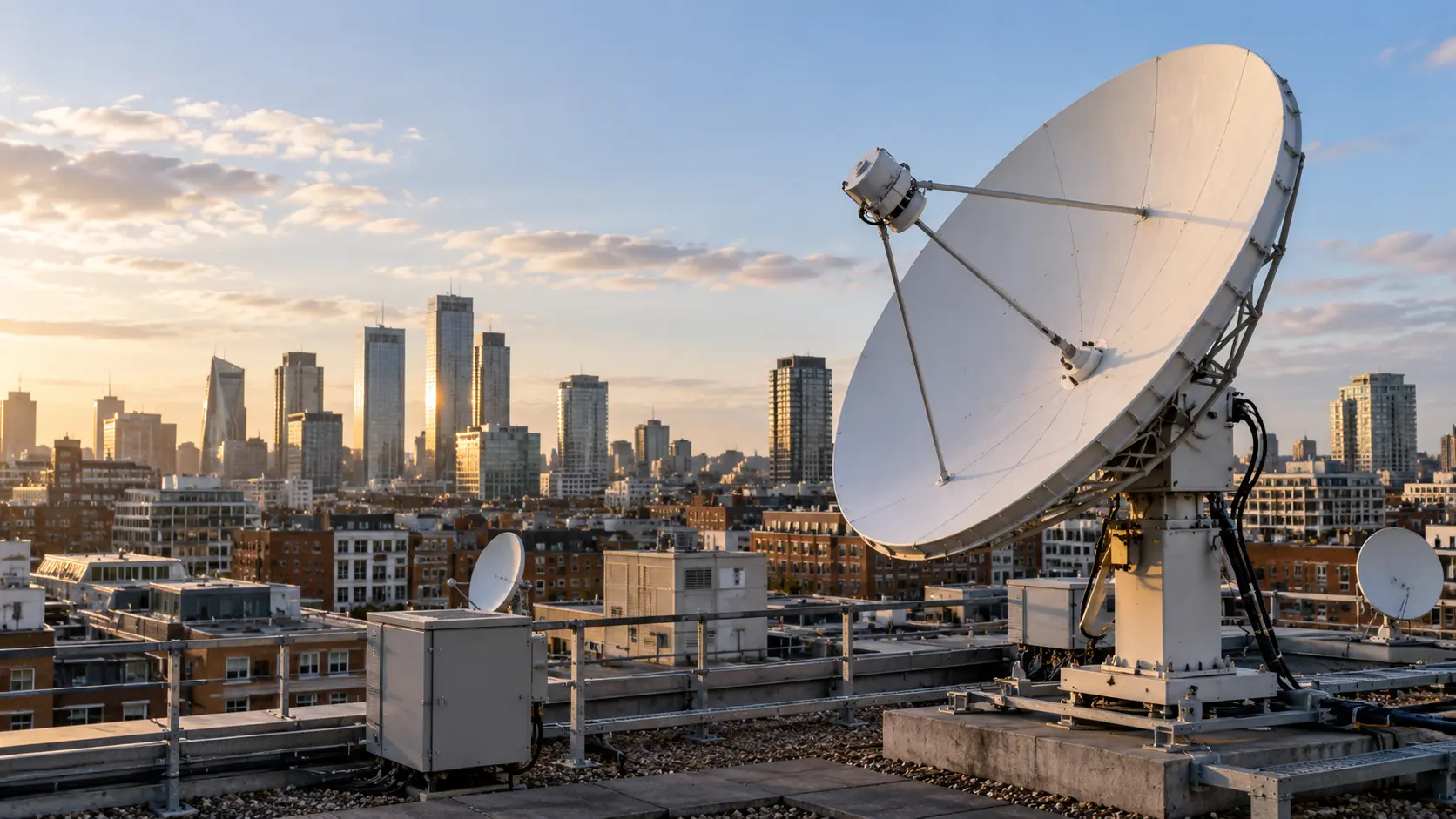
A satellite dish can now apply for a city licence. One useful slice of its downlink still has to negotiate with the incumbent. Ofcom’s 23 October decision opens applications across 68 high-density areas covering about 6% of UK landmass, with access to up to 8 GHz through standard gateway licences.
The bands depend on the orbit. A geostationary gateway can transmit in 47.2–50.2 GHz and 50.4–52.4 GHz, then receive in 37.5–40.5 GHz. A non-geostationary gateway gets 47.2–50.2 GHz and 50.4–51.4 GHz for transmission, with the same 37.5–40.5 GHz receive band. The extra gigahertz in the first licence is not shared by the second. Ministry of Defence coordination also applies to 39.5–40.5 GHz and 50.4–51.4 GHz. Minimum antenna elevation is 15 degrees for GSO and 20 degrees for NGSO.
The separate queue starts at 40.5 GHz. Ofcom left the 40.5–42.5 GHz downlink outside the standard urban authorisation because it shares frequencies with other licensed uses and raises urban coexistence questions. Some existing spectrum-access licences in parts of the range run until 1 June 2028.
There is a Local Access route. It costs £950 once. A temporary licence can run for up to three years where the mobile licensee has no plan to use the frequencies during that period. Longer access starts with an agreement with the existing licensee; Ofcom then issues a site-specific licence reflecting the terms. The decision is made case by case. For a gateway operator, the word “local” is the whole point: the right attaches to a site, a frequency and a negotiated sharing arrangement.
This decision completes a two-track map. Ofcom’s March 2026 decision opened up to 10 GHz in low-density areas covering about 94% of the UK landmass. October adds a standard route in the high-density 6%. The broad permission is easier to read than the actual path through a city: fixed links already use coordinated frequencies in 37–39.5 GHz, and their coordination runs first come, first served. Urban receive operations also sit beside mobile services in 40.5–43.5 GHz; the gateway licence does not protect the receiver from those adjacent services. NGSO licences carry an additional non-interference condition.
The rulebook is now public. The operational ledger is not: Ofcom’s statement gives no count of urban applications, granted licences, local agreements or operating gateways. Publishing those steps by site and band would show whether the new city route is producing working gateways or a tidy map with a long queue behind it.
Official sources
Member Briefing
Deeper Profile Context
Sign in with the right membership level to unlock the full briefing and source notes.
Only for Strategic Circle
Strategic Circle
Open to all readers. Unlock profile briefings after joining and signing in.
Join Strategic CircleOnly for Leadership Alliance
Leadership Alliance
For qualified IP-asset owners and management; sign in to unlock alliance briefings.
Join Leadership Alliance