
Summary
- The Department for Transport currently says that before 31 March 2027 NG eCall may not operate and should not be relied upon in an emergency.
- A registration date, a dashboard button and retailer confirmation answer different questions; none alone proves the end-to-end call path.
- Vehicle handover should preserve the official mobile-phone or roadside-SOS fallback until the government's readiness state changes and fitment is confirmed.
The handover looks reassuring. A new car carries a 75 registration plate, an SOS control is visible above the driver, and the sales material describes automatic assistance after a serious collision. It is easy to compress those observations into one conclusion: the emergency service is working.
Current UK guidance does not support that conclusion. The Department for Transport says that before 31 March 2027 Next Generation eCall may not operate and should not be relied upon in an emergency. It directs people to contact emergency services using a mobile phone or a roadside SOS phone.
That warning is not a judgement about a named vehicle, retailer, manufacturer or mobile operator. It is a public statement about the current transition state. The responsible local decision is therefore not to declare NG eCall absent or defective. It is to record precisely what is fitted, what is currently ready, and what the driver must do while those facts do not yet form a proven service.
One button hides three separate states
The first state is eligibility. The Department for Transport says NG eCall is only available in vehicles registered on and after 1 September 2025. That date narrows the population of vehicles in scope. It does not say every eligible vehicle contains the feature.
The second state is fitment. The same guidance tells the customer to ask the retailer whether the vehicle is fitted with NG eCall. A button, handbook entry or sales code may help identify the vehicle configuration, but the retailer or manufacturer record is the appropriate confirmation.
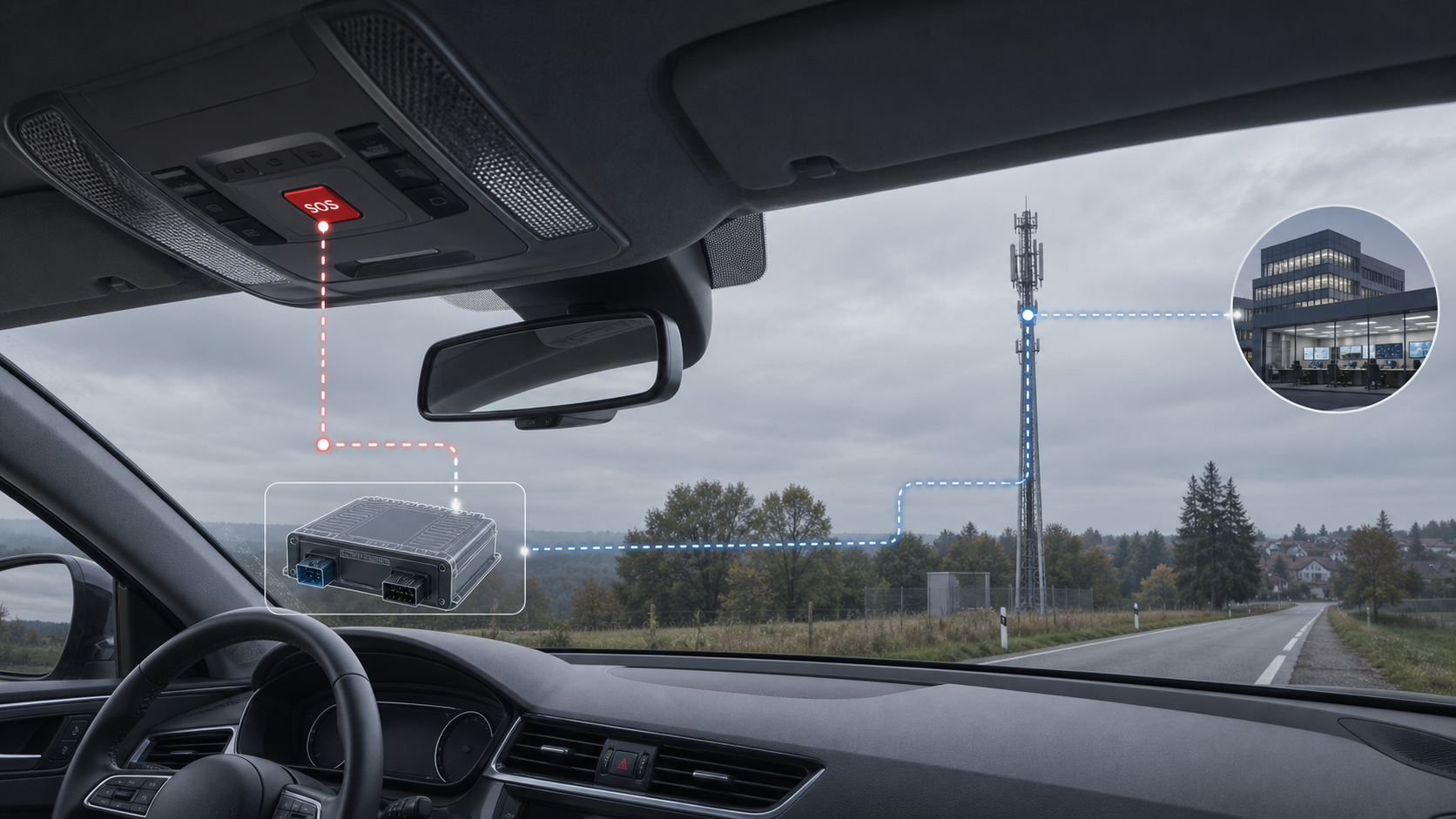
The third state is service readiness. NG eCall depends on more than the vehicle module. The UK telecommunications infrastructure must support the new 4G/5G path and the emergency-service workflow behind it. A component in the roof console can be present while the wider path remains in transition.
These states should not be collapsed into one green tick. An eligible vehicle may not be fitted. A fitted vehicle may sit inside a national transition period. A ready national service would still not prove that every location, vehicle configuration or incident produces a successful call.
The mobile-generation transition changes the evidence
The earlier eCall design relies on 2G. The government's current vehicle guidance says NG eCall is intended to operate on 4G and 5G beyond the older network's retirement. Separate government guidance says UK operators will switch off their 2G networks between 2029 and 2033 and that 2G-only equipment must be upgraded to maintain connectivity.
This is not a simple feature replacement. It is a migration across the vehicle, radio access network and emergency-handling chain. The 31 March 2027 date is described as an expected completion point for the infrastructure changes. It is not itself evidence that the work has completed, and it must not be promoted into an assurance merely because it appears in a project plan.
The useful control is the current state of the official page. The Department for Transport says that page will be updated once the infrastructure has been upgraded. That makes the page a dated readiness record. A later update may change the article's operational conclusion; it should trigger a focused re-check rather than an undated assumption.
Build a bounded handover record
A fleet manager, rental company, retailer or public-service buyer can keep the distinction visible without turning the handover into a technical audit.
| Handover field | Evidence to retain |
|---|---|
| Vehicle identity | VIN or fleet identifier and registration date |
| Eligibility | Whether the registration falls inside the government's stated NG eCall boundary |
| Fitment | Retailer or manufacturer confirmation of the actual NG eCall configuration |
| Readiness state | Date and version of the current Department for Transport guidance |
| Driver instruction | Mobile-phone or roadside-SOS fallback while the warning remains |
| Change owner | Named person responsible for checking the official readiness update |
| Exception | Missing fitment evidence, inaccessible control, incompatible configuration or unresolved warning |
The record must not encourage a test emergency call. An SOS channel should not be activated merely to prove a commissioning point unless an authorised test process exists. The local control is documentary: confirm the configuration, preserve the current warning and make responsibility for the next check explicit.
Keep fact, inference and recommendation apart
The government facts are narrow. The vehicle eligibility date is stated. The pre-31-March-2027 non-reliance warning is stated. The expected infrastructure completion date and the 2G-to-4G/5G transition are stated.
The editorial inference is that a visible button cannot establish the entire path. The operational recommendation is the handover record above. Neither should be attributed to the Department for Transport as its prescribed form.
Heng Lu doctrine may explain why BTW separates authority, evidence state and responsibility. It is not evidence that a vehicle contains NG eCall, that a network is ready, or that an emergency call succeeded.
The acceptance decision
Use three honest labels. Eligible, fitment unknown means the registration date is in scope but the configuration is unconfirmed. Fitted, transition warning active means the feature is confirmed but the current public non-reliance instruction still controls. Ready to represent as operational requires the official readiness state to have changed and the actual vehicle configuration to remain supported; even then, ordinary coverage and incident limits must not be concealed.
Until that evidence changes, the SOS button should be presented as a fitted feature in transition—not as a proven local safety service. The fallback is not an embarrassment. It is the practical bridge between what the vehicle contains and what the public communications path can currently support.
Sources
- UK Department for Transport, Next Generation eCall in cars and light commercial vehicles
- UK Government, Preparing for the 2G switch-off: mobile phones and smart devices
Member Briefing
Deeper Profile Context
Sign in with the right membership level to unlock the full briefing and source notes.
Only for Strategic Circle
Strategic Circle
Open to all readers. Unlock profile briefings after joining and signing in.
Join Strategic CircleOnly for Leadership Alliance
Leadership Alliance
For qualified IP-asset owners and management; sign in to unlock alliance briefings.
Join Leadership Alliance