
Summary
- A controlled neighbourhood cutover would require NEXTELECOM to know exactly how long it can keep the old fibre node available, how customer drops are sequenced, which optical levels constitute acceptance, where spare splitters and transceivers sit, and whether the new cabinet can run through a local power interruption. None of those operating details is public. The company's site supports only the narrower claims that it markets fibre plans from a Dajabón address and regards itself as a regional operator.
- The regulatory and routing records describe different layers. INDOTEL renewed NEXTELECOM's internet-resale registration in 2023 on the basis of a SILKGLOBAL DOMINICANA contract and placed responsibility for continuity and quality toward customers on the reseller. In July 2026, however, public route collectors show both of NEXTELECOM's announced prefixes reaching AS273009 through one immediate neighbour, AS264821, registered to COMCAST-SRL. That is an observable logical dependency, not proof of one cable or of a change in the commercial supplier.
- NEXTELECOM's public evidence is sufficient to establish an operating internet identity but insufficient to establish recovery margin. Its IPv4 /24 and IPv6 /32 are visible globally, the IPv6 route has a valid route-origin authorisation, and current commercial directories still name the company. There is no published subscriber count, busy-hour load, transit commit, node diagram, serviceability map, battery endurance, restoration record or second physical route. A cutover therefore remains a test of field discipline whose safe duration cannot be calculated from outside.
The rollback clock starts under portable lights
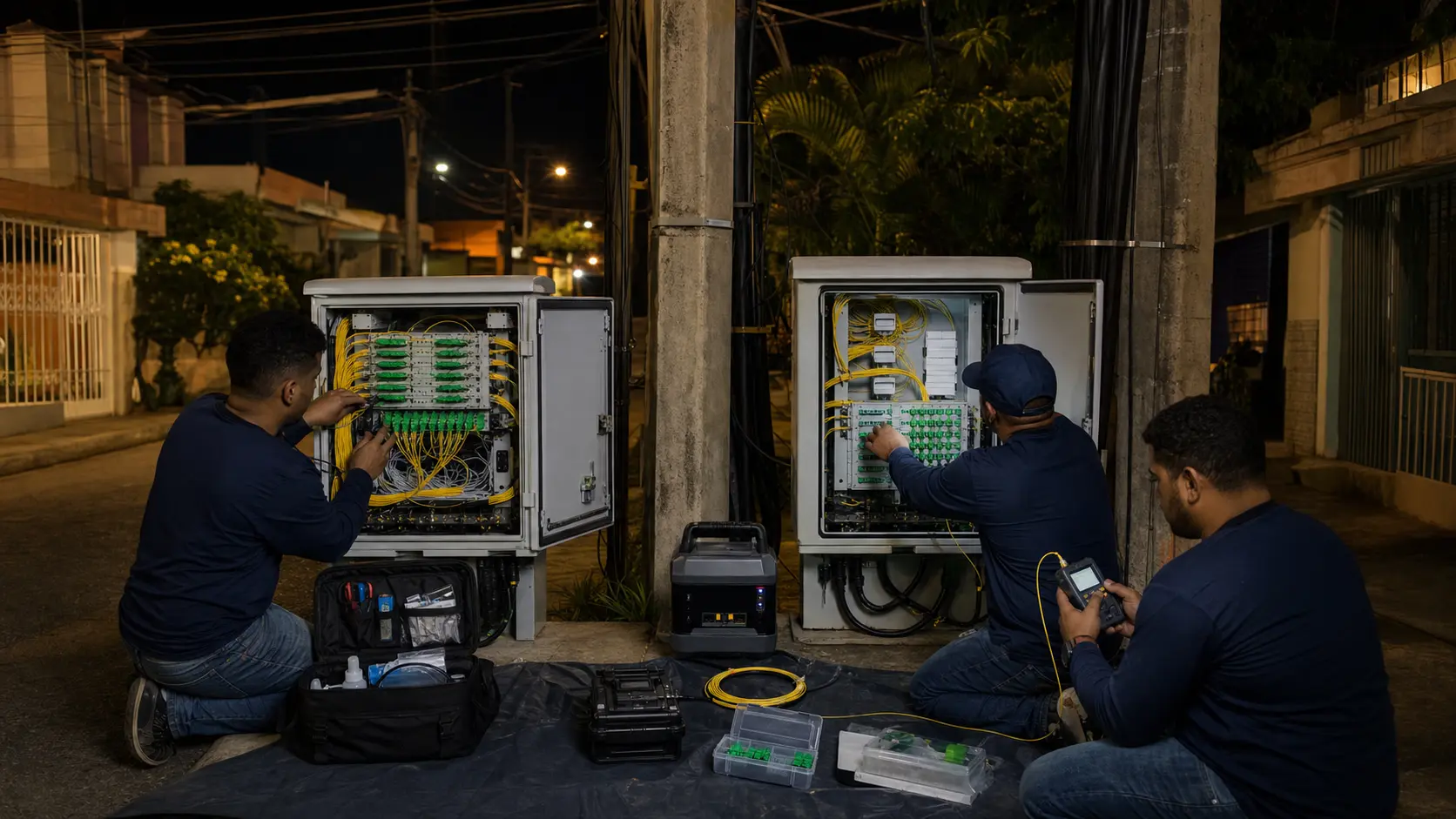
At night, two fibre cabinets stand open a few metres apart on a residential street in Dajabón. Portable lamps turn dust and cable jackets white against the dark. One cabinet carries the live customer fibres; the other is the intended replacement. Patch leads have been arranged in migration order, an optical power meter is on the folding table, and a technician calls out each port as another household is moved. The old node is still powered. That is the rollback path, but only while its fibres, labels, configuration and electricity remain intact.
The scene is a resilience test, not a report of a specific NEXTELECOM maintenance event. It follows from the work implied whenever an access operator replaces a neighbourhood node without abandoning the customers already attached to it. The decisive quantity is not the advertised download speed. It is the rollback clock: the interval during which the crew can discover that the new node is unstable, stop the migration and restore the old service before the old arrangement becomes unusable. Every action consumes part of that interval. A connector must be cleaned and inspected. Receive levels must be measured.
A customer-premises terminal may need to be recognised by the new equipment. The subscriber's session must come back. A mislabeled drop must be traced rather than guessed.
NEXTELECOM's current public site makes the access medium unusually clear for a small operator: it heads its retail offer “internet plans by fibre optic” and displays five monthly plans. It also gives a street address in Dajabón and describes the company as regional. Those statements support the premise that fibre terminations and local field work sit somewhere in its service chain. The page does not identify an optical-line terminal, splitter ratio, cabinet, aggregation site, feeder route, power system or maintenance method. It cannot show whether the imagined old and new cabinets are operator-owned, whether only passive splitters are present, or whether active electronics and batteries share the enclosure.
That absence changes how the cutover should be judged. If the old node is passive, rollback may depend primarily on fibre management and optical budget. If it is active, the crew must preserve configuration, upstream reachability and backup power as well. If both cabinets depend on the same pole transformer, a temporary supply to only one cabinet may not protect the rest of the path. If the replacement uses different optics, a box of generic transceivers is not a meaningful spare set unless wavelengths, reach, connector type and equipment compatibility match. Public evidence does not resolve any of those branches.
The retailer's page itself needs a time boundary. Its visible copyright says 2025, but the site's public page metadata records the home page as last modified in May 2023. The price card can therefore document what the operator has chosen to leave online; it should not be treated as a freshly dated capacity declaration. A disciplined migration starts with the same distinction. The card says service is sold. Only an operating record could say how the service is built, how many customers share the node, what normal receive levels are, and how much time remains before a failed move becomes a prolonged outage.
The rollback clock also forces customer sequencing into view. Moving every drop in street order is convenient, but a risk-aware sequence may begin with test accounts, then customers whose premises can be contacted, then larger groups only after alarms and traffic behave normally. The crew needs a freeze point beyond which the old configuration cannot be reconstructed inside the window. It needs a stop rule for deteriorating optical levels and an authoritative port map that remains readable under portable lights. Without those controls, the new cabinet may look tidy while the operating state becomes less knowable with every moved lead.
No external observer can calculate NEXTELECOM's rollback margin. There is no public count of ports, crew members, spares, test sets, customer contacts or temporary-power runtime. That is the central finding rather than a gap to fill with assumptions. The useful test is whether the operator can bind each customer move to a measured acceptance state, preserve the old state long enough to reverse it, and communicate before the maintenance window becomes an unplanned interruption. Fibre makes the cutover possible; disciplined field control makes it recoverable.
A reseller remains responsible at the customer's door
NEXTELECOM's regulatory history explains why field responsibility cannot simply be passed upstream. In Resolution DE-060-2021, the Dominican telecommunications regulator INDOTEL entered the company in the special register for resale of internet access supplied by TRILOGY DOMINICANA in the provinces of Dajabón and Montecristi. The registration ran for two years from notification. It established a lawful reseller relationship, not a public inventory of the local access plant.
The more revealing instrument is Resolution DE-058-2023. It records a resale contract signed with SILKGLOBAL DOMINICANA on 22 August 2022, NEXTELECOM's March 2023 application for renewal, and the company's April statement that its Trilogy contract had ended on 23 March 2023 and that Silkglobal was then its sole contracted supplier. INDOTEL renewed the registration for internet resale in Dajabón and Montecristi for two years from notification. The public resolution does not state the notification date, a circuit identifier, a hand-off site, contracted bandwidth or a physical route.
Most important for a cutover, the resolution quotes the reseller rule on responsibility. A reseller offers the service in its own name and assumes full responsibility toward its customers for the aspects of provision, including direct response on continuity and quality. The concessionaire remains responsible for compliance with technical standards governing the networks through which the service is provided. This is a divided technical chain but not a divided customer promise. A household that loses connectivity after a local fibre move deals with NEXTELECOM, even if an upstream concessionaire controls another segment of the path.
INDOTEL's reseller list dated 18 December 2023 repeats the renewed resolution, the two authorised provinces and the two-year term. It provides a useful cross-check on the registration, but it still draws a regulatory service area rather than a cable route. A province can be inside an authorisation while many addresses remain unreachable. Likewise, two provinces can be served through one upstream hand-off and one aggregation site. The list does not distinguish those designs.
The two-year renewal creates a present-day qualification. Because the public instrument dates from May 2023 and measures validity from notification, its visible term points toward 2025, but the available documents do not establish the exact end date or prove that no later renewal exists. It would be wrong to declare NEXTELECOM unauthorised on that basis alone. INDOTEL's financial statements and annexes for June 2025 still list NEXTELECOM in the schedule associated with the Telecommunications Development Contribution. That is evidence of a continuing regulatory financial footprint at the reporting date, not proof of subscriber numbers, turnover, payment status, licence renewal or network capacity.
The responsibility boundary matters operationally after the planned window ends. During the migration, the local team can decide which fibre to move and whether measured power is acceptable. If the new node passes local tests but sessions still fail, diagnosis crosses the hand-off boundary: customer terminal, access equipment, aggregation, address assignment, routing and upstream service all become candidates. A useful escalation arrangement would specify who can see alarms at each layer, who can change configuration, how a fault is handed to the supplier, and which party decides to roll back.
The regulator's allocation tells customers who must answer; it does not reveal whether the companies have made that answer fast.
Resale also changes the economics of redundancy. NEXTELECOM may own or control local fibre while buying the wider-area service, or it may depend on a supplier for more of the technical chain. The public resolutions do not settle that asset boundary. A second commercial agreement would not automatically create a second failure domain if both services entered through the same carrier, road, pole line or powered room. Conversely, one named supplier could deliver protected circuits over distinct routes.
The contract label is therefore less important than the physical and operational facts that are absent: demarcation, route, power, capacity, restoration priority and tested failover.
The operating record is alive but not fully current
Several independent signals show that NEXTELECOM is more than an old regulatory name. The company site remains online, an autonomous-system registration is active, two address blocks are publicly routed, and current commercial association pages still list the business. Together these form a credible operating record. None on its own is a complete status certificate, and their dates do not line up neatly enough to remove uncertainty.
The clearest identity record is LACNIC's registration for AS273009. It names NEXTELECOM S.R.L. as the registrant, gives a Dajabón address and records 23 May 2023 as the registration date. An autonomous system lets an operator originate routes under its own number and express routing relationships to the public internet. It does not prove ownership of an access network, a particular upstream contract or continued authority to retail service. It is one layer of the operating identity.
The address records add specificity. The 38.50.165.0/24 record describes an active 256-address reassignment labelled for NEXTELECOM and dated 9 June 2023. Because it is a reassignment, the prudent wording is that the block is registered for NEXTELECOM's use, not that the company owns a provider-independent IPv4 allocation. The 2803:7d90::/32 record is an active IPv6 block registered to the company on the same date as the ASN. Address quantity is not customer quantity. One IPv4 address may serve many users through address sharing, and an IPv6 /32 can support a huge addressing plan while carrying little traffic.
Route collectors show both blocks in use. The RIPEstat announced-prefix view, retrieved for this analysis in July 2026, reports AS273009 announcing exactly those two prefixes through the preceding day. The IPv4 routing-status record sees the /24 with NEXTELECOM's ASN as current origin and broad collector visibility. The IPv6 routing-status record does the same for the /32. These are strong signals of a live public routing identity. They do not show that every retail customer is online or that the path can survive a failed cabinet migration.
Commercial listings reinforce continuity while remaining self-reported. SILKGLOBAL's reseller directory names NEXTELECOM among its resellers. UnaRed's partner page also names NEXTELECOM and presents its broader associated network across Dominican provinces. Such pages can remain stale, and neither gives a contract date, bandwidth, hand-off or service address. Their value is narrower: the company remains visible in the supplier and reseller ecosystem after the 2023 renewal.
Cloudflare Radar's AS273009 profile displays recent traffic observations and an estimated user population around 4,800. That estimate is not a subscriber count and should not be converted into revenue, penetration or ports. It may reflect users behind shared addresses, measurement coverage and Cloudflare's estimation method. It is nonetheless another signal that traffic attributed to the ASN is being observed. The responsible conclusion is that NEXTELECOM appears operational at the internet layer, while the scale and condition of its access operation remain undisclosed.
This mixed chronology is normal for a small regional provider but consequential for diligence. A marketing page last modified in 2023 can coexist with routes observed in 2026. A 2023 regulator decision can coexist with a 2025 contribution schedule. A supplier directory can remain visible after the physical hand-off has changed. Status should therefore be assessed by layer and date rather than collapsed into a single “active” label. The company has a current internet presence; the public record does not establish a current licence term, retail tariff, subscriber base, network diagram or recovery performance.
Two provinces define authority, not the fibre map
Dajabón and Montecristi appear repeatedly in the regulatory documents because they are the provinces in which the resale authorisation applies. That geographic scope is material: it places NEXTELECOM in the Dominican Republic's north-west, along the Haitian border and the Atlantic-facing Monte Cristi area. Yet a province name is the coarsest possible service map. It cannot tell a household whether a drop is available, a crew how to reach a splice, or an analyst whether two upstream paths share the same corridor.
The scale becomes clearer in official demographic material. The National Statistics Office's Dajabón municipality profile reports 35,809 residents and 12,092 households in the municipality in the 2022 census, over 255.4 square kilometres. Those figures are a demand and field-service frame, not evidence that NEXTELECOM passes every household or serves any stated share. Even inside one municipality, an urban street, a peripheral settlement and a rural section create different installation distances, pole dependencies and travel times.
Dajabón's municipal development plan provides the kind of geographic context that a network map would need to resolve: urban neighbourhoods, municipal sections, road connections and patterns of public service. It also contains older communications indicators. It does not identify NEXTELECOM routes, so those indicators cannot be used as current company coverage or customer evidence. The plan shows why “Dajabón” is not a single maintenance zone; it does not show where the operator's feeder fibre runs.
Monte Cristi's municipal development plan similarly describes a territory of urban and rural settlements, road links, productive activity and exposure to environmental conditions. It offers no NEXTELECOM asset layer. The spelling difference between the province name Montecristi in regulatory records and Monte Cristi in municipal usage does not imply different service territories. More important is the distance and terrain between an authorised province and a working service address. Nothing public identifies a NEXTELECOM headend, cabinet, relay, fibre segment or crew base in Monte Cristi.
INDOTEL's own connectivity interventions warn against treating a provincial label as universal terrestrial reach. In 2024 the regulator described satellite connectivity delivered to public institutions in communities across several provinces, including Dajabón and Monte Cristi, where access needs persisted. That project is not evidence about NEXTELECOM's footprint or a substitute for commercial broadband. It is contextual evidence that administrative inclusion within a province does not guarantee an ordinary fixed route to every locality.
A useful NEXTELECOM map would begin with claims of serviceability, not colouring whole provinces. It would identify each locality where orders are accepted; then distinguish feeder, distribution and drop segments; then mark active equipment, passive split points, upstream hand-offs and maintenance boundaries. Each segment would carry an ownership status and a route confidence. A second line on the map would count as resilience only if it avoids the same trench, pole line, bridge, room, power feed and upstream failure domain.
The current evidence supports only a restrained map. A corporate and retail anchor exists in Dajabón. The regulator authorised resale in Dajabón and Montecristi. Public routing gives the company a global logical footprint but no local coordinates. Supplier listings establish commercial relationships at a high level. There is no public basis for drawing a line between Dajabón and Monte Cristi, placing a node in either city, or assigning fibre to a particular road. Any more detailed visual would be illustrative, not an as-built representation.
That boundary should remain visible in outage analysis. If a route disappears, internet observers can say that the ASN's prefix is no longer seen or that its neighbour has changed. They cannot identify which municipality lost access, whether a feeder was cut, whether mains power failed, or whether customer equipment stayed registered. Only the operator's inventory and telemetry can join the global route to the street. Until that joining evidence is published, the two-province authorisation defines market permission rather than physical coverage.
A fibre tariff reveals the medium, not the access plant
NEXTELECOM's retail page offers a rare set of concrete numbers, but they are customer products rather than engineering capacity. The displayed tiers range from 2.5 Mbps down and 1 Mbps up for RD$700 a month to 10 Mbps symmetric for RD$2,000. Intermediate cards show 3/2 Mbps, 4/2 Mbps and 5/4 Mbps. The page does not state taxes, installation fees, contract length, usage policy, committed rate, contention, availability, service area or whether the cards remain open to new orders. Because the page metadata was last changed in 2023, the figures are best treated as a dated public offer that remains visible.
The word “fibre” narrows the likely last-mile medium but does not identify the architecture. The service could use a passive optical network, active Ethernet, fibre to a local distribution point, or a combination. There is no published optical-line-terminal model, port count, wavelength plan, split ratio, feeder length, loss budget or customer-terminal inventory. Without those facts, one cannot calculate how many households share a port, how much optical margin exists at the farthest drop, or whether moving a splitter changes levels for customers not yet migrated.
This is where a tariff can mislead capacity analysis. Ten customers buying 10 Mbps do not necessarily require a dedicated 100 Mbps at every moment, and 100 such customers do not by themselves prove a one-gigabit bottleneck. Demand depends on concurrency, application mix, sharing policy and growth. At the same time, a low advertised rate does not guarantee generous headroom. A small transit commitment or narrow aggregation link can still congest if enough users become active. The public price grid supplies no subscriber count and no busy-hour utilisation, so multiplying plan rates would manufacture a number rather than reveal capacity.
Installed capacity also differs from saleable capacity. An access chassis may have open ports but insufficient feeder strands, optical budget, power, rack space or upstream headroom for the next cabinet. A distribution route may pass a street but lack a spare splitter port. A reseller may be able to order more upstream bandwidth but face a lead time that makes current spare capacity the binding constraint. None of these margins appears on the site. There is no disclosed count of homes passed, active terminals, ports lit, ports reserved, fibres available or customers awaiting installation.
The cutover exposes these hidden dimensions. Suppose the replacement node has enough ports for every listed customer but a smaller upstream interface than the old one, or an uplink that has negotiated below its intended rate. Basic connectivity tests may pass at 2 a.m. while congestion appears after breakfast. Conversely, a full-rate uplink can be operationally unsafe if the replacement has no backup supply or the crew has no compatible spare optic.
Capacity acceptance must therefore include both throughput and failure usability: measured interface rate, loss and latency under load, available headroom, error counters, power endurance and the behaviour when one component is removed.
Price also defines the economic room available for such preparation. The visible plans place the monthly retail charge between RD$700 and RD$2,000. That revenue must support upstream service, local plant, pole or site access, electricity, customer equipment, staff, transport, spares, billing and taxes. The public evidence does not reveal the customer mix or cost base, so no margin can be calculated. It does show why spare optics, a second route and an overnight crew cannot be assumed merely because they would improve resilience. They are investments competing with affordability in a regional market.
The economically useful disclosure would not require revealing commercially sensitive per-customer data. NEXTELECOM could publish aggregate ranges: active access ports by locality, peak utilisation band, upstream capacity band, spare-port ratio, number of independent hand-offs, typical installation interval and restoration percentiles. It could state whether plan rates are symmetric, best-effort or committed and whether traffic is shaped. Those measures would let a customer or institutional buyer distinguish a fibre medium from a managed access system. At present, only the medium and a historical-looking price ladder are visible.
AS273009 has one visible exit for both address families
NEXTELECOM's routing evidence is more current and more precise than its physical evidence. RIPEstat's AS-neighbour summary reports one adjacent autonomous system on the provider side: AS264821. The same neighbour is seen for IPv4 and IPv6. A neighbour in this dataset is a logical relationship inferred from public route paths. It can represent one physical circuit, multiple protected circuits, a remote session or changing carrier arrangements hidden behind the same ASN. It should not be drawn as a single cable.
The full path snapshots make the concentration visible. In the IPv4 BGP state, all 334 routes observed at retrieval had AS264821 immediately before origin AS273009 after repeated path entries are collapsed. In the IPv6 BGP state, all 340 observed routes had the same immediate predecessor. The exact collector counts will change as sessions appear and disappear, but unanimity across the observed paths is the important point: there is no public route-collector evidence of a second immediate neighbour for either family at that moment.
CAIDA's AS Rank record for AS273009 independently presents the network as having one provider relationship, no observed peers and no observed customers, with a very small customer cone. AS Rank is an inference and can lag private or newly established relationships. Its value is corroborative rather than dispositive. Two observation systems reach the same narrow conclusion: the publicly visible autonomous-system topology is single-provider at the first hop.
The neighbour itself is identifiable. LACNIC's AS264821 record registers that ASN to COMCAST-SRL in the Dominican Republic. RIPEstat's AS264821 neighbour view shows it connected onward to AS23520 and shows AS273009 among its downstream relationships. This supports the logical chain seen from NEXTELECOM toward the wider internet. It says nothing about the physical location of the interconnection, the number of circuits, their capacities or whether COMCAST-SRL uses diverse infrastructure beneath the one ASN.
Route security is asymmetric. The IPv4 RPKI validation result returns an unknown state because no matching route-origin authorisation is found. Unknown is not invalid: the announcement can still be legitimate, but relying networks cannot validate it through this mechanism. The IPv6 validation result is valid and identifies AS273009 as the authorised origin, with more-specific announcements permitted to /48. That protects an aspect of origin legitimacy, not availability. A valid route can still disappear when a fibre, router or power source fails.
The one-neighbour observation changes the cutover question. If the neighbourhood node loses only its local uplink, restoring the old node may recover service. If both old and new nodes depend on the same aggregation path toward AS264821 and that path fails, local rollback will not restore internet reachability. The crew must be able to distinguish access failure from upstream failure before it spends the rollback window moving fibres twice. That requires tests beyond a light level: gateway reachability, address assignment, reachability through both address families, route state and an external test point.
Single-neighbour visibility is not proof of fragility. One ASN can provide protected services over diverse entry points and can fail over internally without changing the customer's BGP path. NEXTELECOM could also maintain an unadvertised standby or a service that appears only during failure. No such arrangement is visible. The correct external finding is narrower: public routing supplies no evidence of autonomous upstream diversity. Any claim of resilience must therefore be supported with circuit and route information that route collectors cannot infer.
The named supplier and the observed neighbour occupy different layers
At first sight, the records appear inconsistent. INDOTEL's 2023 renewal says NEXTELECOM's contracted supplier was SILKGLOBAL DOMINICANA. The current route paths place COMCAST-SRL immediately upstream of NEXTELECOM's own ASN. These facts can coexist because a legal resale supplier, a transport carrier and the ASN visible in BGP are not necessarily the same party. A reseller can buy a service whose delivery uses another network; a supplier can subcontract transport; or commercial arrangements can change between a dated resolution and a current route observation.
SILKGLOBAL's own internet identity is distinct. Its PeeringDB profile describes AS272073, an internet-service network with an open peering policy, a self-reported traffic range of 20–50 Gbps and presence at PIT DOMINICANO. PeeringDB information is operator-supplied. More importantly, those figures describe Silkglobal's network, not the capacity sold to NEXTELECOM. The absence of AS272073 next to AS273009 in current public paths does not disprove the regulatory contract; it shows that the legal document cannot be used as a current BGP diagram.
The same restraint applies in the other direction. The observed AS264821 adjacency does not prove that NEXTELECOM abandoned Silkglobal, contracted directly with COMCAST-SRL, or receives only one physical circuit. Public routing exposes which ASN announced the path to collectors, not the invoices or delivery chain behind it. A route can pass through the ASN of a wholesale access partner while a different company remains the commercial counterparty. Without a current contract statement or a carrier letter, assigning commercial roles would be speculation.
For resilience, the practical problem is accountability across those layers. A customer reports an outage to NEXTELECOM. NEXTELECOM may test the access node and its hand-off. A commercial supplier may open a case with a transport network. The BGP-visible neighbour may operate the router that announces the path. If each party sees only its own segment, restoration time depends on the quality of timestamps, test results and escalation rights exchanged between them. The 2023 resolution places the direct customer response on NEXTELECOM, making an unclear supplier chain an operating issue rather than a defence.
A sound cutover plan would therefore identify the current demarcation by circuit, not by company name alone. It would record the hand-off interface, service identifier, bandwidth, addressing, provider contact, escalation clock and maintenance interactions. It would establish whether the old and new access nodes share that demarcation and whether the upstream can see each node separately. If there are two circuits, it would state whether they terminate on different routers, buildings, power feeds and physical approaches. None of this needs to expose customer data, but none is public now.
The gap also affects capacity interpretation. Silkglobal's network-wide traffic range says nothing about an individual wholesale port. AS264821's broader neighbour set says nothing about how much capacity is allocated to AS273009. The fact that both NEXTELECOM prefixes are globally visible says only that some reachable route exists. It does not reveal a committed information rate, burst limit, oversubscription, protection ratio or restoration priority. Treating supplier scale as customer capacity would erase the very bottleneck under examination.
The useful conclusion is not that one record is wrong. The useful conclusion is that NEXTELECOM's dependency chain has at least three observable descriptions—a regulator's commercial relationship, supplier association listings and a route collector's logical adjacency—and no public document reconciles them. That makes a maintenance window harder to assess from outside. The operator can close the gap by dating its current supplier roles and publishing a simplified dependency diagram that separates retail responsibility, local access, transport, autonomous-system adjacency and wider transit.
Capacity disappears between the tariff card and the transit port
Capacity evidence exists at both ends of the service but not in the middle. At the customer end, NEXTELECOM's page names five speeds. At the internet end, two prefixes are announced and traffic is observed. Between them lie the quantities that determine performance: active customers by plan, simultaneous demand, access-port rates, aggregation links, upstream commit, bursting terms, loss, latency, headroom and failover capacity. None is published.
This prevents even a defensible order-of-magnitude calculation. The IPv4 /24 has 256 addresses, but address sharing can place many customers behind fewer public addresses, while infrastructure and business services can consume others. The IPv6 /32 is vastly larger than the likely customer base by design and carries no subscriber implication. Cloudflare's user estimate is not an operator count. The price cards give rates but not the distribution of subscriptions. Multiplying any of these figures would combine unrelated measures.
It is also impossible to tell whether the installed access system or the upstream service is the limiting layer. A fibre distribution network can have abundant optical capacity while a wholesale hand-off constrains the evening peak. An ample transit port can feed an access node whose uplink is undersized. A cutover can change the bottleneck if the replacement cabinet uses a different uplink or aggregation route. A successful speed test on one port is not enough; the operator must compare aggregate traffic and errors before and after the move.
Failure capacity is more demanding than normal capacity. Suppose two upstream circuits exist behind the one visible neighbour. The service is resilient only if the surviving circuit can carry an acceptable load, or if a documented shedding policy preserves priority services. A nominal second link that saturates as soon as the first fails may improve reachability but still produce an operational outage for many users. The public record contains no normal or degraded capacity figure, so it cannot establish a survivable level.
The same applies to the local node. “Spare ports” can mean empty connectors while hiding constraints in optical power, licences, line cards, feeder strands or backhaul. Spare optics are useful only if they are tested, compatible and located close enough to meet the repair target. A spare cabinet without a loaded configuration may lengthen rather than shorten the cutover. Capacity is therefore not merely a number on a port; it is the amount of usable service that remains within the operator's restoration time after a component is removed.
NEXTELECOM could make this legible with bands rather than sensitive exact values. A quarterly statement might show upstream provisioned capacity, peak-utilisation range, access ports installed and active, largest single failure, surviving capacity after that failure, and the age of the last failover test. The company could separate IPv4 and IPv6 if their paths differ. It could disclose whether the public 10 Mbps symmetric card is still sold and whether the lower tiers remain on legacy contracts. Those facts would turn an old tariff page into a capacity story.
Until then, the only firm capacity statement is negative: no public document quantifies NEXTELECOM's installed or utilised bandwidth. Silkglobal's self-reported network traffic cannot be allocated to the company. Route-collector path counts are observations from collector peers, not megabits per second. Address space is not throughput. Retail rates are not upstream commitment. The access-node cutover may have generous headroom or almost none; both remain compatible with the available evidence.
Temporary power decides whether the new node is really independent
Power is the easiest shared dependency to overlook in a fibre migration. Passive glass does not need electricity between powered endpoints, but optical-line terminals, Ethernet switches, routers, monitoring equipment and many distribution designs do. Customer terminals need household power too. A replacement cabinet can use a new chassis and new fibre while remaining dependent on the same utility circuit, transformer, upstream room and battery that constrained the old one.
EDENORTE's local notices show why this is not a theoretical issue. In its planned-maintenance schedule for 11–15 August 2025, the distributor listed work affecting parts of Dajabón municipality for a five-hour daytime period, alongside work in other north-western communities. The notice describes utility maintenance, not a NEXTELECOM outage, and it does not identify the operator's feed. It establishes that planned interruptions of several hours occur in the service geography—a duration long enough to exceed a small untested battery.
Storm damage can couple electricity, pole access and communications restoration. EDENORTE reported that a tornado brought down ten poles in Cayuco, Dajabón in August 2025, requiring crews to reconstruct the affected electricity section. There is no evidence that NEXTELECOM used those poles or lost service. The incident nevertheless illustrates a shared-risk mechanism: if fibre and power occupy the same pole corridor, one event can remove the line, the feed and the crew's safe access at once.
The distributor has also described reinforcement of north-western electricity networks after deterioration and wind-related contacts affected a 34.5 kV branch serving Santiago Rodríguez and Partido, with additional work in Dajabón and Montecristi. Again, this is utility context rather than evidence about a NEXTELECOM site. It shows that vegetation, structures and regional distribution lines are active maintenance dependencies, not a fixed background condition.
EDENORTE's 2026 hurricane-season contingency announcement says the utility positioned crews and equipment across its area, including Dajabón and Montecristi, and prioritised essential infrastructure. That preparation can improve regional restoration, but it is not a telecom backup-power guarantee. A local operator still needs to know which sites must ride through, how long batteries last under actual load, where generators can connect, how fuel reaches a site and when a technician is dispatched.
For the imagined cutover, temporary power is not just insurance against a grid failure. It prevents the maintenance itself from destroying rollback. The old cabinet must remain energised until the new one passes acceptance. The new cabinet may need a separate temporary supply so both can operate simultaneously without overloading one branch. Batteries should be load-tested before the window, not accepted from nameplate age. Generator neutral, grounding, transfer and exhaust arrangements must suit the site. A portable unit that cannot be connected safely within minutes is not part of the rollback margin.
The upstream path needs the same audit. Keeping the street cabinet alive does not help if the aggregation site, radio relay or carrier demarcation loses power. The route collector cannot see batteries. Supplier marketing does not state site endurance. A meaningful power map would list every active point between the access node and the hand-off, its normal feed, backup type, tested runtime under load, refuelling interval and alarm path. NEXTELECOM publishes none of these values.
That absence should not be turned into a claim that backup power is absent. It means recovery cannot be assessed. The operator may have excellent batteries and generator practice; it may rely on short-runtime supplies; its fibre segment may be entirely passive. Public diligence can identify the questions and the local hazard mechanisms, but only test records can establish endurance. In the cutover, the new node is independent only when its service survives the failure conditions that could remove the old one, including loss of the shared utility feed.
A cutover is a labour-and-spares test
Networks are often described as equipment, but a maintenance window is performed by people with finite time and a finite kit. The local crew must know the live state, execute a sequence, recognise a bad result and reverse course. If a connector is contaminated, a splice tray is mislabelled or an optic fails, resilience depends on what the technicians can diagnose and replace on that street—not on what the supplier could ship next week.
The NEXTELECOM site gives contact channels but no support hours, service target or field footprint. There is no published number of technicians, vehicles, fusion splicers, optical meters, spare cable reels, closures, splitter modules, customer terminals or optics. There is no location for a depot or a statement that parts are held in both authorised provinces. These unknowns matter because Dajabón and Monte Cristi are not one compact urban worksite. A single team can be highly capable yet still face travel and concurrency limits when several incidents occur together.
The cutover should begin with an inventory frozen to the actual cabinet. Each live port needs a customer or distribution identifier, expected optical level, service state and rollback position. Each replacement component needs a tested spare of the right type. Fibre jumpers should be long enough for the intended routing but not coiled into an unmanageable mass. Cleaning supplies, inspection scope, calibrated meter and visible labels are as important as the new chassis. A second technician should verify each move so the record does not depend on one person's memory under time pressure.
The acceptance sequence should also test the service beyond link lights. A green optical indicator can coexist with excessive loss, incorrect VLAN assignment, failed address allocation or upstream reachability through only one protocol family. Representative customer circuits should be tested for registration, latency, loss and throughput. IPv4 and IPv6 should both be checked because AS273009 originates both and their route-security states differ. Alarms should be visible at the monitoring point, and a deliberate uplink interruption should confirm what the replacement does when its preferred path disappears.
Customer order matters. A pilot group limits the first error domain. Households that can confirm service can be moved before unreachable premises whose internal equipment state is uncertain. Institutional or business customers may need explicit notice and a separate verification call. Once a batch is accepted, its result should be written into the live record before the next batch begins. If a threshold is crossed—too many failed registrations, receive levels outside range, rising errors, unstable upstream reachability—the crew stops and decides whether the remaining clock permits diagnosis or requires rollback.
Communication is an infrastructure function during this work. Customers need a start time, expected interruption, update interval and a clear statement when the window changes. The support desk needs the same migration list as the field team so it can distinguish expected brief interruptions from exceptions. The upstream contact needs a maintenance reference before the first fibre moves. After the window, unresolved customers should remain in a named recovery queue with ownership and next contact time. Silence turns an engineering problem into uncertainty across every household.
The field boundary continues after the lights are packed away. A migration that looks successful at 3 a.m. can reveal marginal optics, congestion or power problems during the next day's load and heat. The crew needs a monitoring period, error thresholds and the ability to return before the old equipment is dismantled or removed from the area. Spare optics and customer terminals must remain available through that period. The old configuration should be archived in a form that another technician can understand, while disposal waits until rollback is no longer credible or needed.
Local support labour is therefore part of NEXTELECOM's economic product. The customer buys more than a nominal fibre speed: the price must sustain installation, fault isolation, spare holdings, communication and restoration. The public record does not reveal whether that system is deep or thin. A controlled cutover would demonstrate it through measured execution. In the absence of such evidence, the safest conclusion is not that the team would fail, but that its recovery capacity is unquantified.
What would prove a controlled migration
NEXTELECOM can close most of the evidence gap without publishing sensitive street-level security details. The first requirement is a dated, simplified topology. It should show the localities served, aggregation points, upstream hand-offs and whether each interconnection is owned, leased or supplied. Physical routes can be generalised to corridor level while still identifying shared poles, roads, buildings and power feeds. Logical BGP adjacencies should be drawn separately from carrier circuits so one visible ASN is not mistaken for one strand of fibre.
The second requirement is a capacity statement tied to failure. Normal provisioned and peak-utilisation bands are useful, but the decisive number is capacity after the largest credible loss. If two circuits sit behind AS264821, the statement should identify whether either can carry the busy hour alone and whether they approach the site independently. If only one circuit exists, the operator should state the restoration target and the alternative available during a prolonged fault. For the access layer, installed ports, active ports, optical headroom and spare feeder capacity can be published as ranges.
Third comes power. Each active site needs a current load test, battery runtime, generator or temporary-supply method, alarm path and refuelling plan. The result should include the upstream demarcation and aggregation points, not just the customer-facing cabinet. Because local utility notices show multi-hour planned work and storm-related pole damage, a resilience claim should specify which duration the system is designed and tested to ride through. A nameplate battery rating is not the same as measured endurance.
Fourth is the cutover record itself. Before work, it should capture port inventory, optical baselines, configuration versions, customer batches, stop rules, communications and rollback deadline. During work, it should time-stamp each batch, exceptions and measured results. After work, it should preserve traffic, error, alarm and customer-contact outcomes through the next busy period. A concise public summary could report customers moved, planned and actual interruption, rollback availability, exceptions, and whether any capacity or power threshold was breached.
Fifth is dependency reconciliation. The 2023 regulator decision names SILKGLOBAL DOMINICANA, current association pages still list NEXTELECOM, and public routing shows AS264821 next to AS273009. NEXTELECOM should explain, at a high level, which party supplies the regulated retail input, which operates transport, and which ASN is the current immediate neighbour. A dated explanation would remove the temptation to infer contracts from BGP or infer present routing from an older administrative instrument.
Sixth is regulatory currency. Because the visible renewal lasts two years from an unpublished notification date, a current registration reference would settle the status without forcing readers to infer it from a 2025 contribution annex. This is a legal-status disclosure, not a technical resilience measure, but it establishes who is responsible for the service while a migration or outage is under way.
The evidence already available sets a credible baseline. NEXTELECOM is a named regional reseller with a Dajabón address, a fibre retail claim, current IPv4 and IPv6 announcements, and a distinct autonomous-system identity. Its IPv6 origin is valid under RPKI. Its public paths converge on one immediate neighbour. The regulator assigns direct continuity and quality responsibility toward customers to the reseller. Those facts make the company assessable; they do not make its infrastructure transparent.
The missing evidence is precisely what the night scene tests. Can the old node remain available while the new node is proved? Are power and upstream paths independent enough for the test to mean anything? Does the crew have the map, time, spares and authority to reverse a bad move? Can customers be sequenced and informed, and can the operator sustain service when the next day's load arrives? Until NEXTELECOM publishes operational answers, the rollback margin remains private—and the single visible neighbour leaves no public evidence that the internet side supplies another way out.