
Summary
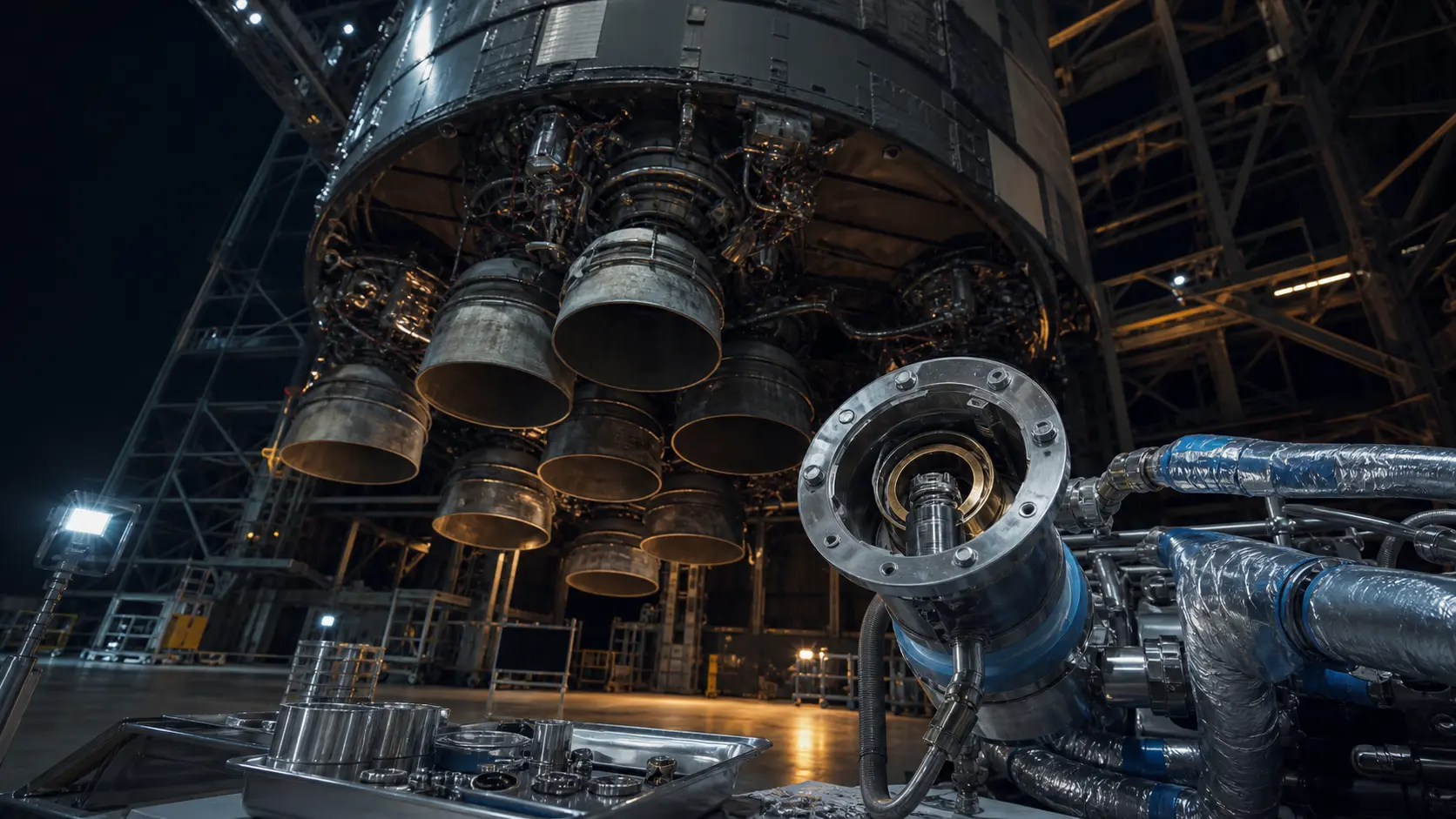
- Blue Origin said on 5 August that the 28 May GS1-3 ground-test failure originated at the main oxygen valve on one of New Glenn’s seven first-stage BE-4 engines.
- The company said recovered hardware, inspection, component testing and engine hot fires support that attribution, while analysis of the remaining fault-tree branches continues.
- Blue Origin described the required changes as small modifications that can be retrofitted into existing engines and said it expects hardware to be ready by the end of August.
- The company did not disclose how the valve failed, how many engines require modification or the qualification and installation burden for the existing fleet.
- New Glenn’s separate second-stage test programme at NASA Stennis uses two BE-3 engines and does not establish closure of the first-stage BE-4 issue.
- Blue Origin still aims to return New Glenn to flight by the end of 2026, but its update did not announce a new launch date or a completed return-to-flight approval.
A named component turns a catastrophe into a falsifiable repair
The useful change is not that Blue Origin has described the May explosion in more detail. It is that the company has moved the initiating point from the broad tail of an integrated vehicle to one main oxygen valve on one BE-4. Recovered hardware and inspection provide physical evidence; component trials and full-engine hot fires offer ways to test whether a modification prevents recurrence.
The attribution is still Blue Origin’s. The company has not published the valve’s physical failure mechanism, and it says branches of the fault tree remain under analysis. Locating the origin is therefore stronger than merely naming an affected area, but weaker than closing every causal path.
“Small” describes the hardware, not the burden of proof
Blue Origin says the modifications are small and can be retrofitted into existing engines. That could limit scrappage and protect schedule value already embedded in built hardware. It does not tell investors, customers or launch partners how many engines are affected, how long each retrofit takes, or which acceptance tests must be repeated.
A cheap part can still carry an expensive evidence bill: controlled instructions, consistent installation, inspection records and repeated tests. Blue Origin has not quantified that burden. Its end-August objective is a component milestone, not a statement that every affected engine will then be qualified and available for flight.
Seven engines turn one valve into a configuration problem
New Glenn’s first stage uses seven BE-4 engines. The May failure was attributed to a valve on one engine, but a fleet decision requires evidence about commonality. If the relevant design and manufacturing configuration is shared, a modification may have to travel across several engines. If only a limited lot or configuration is exposed, the company needs traceability strong enough to separate it from the rest.
This is where the company carries the downside. Customers buy a launch service, not an engine-level diagnosis. Blue Origin must absorb the integration work needed to make the seven-engine stage credible again before the service can generate revenue.
Hardware readiness is not launch readiness
The 28 May event destroyed the test vehicle and severely damaged the launch pad. A replacement valve design therefore sits inside a wider recovery programme: engine modification, stage assembly, integrated testing, launch-site restoration and whatever case-specific acceptance is required before flight. Blue Origin’s update supplies no new launch date beyond its objective of returning New Glenn to flight by the end of 2026.
The general FAA mishap framework separates evidence preservation, root-cause work, corrective actions and a safety determination. It does not establish that this ground test is subject to a particular licensed-mishap process or that the FAA has cleared New Glenn. The practical schedule will be set by the slowest required path, not the first available component.
A shared engine name does not establish Vulcan exposure
BE-4 also powers United Launch Alliance’s Vulcan. That makes the investigation relevant beyond one launch vehicle, but it does not prove that Vulcan carries the same valve configuration, production lot or operating exposure. SpaceNews reported that ULA had not said whether the issue affects its vehicles.
The transferable evidence has to be configuration-specific. Blue Origin’s most valuable next disclosure would define the affected design population and show whether the modification applies to all BE-4 engines, a subset, or only New Glenn’s installation. Without that boundary, asserting a Vulcan impact would convert a reasonable question into an unsupported fact.
The second-stage test track is real but separate
NASA announced in July that its Stennis Space Center would support New Glenn second-stage hot-fire work at the B-2 Test Stand. That programme uses two BE-3 engines. It can advance second-stage readiness while first-stage BE-4 corrective work continues, which is useful schedule parallelism.
It is not corroboration of the valve fix. Different stages, engines and test objectives generate different evidence. Treating the Stennis work as proof that New Glenn’s first-stage safety case is closing would overstate what a parallel test can establish.
Sources
Member Briefing
Deeper Profile Context
Sign in with the right membership level to unlock the full briefing and source notes.
Only for Strategic Circle
Strategic Circle
Open to all readers. Unlock profile briefings after joining and signing in.
Join Strategic CircleOnly for Leadership Alliance
Leadership Alliance
For qualified IP-asset owners and management; sign in to unlock alliance briefings.
Join Leadership Alliance