
Topic
Software Testing Automation
Within the Topic facet, Software Testing Automation topic intelligence connects articles that share a specific subject, signal focus, or monitoring theme. The page gives readers a richer path through related reporting, source evidence, market actors, and infrastructure implications, with enough context to understand why the topic matters across company movements, governance decisions, regional exposure, and operational risk. Readers can compare recurring signals, affected organisations, public evidence, market context, service continuity, procurement, competition, compliance, and strategic planning questions behind the subject instead of stopping at a thin list of matching articles. It explains what the topic covers, which infrastructure actors or policies are involved, what evidence supports the coverage, and why the subject may matter for operators, customers, investors, and policy readers.

IETF
The Copy-Control Field Was Missing. RFC 5364 Made the Recipient Blind by Default.
An absent `copyControl` attribute does not leave a resource-list server free to guess. RFC 5364 assigns the entry `bcc`. That small default exposes the standard's larger design: a recipient list is not one shared truth copied to everyone. The relay constructs a different…

IETF
One Authenticated Request Became Many Requests. The Outcomes Stayed Separate.
The service accepted one signed request and expanded it into ten downstream operations. Nine recipients returned a result. The tenth connection disappeared between send and response. Calling the original request “successful” would be tidy, fast and wrong: the front door had…

IETF
The Relay Returned 202. The Recipient Had Not Consented Yet.
In RFC 5360, a client can ask a relay to add a recipient and receive HTTP 202 while that recipient is still only pending. The relay must request permission, authenticate the grant or denial, and update its translation logic before it may fan traffic out to that URI. “Accepted”…

IETF
The Message Said `Content-Length: ...`. A Parser Cannot Execute an Ellipsis.
RFC 5359 gives SIP implementers carefully checked, working-group-reviewed service examples. It also warns that the examples differ from actual messages: authentication values are illustrative, identifiers repeat, counters restart and some body lengths are written as `...`. The…

IETF
The Reflector Returned the Evidence. It Kept No Measurement Report.
TWAMP's Session-Reflector receives a test packet, timestamps it, creates a response and sends the relevant packet evidence back. It does not retain packet-level results for a Fetch-Client, because TWAMP has no such role. RFC 5357 therefore places measurement custody at the…

IETF
The Probe Shared the Path. It Still Did Not Prove the SLO: RFC 9551
The operations screen showed the DetNet test packet crossing the right links with the right priority. That was valuable evidence—and still not the same thing as proving that every protected packet arrived within its delay, loss and ordering objective. RFC 9551 is most useful when…

IETF
The Ping Replied. It Did Not Prove the Origin Was There: RFC 9508
A green diagnostic arrived for `/video/segment/42`, yet the origin server could have been offline. In an information-centric network, the answer may have come from a forwarder’s administrative name, a local application face or an on-path Content Store. RFC 9508 makes that…
IETF
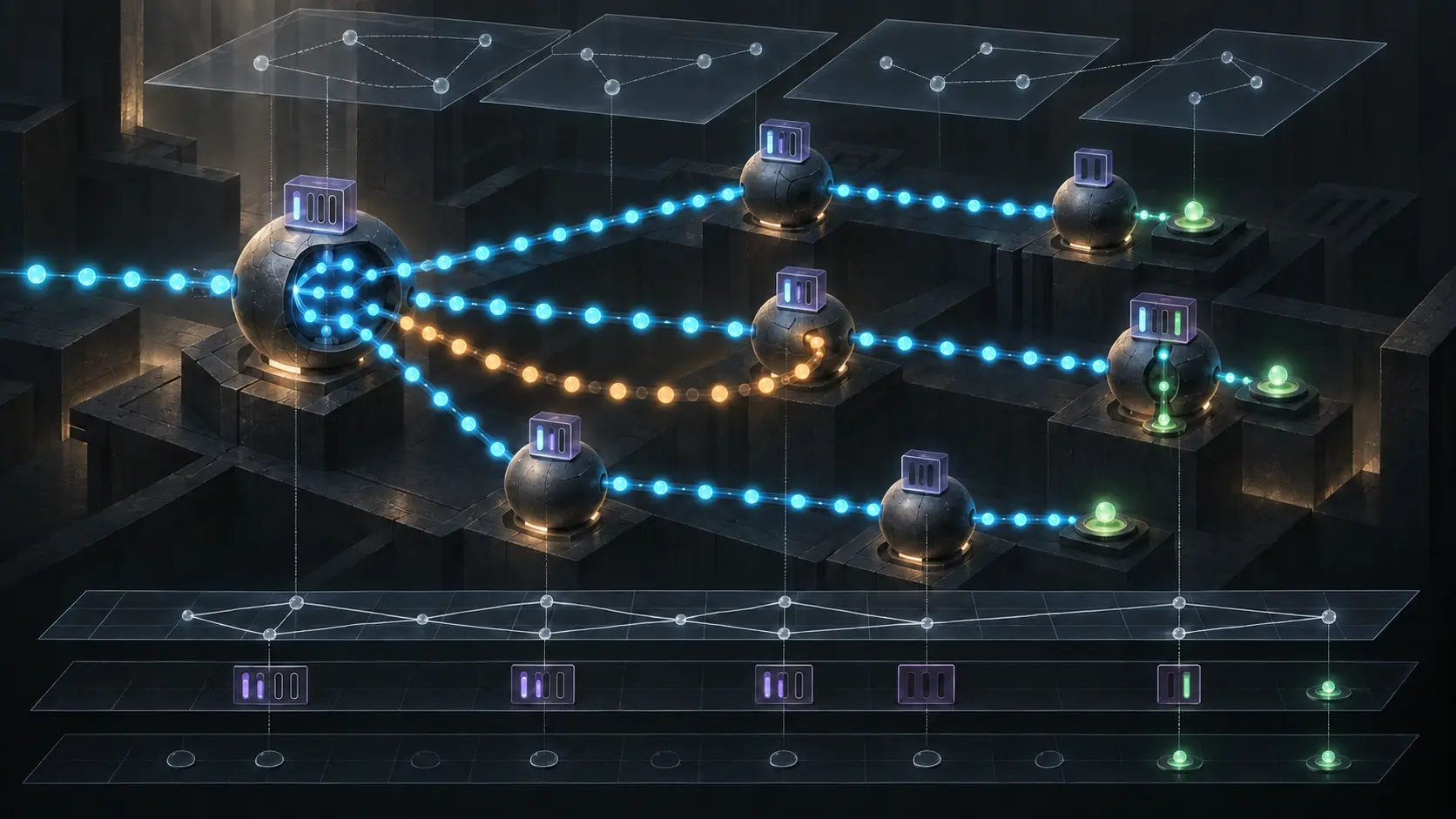
The Replication SID Found State. It Did Not Prove the Tree: RFC 9524
Every Replication-SID on the controller screen was green. Then one packet entered the network, became two, returned to an earlier replication node and became four. The labels were valid, the state lookups succeeded, and the tree was wrong. RFC 9524 explains why local forwarding…

IETF
The Probe Carried Two Link IDs. Only the Ports Could Confirm Them: RFC 9533
A measurement console said bundle 7 was healthy. The result was numerically precise and operationally vague: four physical links sat behind the bundle, the probe's five-tuple could select only one of them, and nobody had retained which member carried the request or its…

IETF
The Origin Changed the File. DNS Kept the Old World.
In a constructed operating case, an origin replaced its `origin-svcb` JSON and the fetch returned valid HTTPS. The dashboard marked the ECH rotation complete. The zone serial had not changed, one zone factory had rejected an endpoint, and recursive caches still carried the…

IETF
The Ceiling Was Large. The Memory Was Never Promised.
A capacity model saw a peer advertise a very large TLS receive limit and booked the same number of bytes as dependable headroom. In the constructed test, many connections exercised that permission together. The protocol ceiling held; the memory assumption did not. A maximum…

IETF
The Allocator Moved the Capacity. The Controller Still Held Yesterday’s Map.
The switching element reported a smaller resource envelope. The partition never restarted, its control session stayed up and its existing state remained present. Yet the controller could continue planning against the old limit until a later request failed. A successful…

IETF
The Directory Agent Said Accepted. The Mesh Had Not Yet Heard.
The service agent received a clean acknowledgment and closed its registration transaction. At that instant, another directory agent in the same scope could still answer without the new record. The receipt was genuine. The conclusion drawn from it was not.

IETF
The Group Was Larger. The Exponent Could Still Be the Weakest Link.
The negotiation selected an 8192-bit MODP group. The audit celebrated the largest number in the exchange. It had no record of how the private exponent was generated, whether the peer’s public value was tested, or which endpoint had actually been authenticated.

IETF
The ACK Proved the Retransmission Was Needless. It Did Not Undo the Recovery.
The first acceptable acknowledgment returned with an older timestamp. That was enough to show that the original transmission—not the retransmission—had earned the acknowledgment. It was not enough to widen the congestion window that the sender had already narrowed.

IETF
The Token Authorized the Reservation. It Did Not Deliver the Session.
The authorization capsule survived its trip from signaling to resource control. Its signature verified, its fields matched, and the policy server admitted the request. None of those receipts showed that media crossed the path or that the application outcome occurred.

IETF
The SET Returned No Error. The Service Still Had No Receipt.
A successful SNMP response proved that an agent accepted a bounded operation. It did not, by itself, prove that dependent rows committed, the subsystem activated, startup state persisted, the network converged or the revenue-producing service worked. RFC 3512 made that…

IETF
The Firewall Kept Its Throughput. The Benchmark Lost Its Configuration.
A performance figure survived into a procurement brief after its rule set, NAT state, security features, traffic mix and validation record had disappeared. RFC 3511 and its successor RFC 9411 make the missing context part of the measurement, not an appendix to it.

IETF
The Parser Said Well-Formed. The Application Said No.
The document crossed the XML parser without a syntax error. The requested operation was still invalid, unauthorized and never committed. RFC 3470 explains why those are separate receipts rather than one green result.

Leaders
Margaret Hamilton and the Five Seconds Between Warning and Choice
Margaret Hamilton’s account of Apollo’s priority display begins with a deceptively small interface problem: ordinary computer data could not necessarily interrupt an astronaut when the system needed attention. Apollo 11’s alarm record shows why interruption matters—and why an…