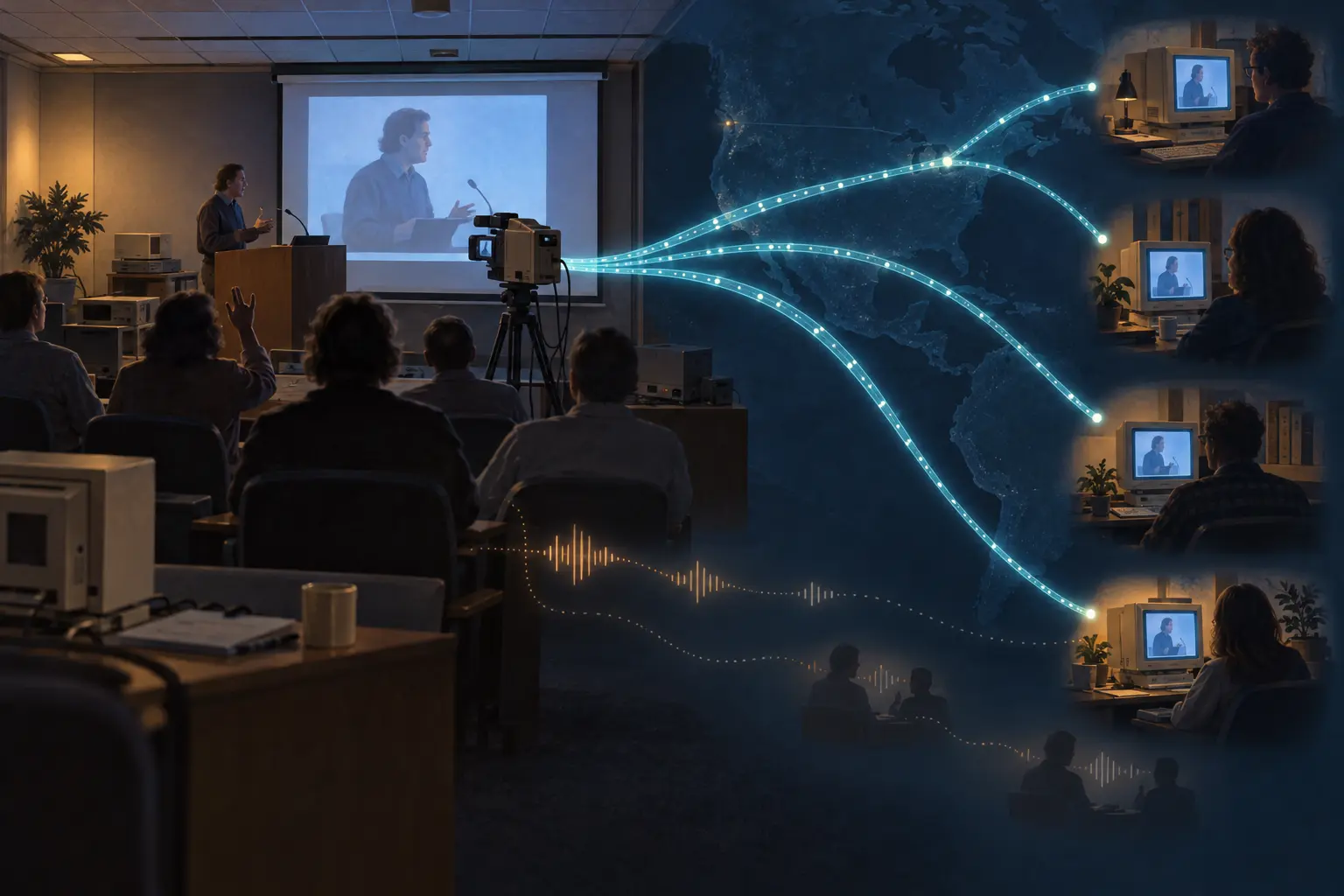
Summary
- NANOG’s public material establishes that technical educational activities are offered in several forms and, in some cases, with a stated format, capacity, registration condition or subject. It does not turn an announced seat, a sign-up requirement or a recording into evidence of participation, learning, deployment or operational effect.
- A useful public account of educational activity need not become a surveillance system. A minimal, privacy-preserving record could distinguish an offer from aggregate participation and from optional, carefully bounded indications of use, while making clear what it neither collects nor claims.
- The central governance question is not whether every course must produce a measurable outcome. It is whether an institution can describe the reach and limits of an educational offer honestly enough that readers do not mistake visibility for proof.
The difference between an offer and a result
An educational programme begins with an offer. Someone identifies a subject, arranges time and space, finds an instructor, publishes a description and invites people to take part. In a technical community, that offer can be valuable before anybody has measured it. It can lower the cost of finding an entry point into a difficult subject. It can put practitioners in the same room. It can provide a hands-on setting that would be hard for a person to assemble alone. It can also signal that a topic has become important enough to merit collective attention.
But an offer is not a result. The distinction is not pedantry. It protects both the learner and the institution from claims that the available evidence cannot carry. A workshop announcement may show that a session was planned. A registration page may show that the organisers intended to manage access. A capacity limit may show that a room, exercise or instructor team had practical limits. A recorded session may show that a later opportunity to watch was contemplated.
None of those things tells an outside reader who entered the room, stayed through the session, understood the material, used it at work, obtained permission to make a change, or saw an operational consequence.
The chain matters because every link introduces a different condition. Registration can be constrained by travel, scheduling, cost, approvals, time zones, disability access, immigration rules, caregiving, a participant’s confidence, or the ordinary fact that a person changed plans. Attendance can differ from registration because a meeting day is volatile. Completion can differ from attendance because a hands-on task can be interrupted, unsuitable for a particular level of preparation, or deliberately left unfinished.
Learning can differ from completion because a completed exercise may be mechanical, while a participant who asks difficult questions and leaves early may understand more than the person who receives a certificate. Use at work can differ from learning because an employer may not permit the necessary change, a customer may have a dependency, a maintenance window may not exist, or a security review may reject the proposed approach.
Even a successful technical change does not settle the final question. Reliability, security and performance are produced by many decisions over time. A new configuration can coexist with new hardware, an incident response, a supplier change, a staffing shift, a policy revision or a wider migration. A person who learned something in a clinic may later contribute to a change, but that does not make the clinic the single cause. The fact that a course concerns a topic that later appears in an operational decision does not supply causation. It supplies, at most, a reason to ask a more careful question.
The public record of technical education should therefore be read as a record of what it is: a record of activities described to the public. That is not a trivial record. It can reveal a programme’s breadth, its recurring forms, its stated educational ambitions and some of the institutional choices behind it. The error begins when those observations are quietly converted into a report card about outcomes that have not been published.
What the public file establishes
The NANOG material at issue shows several educational forms rather than one uniform product. A May 2026 attendee announcement for NANOG 97 described two workshops planned by the Workshop Committee. Each required separate registration and had 50 available seats. The announced subjects were a hands-on SONiC session about data-centre leaf-spine fabric design and a network-observability session in AWS, with dates and times listed. That is useful information about the proposed activity.
It tells an interested reader that the programme distinguished these workshops from the general meeting and that the organisers expected a constrained number of places. It does not disclose how many people registered, attended, completed an activity or made use of either subject later.
Earlier material makes the same distinction in a different setting. June 2025 NANOG 94 attendee material listed an RPKI workshop, an IPv6 hands-on activity and hackathon support as activities requiring additional sign-up. It also stated that session recordings would become available after the meeting. Separate sign-up is evidence of an access condition; it is not evidence of a participant count, a selection rule, a completion rate or an outcome. A recording being made available later is an additional route to material, not evidence that anyone watched it, learned from it or used it in an operating environment.
NANOG’s NANOG 93 IPv6 Clinic page similarly described a free, in-person, registration-required event with presentations, discussion of IPv6 reference architectures, a hands-on workshop and question-and-answer time. The description gives an outside reader a richer view of format than a bare title would. It indicates a mixture of presentation, discussion, practice and exchange. Yet no reasonable reader should infer from that mixture that an attendee adopted IPv6, altered an architecture or acquired a verified capability. Those propositions concern people and networks that the activity description does not identify or measure.
The public past-events index provides a fourth form of evidence: recurrence. It lists hackathons from NANOG 82 through NANOG 92, including an explicitly virtual NANOG 82 and later in-person entries. That pattern can support an observation that hackathon activity has appeared across multiple meetings and formats. It cannot establish the project work undertaken in any one hackathon, who contributed, whether a result was released, whether it was maintained, or whether it was adopted. Repetition of a format is evidence of repeated offering, not proof of a cumulative technical effect.
NANOG U adds another audience and format. Its webinar programming is described as a virtual way for North American undergraduate and graduate students to engage with industry innovators and learn about internet technologies, best practices and career-building resources. That statement helps describe the intended audience and the programme’s stated purpose. It does not establish enrolment, attendance, completion, knowledge change, employment, career progression or the representativeness of those who encountered the material.
A programme can articulate a broad educational purpose without claiming that every intended effect has occurred for every person who might be reached.
There are also public indications of institutional responsibility. A March 2026 message described the Workshop Committee as determining workshop topics, working with instructors to develop and deliver sessions, and guiding workshop-content creation. This is a reported remit, not a complete decision log. It does not identify the reasoning behind every particular choice or tell a reader how any session was evaluated. But it matters because it places topic selection and content development in a recognisable responsibility category rather than treating each workshop as an accidental occurrence.
Finally, a January 2026 announcement described a NANOG 96 workshop on autonomous agents in networking as limited-capacity, preregistration-required and hands-on. Again, the words establish a proposed form and subject. They do not establish that anyone adopted autonomous agents, changed operations or achieved a technical result. The more novel a topic sounds, the more important that restraint becomes. A public description of technical interest is not a deployment record.
Taken together, these materials establish a real but bounded picture: NANOG publicly presents workshops, clinics, webinars and hackathons; some activities have stated registration arrangements, capacity, delivery form, subjects or institutional responsibility; and the forms vary by meeting and audience. They do not furnish a single public chain from activity to registration, attendance, completion, learning, intended use, deployment, reliability or broader institutional effect. That is a limit of what the public descriptions show. It is not evidence that a different record is absent, concealed or unimportant.
Why the missing links are not a minor detail
It is easy to dismiss the distinction between a workshop and an outcome as a technicality when the topic itself appears urgent. RPKI, IPv6, routing, observability, network design and automation all invite an impatient question: did the programme make the internet better? The question is understandable. It is also too broad for the evidence represented by an announcement or an index.
The first reason is that the words at each stage describe different units. An activity is a scheduled offering. A registration is an expression of intended participation under whatever process applies. Attendance is presence according to a stated definition. Completion is the fulfilment of some defined activity. Learning is a change in understanding, skill or confidence, and it requires a method before it can be assessed. Operational use is a decision or action in a particular setting. A deployment is a technical change, usually with an implementation boundary. Reliability is a property observed across systems and time.
Institutional effect is broader still: it may involve norms, recruitment, cooperation, capacity or policy.
Collapsing these units produces false precision. If fifty seats are listed, someone may call the workshop a fifty-person training outcome. But seats are not people, people are not attendees, attendees are not completers, completers are not demonstrably more capable, and capability is not deployment. If recordings are said to be available, someone may call the material scalable. Yet availability tells nothing about reach, completion, access conditions, comprehension or use. If hackathons recur across meetings, someone may call them an innovation pipeline.
Yet an index cannot establish what was built, what survived, what found a maintainer or what had any public consequence.
The second reason is fairness. Participants have different reasons for choosing a session. One may be testing whether a topic is relevant. One may be new to the field. One may be an experienced operator looking for a comparison point. One may attend because a colleague could not. One may be collecting context before making a decision that will be taken elsewhere. A metric that treats every attendance event as the same kind of success obscures those differences.
It can also create pressure for people to expose their work, employer or technical environment merely so that an institution can convert participation into a more impressive outcome statement.
The third reason is governance. An institution that claims a result assumes responsibility for the definition, collection, interpretation and publication of the evidence behind it. If it says a workshop improved reliability, readers should be entitled to ask: for whom, compared with what, over what period, under what conditions, and with what alternative explanations considered? If it cannot answer those questions, the claim should not be laundered through the benign language of education. A more modest account is not weak.
It is a refusal to make a learner’s or operator’s private work carry an institutional narrative without a defensible record.
Registration, attendance and completion are not synonyms
Registration is often treated as the first solid number because it is administratively convenient. It is usually a signal that a person has attempted to reserve a place, submitted required information or expressed an intention to participate. But even the meaning of registration varies. A separate sign-up can be a capacity-management device, a safety measure for a lab, an attempt to allocate materials, a way to communicate logistics, or simply a distinction between a meeting session and a side activity.
The NANOG 97 workshops, NANOG 94 activities, NANOG 93 clinic and NANOG 96 workshop all include a registration or preregistration condition in their public descriptions. That condition should not be made to bear more than it says.
Attendance is a separate event and needs a definition. Does it mean entry at the door, presence at any point, attendance for a majority of the session, or verified participation in a particular exercise? The answer can affect the count substantially. A virtual webinar has another set of questions: is attendance joining the stream, remaining connected for a threshold period, participating in a discussion, or accessing a recording later? There is no universal correct definition. There is only the need to state the definition before using a number as an indicator.
Completion is different again. For a presentation, completion may mean remaining through the event. For a hands-on lab, it may mean reaching a final exercise, submitting a voluntary task, or simply confirming that the participant had an opportunity to attempt the material. For a hackathon, completion is especially slippery. A team can make substantial progress without a finished project; a person can learn deeply while not contributing an artefact; an early prototype can be valuable without being ready for release. Treating completion as a universal badge risks rewarding only the kinds of activity that can be made legible quickly.
The right response is not to refuse all measurement. It is to retain the distinctions. A public record could report aggregate registrations where registration is defined, aggregate attendance where attendance is defined, and aggregate completion where completion is meaningful and defined. It could also state when an activity does not use a completion concept. That last sentence matters. An institution does not fail merely because a discussion session has no sensible completion test. It fails only if it presents an undefined count as though it settled a question that the activity was never designed to answer.
Definitions also prevent comparison theatre. A high registration total for a free virtual event cannot be compared casually with attendance at a limited-capacity, in-person hands-on workshop. A clinic that mixes discussion and practice cannot be compared mechanically with a lecture. A hackathon that prioritises collaboration cannot be evaluated as though it were a certification examination. The purpose of a minimal record is not to create a league table of formats. It is to describe each format clearly enough that readers can see its boundaries.
The burden of a workshop seat
A limited-capacity workshop can create a powerful impression of scarcity. Scarcity can be useful: it may reflect a lab’s technical constraints, the number of instructors available, the capacity of a room, or the safety and quality limits of a hands-on exercise. It can also produce an intuitive but misleading conclusion: if seats are valuable, every seat must produce an important result. That conclusion is unfair to participants and corrosive for programme design.
A participant may register and be unable to attend. An attendee may leave early because of a work incident, a health issue or a competing obligation. A person may attend solely to understand whether the subject is relevant. Another may decide, correctly, that the proposed approach does not fit their circumstances. An experienced participant may receive little new technical knowledge but find value in contact with peers. A novice may learn a great deal but lack any authority to apply it. None of these outcomes is a failure of education. They are ordinary features of voluntary technical learning.
Nor does a seat grant a governance mandate. A workshop attendee does not thereby speak for the broader NANOG community, their employer, a technology sector or a population of networks. A registration list is not a constituency roll. A clinic does not convert its participants into delegates. An instructor’s presentation does not turn into a recommendation binding on people who were not present. These points may seem obvious, but they are easy to lose when programme participation is invoked as evidence that a community has endorsed a particular technical direction.
The governance value of a public record lies partly in refusing that conversion. It can show that an opportunity was created and, where appropriate, how many aggregate participation events occurred. It should not use the act of participation to claim authority over non-participants. It should be particularly careful where capacity is small, because a small cohort is more vulnerable to identification and more likely to be unrepresentative of any wider group.
A committee remit is not a causal chain
The March 2026 description of the Workshop Committee gives an outside reader a useful institutional clue. It says the committee determines workshop topics, works with instructors to develop and deliver sessions, and guides workshop-content creation. Those are significant responsibilities. They create an identifiable locus for decisions about what educational opportunities will be offered and how content may be shaped.
Yet responsibility for an offer is not responsibility for every outcome that could follow it. The committee may determine a topic, but it cannot determine whether an individual registers, attends, completes an exercise, understands a concept, seeks employer approval, finds a maintenance window, or makes a later operational change. Instructors can develop material and deliver a session, but they cannot make a particular network adopt a design or guarantee the result of a change in a different environment. Participants themselves may exercise judgment precisely by deciding not to implement an idea.
This distinction is liberating as well as limiting. It means programme stewards can be accountable for the quality and clarity of an offer without claiming power they do not possess. They can state objectives, define format, explain capacity, set accessibility expectations, describe the responsibility category, and improve future sessions using appropriate aggregate feedback. They need not promise that every topic produces a measurable deployment.
Trying to do so could move attention away from the actual educational craft: selecting subjects thoughtfully, matching format to purpose, preparing instructors, communicating limitations and creating a setting in which people can ask useful questions.
The same caution applies to participants and sponsors. A participant should not be treated as an implementation agent for a programme. A sponsor should not be inferred to control a workshop merely because it appears in the ecosystem around a technical event. A public programme description is not evidence of a vendor recommendation, a product endorsement or marketing capture. The material described here supports no such inference. Its practical value is in showing activities and remits, not hidden motivations or downstream ownership.
The temptation to infer absence
When public information stops at the activity description, commentators often fill the silence with one of two stories. The optimistic story assumes that a well-designed opportunity naturally produced learning and beneficial use. The cynical story assumes that the absence of public outcome data proves nothing happened, nothing worked or something was withheld. Both stories overreach.
Public documentation can be deliberately narrow for good reasons. Individual technical learning may be private. An employer may prohibit disclosure of infrastructure plans. A network diagram can reveal security-sensitive design information. A person early in a career may not want their participation tied to an employment outcome. A small cohort may be identifiable even when names are removed. A participant may not have an immediate operational role, and later effects may be delayed or impossible to trace. Volunteer-led organisations also have finite administrative capacity.
The fact that a particular field does not appear in a public description is therefore not proof that the underlying activity had no effect or that an unreported internal process does not exist.
The inverse is equally important. Privacy and complexity do not authorize an institution to imply outcomes it has not established. It can say what it offered. It can say what it counts if it has clear definitions. It can ask participants whether they consent to share broad, optional information. It can publish aggregate observations with suitable caution. It cannot turn the possibility of private success into a public assertion of success.
The discipline here is simple: absence in a public activity description is not proof of failure, concealment or non-existence; presence of an activity description is not proof of learning, adoption or impact. Holding both sides at once is what makes the record credible. It is also what prevents legitimate privacy concerns from becoming an excuse for indistinct institutional claims.
Why outcome measurement can damage the thing it seeks to describe
The case for more careful records should not be confused with a case for extracting every possible datum. Measurement changes behaviour. Once a programme is judged by a single visible outcome, organisers may choose activities that are easy to count rather than activities that are useful. Instructors may simplify material so that a completion metric rises. Participants may report an intended change because the question implies that a positive answer is expected. Employers may discourage attendance if they believe participation will create an obligation to disclose technical plans.
Small organisations and volunteers may step away if reporting becomes more burdensome than teaching.
These effects are particularly acute in technical communities. A hands-on exercise may be valuable precisely because it lets a participant explore a topic without committing to deployment. A clinic may succeed because it allows an operator to discover that a proposed approach is not suitable for their situation. A hackathon may create relationships or questions rather than a release. A webinar may be an early exposure for a student who will not make a technical decision for years. A metric that recognises only immediate implementation will discount these forms of value and reward a narrower, more public-facing subset of participants.
There is also an equity concern. People with greater institutional authority, larger teams, more permissive employers or lower confidentiality constraints are more able to report a change. If those reports become the principal evidence of success, the programme may appear to serve only the already empowered. The resulting record can then reshape the next programme toward the same group, not because their learning is inherently more valuable but because it is easier to observe. That is a second-order effect of measurement design: the measure begins to govern the offer.
A privacy-preserving record must therefore be designed around restraint. It should seek enough information to distinguish claims, not enough information to reconstruct a participant’s career or network. It should allow a meaningful “not collected” or “not disclosed” boundary. It should be useful even when the answer to an outcome question is uncertain, delayed or unavailable. And it should make the costs of collection visible to those who decide whether to collect.
A minimal record worth testing
The appropriate proposal is not an outcome dashboard that promises to explain the effects of all technical education. It is a minimal record, published or made available in an appropriate aggregate form, that makes the stages of an activity legible without pretending to resolve every downstream question. The record should be a voluntary editorial and governance option, not an assertion about current NANOG practice.
First, each activity should state its type and objective. “Workshop,” “clinic,” “webinar,” “hackathon,” “tutorial” and “discussion” are not interchangeable labels. The type signals a likely format, while the objective explains what the activity is intended to help participants do: orient themselves to a subject, examine a reference architecture, practice a method, exchange ideas, explore a technical approach or understand a career path. Objectives should be written as opportunities, not promises.
A workshop can aim to give participants a setting to explore a design question; it should not promise that every participant will deploy that design.
Second, the record should state format and capacity where those are applicable. In-person, virtual and hybrid arrangements affect access and interpretation. A stated capacity can explain why registration is required without turning a maximum seat count into a participation result. Where an activity has no fixed capacity, that too can be stated. The aim is to let readers understand the conditions of the offer rather than infer them from a registration form.
Third, the record should define aggregate registration, attendance and completion measures before publishing them. If no attendance measure is available or appropriate, it should say so. If completion is not meaningful for an activity, it should not be invented. If a limited capacity is reported, it should be clearly labelled as capacity rather than attendance. Such definitions are not bureaucratic decoration; they keep numbers from being transferred across formats without context.
Fourth, the record should identify a responsibility category. It need not name individual decision-makers or expose deliberations. It can state whether topic selection, content development, delivery, logistics or evaluation sits with a committee, instructor group, staff function or another defined role. The public description of the Workshop Committee illustrates why this category is useful. It gives readers a way to understand institutional responsibility without suggesting that responsibility extends to every personal or operational consequence.
Fifth, the record could allow optional, anonymous or consented indications of capability. This must be carefully bounded. A participant might voluntarily report whether they felt more able to identify a topic, assess an approach, ask a better question or seek further resources. An activity might offer an optional pre- and post-session self-assessment, reported only in aggregate and only where the cohort size protects privacy. Such indications are not objective proof of competence. They are modest evidence about a participant’s own reported change, and their limitations should be published alongside them.
Sixth, a follow-up window should be stated in advance. Immediate feedback measures immediate experience, not operational use. A later voluntary check-in might ask whether the participant pursued further learning, discussed the topic internally, explored it in a test setting, decided it was not applicable, or had no update. The window could be short and practical; the point is to avoid treating silence as either success or failure. A declared window also prevents retrospective selection of the most flattering moment at which to ask.
Seventh, where participants choose to respond, the record could use broad aggregate categories for intended use or observed operational change. The categories should be deliberately coarse: further study, internal discussion, evaluation, test environment exploration, no planned use, not applicable, or no response. They should not demand employer names, customer details, network diagrams, security-sensitive configurations, commercial plans or claims that a particular educational activity caused a later result.
A participant who reports “evaluation” has provided a useful directional signal without turning a private network decision into a public case study.
Finally, the record needs an explicit non-collection and non-disclosure boundary. It should say, in plain language, that learner names, individual scores, employer information, personal course files, network diagrams, security-sensitive configuration details and commercial plans are not required for the public account. It should also say that it will not claim causal certainty about deployment, reliability, career progression or institutional effect from voluntary aggregate feedback. This boundary is not a legal footnote. It is the condition that makes the rest of the record trustworthy.
Definitions before numbers
The durability of a minimal record depends less on sophisticated analytics than on ordinary definitional discipline. Before an institution publishes a number, it should be able to answer a short list of questions. What exactly was counted? During what interval? Was the measure optional or mandatory? Is it a capacity, a registration, an attendance event, a completion event or a response rate? Does it refer to people, sessions, groups or responses? What did the measure exclude?
Consider how this would work without demanding sensitive information. A workshop could report a stated capacity, if one existed; an aggregate number of completed registrations under a published definition; an aggregate attendance figure if attendance was measured; and an aggregate completion figure only if the activity had a clear completion concept. A webinar could report a different set of measures and explain that recording access was not treated as evidence of viewing or learning. A hackathon could describe participation in broad aggregate terms while declining to create a universal completion measure.
The resulting record would not be perfectly comparable. That is a virtue. It would preserve the difference between formats rather than manufacture a common denominator that misleads.
Definitions also improve programme stewardship. If a capacity limit routinely fills while a particular programme format produces few optional follow-up responses, that may suggest questions about accessibility, timing, communication or the follow-up method. It does not prove that the activity lacked value. If a clinic attracts participants but reports varied self-assessments, that may indicate that the format serves multiple levels of experience. It does not establish a causal skill gain. The measure becomes a question for judgement, not a verdict.
The alternative is a cycle of rhetorical inflation. An institution sees an announcement, a seat count or an access statistic; converts it into a success claim; then makes future activity defend that claim. Over time, participants learn that honest uncertainty is institutionally inconvenient. A minimal record resists this by giving uncertainty a proper field. “Not measured,” “not applicable,” “no response,” and “not disclosed” are not embarrassments. They are often the most accurate answers available.
Follow-up without surveillance
Follow-up is where a programme’s curiosity about outcomes can most easily become intrusive. A technical educator may reasonably want to know whether material remained useful after a session. A participant may reasonably want to be left alone, especially if their employer, network or career circumstances make disclosure difficult. The design question is not whether follow-up is good or bad. It is whether it gives participants real control and produces information that is modest enough to be credible.
An optional follow-up window should therefore be bounded, announced and easy to ignore. It should not create a presumption that participants owe a report. It should not ask for hidden configuration details to make a general statement look persuasive. It should not require people to explain why they did not proceed with a technical change. A decision not to adopt an approach may be wise, but it may also involve confidential facts that do not belong in an educational record.
The questions can remain broad. Did the activity lead to further study? Was the subject discussed with a team? Was there an evaluation, a test, a decision that the approach was not applicable, no planned use, or no update? These are categories, not proofs. They help identify whether the programme’s stated objective has an observable life beyond the room, while preserving the line between an intention and a deployment.
The follow-up window should also acknowledge time. A person may need months before an opportunity to apply a lesson appears. Another may use the material immediately but never respond. A short window yields a timely but incomplete picture; a long window yields more attrition, changing circumstances and less direct recollection. The right choice depends on format and objective. What matters is that the window be named and that a lack of response not be interpreted as failure or disinterest.
Where cohorts are small, aggregation is essential and may not be sufficient. An institution should consider whether a category or a cross-tabulation could identify a participant indirectly. The safest public record may omit a breakdown rather than publish a number so granular that community members can infer a person’s identity or employer. A measure that damages trust is not neutral simply because it has been anonymised in name.
Operational change is not a trophy
Technical communities understandably value the connection between learning and practice. A workshop that helps someone frame a better operational question can be valuable. A clinic that makes a reference architecture more intelligible can be valuable. A webinar that helps a student decide to continue in the field can be valuable. A hackathon that exposes a maintainer problem can be valuable. None of these values depends on turning a later change into a trophy for the programme.
An aggregate category for intended use or observed operational change can still have a role. It lets a programme see whether participants, on an optional basis, report that they pursued further study, internal discussion, evaluation, test activity or some other broad next step. It may also reveal that a substantial group found the subject not applicable. That is not necessarily bad news. A well-run educational offer can help people decide not to use an approach when it does not fit their environment.
The record becomes misleading when it skips the intermediate language. “Evaluation” is not deployment. “Test environment exploration” is not production use. “Internal discussion” is not a changed policy. “Observed operational change” is not proof that the activity caused the change. Even a participant’s own account may describe one influence among many. The institution should present such categories as voluntary self-reports, aggregated and bounded, not as a cumulative score for the programme.
This restraint protects technical judgement. Operators should be able to learn without being rewarded only for making fast, visible changes. In many environments, the responsible outcome of education is a slower decision, a request for more evidence, a security review, a decision to defer, or a conclusion that a technique is unsuitable. A metric that credits only deployment can make caution look like failure. That is a perverse incentive in a field where caution is often part of competence.
The public benefit of saying less, precisely
Institutions often fear that a cautious account will make their programmes look less important. The opposite can be true. A reader who sees the difference between a workshop offer, a registration condition, aggregate attendance, optional feedback and later voluntary categories is more likely to trust each claim. Precision does not diminish a programme; it tells the public where its value is observed and where it remains a matter for future inquiry.
The benefits are practical. Participants know what will not be demanded of them. Instructors know that their work will not be evaluated by a causal claim they cannot substantiate. Committee members know which part of the chain they own. Sponsors and observers cannot easily convert a programme description into a claim of endorsement or mandate. Future organisers inherit definitions rather than a pile of incomparable numbers. And readers who care about impact receive a better answer than either a promotional flourish or an accusation based on silence.
The public benefit is also institutional. Educational legitimacy is not produced by the maximum possible amount of data. It is produced by a visible alignment between the scope of an offer and the scope of the claims made about it. NANOG’s public educational material is sufficient to establish that a varied set of learning activities has been publicly described, with some observable conditions and a reported committee remit. It is not sufficient to certify outcomes that belong to participants, employers, networks and time.
That boundary does not close the conversation. It opens a more serious one. If the community wants a clearer view of educational reach, it can debate a minimal record: which fields are useful, which definitions are fair, which feedback is truly optional, which follow-up period makes sense, and which information should never be collected. The debate should begin not with a demand for proof of grand impact, but with a commitment not to make a workshop seat carry more meaning than the evidence can support.
Sources
- https://lists.nanog.org/archives/list/[email protected]/2026/5/
- https://lists.nanog.org/archives/list/[email protected]/2025/6/
- https://nanog.org/events/nanog-93-ipv6clinic-waitlist/
- https://nanog.org/events/past/?m=virtual&type=hackathon
- https://nanog.org/events/webinar-fireside-cenic/about/
- https://lists.nanog.org/archives/list/[email protected]/2026/3/
- https://lists.nanog.org/archives/list/[email protected]/2026/1/
Member Briefing
Deeper Profile Context
Sign in with the right membership level to unlock the full briefing and source notes.
Only for Strategic Circle
Strategic Circle
Open to all readers. Unlock profile briefings after joining and signing in.
Join Strategic CircleOnly for Leadership Alliance
Leadership Alliance
For qualified IP-asset owners and management; sign in to unlock alliance briefings.
Join Leadership Alliance