
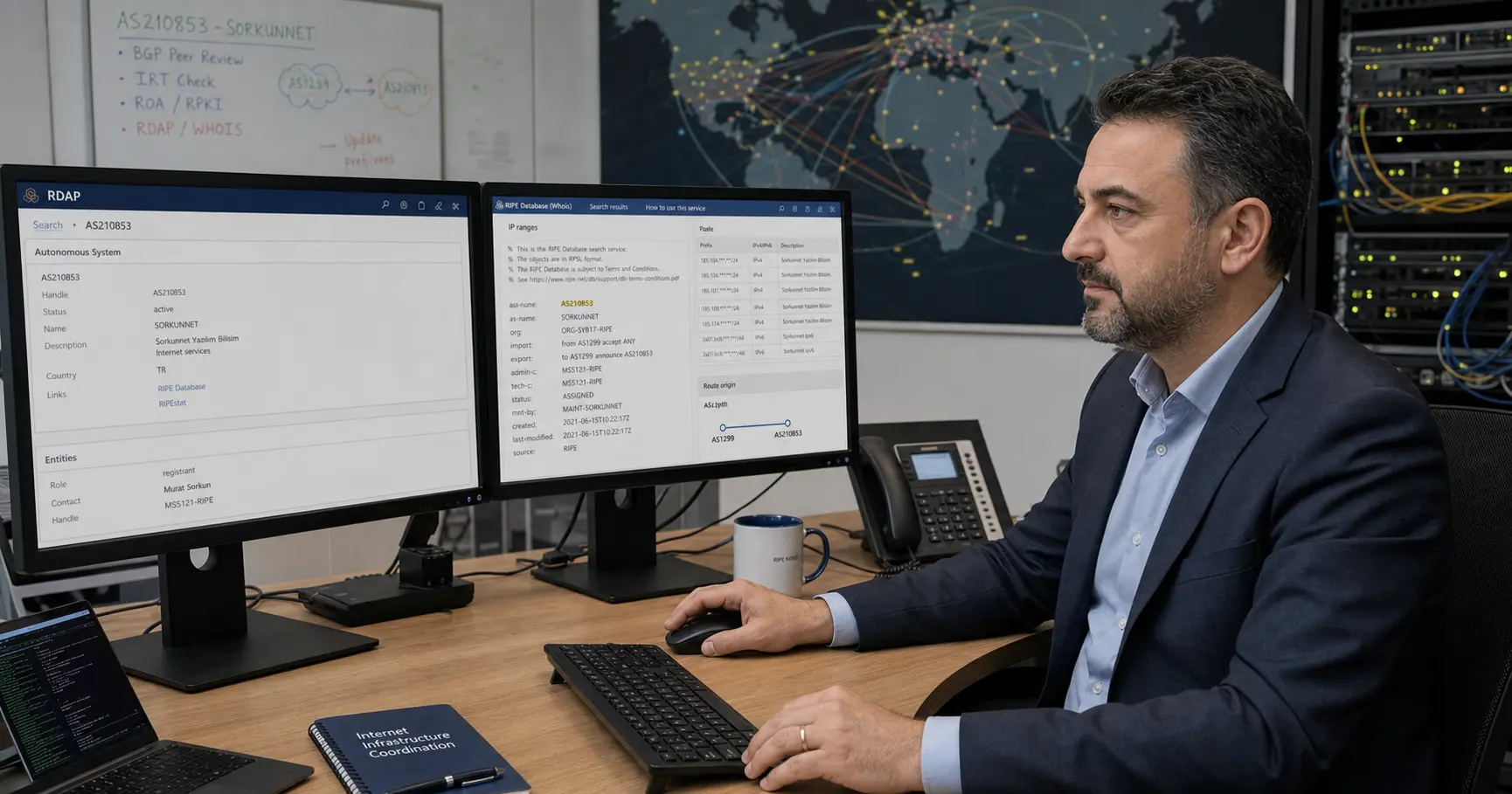
Murat Sorkun is a public profile built from public RIPE RDAP and RIPEstat records. It summarizes what can be verified: a named administrative and technical contact for AS210853. The profile makes no claim of employment, authority, or personal control of internet resources. The monitoring value lies in tracking registry continuity; a change in contact would signal operational shift. Evidence is limited to two official sources; no independent verification exists. Readers should treat this as a baseline surveillance point, not a comprehensive assessment.
Murat Sorkun
Murat Sorkun is a person listed as administrative and technical contact for ASN 210853 in RIPE's RDAP records. The only verifiable public fact is the registry contact role; no employer, job title, or broader operating history has been confirmed. Monitoring this contact provides a low-cost signal for administrative continuity and accountability around AS210853.
Why It Matters
If the registry contact for AS210853 is stale or inaccurate, external parties seeking to address routing issues or abuse may direct communications to an unresponsive or incorrect party, prolonging resolution. Conversely, stable and accurate contacts can streamline operational coordination and abuse handling for the resources behind that autonomous system.
What Public Sources Show
Murat Sorkun appears in the RIPE NCC’s RDAP system as the administrative and technical contact for Autonomous System 210853. That single registry entry is the only publicly verifiable evidence tying the name to any internet infrastructure role. No employer, job title, geographic location, or broader operating history could be confirmed from the available public sources.
Because registry contacts offer a narrow but concrete window into accountability for an autonomous system, monitoring Murat Sorkun helps analysts detect shifts in the operational responsibility surface for AS210853 without relying on private or unverifiable claims.
The core evidence comes from a public RDAP record retrieved for AS210853. That record lists Murat Sorkun with two distinct contact roles: administrative and technical, both linked to the entity handle MKK54-RIPE. The RDAP response is the authoritative source, and it does not attribute any organisational affiliation beyond the handle.
A companion source, the RIPEstat page for the same autonomous system, confirms that AS210853 exists and provides public routing and registration context, but it adds no further detail about the person.
As the registered admin-c and tech-c, Murat Sorkun is the designated recipient for operational communications about AS210853, including routing updates, abuse reports, and registry maintenance queries. However, the authority derived from these roles is tied strictly to the registry record; there is no public evidence that the person controls network resources, holds financial authority, or makes operational decisions beyond what the registry permits.
Any assumption of personal ownership or broader corporate influence would be unsupported.
The impact of tracking Murat Sorkun lies in the signal provided by registry continuity. When a named contact remains stable over time, it suggests deliberate administration and reduces the likelihood of stale or abandoned resources. Conversely, a sudden replacement of the contact—or the appearance of multiple conflicting contacts—could indicate a change in operational control, organisational restructuring, or simple neglect.
Such changes can affect how quickly routing or security incidents are resolved, because external parties may reach an outdated or unresponsive party.
The current evidence boundary is narrow. The only sources that mention Murat Sorkun are the RDAP record and the derived RIPEstat overview. No independent verification—such as a LinkedIn profile, company website, PeeringDB entry, or news article—was located. This absence means readers cannot confirm whether the person is a current employee of the entity that operates AS210853, a former staff member, or even an automated role account.
The entity behind the autonomous system remains unnamed in the provided sources, further limiting the ability to assess the contact’s real-world authority.
Several watchpoints can sharpen or weaken the assessment. Any change to the admin-c or tech-c fields for AS210853 in the RIPE database would immediately alter the operating baseline. The addition of a PeeringDB record, a corporate affiliation, or a new public appearance by Murat Sorkun in a related network context would raise the person’s infrastructure relevance.
Conversely, if the RDAP record ceases to resolve or shows a different contact without a linked update history, it would suggest the information is stale and lower the monitoring value.
In summary, Murat Sorkun is a registered contact for AS210853 and nothing more in the public domain. The profile offers a surveillance-grade observation point for one autonomous system’s accountability surface, but it does not prove employment, operational control, or strategic importance. Until additional public evidence emerges, the most useful intelligence is the continued presence—or disappearance—of this name in the RIPE registry.
Operating Surface
Murat Sorkun serves as the published administrative and technical contact for Autonomous System 210853 according to a RIPE RDAP record. The role does not imply verified employment; it only signals a registry-level contact point that is relevant for network operations inquiries, abuse handling, and registry maintenance related to that ASN.
Registry contacts act as low-cost public signals for operational accountability. A change in the contact record for AS210853 can indicate reassignment of responsibility, organisational turnover, or stale data that undermines incident-resolution pathways. Tracking Murat Sorkun helps analysts detect such shifts using open sources.
Watchpoints
Murat Sorkun's registry contact role for AS210853 provides a low-cost, public-signal point for monitoring administrative continuity of that autonomous system. Absent of any company or employment data, the contact's persistence or disappearance is the key strategic signal. Changes could reflect organisational restructuring or data staleness, which in turn affect accountability for routing and abuse handling. The narrow evidence base makes this a surveillance-grade, not decision-grade, indicator.
- Any update to the RIPE WHOIS/RDAP admin-c or tech-c for AS210853. 2) Appearance of Murat Sorkun in PeeringDB, LinkedIn, or company websites that would confirm employment. 3) Addition or removal of prefixes announced by AS210853 that might tie the contact to operational activity.
Missing: verified employer name, job title, geographic location, and any corroborating public biography. Also missing: direct evidence that the person is currently active or responsive. Without these, confidence in the contact's operational relevance remains low. Additional public sources like company websites, professional profiles, or network operator databases could fill these gaps.
Sources
- Registry RDAP / WHOIS record - public-source identity and registry context for Murat Sorkun.
- RIPE registry record - RIPEstat provides public routing and registration context for ASN 210853, the same ASN referenced by the RDAP record tied to Murat Sorkun.
Signal Brief
- Signal: Murat Sorkun
- Region:
- Market Class: Global Cloud Services Trends
Operating Footprint
- public operating records
- official service pages
- documented relationships updates
Market Context
- If the registry contact for AS210853 is stale or inaccurate, external parties seeking to address routing issues or abuse may direct communications to an unresponsive or incorrect party, prolonging resolution. Conversely, stable and accurate contacts can streamline operational coordination and abuse handling for the resources behind that autonomous system.
- Operational relevance: Medium
- Time Horizon: Next quarter
What To Watch
- official company sources
- public registries
- operator-published records
Member Briefing
Deeper Trend Context
Sign in with the right membership level to unlock the full briefing and source notes.
Only for Strategic Circle
Strategic Circle
Open to all readers. Unlock trend briefings after joining and signing in.
Join Strategic CircleOnly for Leadership Alliance
Leadership Alliance
For operators, investors, and policy teams that need relationship evidence, failure paths, and source notes. Sign in to unlock.
Join Leadership AllianceSnapshot
Category
Global Cloud Services TrendsMurat Sorkun serves as the published administrative and technical contact for Autonomous System 210853 according to a RIPE RDAP record. The role does not imply verified employment; it only signals a registry-level contact point that is relevant for network operations inquiries, abuse handling, and registry maintenance related to that ASN.
Content Type
EventPrimary Domain
MarketImpact
MediumIf the registry contact for AS210853 is stale or inaccurate, external parties seeking to address routing issues or abuse may direct communications to an unresponsive or incorrect party, prolonging resolution. Conversely, stable and accurate contacts can streamline operational coordination and abuse handling for the resources behind that autonomous system.
Confidence
High confidence (95%)Confidence score guide
Several public sources