
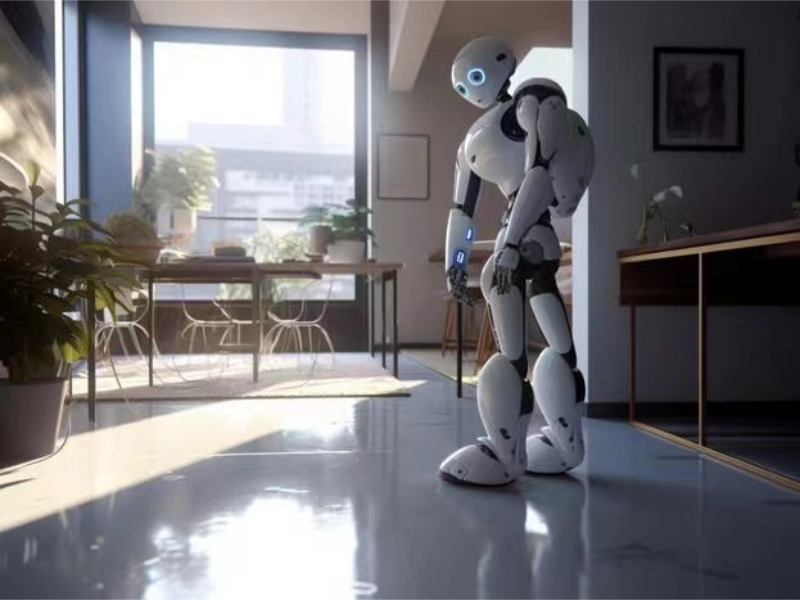
- Massachusetts Institute of Technology Computer Science and Artificial Intelligence Laboratory (MIT CSAIL) has demonstrated a new way to train a domestic robot using an iPhone to scan the home environment and upload it to a simulation.
- This approach uses virtual simulations to allow robots to improve their adaptability to dynamic home environments over millions of exercises.
OUR TAKE
MIT CSAIL has developed a new method for training domestic robots utilising an iPhone to scan the home environment and upload it into a virtual simulation. By performing millions of practice sessions in the virtual world, the robot is able to improve its skills without real-world consequences. This innovative technology enhances the robot’s ability to adapt to dynamic home environments, such as changes in furniture movement or item placement, to perform household tasks more efficiently.
-Rae Li, BTW reporter
What happened
Researchers at the MIT CSAIL have demonstrated an innovative approach to training domestic robots to cope with the complexity and variability of home environments. Their research aims to address the difficulty of non-vacuuming robots being widely used in domestic scenarios, as each home varies in terms of layout, lighting, surfaces, occupants and pets. Even if the robots were able to effectively map each home, these spaces are always in flux.
Central to this research is the use of an iPhone for environmental scanning. Users can scan a part of their home with their iPhone and then upload the scans to a simulation system. In this way, researchers can create detailed models of homes in virtual environments that can be used to train robots. Simulation training has become a significant part of robot training because it allows robots to perform a large number of trials and errors in a short period of time. The researcher Pulkit Agrawal explains in a video related to the study, “Training in simulations in the virtual world is very powerful because the robot can practice millions of times over and over again. It may break a thousand plates, but that’s okay because everything is in the virtual world.”
Also read: Tesla moves toward humanoid robots and self-driving Taxis
Also read: Musk delays robotaxi reveal to October 10 amid design changes
Why it’s important
This innovative approach from MIT CSAIL indicates how a combination of virtual simulation and real-world data can be used to solve the problem of adapting domestic robots to complex, changing environments. By using an iPhone to scan the home environment and upload it to the simulation system, the researchers are able to create a detailed virtual model of the home, enabling the robot to perform millions of trials and errors in the virtual environment.
This approach significantly reduces training costs and risks, improves the performance of the robots in real-life environments, and enhances their flexibility and adaptability in different home environments.
In addition, this research demonstrates how technological innovations can overcome the limitations of traditional approaches. As home environments become more diverse and changeable, robots that can quickly adapt to these changes will become increasingly important. Thus, this combination of virtual and real training methods is expected to drive the overall development of home robotics and improve people’s quality of life in the future.