Summary
- Millicom's equity free cash flow reconciliation carries a deduction for proceeds from tower disposals, net of taxes; it reads nil in the third quarter and the first nine months of 2026, against (5) and 37 in the same columns of 2025.
- A master lease amendment signed by Tigo Guatemala on 22 January 2026 prints a 15-year term, an annual lease amount of approximately US$13 million, recognition of US$118 million of right-of-use assets and lease liabilities, and US$20 million of equipment dismantling provisions.
The reconciliation inside Millicom International Cellular S.A.'s third-quarter results carries one line that a cash measure does not obviously need: a deduction for proceeds from tower disposals, net of taxes. In the nine months to 30 September 2026 it reads nil. In the same nine months of 2025 it reads 37. In the third quarter of 2026 it reads nil; in the third quarter of 2025 it reads (5) (Millicom (Tigo) Q3 2026 Earnings Release).
The row above it prints equity free cash flow of 316 for the quarter against 243, and 867 for nine months against 638, with the company's own growth rates of 29.9 per cent and 36.0 per cent. The row below prints the same measure with divestitures removed: 316 against 248, printed at 27.1 per cent, and 867 against 601, printed at 44.3 per cent. Two growth rates for one nine-month figure, because the prior-year base moves when the disposal adjustment is applied.
The subtraction is the company's to supply, so the only arithmetic I add is mine and labelled: 316 less 243 is 73 for the quarter, and 867 less 638 is 229 over nine months. What the table establishes is an identity. Because the adjustment is nil in both 2026 columns, reported and ex-divestiture equity free cash flow print as the same number — 316 and 867 — in the comparison shown.
The nil says something narrower than it first appears to. That line exists to strip disposal proceeds out of a free-cash-flow measure; it is not a ledger of what any asset sale paid, and it does not accumulate across periods. What it records for 2026 is that there was nothing of that kind left to strip.
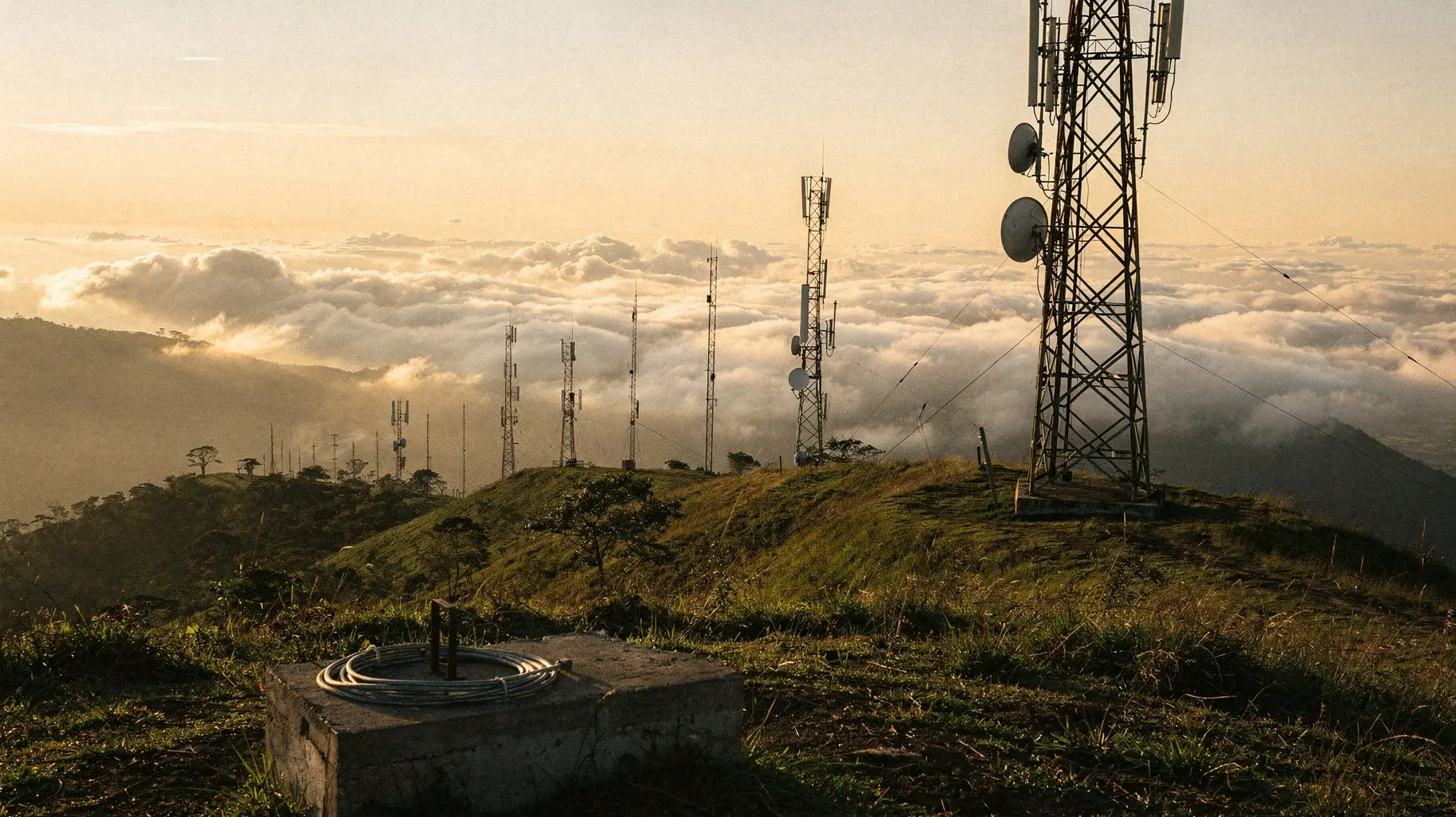
The disposal itself was agreed on 28 October 2024: approximately 7,000 towers in Guatemala, Honduras, Panama, El Salvador and Nicaragua, sold and leased back to SBA Communications Corporation for total consideration of approximately US$975 million plus an earn-out contingent on achieving certain financial performance metrics (Form 6-K, 28 October 2024). An agreement is a price, not a receipt. That document prints no cash received and no liability assumed.
The interim statements for the nine months to 30 September 2026 supply the other end, and they open with a phrase that settles a chronology: "Following the closings with SBA, Tigo Guatemala signed a Master Lease Agreement amendment for the use of ground space on January 22, 2026" (Unaudited Interim Condensed Consolidated Financial Statements, nine months ended 30 September 2026). The sentence then carries three quantities that cannot be interchanged: "The amendment has a 15-year term and is for a total annual lease amount of approximately $13 million (resulting in the recognition of right-of use assets and lease liabilities for $118 million, together with new equipment dismantling provisions for $20 million)."
Three bases in one parenthesis. US$13 million is an annual amount. US$118 million is a present-value recognition of a right-of-use asset and a lease liability, not the sum of the payments. Fifteen years is a term. My own multiplication of the first and the third — fifteen years at roughly US$13 million a year, approximately US$195 million undiscounted — is my arithmetic, not a printed number, and it is not the same object as the US$118 million recognised beside it.
The US$20 million is easy to skim past and it is the part that shows how much the amendment did. A provision for dismantling equipment is a second obligation created by the same entry: rent for the sites, and a recognised cost for the equipment that will eventually come down.
Now the return ledger. The Form 6-K filed on 5 November 2026 is explicit: "During the nine-month period ended September 30, 2026, Millicom did not repurchase any shares and withheld approximately 168,911 shares for the settlement of tax obligations on behalf of employees under share-based compensation plans (2025: 4,216,397 shares repurchased and 293,555 withheld)" (Form 6-K, 5 November 2026). Zero repurchases against 4,216,397 shares a year earlier is a change of instrument, not a rounding of one, and the document itself separates the 168,911 withheld shares from a buyback in the same sentence.
The cash distribution moved the other way. "Following the AGM, we established a May-to-May dividend cycle of $0.75 per share per quarter and subsequently increased the January and April 2027 dividend payments by an additional $0.75 per share" (Millicom (Tigo) Q3 2026 Earnings Release, press-release page). Per-share amounts and payment months is all that sentence carries. No share count appears in the evidence read, so no aggregate figure can be computed from it, and the two raised payments fall in 2027 rather than in the nine months under review.
Then the conditional. The convening notice for the meeting of 26 March 2026 records a board proposal "that the AGM acknowledges that, upon a decrease of Millicom's leverage below 2.5x, the Board would review the possibility of paying an additional interim dividend or share buy back" (Form 6-K, 26 March 2026). Read that for what it is: a review, contingent on a threshold, of a possibility. It creates no entitlement. The reviewed text does not say which measure of leverage the threshold applies to, and none of the verbatim evidence prints a leverage figure, so whether the condition was satisfied at 30 September 2026 cannot be settled from these documents.
The roles belong to three different entities, and the split is not cosmetic: Millicom International Cellular S.A. is the issuer of the 6-K filings and the interim statements; Tigo Guatemala, a subsidiary, signed the master lease amendment of 22 January 2026; SBA Communications Corporation is the counterparty to both the October 2024 sale-and-leaseback agreement and the master lease.
Put the four objects side by side and the gap is the story. An agreement-stage consideration of approximately US$975 million across about 7,000 towers in five countries, with an earn-out attached. A ground-space lease in one of those countries, recognised at US$118 million with roughly US$13 million a year for fifteen years and a US$20 million dismantling provision. A cash measure whose disposal adjustment now reads nil. A per-share payment raised for two instalments in 2027.
Nothing in the material read reconciles any of them to any other: no realised cash total for the closings, no rent bill for the wider portfolio, no share count, no leverage figure.
The mechanism is a change in the shape of the cash rather than its size. A disposal delivers a receipt once and then leaves an adjustment line in every later comparison; a lease delivers a payment every year for fifteen. Millicom's 2026 free-cash-flow table is the cleaner of the two periods precisely because the strip-out has nothing to do — and the obligation that replaced the towers appears in these papers as a balance-sheet recognition and an annual lease amount, not as a line inside that reconciliation.
What a reader can compute: the per-share rate the board has set for the January and April 2027 payments; the annual lease on one master lease amendment; and, if they choose to multiply, the discount-free sum of fifteen such years. What no document read here supplies is the cash the towers actually delivered, the rent bill across the portfolio, or the debt measure behind the 2.5x threshold that would let a board review a second instrument. The directory record for Millicom International Cellular S.A. is the entity this reading belongs to.
Member Briefing
Read the full trend briefing
Members read the full briefing with the source notes behind every finding.
Strategic Circle
A daily briefing in your language, built from changes we have verified.
Join for USD 20/monthCancel anytime.
Members also get the full research library, a daily briefing on the networks they follow and the private forum.