
Summary
- Transporter-18 delivered Meridian’s First Customer Link satellite, and the company says its communications payload was initially activated in orbit.
- Kongsberg NanoAvionics reports spacecraft-level two-way contact and responsive subsystems; Meridian’s own release still places the first communications link through its proprietary payload in the future.
- The distinction matters: power-on, command contact, a measured payload link, repeatable service, a deployed constellation and customer control are separate proof points.
The satellite was aloft. That is the part of the announcement a launch record can settle. SpaceX says Transporter-18 lifted off from Vandenberg on 1 October 2026 with 130 payloads aboard. Meridian’s First Customer Link (FCL) was one of them. On 2 October, Meridian said its communications payload had been initially activated in orbit after five years of antenna development and qualification. Its partner, Kongsberg NanoAvionics, added a second operational fact: during the first available ground-station pass, it established two-way communications with the spacecraft and verified that subsystems, including Meridian’s payload, were powered and responsive. SpaceX’s Transporter-18 mission record, Meridian’s announcement, and NanoAvionics’ account describe a credible first step beyond a press image: the satellite was contacted and its equipment answered.
Then comes the sentence that narrows what this proves. Meridian says the first communications link using its proprietary payload is planned for the coming weeks. The partner’s two-way spacecraft contact is not the same test as a data-bearing link through that payload, and neither statement reports the rate, duration, error performance or traffic of a customer session. The distinction is not pedantic. A bus can answer a command while the mission payload has not yet completed the intended communications test.
A payload can pass one link test without establishing repeatability across orbital passes, ground stations, weather, beam steering or operating modes. A functioning link can still fall short of a service that customers can order and depend on.
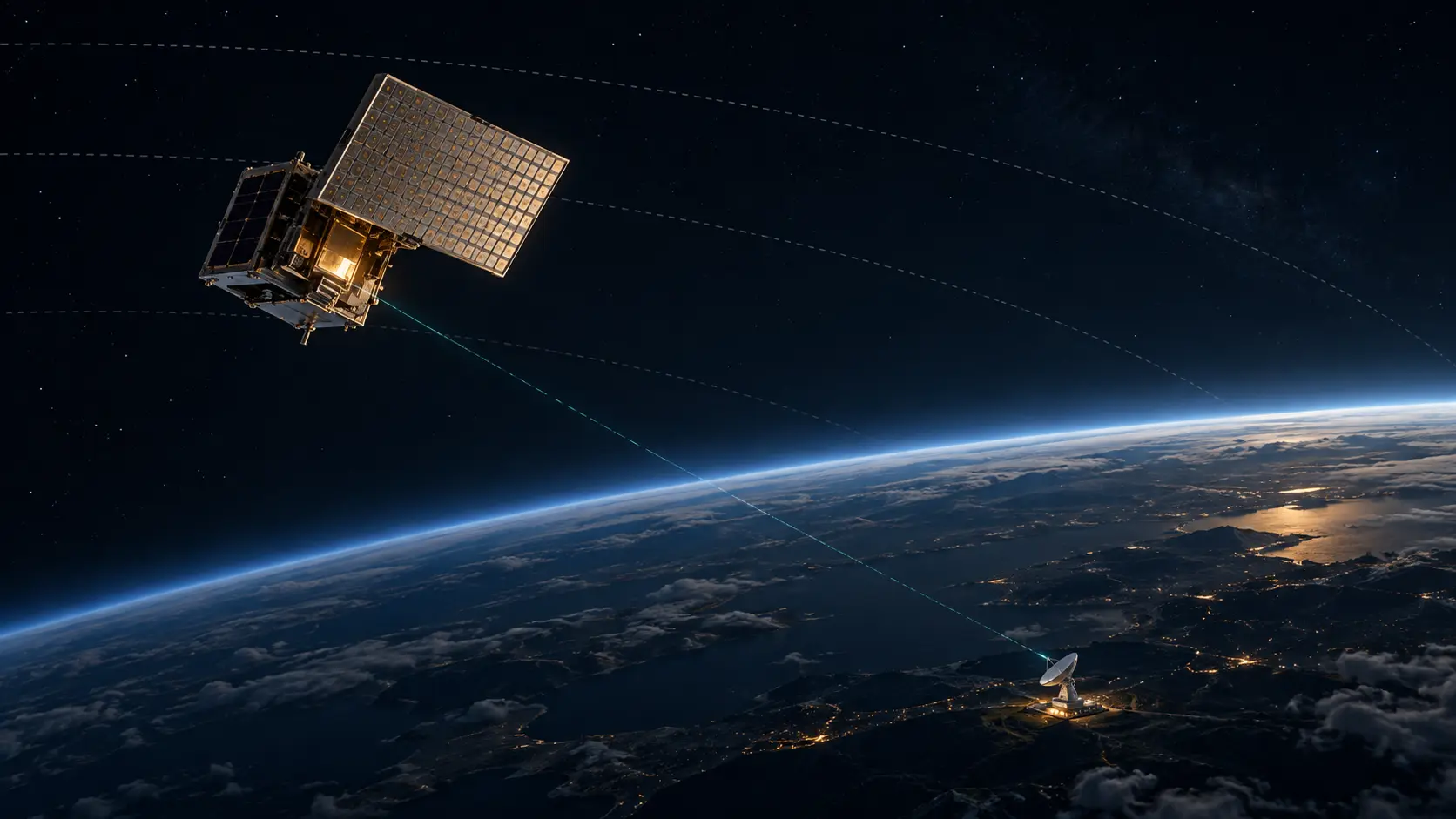
FCL carries an electronically reconfigurable reflectarray antenna. Meridian describes the design as a way to steer a beam while reducing satellite mass and power. The company says the mission is designed for downlink speeds of up to 1.1 Gbps. “Designed for” and “up to” describe a design ceiling, not a result from this spacecraft. The public materials reviewed do not provide a link budget, test configuration, received-signal record, achieved throughput, availability figure or independently reviewed measurement. Until such evidence appears, 1.1 Gbps belongs in the requirements column, not the performance column.
There is a useful comparison in NASA’s earlier ISARA mission, though it is not a like-for-like benchmark. NASA says ISARA transmitted a Ka-band signal from its reflectarray to a JPL ground station, measured antenna gain over an in-orbit demonstration, and found the gain data consistent with pre-flight measurements. That report specifies the observable: a signal at a named receiver and a measured antenna property over a stated mission. It does not tell us how Meridian will perform. It shows what turns a technology claim into a test result: define the path, name the receiver, identify the metric and report the measurement. NASA’s ISARA record offers a standard of evidence, not a comparison of hardware generations.
The commercial narrative is larger than one satellite. NanoAvionics says FCL rides on its MP42 bus and forms part of a EUR 122.5 million contract for 280 satellites. Its release discusses constellation-optimized production and a factory capable of hundreds of custom satellites per year. Meridian’s technology page presents a future architecture around fixed-track orbits, compact spacecraft and a 250-satellite global-coverage concept. These statements describe contracts, design plans and a production proposition. They do not establish that 280 spacecraft have been manufactured, that a 250-satellite system has been deployed, or that one launch can currently provide global capacity. Meridian’s technology description remains company-authored design material.
The word “customer” in First Customer Link can also blur the boundary between proving a component and serving a customer. In this mission, customer link is the name and purpose of the technology demonstrator. The releases reviewed identify no customer traffic, service-level commitment, production acceptance test or operator console that gives a customer independent control. The proposed model—governments or companies owning and operating dedicated satellite networks instead of leasing capacity—would shift more than financing.
It would require a customer to control, observe and recover the system: spacecraft, payload, ground segment, spectrum coordination, gateways, software updates and failure response. None of those capabilities follows automatically from a powered-on payload.
The right reading is neither dismissal nor victory lap. Meridian has crossed a real threshold: a company-developed reflectarray payload reached orbit, powered on and answered through the spacecraft. The next evidence should be concrete and staged: a payload-originated signal received at a disclosed ground station; measured gain or throughput against a test configuration; repeated passes and operating modes; then an end-to-end demonstration that traces a customer device or terminal, satellite, gateway and destination. Beyond that come fleet reliability, coverage, capacity, operating responsibility and customer control. Heng Lu Note 65 informs this insistence on observable running systems rather than promised capability; it is an editorial lens, not evidence about Meridian. ITU’s Space Services Department illustrates the wider coordination and assignment processes that also sit around satellite operations, but does not establish Meridian’s filings or authorizations.
One spacecraft can prove that a particular engineering chain has begun to work. It cannot, by itself, prove a network. The commercial claim will become stronger when Meridian reports the next link as a measured result and keeps the later steps—repeatability, fleet deployment, service and control—visible as separate milestones.
Member Briefing
Deeper Profile Context
Sign in with the right membership level to unlock the full briefing and source notes.
Only for Strategic Circle
Strategic Circle
Open to all readers. Unlock profile briefings after joining and signing in.
Join Strategic CircleOnly for Leadership Alliance
Leadership Alliance
For qualified IP-asset owners and management; sign in to unlock alliance briefings.
Join Leadership Alliance