
Summary
- MENOG's 2016 strategy moved venues, promotion, registration and some language delivery closer to individual countries, while documented responsibility for instructors, core materials and accreditation remained with MENOG, the RIPE NCC or specialist partners.
- Local demand influenced delivery—the Turkish-and-Farsi trainer campaign moved from Istanbul to Tehran, and some trainees became co-trainers—but the public record does not establish ordinary admissions rules, country-controlled curricula, general reuse rights or programme-wide outcome measurement.
- The strongest alternative explanation is also the most practical: MENOG brought a centrally coordinated training service closer to engineers. Common curricula and accreditation were designed to support consistency and help scarce expertise travel; that does not by itself amount to local control over technical choice.
The meeting that disappeared
On 20 May 2016, MENOG's Programme Committee chair, Khalid Samara, announced a subtraction. From MENOG 17, the Middle East Network Operators Group and Peering Forum would move from two meetings a year to one. The released time and resources, he wrote, would support more roadshows and longer national engagements. The announcement presented this as the outcome of Programme Committee discussions, informed by feedback and by the growing number of country-level operator groups. It was not evidence of a community-wide vote or electoral mandate.
The arithmetic looked straightforward: one fewer regional gathering, more encounters nearer to where engineers worked. Yet it was also an allocation of decision rights. A conference convenes people around a programme at a regional destination. A roadshow reverses the motion: instructors, materials and equipment travel towards a country. That reversal can redistribute cost, attention and opportunity without necessarily redistributing authority. The classroom is local. The decisions that define the classroom may not be.
That distinction is the hinge of MENOG's roadshow experiment. Its public record shows genuine adaptation: venues in many cities, tracks for different technical constituencies, recruitment in Turkish and Farsi, local co-trainers and a venue change after strong Iranian demand for one trainer workshop. It also shows a coordinated core: MENOG arranging experts, the RIPE NCC supporting instructors and materials, experienced trainers judging accreditation, and technical partners leading particular tracks. What it does not show is just as consequential.
There is no public ordinary-roadshow admissions rule, no standing host-scoring rubric, no sequence of versioned national curricula, no verified general licence for modifying and redistributing the materials, no complete cost ledger and no programme-wide account connecting alumni to later network deployment.
The result resists the easy verdicts. It would be wrong to describe the roadshows as a central curriculum simply photocopied into smaller rooms. Language, place and local instructor capacity mattered. It would be equally wrong to treat proximity as proof that technical choice had been devolved. MENOG decentralised delivery more clearly than it decentralised control. The public record is strongest on who prepared the room and weakest on who could rewrite the lesson.
Before the substitution
The origin story itself warns against tidy institutional narratives. A RIPE NCC account says the roadshows grew from IPv6 workshops held alongside MENOG meetings beginning with the first meeting in 2008. That is useful background, but it is an institutional account and not a launch certificate. On the starting year of the roadshow programme, the sources disagree. The same RIPE NCC document, RIPE-557, says it launched in 2010. MENOG's later overview and the 2016 announcement say 2011. The discrepancy remains unresolved.
There is, however, a visible 2011 sequence. MENOG's public IPv6 inventory lists six roadshows between January and October in Damascus, Amman, Ramallah, Al-Khobar, Dubai and Jeddah. The list records presence, not institutional completeness. It does not supply hosts, rosters, admissions rules or outcomes for those six entries. It tells us that classrooms occurred in several places; it does not tell us how each room was constituted or what changed afterwards.
By July 2012, RIPE-557 reported 11 roadshows in eight countries. It described participation for public-sector attendees as free and local trainers as part of a scaling strategy. This was an institutional self-report, not an independent audit, and it carried the disputed 2010 launch year. Still, it reveals the operating ambition. Roadshows were meant to make scarce training repeatable without depending forever on travelling instructors. The programme would spread not only content but also the capacity to teach it.
A local account from Beirut gives the numbers human scale. Berytech reported that, from 21 to 25 May 2012, it hosted a five-day event with APNIC and the RIPE NCC. Around 25 engineers from local internet service providers, universities and ministries received training. The stated purpose was to form a core team for a Lebanese IPv6 taskforce. The host named instructors and institutions and described a concrete national objective. It did not publish a participant roster, a completion test or a later deployment evaluation. The workshop could be both useful and insufficiently measured; those are not contradictory statements.
The archive then shows an expanding menu. In April and May 2015, the inventory records a train-the-trainer cohort in Dubai drawing participants from four countries, followed by an Amman event targeted at Yemen and an enterprise-oriented event in Saudi Arabia. These entries demonstrate programme differentiation and an attempt to seed new instructors. They do not establish that every listed event finished as planned, who gained admission, or what its participants later did. That evidentiary gap matters because the roadshow's promise rested on what would survive after the visitors left.
A room built by the host
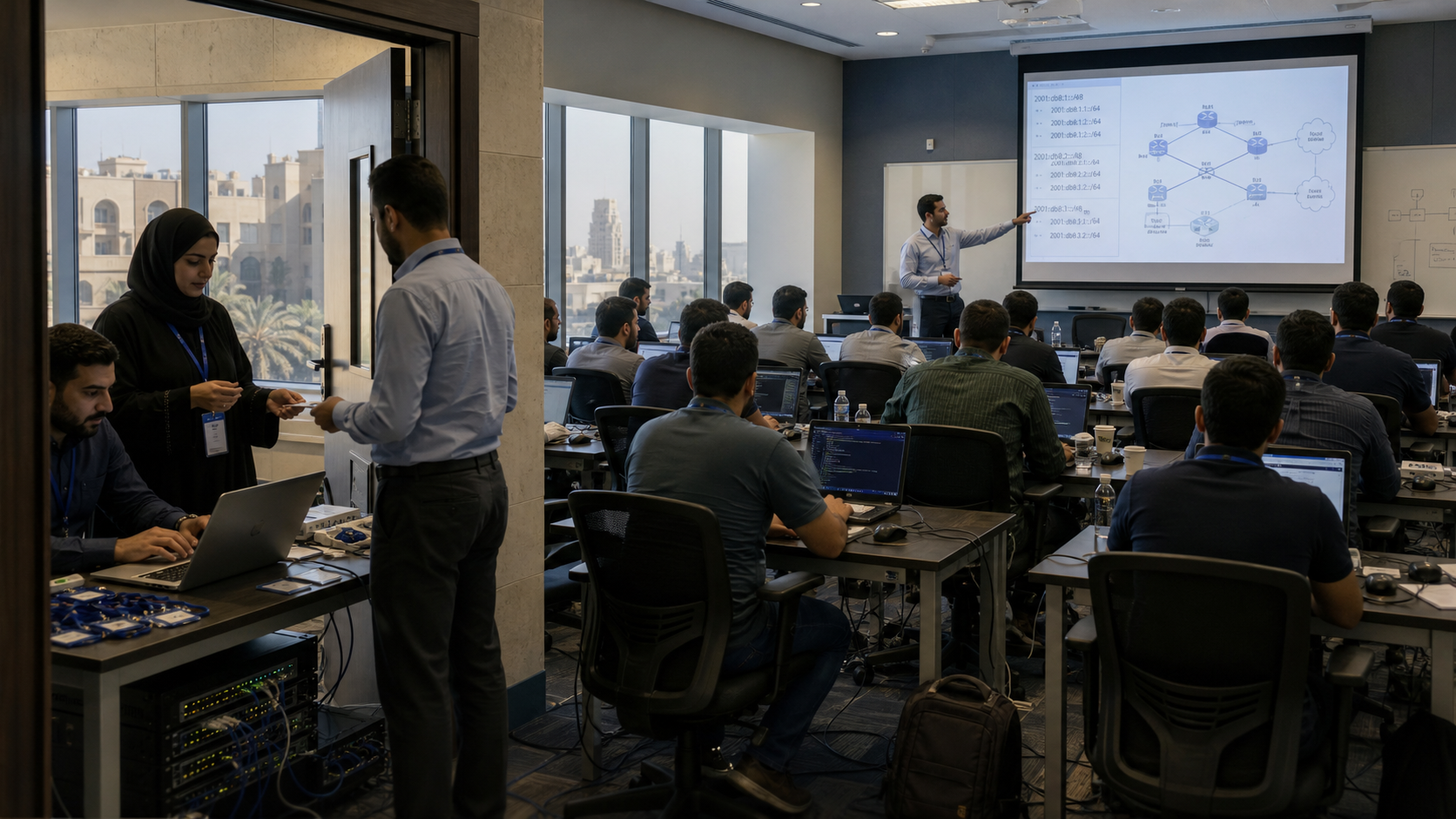
MENOG's host specification makes local responsibility tangible. A prospective organisation—usually described as a government body, regulator or internet service provider—could express interest through a RIPE-domain roadshow address. If a roadshow went ahead, the host supplied the venue, internet connectivity, catering and local facilities. It promoted the event in the local technical community and handled attendee registration. The specification expected a small room, typically 20 to 25 people, for three or five days.
These are not ceremonial tasks. A failed link can ruin a networking lab. A poorly chosen room can make hands-on instruction impossible. Local promotion affects which communities hear that a course exists, and registration is the administrative gateway into the room. Catering and facilities affect whether participants can remain through an intensive day. In a region where travelling to the annual meeting may require flights, accommodation, visas and permission from an employer, moving the venue can redistribute access even when the syllabus stays fixed.
The arrangement also divided costs. Local organisations bore venue, connectivity, catering and in-kind event support. The early IPv6 specification assigned workshop materials, an instructor and the instructor's travel and accommodation to MENOG and the RIPE NCC. For the 2017 trainer cohort, the RIPE NCC offered airfare and accommodation to selected participants. RIPE-557 said early public-sector participants attended free. These arrangements could make participation possible for people whose employers would never fund a regional conference trip.
But the word “registration” can conceal more than it reveals. The published specifications do not say whether ordinary seats were first-come, allocated by a host, distributed by invitation or balanced across operators and public institutions. They do not identify who made the final admissions decision, how rejections were communicated, or whether a conflict could be appealed. Nor does the public invitation to host a roadshow disclose a standing scoring rubric, final decision authority, cancellation rules or a dispute process. Governments, regulators and large providers may have been the actors most able to supply the required infrastructure.
That practical capacity also gave them influence over the gateway through which a local technical community entered the programme.
The absence of a published rule is not proof that decisions were arbitrary. It means the record cannot support a stronger claim. Local promotion and registration are verified responsibilities. Transparent, representative selection is not. This is the first place where local delivery and local accountability part company.
The complaint from outside the room
On 13 June 2016, less than a month after the one-meeting announcement, a participant wrote to the public Persian LIR mailing list about a training course. The writer said it had not been publicly announced and that all 45 participants came from a small number of local internet registries. The message asked for train-the-trainer access in Farsi. It was an attributable complaint, not a statistical portrait of MENOG's roadshows. The event was not even conclusively established as a MENOG roadshow. It cannot bear the weight of a programme-wide indictment.
It nevertheless exposes the political edge of logistics. A roadshow is praised for reaching a country, but a country is not a single technical public. It contains incumbent operators, smaller providers, universities, ministries, regulators, independent engineers and people whose employers do not sit near the organising network. Bringing a course across the border does not answer who hears about it, which organisations receive seats or whether a local gatekeeper regards the wider engineering community as its constituency.
The subsequent trainer-campaign thread adds a debate over money. A participant argued that flying trainees abroad was a poorer use of funds than bringing trainers to Iran. Hisham Ibrahim, then the RIPE NCC's regional lead, replied that preparation and staffing limited the programme to one workshop meeting the required standard. His response was not a full budget; it was a capacity argument. A rigorous trainer workshop required materials, evaluators and enough experienced people to observe candidates. Duplicating it was not as simple as buying a different set of tickets.
No complete per-event budget resolves the dispute. The public record lacks in-kind valuations, participant wage and time costs, sponsor contributions and any systematic record of reimbursements to hosts. Travel can move from participants to instructors without disappearing. A “free” seat may still cost an engineer days away from work. A venue contributed by a host remains a real local subsidy even when it is absent from programme expenditure. Cost decentralisation, like curriculum decentralisation, depends on what is counted.
The ladder to accreditation
The trainer route was more explicit than ordinary admissions. The archived Turkish-and-Farsi call asked for networking experience and language ability, then used an application that included a quiz and a CV. The workshop was the first stage, not an automatic credential. Candidates would proceed to co-training and receive feedback from experienced instructors before MENOG accreditation. In one public account, 15 participants at the 2015 Dubai trainer workshop produced two accreditations, while 15 attendees at a Moscow cohort had produced none at the time of the discussion.
Those figures were reported by the RIPE NCC regional lead rather than independently audited; they present the credential as selective but do not supply a complete cohort audit.
In June 2016, the RIPE NCC reported 36 roadshows across ten countries and roughly 1,000 participants. It said three train-the-trainer participants had co-trained at six IPv6 roadshows. These were institutional counts, not participant-level longitudinal data. Even so, they document reported movement up the ladder: from trainee, to observed co-trainer, towards accreditation.
A 2017 retrospective supplies one vivid continuity case. A participant from the 2015 cohort became accredited, later led a workshop and, according to the RIPE NCC regional lead, co-trained around ten roadshows. The same retrospective described a Lebanon peering discussion continuing at MENOG 17. These are examples of return and institutional memory, not a denominator. Without a programme-wide roster, we cannot calculate how often trainees became instructors, how many later taught without visiting support, or whether local delivery continued after a particular roadshow.
Still, the accreditation ladder complicates the claim of a merely travelling central curriculum. A local engineer who becomes a recurring instructor changes who carries the knowledge, who can explain it in a familiar language and who remains accessible after the event. Teaching is not a neutral pipe. A trainer knows the operational constraints, vocabulary and professional relationships of a place in a way a visitor may not. Local capacity can expand even if the rule for accrediting it remains centrally structured.
The authority split is therefore mixed. MENOG said it coordinated experts from the global technical community. The early host specification assigned an instructor and travel support to MENOG and the RIPE NCC. Experienced instructors evaluated candidates before MENOG accreditation. Local people could ascend, but the public process did not give the host authority to choose instructors or issue its own equivalent credential. The programme localised personnel through a common ladder; it did not document a transfer of the ladder itself.
Istanbul, Tehran and what responsiveness looks like
The strongest evidence of country demand changing an organising decision comes from the Turkish-and-Farsi trainer campaign. The call targeted speakers of both languages. Applicants had to show relevant qualifications, complete a quiz and submit a CV. It was initially planned for Istanbul. After organisers received many applications from Iran, the venue moved to Tehran for the March 2017 workshop.
That move mattered. It addressed the same access problem raised in the earlier Persian-list exchange, although the record does not establish that the complaint caused the move. The changed location reduced the travel burden for many Iranian applicants and made a local-language cohort more feasible. It shows that the programme could respond to observed demand rather than mechanically insist on its first plan.
But the event also shows the boundary of the response. The location moved; the qualification process remained. The languages were targeted; the materials and training method remained coordinated. Selected participants received travel support; they did not gain the documented right to accredit themselves. Local demand influenced where the programme happened and who it sought, while the programme retained its standards for entry and progression.
This is a useful definition of partial decentralisation: an institution changes its delivery in response to local information without surrendering every common rule. That can be good design. The question is not whether any centre survives. It is whether the division is legible, contestable and suited to the work. On location and language, the archive offers evidence of responsiveness. On the ordinary host decision, applicant allocation and appeals, it offers very little.
A menu is not a local kitchen
Curriculum is where the roadshow's local rhetoric meets its most durable central artefact. MENOG published separate IPv6 agendas for internet service providers and enterprises, then public inventories for DNS operations and DNSSEC, and for routing and peering. This was not one undifferentiated lecture dragged from city to city. The menu recognised that an enterprise engineer, a service-provider routing team and a DNS operator face different problems.
The three-day ISP syllabus was nevertheless highly specified. It set prerequisites and described a sequence covering addressing, OSPFv3, BGP, security, transition mechanisms and extensive hands-on labs. In the trainer discussion, the RIPE NCC regional lead said candidates would study the existing ISP and enterprise materials and learn to build the labs. MENOG's overview described roadshows as tailored to local needs. The public record does not show the tailoring at the level needed to test that description: no versioned country syllabus, host change request, translation history, instructor deviation or before-and-after course plan was found.
Different tracks are a broader central menu. They are not, by themselves, evidence that a country host could rewrite the recipe. Language adaptation can transform learning without changing the technical sequence, but no archive of translated or locally modified materials establishes how far that went. The evidence supports responsiveness in track selection, audience and language. It does not establish host control over the technical content.
Partner specialisation makes the picture more complicated. At an ICANN60 working-group discussion in 2017, ICANN's Fahd Batayneh said that ICANN was leading the DNS-related track and using alumni of train-the-trainer efforts in capacity-development workshops. The Internet Society was involved in routing and peering activity. This can look like authority migrating away from the local host towards a federation of specialist institutions. It can also be exactly the point of a partnership: DNSSEC, interdomain routing and IPv6 deployment demand expertise that a venue provider should not have to recreate.
The actor boundaries matter. ICANN's statement establishes its account of leadership on the DNS surface; it does not make ICANN the owner of MENOG or of the IPv6 programme. RIPE NCC support does not make it MENOG's parent or legal person. No separately incorporated MENOG legal person was verified, and the RIPE NCC must not be used as a substitute. “MENOG” in the roadshow record names a programme, committee and convening identity whose operating tasks were distributed among identifiable bodies. Treating all of them as one central actor would obscure rather than reveal the allocation of power.
The case for a coordinated core
The strongest argument for a common curriculum is technical, not institutional. An IPv6 lab is not a general-awareness seminar. Address plans, routing policy, transition mechanisms and security configuration can fail in specific and expensive ways. A flawed exercise may teach a habit that later reaches production. A trainer who can complete a quiz is not necessarily able to diagnose twenty participants' broken lab states, explain why a route behaves unexpectedly or distinguish a classroom shortcut from an operational practice. Common materials give instructors a known technical baseline.
Observed co-training gives evaluators a chance to see how a candidate handles uncertainty. Accreditation can protect participants and local trainers by making the credential mean something.
The 2015 MENOG 15 minutes capture this conflict unusually well. A participant asked whether training materials would be available under Creative Commons. The recorded discussion included support for reuse and a RIPE NCC concern about certification and quality control. The minutes do not record a final licensing decision. They should not be turned into proof that the materials were either closed or openly licensed. But the exchange names a real trade-off. Portability makes it easier for local instructors to translate, adapt and teach after the programme leaves. Quality control tries to prevent altered material or unprepared instruction from circulating under an accredited name.
The practical case for coordination extends beyond accuracy. A reusable ISP course reduces the cost of creating every workshop from zero. Common labs make equipment and instructor preparation predictable. Specialist partners can maintain modules in domains where standards and attacks change. A recognised accreditation path lets a host recruit someone whose preparation has been observed, rather than relying on reputation alone. In a region spanning several languages, regulatory systems and levels of network maturity, a stable technical core can make repeated delivery feasible.
The same structure can serve access. If every country had to finance its own full curriculum, lab environment, instructor-development system and quality process, the best-resourced regulators and operators would have an advantage. The RIPE NCC's funding of instructor travel and selected trainees, combined with local facilities, pooled important costs across events. MENOG's reported 36 roadshows in ten countries by mid-2016 is consistent with the value of that shared structure, although an institutional count cannot prove that isolated national programmes would have failed.
Nor is accreditation incompatible with localisation. The evidence of local co-trainers shows a mechanism by which a common standard can travel into local hands. The Tehran move shows that a coordinated programme can listen. Separate ISP, enterprise, DNS and peering tracks show that consistency need not mean one course for everyone. Berytech's taskforce purpose shows that a standard workshop can sit inside a local institutional plan.
This alternative explanation deserves full weight: MENOG may have been solving a delivery problem through closer venues and a centrally coordinated curriculum, not promising to devolve control of the curriculum itself. Under that reading, local hosts contributed knowledge of place, relationships, facilities and potential participants, while MENOG, the RIPE NCC and topic partners conserved scarce technical and teaching capacity. The arrangement can widen access without converting the local host into a curriculum authority.
That division of labour also avoids romanticising the local level. A curriculum controlled by a single host could reflect an incumbent operator's preferences, a regulator's caution or a sponsor's priorities. Local selection can be opaque. Locally produced material can be excellent, but it can also become an unmaintained fork. These are risks rather than findings about any MENOG host. They explain why retaining common standards is not automatically institutional overreach.
The evidence therefore supports a more exact criticism. The problem is not that MENOG kept a common core. It is that the public record makes the boundaries of that core hard to inspect. We do not know the material owner, exact licence, right to modify, right to translate or right to continue independent use. A downloadable lab configuration is not the same thing as permission to adapt and redistribute it. We do not know whether a host could request a module change or how the programme would adjudicate a disagreement. Quality control is a persuasive reason to set standards. It is not a reason to leave reuse and adaptation rights indeterminate.
A quality regime can publish its perimeter without weakening the standard. It can say which technical outcomes are non-negotiable and which examples a local instructor may replace; which translated materials remain compatible with accreditation and which changes require review; whether a host can request a country-specific lab and who answers; and whether alumni may continue teaching from the same materials after their formal co-training period. Such clarity would not hand a routing lab to a popularity contest. It would let local engineers know where judgment is invited and where consistency is required.
It would also protect the coordinating bodies from being held responsible for every local variation merely because nobody can see where authorised adaptation ends.
That distinction affects the standing of local trainers. Accreditation can certify that an instructor has crossed a common threshold, but durable capacity requires some room for professional judgment after the threshold is crossed. If every deviation depends on a visiting evaluator, local succession remains operationally fragile. If every accredited trainer may silently fork the material, the credential loses coherence. The public record documents the ascent to accreditation more clearly than it documents the discretion available afterwards.
The promise of “train the trainer” should eventually be tested not only by the number of approvals, but by what approved people are trusted to decide.
What remained when the visitors left
The roadshow theory depends on continuity. A three-day or five-day course is an event. The institutional claim is that it leaves capacity behind: engineers who can deploy, instructors who can teach, taskforces that can coordinate and local operator groups that can keep convening.
There are encouraging traces. The Berytech workshop brought engineers from service providers, universities and ministries into the proposed core of a Lebanese IPv6 taskforce. Three trainer participants were reported to have co-trained at six events by June 2016. One 2015 trainee reportedly became accredited and co-trained around ten roadshows. ICANN said it used trainer alumni in its regional workshops. A Lebanon peering conversation was said to have continued at MENOG 17.
These traces establish possibility and, in specific cases, continuity. They do not establish the programme-wide conversion rate. No public alumni ledger follows each trainee into later instruction. No inventory records later local courses, curriculum forks or deployment decisions linked to participants. No independent impact evaluation compares roadshow countries, organisations or cohorts with a credible baseline. The record cannot tell us whether the recurrent trainer was typical, exceptional or somewhere in between.
This is not a demand that a training programme prove it caused national internet development. That would be an unreasonable standard. It is a demand to distinguish what different measures mean. A course date measures delivery. Attendance records presence. A certificate records completion under an accreditation process. None measures learning on its own. An IPv6 prefix announcement shows routing capability, not end-user use. End-user adoption shows that people can reach services over IPv6, not which workshop caused an operator to invest.
The distinction is especially important because the roadshow strategy was justified partly in terms of national engagement. If success is counted only as events, the institution is measuring its own activity. If success is counted only as national deployment years later, it is borrowing the achievements of regulators, operators and engineers whose causal connection to the course has not been shown. A credible middle layer would track voluntary follow-up: whether alumni taught again, whether organisations approved implementation plans, whether a lab configuration entered a pilot and what obstacles stopped it.
The public record examined here does not provide that programme-wide layer.
Saudi Arabia and the refusal of a simple success story
Saudi Arabia offers the most useful counterexample because its later IPv6 progress is real and its causal story is crowded. MENOG's early inventory lists Al-Khobar and Jeddah in 2011, and later entries include Saudi events. It would be tempting to draw a line from training to adoption. The operational evidence does not permit it.
An APNIC-published synthesis, adapted from Internet Society Pulse and drawing partly on regulator interviews, reported that by 2018 Saudi Arabia still lagged the global average despite earlier efforts. Progress accelerated after a national taskforce was refocused and reporting became more systematic. The account describes regulator coordination, operator participation, fixed and mobile implementation, investment decisions, supported customer devices, business-case approval, key performance indicators and billing-system upgrades. Training and workshops belonged to that environment, but they were not the sole mechanism.
The layers of deployment matter. Routing tables can show that an IPv6 prefix is announced. Traffic measurements can show data moving. Client-side measures can show end users actually connecting. A global peer-reviewed measurement study demonstrates why these surfaces should not be collapsed. A country can possess routed IPv6 space while customers remain on IPv4. An operator can train engineers without approving capital expenditure. A regulator can set targets while billing software or unsupported devices delay activation. Each layer has different evidence and different decision-makers.
Saudi progress therefore supplies neither acquittal nor indictment of the roadshows. It provides a multi-causal limit. A workshop may give an engineer the competence or confidence to advocate for a pilot. The pilot still needs organisational authority, equipment, a business case, customer-device support, internal systems and sustained measurement. Without a chain linking a roadshow participant to those decisions and then to observable traffic, the roadshow's marginal contribution is unidentified.
The same caution applies to DNSSEC, peering and internet exchange points. MENOG's DNS inventory lists Istanbul, Muscat and Riyadh events in 2016 and 2017. Its routing and peering inventory lists a Beirut community-building event and an Amman IXP workshop in 2017 and 2018. These dates measure delivery. They do not demonstrate that an exchange was built, a peering policy changed or a DNSSEC deployment entered production because of the workshop. ICANN and the Internet Society had specialist roles; local operators and institutions held the operational decisions.
This caution matters because causal credit is also a claim about authority. If MENOG is credited for country adoption because it convened training, the labour and investment of operators disappear into the programme brand. If a regulator's KPI is treated as the decisive cause, instructor development and peer learning disappear. Multi-causal explanation returns agency to the actors who controlled different parts of deployment.
The archive ends before the question does
The public record grows thin just as a long-term evaluation would become possible. The IPv6 inventory's listed events stop in 2017. The DNS page also stops in 2017. The routing and peering page contains two entries through 2018. As of 20 July 2026, the IPv6 page says only that upcoming roadshows are “To be announced.”
That is a reproducible measure of the archive, not proof that the programme ceased. Later training might have been unlisted, rebranded, delivered through other partner programmes, moved online, or simply left off pages last modified years earlier. The archive could be incomplete. The pandemic and changes in programme form are plausible explanations for a broken series, but the examined sources do not establish any one of them.
The safe conclusion is narrower: activity after the public 2017–2018 inventories is unknown. So are the long-run programme budget, alumni continuation rate and deployment impact. The 2016 announcement established a substitution—one annual meeting in place of two, with more roadshows and national weeks. It did not establish that this exact cadence continued through 2026.
Archival silence also changes accountability. When a programme distributes work among a committee, a secretariat, hosts and topic partners, a public inventory is one of the few places an outsider can see the whole. Sparse pages make it difficult to compare promises with delivery, distinguish recurring from one-off activity, or ask which countries and constituencies were repeatedly served. The remedy is not to infer failure from a blank page. It is to recognise the blank as a limit on what the institution can credibly claim.
Access is not authority
MENOG's 2016 bet was practical. One regional meeting could preserve the shared forum while roadshows and national weeks reached people who could not travel. The evidence shows that this was more than rhetoric. Hosts supplied the physical and social infrastructure of local events. Countries and languages shaped where at least some training occurred. Track differentiation served distinct technical needs. A trainer pathway produced local co-instructors and at least one durable return case. Specialist partners contributed expertise that a country host should not be expected to manufacture.
These achievements are forms of decentralisation. They concern distance, cost, language, participation opportunity and the location of teaching capacity. They deserve to be named without being inflated.
The documented technical decision rights were distributed differently. MENOG coordinated experts. MENOG and the RIPE NCC supported the IPv6 instructor and materials in the early specification. Experienced trainers mediated accreditation. ICANN said it led the DNS track. The local host provided the room, network, catering, promotion and registration. What the host could not be shown to control were the instructors, the accreditation standard, the core syllabus, the legal terms for adapting the materials, or the programme's measurement of later outcomes.
Nor can the host's role in registration be translated into a claim of representative admissions. The Persian-list testimony demonstrates why the distinction matters, even though it cannot be generalised. Local trainer succession does not establish that local trainers owned the curriculum, and national deployment cannot be converted into roadshow impact. Each claim would cross from a supported observation into an unverified institutional story.
The strongest case for MENOG is not that it decentralised everything. It is that it built a division of labour capable of moving scarce technical knowledge across a region: common materials and accreditation for reliability; partner-led specialisms for depth; host-provided facilities and promotion for local reach; co-training for continuity. That is a defensible arrangement. It may be more equitable than requiring every local community to reinvent a lab and quality system with unequal resources.
Its weakness is not central coordination by itself. Its weakness is the uncertain public boundary around local choice. A more accountable roadshow design would make the allocation explicit: how hosts are chosen, how seats are distributed, which curriculum elements are fixed, which can be translated or modified, who owns the result, what accreditation protects, how disputes are handled and which follow-up measures are proportionate. Those disclosures would not abolish the common core. They would make it inspectable.
So, did the roadshows decentralise technical choice, or reproduce a centrally prepared curriculum at smaller venues? They did neither in pure form. They moved the classroom, a share of the costs, local promotion, registration, some language delivery and some instruction closer to countries. They retained a coordinated curriculum architecture, expert network and credential pathway. Local demand could alter venue and language; the public record does not show that hosts could rewrite the technical core or freely carry it forward under clear reuse rights.
The 2016 decision replaced a second annual meeting with a promise of more local opportunity. What moved was access. What partly moved was teaching capacity. What mostly stayed coordinated was the definition and certification of the lesson. And what the archive cannot show—ordinary selection rules, curriculum changes, ownership, budgets, long-run continuity and attributable deployment—is precisely what would be needed to call local delivery local control.
Sources
- MENOG once-a-year announcement
- MENOG roadshow overview
- MENOG host specification
- MENOG IPv6 roadshow inventory
- MENOG 15 minutes
- RIPE NCC Middle East activity update
- Berytech host report
- RIPE-557
- ICANN60 Middle East Strategy Working Group transcript
- Saudi Arabia IPv6 adoption synthesis
- Independent IPv6 measurement study
Publication source register
- http://www.menog.org/ipv6-roadshow/ttt/
- https://archive.icann.org/meetings/icann60/schd.ws/hosted_files/icann60abudhabi2017/11/I60_AUH_Thu02Nov2017-Middle%20East%20Strategy%20WG-en.pdf
- https://berytech.org/berytech-hosts-menog-ipv6-roadshow/
- https://blog.apnic.net/2021/06/15/understanding-saudi-arabias-ipv6-boom/
- https://faculty.cc.gatech.edu/~mbailey/publications/sigcomm14_ipv6.pdf
- https://labs.ripe.net/author/hisham_ibrahim/ten-years-of-menog-what-have-we-learned/
- https://labs.ripe.net/author/hisham_ibrahim/update-ripe-ncc-activity-in-the-middle-east/
- https://lists-ext-2.ripe.net/archives/list/persian-lir%40ripe.net/thread/X6S7JQYAFUQJ7S7RVQXSIWSD7VTOHNG4/
- https://www.menog.org/dns-roadshows/
- https://www.menog.org/host-a-roadshow/
- https://www.menog.org/ipv6-roadshow/
- https://www.menog.org/ipv6-roadshow/host-an-ipv6-roadshow/
- https://www.menog.org/ipv6-roadshow/ipv6-workshop-for-isps-3-days/
- https://www.menog.org/meetings/menog-15/minutes/
- https://www.menog.org/news/menog-once-a-year-announcement/
- https://www.menog.org/roadshows/
- https://www.menog.org/routing-peering-roadshows/
- https://www.ripe.net/documents/2795/ripe-662.pdf
- https://www.ripe.net/publications/docs/ripe-557/
- https://www.ripe.net/ripe/mail/archives/persian-lir/2016-June/000080.html