Summary
The first call can go well. A person answers, confirms the account and listens to the symptoms. The provider may test the router, line and local configuration before deciding that the fault belongs on the wholesale network. None of that work is trivial. It is also not yet the same event as an Openreach repair target beginning.
Openreach says that its service maintenance levels are measured from the point at which a communications provider reports a fault to it. Its published explanations distinguish level 1, targeted for the end of the second working day after reporting, from level 2, targeted for the end of the next working day under the stated calendars. The end customer must ask the retail provider which level applies.
The first clock starts with the customer
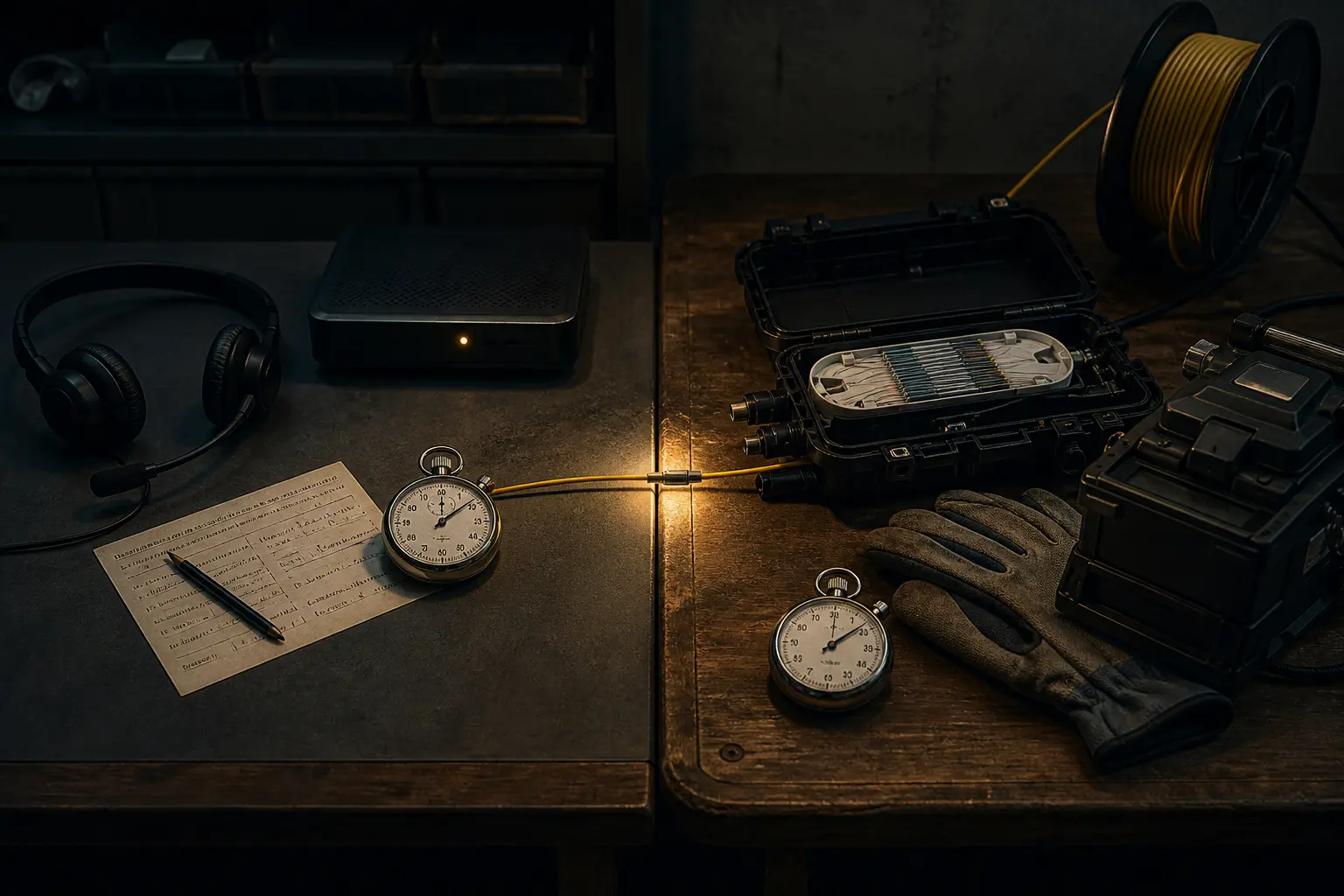
That creates a handoff with operational consequences. The customer’s clock begins when service is lost or when the provider is contacted. The wholesale clock begins later, after diagnosis and acceptance. A retail dashboard can therefore show an excellent answer time while a customer still waits for the event that starts the physical repair target.
This does not make retail support theatrical. Openreach does not sell the service to the household and tells end customers that appointments, rebooking and contact details are handled by their provider. A capable local team can remove bad premises equipment from the case, submit a clean fault report, protect an appointment and keep one person accountable. Those are valuable forms of control even when the engineer queue belongs upstream.
The distinction matters because a provider should not describe authority it does not possess. It can own the diagnosis, the quality of the wholesale submission, customer communication and any compensation it owes. It cannot honestly imply that answering the telephone gives it direct command of every Openreach engineer, civil-work dependency or difficult repair.
Primary sources
- Openreach, Our performance FAQs — https://www.openreach.com/about/our-company/our-performance-faqs
- Openreach, What will happen during my Openreach repair visit? — https://www.openreach.com/help-and-support/what-will-happen-during-my-repair-visit
- Ofcom, Automatic compensation: what you need to know — https://www.ofcom.org.uk/phones-and-broadband/service-quality/automatic-compensation-need-know
- Ofcom, 2022/23 Openreach quality of service performance — https://www.ofcom.org.uk/phones-and-broadband/telecoms-infrastructure/2022-23-openreach-quality-of-service-performance
- Office of the Telecommunications Adjudicator, Key Performance Indicators — https://www.offta.org.uk/kpis
Member Briefing
Deeper Profile Context
Sign in with the right membership level to unlock the full briefing and source notes.
Only for Strategic Circle
Strategic Circle
Open to all readers. Unlock profile briefings after joining and signing in.
Join Strategic CircleOnly for Leadership Alliance
Leadership Alliance
For qualified IP-asset owners and management; sign in to unlock alliance briefings.
Join Leadership Alliance