
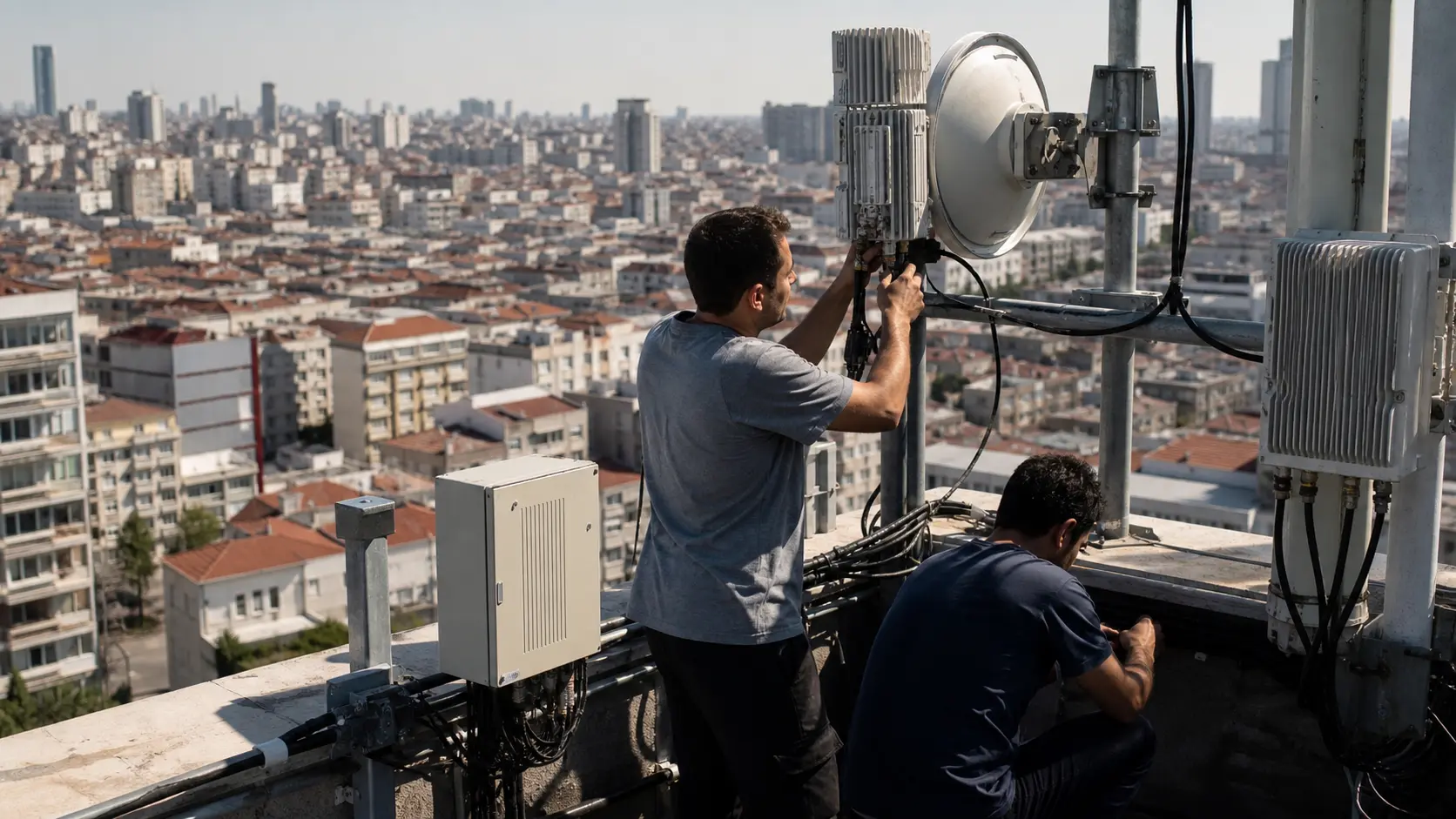
Summary
- Linyit Net looks economically less like a national broadband platform and more like a local access operator balancing three business lines: wireless and GPON service in its own coverage pockets, resale or delivery over incumbent telecommunications infrastructure, and higher-priced corporate metro or point-to-point circuits. That mix gives it several pricing levers, but it also exposes the company to imported equipment, wholesale access, power, support labour and churn pressure at the same time.
- The pricing evidence is unusually concrete. Public tariff pages show GPON residential offers at TRY 500 to TRY 700 per month for advertised downstream speeds of 100 Mbps to 1,000 Mbps, Telekom-infrastructure VDSL/fiber offers at TRY 700 to TRY 800 for 16 Mbps to 100 Mbps, wireless offers clustered around TRY 460 to TRY 600 for lower speeds, and corporate metro offers from TRY 3,500 to TRY 30,000 per month before taxes for symmetric 10 Mbps to 100 Mbps circuits. The implied unit price gap is the operating story: local consumer access depends on density and low support cost, while business access must absorb installation, service commitment and scarce engineering time.
- Public routing evidence identifies AS212285, one announced IPv4 /24, no observed IPv6 allocation in one commercial dataset, RIPE LIR membership and a small estimated measured user population. Those signals are enough to treat Linyit Net as a real autonomous network, but not enough to infer audited subscribers, revenue, EBITDA, churn or capital intensity.
- The core judgment is conditional. If Linyit Net can raise prices regularly, concentrate GPON and fixed-wireless investment in dense or defensible neighbourhoods, keep wholesale-input risk from overwhelming resale tariffs, and reserve field labour for customers with durable margin, it can remain a rational regional ISP. If it locks customers into slow repricing while the lira cost of routers, radios, optics, upstream capacity and electricity continues to move faster than local willingness to pay, the apparent affordability of its tariffs becomes a margin trap.
Start with a single access contract and one replacement router. A customer in Soma, Bergama or Dikili asks for service. If the address sits in a Linyit Net GPON pocket, the company can quote a fiber tariff: 100 Mbps for TRY 500, 500 Mbps for TRY 600, or 1,000 Mbps for TRY 700 per month, with modem and installation charged separately. If the address is better reached over a rooftop wireless installation, the price card moves down in speed and only partly down in monthly price: 10 Mbps at TRY 460, 12 Mbps at TRY 480, 16 Mbps at TRY 500 after an introductory offer, or a 16 Mbps rural version at TRY 600.
If the address relies on the incumbent telecommunications network, Linyit Net advertises Telekom-infrastructure offers from 16 Mbps at TRY 700 to 100 Mbps at TRY 800. The customer sees a monthly access price. The operator sees a risk stack.
The replacement router makes that risk stack visible. Customer-premises equipment, outdoor wireless gear, fiber optics, switches, spares and many power or enclosure components are either imported directly or priced through local distributors who watch dollars and euros. A residential tariff is collected in lira. Staff wages, rent, local transport, tower visits and customer support are mostly lira-denominated, but they reprice through inflation and labour-market expectations.
Wholesale access, IP transit and upstream connectivity sit between those worlds: some contracts are lira invoices connected to regulated or negotiated Turkish terms, while some capacity, hardware and software dependencies embed foreign-currency economics. When the lira falls or inflation stays high, a router that looked like a tolerable one-time subsidy can absorb several months of margin.
That is why the economic question is not whether Linyit Net can sell broadband. The public materials show that it can: it has operated since 2014, says it was authorized as an ISP in October of that year, lists a headquarters in Soma, publishes tariff pages, runs an online transaction app, accepts digital and bank-transfer payments, and appears in internet-number-resource datasets as the holder of AS212285.
The real question is whether the company can reprice access faster than network cost rises without teaching customers to churn to a national carrier, a mobile plan, a neighbour's shared connection, a building-wide alternative or another local wireless ISP.
The first boundary to draw is identity and control. Linyit Net's own corporate page gives the commercial identity as LinyitNet Iletisim Telekomunikasyon Hizmetleri San. ve Tic. Ltd. Sti., with a Soma tax office, MERSIS number 0609 05135 7300010, Soma chamber registration, a named authorized person and an address at Kurtulus Mahallesi, C. Numanoglu Sokak No. 5/A in Soma, Manisa. ETBIS, Turkey's electronic-commerce information system, lists the same site, the same MERSIS number, a limited-company form, a registration date in April 2021 for the e-commerce system, and mobile-app links.
These do not prove current profitability, but they do anchor the operating entity in public registries rather than in a merely promotional website.
The second boundary is network control. Public internet datasets identify AS212285 as Linyit Net Telekomunikasyon Hizmetleri Sanayi ve Ticaret Ltd. Sti. IPinfo lists the AS as a Turkish ISP, allocated in November 2020, with 256 IPv4 addresses and the 91.243.116.0/24 netblock. CIDR Report shows AS212285 originating 256 IPv4 addresses and no downstreams in its report. A RIPE-related dataset identifies Linyit Net as a local internet registry member in Turkey. A third-party WHOIS mirror shows the RIPE aut-num object, the organization object, and routing-policy imports from several upstream ASNs.
Cloudflare Radar and APNIC measurement pages estimate a small user population for the AS, though those estimates are measurements of observed users behind routes, not audited subscriber counts. Taken together, this is the evidence of a modest but genuine access network: Linyit Net has its own AS and address space, but public routing evidence does not show the scale or redundancy one would expect from a national backbone.
That modest scale matters because the unit economics of broadband do not scale linearly. A national operator can spread software systems, wholesale negotiations, NOC staffing, procurement teams, call-centre capacity and spares inventory across millions of accounts. Linyit Net's public footprint points to a much more local model. Its coverage page emphasizes wireless service in Manisa's Soma district and Izmir's Dikili and Bergama districts. Its contact-office page lists Soma, Luleburgaz, Dikili, Karacabey and Bergama locations.
Its service pages speak directly to rooftop wireless, GPON, central-system apartment projects, hotspot deployments, and point-to-point radio links. This is a field-operation company, not just a billing brand.
That can be an advantage. Locality lets a regional ISP know which apartment blocks are easy to serve, which roofs have line-of-sight, which neighbourhoods lack satisfying incumbent service, and which small businesses will pay for a human installer rather than a national call-centre queue. It can also make customer acquisition less expensive than mass advertising. But locality makes each field visit expensive. A truck roll to realign a radio, replace a power supply, diagnose a rooftop cable, inspect a building distribution issue or collect equipment after cancellation consumes scarce technician hours.
In an inflationary economy, support labour is not a free input. Even when wages lag headline inflation, retention, fuel, tools and subcontracted work steadily lift the cash cost of keeping a small network stable.
The most revealing tariff comparison is between Linyit Net's GPON and incumbent-infrastructure offers. On its own GPON page, the company advertises 100 Mbps for TRY 500, 500 Mbps for TRY 600 and 1,000 Mbps for TRY 700. That is a steep speed discount. The price per advertised downstream Mbps falls from TRY 5.00 at the 100 Mbps tier to TRY 1.20 at the 500 Mbps tier and TRY 0.70 at the 1,000 Mbps tier.
Such pricing is common where the operator wants to monetize a fixed access build once the fiber is already present: the incremental cost of offering a higher headline downstream rate may be lower than the marketing value of a faster plan, provided peak-hour capacity and customer-premises equipment keep up.
The Telekom-infrastructure page tells a different story. There, 16 Mbps is TRY 700, 24 Mbps is TRY 730, 35 Mbps is TRY 760, 50 Mbps is TRY 780 and 100 Mbps is TRY 800. The price per advertised downstream Mbps falls as speed rises, but every tier is materially more expensive than Linyit Net's own 100 Mbps GPON price. That gap is exactly what one would expect if the company has less control over the input cost, depends on another network's local loop or access product, and must preserve a margin on top of wholesale or operational charges.
The customer may think "internet is internet"; the operator's cost ledger says otherwise.
Wireless is the third curve. Linyit Net's public wireless page advertises rooftop-device residential service and rural or central-system variants. A 10 Mbps plan is TRY 460, a 12 Mbps plan is TRY 480, a 16 Mbps plan is TRY 500 after an introductory period, a rural 16 Mbps plan is TRY 600, a central-system 24 Mbps plan is TRY 550 after an introductory period, and a 35 Mbps central-system plan is TRY 570 after an introductory period. These prices are not cheap on a per-Mbps basis, but wireless is not sold only by megabit.
It is sold where trenching is impractical, where an incumbent line is poor, where a site can be connected quickly, or where a building-level arrangement creates enough density to justify equipment. The margin test is not downstream speed alone; it is how many customers a radio sector can carry before complaints, contention and support calls destroy the economics.
Corporate metro tariffs sit in a separate economic category. The public corporate page lists symmetric plans with 12-month commitments and prices before taxes: 10 Mbps at TRY 3,500, 20 Mbps at TRY 5,000, 30 Mbps at TRY 12,000, 40 Mbps at TRY 14,000, 50 Mbps at TRY 15,000, and 100 Mbps at TRY 30,000. These are not consumer affordability prices. They are a way to charge for symmetry, service expectation, installation, monitoring, lower oversubscription and the customer's willingness to pay for continuity.
The unit prices show no simple smooth curve because each circuit may reflect route, build complexity, committed support and the competitive alternatives at that address. A 30 Mbps line at TRY 12,000 can be rational if the site is hard to reach or labour-intensive; it can be impossible if a national provider can quote a better path.
That segmentation is the company story. Linyit Net must keep consumer access attractive enough to retain households, keep wireless and GPON concentrated enough that field operations do not become too expensive, and use corporate access to fund the harder parts of the network. The danger is that each segment reprices on a different clock. Month-to-month consumer plans can in theory be adjusted more often, but they are also the most exposed to churn and complaint. Corporate circuits can carry more margin, but 12-month commitments slow repricing unless the contract contains escalation language.
Wholesale-input prices, equipment quotes and power bills do not align themselves to those customer clocks.
Inflation makes that mismatch more than an accounting problem. The Central Bank's consumer-price table, drawing on TurkStat data, showed annual consumer inflation of 32.11 percent in June 2026 after 32.61 percent in May. On July 27, 2026, the official daily exchange-rate table showed the dollar near TRY 47.3 and the euro near TRY 53.9 on buying/selling measures. These point-in-time numbers do not determine Linyit Net's exact costs, but they frame the environment in which a Turkish regional ISP buys equipment, refreshes spares and explains price increases to households.
A tariff that is politically or commercially hard to change for six months can lose purchasing power quickly.
The replacement-router example is useful because it compresses the problem. If an imported router, GPON terminal, radio, switch port or power system is priced effectively in dollars or euros, a local-currency depreciation raises the replacement cost immediately for the next purchase order. The customer whose old equipment failed may still be paying a lira tariff set months earlier. If the company absorbs the equipment cost, gross margin falls. If it charges separately, conversion falls and churn risk rises. If it uses cheaper hardware, service quality risk rises. If it waits to replace equipment, outage and support costs rise.
There is no free option; there is only a choice of which risk shows up first.
Power is a similar hidden variable. Fixed networks convert electricity into availability. Wireless access points, aggregation switches, routing equipment, customer premises gear, office systems and air-conditioning all depend on stable power. Linyit Net's site does not disclose energy cost, backup design or outage rates, so the analysis cannot quantify the bill. The structural point is simpler: any operator promising continuous broadband must pay for electricity and resilience before it knows how many customers will call support this month. In a dense GPON pocket, that fixed cost can be spread across more accounts.
In a lightly populated wireless area, the same class of fixed cost may sit behind fewer paying customers.
Wholesale access adds another channel of exposure. BTK's public explanation of internet access tariffs says ISPs use Türk Telekom's local loop for ADSL internet access and purchase wholesale-level services from Türk Telekom; those wholesale-level tariffs are subject to BTK approval, while retail ISP fees charged to end users are not. BTK's access-and-interconnection material also frames access as the wholesale provision of networks, infrastructure or services between operators under the Electronic Communications Law.
For a company like Linyit Net, this means one product family is directly tied to another operator's infrastructure and regulatory tariff environment. The retail price is a market decision; the input cost is partly a wholesale and regulatory one.
That matters for competitive positioning. If Linyit Net sells over Telekom infrastructure, it competes not by owning every physical path but by packaging service, support, local knowledge and price. Yet its freedom is bounded. The incumbent and national challengers have scale, brand recognition, bundled mobile relationships, broader procurement and more bargaining power. Türk Telekom reports national scale, including millions of fixed broadband subscribers and a large fiber footprint. Turkcell Superonline offers wholesale fiber data-flow access over fixed infrastructure reaching millions of homes in 28 provinces.
TurkNet markets wholesale services to carriers and operators. These are not all direct competitors at every Soma or Bergama address, but they show that the substitute set is deeper than "another local shop."
Mobile substitution is also relevant. A household that tolerates only modest speed, uses video at ordinary quality, or needs a backup connection may compare a fixed wireless plan with mobile data or a national home-internet bundle. Mobile is rarely a perfect substitute for high-usage fixed broadband, especially for gamers, remote workers or crowded households. But churn does not require a perfect substitute. It requires a customer angry enough about price, outage or support to accept a worse product temporarily.
Public complaint pages are not statistically representative evidence, and the complaint portal should be treated as market signal rather than verified service-quality fact. Still, January and February 2026 posts alleging disconnections, low speeds, high ping, cancellation friction and poor communication are exactly the kind of signal that turns pricing power into churn risk.
The company's own support page indirectly acknowledges the sensitivity. It answers why the internet is cheap by referring to shared infrastructure with established internet operators and passing cost advantages to subscribers. It says IP addresses are dynamic by default, while static IP addresses are available on request. It presents legal authorization and security in customer-facing language. That positioning is rational for a regional ISP: price, legality, support and reassurance all matter when customers are comparing a local provider with a national name. But it also sets expectations.
Once affordability is part of the promise, frequent repricing becomes harder to explain.
The company has one counterweight: it can sell work that is not pure commodity broadband. Its metro internet page describes symmetric internet, radio-link delivery, customer-specific circuits, monitoring interfaces and service commitments. Its hotspot page offers 5651-oriented logging, captive portal features, SMS registration, user-group management, bandwidth controls and integrations. Its collective-housing page describes turnkey site or apartment-complex installations where building management approves and Linyit Net installs infrastructure for many residents.
These products can be more defensible than a single household broadband line because they embed operational know-how, installation work, compliance requirements or group adoption.
Even there, the margin is not automatic. Hotspot and logging services depend on legal and operational trust. Linyit Net's loglama page says institutions may need two-year retention under 5651-related rules and that its service offers compliant log output. Its KVKK and privacy materials describe personal-data handling and visitor/customer-data practices. Those public claims create a compliance-sensitive operating surface. A regional ISP can earn margin by solving this problem for cafes, municipalities, dormitories or local businesses, but the company must keep records, access controls, customer instructions and support processes credible.
If support labour is underpriced, a compliance-like product can become a high-touch burden.
The customer-concentration question is unresolved. Public pages include counters for subscribers, broadband speed, service branches, fiber kilometres and points of presence, but the values visible in the crawl are zeros, which appear to be template or unpopulated counters rather than operating disclosures. APNIC and Cloudflare provide estimated measured population signals for AS212285, and those estimates are useful for scale intuition, but they are not audited subscribers and should not be converted mechanically into revenue. Public routing shows one small originated IPv4 block. Public office and coverage pages show a regional footprint.
That evidence supports a small-to-mid local operator profile, not a precise customer-count model.
The corporate-concentration question is also unresolved. A single apartment complex, municipal hotspot project, hotel, factory, hospital, school, shopping-centre tenant group or business circuit can matter disproportionately to a local ISP. Linyit Net's pages target collective housing, public hotspot venues and business metro users, but no public customer list, contract backlog, renewal schedule or receivables table was found in the reviewed sources.
That leaves an investor or counterparty with a risk question: how much of revenue is sticky recurring household access, how much is a handful of business or building deals, and how much requires fresh fieldwork to keep?
There is a regulatory history signal to weigh carefully. A 2019 BTK board decision, available through a legal-publication mirror, includes Linyit Net among operators sanctioned for a share-transfer permission violation and refers to a 20 percent share transfer shown in a January 2017 trade-registry record. A 2020 decision concerning subscription-contract obligations includes Linyit Net and references a penalty basis connected to failure to arrange or preserve subscription contracts under consumer-rights rules. These are historical regulatory matters, not proof of current non-compliance.
They do, however, show that the company has operated inside a regulated authorization regime where ownership changes, subscriber records and consumer rights can carry real financial consequences.
That history matters because small ISPs are often judged informally by local reputation while their actual risk sits in formal records. A customer asks whether the service works. A regulator asks whether authorization, records, contracts, retention and consumer-handling obligations are satisfied. A supplier asks whether receivables and cash flow can support payment terms. A network peer asks whether routes and abuse contacts are maintained. A regional ISP must satisfy all of them with a thinner management layer than a national carrier. That overhead is a fixed cost of legitimacy.
The routing evidence creates one operational concern and one mitigating fact. The concern is that public datasets show a small address footprint. An IPv4 /24 gives only 256 addresses, and public datasets did not show IPv6 addresses in one profile. Carrier-grade NAT can let an access ISP serve many more subscribers than its public IPv4 count, and dynamic addressing is common, but address scarcity complicates customer experience, port-forwarding expectations, abuse handling and premium static-IP offers.
The mitigating fact is that the company is a RIPE LIR member and has an autonomous system, which gives it more direct control than a pure reseller. That control can improve resilience and supplier optionality if maintained well.
Active upstream diversity remains uncertain. One WHOIS mirror of the RIPE object lists routing-policy imports from several upstream ASNs. CIDR Report, however, showed a single upstream adjacency in its snapshot. These two facts are not necessarily contradictory: registered route policy can be broader than the currently observed BGP path, and public collectors see different parts of the internet at different times. But the difference is a due-diligence flag. Before underwriting resilience, a buyer or lender would need looking-glass evidence, transit contracts, failover tests and outage history.
A route object is not the same as working redundancy.
The company also faces a product-truth problem. Linyit Net's GPON page says speeds can vary depending on infrastructure, geography, network congestion, device and building location. The VDSL/fiber page carries a similar caution. Wireless service is explicitly affected by rooftop equipment, line-of-sight and environmental conditions. These disclaimers are fair, but they reduce the value of headline speed as the only metric. A customer paying TRY 700 for a 1,000 Mbps GPON offer may forgive occasional variance because the unit price looks generous. A customer paying TRY 600 for rural 16 Mbps has a different tolerance.
The slower the plan and the harder the installation, the more support quality becomes the product.
Churn risk is therefore not uniform. The customer most likely to leave after a price increase is not always the lowest-margin customer. A rural customer with weak alternatives may stay if the service is merely adequate. A dense apartment customer may have more substitutes and lower switching cost. A small business may tolerate higher prices if Linyit Net answers the phone and a national carrier does not solve local problems quickly. A corporate metro user may negotiate hard at renewal but value continuity enough to accept escalation. Pricing strategy has to segment those realities.
A flat across-the-board increase is easy to administer and dangerous to retention.
What would healthy repricing look like? First, separate access technologies. GPON in owned or controlled infrastructure should be priced to maximize take-up and pay back neighborhood build cost, but not so cheaply that congestion and equipment replacement erase the advantage. Telekom-infrastructure products should track wholesale-input changes quickly and transparently because the operator has less control over the cost base. Wireless should charge for serviceability, not just speed: line-of-sight, installation complexity, expected trouble tickets and sector capacity should determine whether a low-speed customer is worth acquiring.
Corporate metro should have indexed clauses, renewal discipline and installation fees that reflect site-specific work.
Second, separate customer acquisition from customer equipment financing. A one-time modem or installation charge can reduce conversion, but burying equipment cost entirely inside a low monthly tariff creates a payback risk. Linyit Net's public pages already indicate paid modem and paid installation on several consumer plans. That is economically sensible in an inflationary market. The more dangerous subsidy is invisible replacement: when older equipment fails, the company may feel pressure to replace it cheaply to avoid churn. A disciplined operator tracks payback period by technology, customer cohort and failure rate.
If replacement cost rises faster than tariffs, the company needs either upfront equipment recovery, longer minimum tenure, or faster price resets.
Third, protect labour. Local support is an advantage only if it is scarce and priced accordingly. A field technician who can install a radio, troubleshoot a GPON terminal, diagnose a building distribution problem and calm a frustrated customer is not interchangeable with a low-cost call-centre script. If the tariff structure invites too many marginal customers with high support intensity, labour becomes the bottleneck. The public support materials and complaint signals suggest that service responsiveness is part of market perception. That makes labour planning central to unit economics, not a back-office expense.
Fourth, monitor unofficial signals without treating them as audited fact. Complaint portals, app reviews, map listings and social pages do not provide representative samples. They are still useful early warnings. A cluster of complaints about disconnections, low speed, high latency or cancellation difficulty tells management where churn narratives may form. App-store ratings and online-transaction features show digital self-service exists, but a small number of ratings cannot prove customer satisfaction.
The right use of these signals is triage: compare complaint themes with trouble-ticket logs, outage windows, sector utilization, churn at affected addresses and payment behaviour after price changes.
Fifth, use regulatory compliance as a pricing shield, not only as a cost. Hotspot, logging, KVKK-sensitive customer records, subscription-contract retention, static-IP requests and consumer complaint handling all cost money. They also let a serious operator differentiate from informal or under-documented access providers. If Linyit Net can show local businesses and building managers that it handles records, support and lawful operations better than a cheaper informal alternative, it can defend a premium. If compliance exists only as website language and paperwork burden, it becomes an unrecovered cost.
The facts that would change the judgment are concrete. Verified audited subscriber counts by product, churn by technology, gross margin by tariff family, wholesale input cost per Telekom-infrastructure line, average truck rolls per customer, equipment failure rates, active transit contracts, power cost per site, and accounts-receivable aging would turn this from an operating thesis into a financial model. Public data do not supply those figures. The absence does not make the company weak; it means external analysis must remain cautious.
A local ISP can be quite profitable in the right pockets and fragile in the wrong ones, and public web evidence alone rarely distinguishes the two.
The strongest current evidence supports a narrow conclusion. Linyit Net has enough identity, authorization, tariff, office, app, service and routing evidence to be treated as a real regional ISP with a mixed access portfolio. It is not just a reseller brand, because AS212285, RIPE membership and its own GPON/wireless positioning show network control. It is not a national-scale platform, because public routing, coverage, office and market evidence all point to a regional footprint. Its economics are therefore highly sensitive to repricing discipline.
In Turkey's inflation and currency environment, the company cannot let the customer contract age while the replacement router, upstream path, power bill and technician wage are repriced in real time.
The cleanest stress test is a three-scenario view. In the benign case, Linyit Net raises retail prices in smaller but more frequent steps, keeps the cheapest consumer tiers from becoming unlimited support obligations, and uses GPON density to dilute fixed power and aggregation costs. Wireless remains a targeted product for locations where a national fixed line is weak or slow, not a promise to serve every hard address. Corporate metro renewals include enough escalation or reset room to avoid year-long lira erosion.
In that case, inflation is still painful, but the company can keep gross margin from collapsing because each product family carries a credible reason for its price.
In the middle case, prices move, but always late. A new customer sees attractive lira tariffs, the company wins the order, and the equipment or installation cost is recovered only if the customer stays long enough. Then a router fails, an access point needs replacement, a radio sector becomes congested, a wholesale input changes, or a technician must visit a marginal address twice. The tariff eventually rises, but after customers have already formed a service-quality complaint or compared offers from national brands.
Margin leakage is not dramatic in any single week; it accumulates through delayed repricing, small credits, unpaid invoices, support callbacks and customers who cancel before their installation payback is complete. This is the most likely danger for a capable regional ISP, because it looks manageable until the operating calendar is reviewed by cohort.
In the adverse case, Linyit Net tries to defend volume with headline affordability while too many cost lines float. Consumer GPON is sold too cheaply to absorb equipment replacement and peak-hour capacity. Telekom-infrastructure products cannot pass through wholesale or related operating costs fast enough because national offers anchor customer expectations. Wireless coverage expands into low-density or technically awkward sites, lifting truck rolls and complaint risk. Corporate circuits are signed at fixed lira prices with service expectations that require scarce technicians.
At the same time, public complaints make each price increase harder to communicate. The company still has customers and routes, but the business starts behaving like a collection of promises priced in old money.
The operating dashboard should therefore be built around payback and friction, not only around subscriber additions. For GPON, the decisive measures are homes passed, active penetration, split ratio, peak-hour congestion, optical terminal failure rate, and installation payback months. For wireless, the measures are sector utilization, line-of-sight quality, repeat trouble tickets, average time on roof, and churn after the first price increase.
For Telekom-infrastructure access, the measures are gross margin after wholesale cost, fault ownership delays, and whether the customer blames Linyit Net for a local-loop problem it does not fully control. For corporate metro, the measures are renewal spread, time to install, service credits, escalation language and technician burden per circuit. A single blended ARPU would hide the most important facts.
Receivables are another hidden stress point. The bank-account page tells customers to include name and subscriber number and says payments are checked on weekdays. That is ordinary, but it also hints at the cash-cycle mechanics of a local ISP. If a meaningful share of customers pay manually, collections discipline matters. Inflation punishes slow collections because the lira received late buys less equipment, less fuel and fewer spare parts. A national operator can automate more of the billing and collection cycle; a smaller operator must make sure local flexibility does not become working-capital leakage.
Payment friction can be as important as headline churn.
There is also a reputational asymmetry. When a national carrier disappoints a customer, the customer may still believe the network is unavoidable. When a local ISP disappoints a customer, the customer may decide the provider itself is the problem. That asymmetry cuts both ways. A regional ISP can build trust by sending a known technician, solving a building problem quickly, and explaining a tariff change honestly. It can also lose trust faster if customers believe price increases are arriving without service stability.
The public complaint record is too thin to score the company, but the themes are exactly the themes that management should map to network segments and recent price changes.
Finally, the strongest defence against currency mismatch is not a currency hedge in the financial-market sense. It is operational selectivity. Buy equipment where the payback is visible. Keep enough spare inventory to avoid emergency purchases but not so much that cash is trapped in hardware. Charge installation and modem fees where customer tenure is uncertain. Push business contracts toward indexed or reviewable terms. Avoid building coverage for political or promotional reasons when density is absent. Use local support as a paid advantage, not as an unlimited promise bundled into a low monthly price.
In a high-inflation access business, discipline is the hedge.
The strategic answer is not to chase every household. It is to know which addresses deserve subsidy, which buildings deserve buildout, which wireless sectors deserve capacity, which corporate circuits deserve escalation clauses, and which customers should be allowed to leave rather than consume support hours below cost. Affordability helped create the demand. Control, pricing cadence and operational selectivity determine whether that demand converts into durable margin.
Sources
- https://www.linyitnet.com.tr/hakkimizda/
- https://www.linyitnet.com.tr/gigapon-tarifeler/
- https://www.linyitnet.com.tr/vdsl-ve-fiber-tarifeler/
- https://www.linyitnet.com.tr/kablosuz-tarifeler/
- https://www.linyitnet.com.tr/kurumsal-tarifeler/
- https://www.linyitnet.com.tr/altyapi-sorgula/
- https://www.linyitnet.com.tr/kapsama-alanimiz/
- https://www.linyitnet.com.tr/irtibat-burolari/
- https://www.linyitnet.com.tr/destek-yardim/
- https://www.linyitnet.com.tr/metro-internet/
- https://www.linyitnet.com.tr/loglama/
- https://www.linyitnet.com.tr/hotspot-hizmetleri/
- https://www.linyitnet.com.tr/toplu-konut-projeleri/
- https://www.linyitnet.com.tr/banka-hesap-bilgileri/
- https://www.linyitnet.com.tr/kvkk-aydinlatma-metni/
- https://www.linyitnet.com.tr/mesafeli-satis-sozlesmesi/
- https://www.linyitnet.com.tr/gizlilik-ve-guvenlik-politikasi/
- https://www.eticaret.gov.tr/siteprofil/7642564087824443/wwwlinyitnetcomtr
- https://apps.apple.com/tr/app/linyitnet/id6739831345?l=tr
- https://play.google.com/store/apps/details?id=com.wiradius.linyitnet&pli=1
- https://yandex.com.tr/maps/org/linyit_net_telekomunikasyon/51089387752/
- https://www.sikayetvar.com/linyitnet
- https://ipinfo.io/AS212285
- https://www.cidr-report.org/cgi-bin/as-report?as=AS212285&view=2.0
- https://bgp.he.net/AS212285
- https://2ip.io/as/212285/
- https://radar.cloudflare.com/routing/as212285
- https://stats.labs.apnic.net/cgi-bin/aspop?c=TR&d=12%2F05%2F2026
- https://www.ripe.net/membership/member-support/list-of-members/TR/
- https://stat.ripe.net/AS212285
- https://apps.db.ripe.net/db-web-ui/query?searchtext=AS212285
- https://rdap.db.ripe.net/autnum/212285
- https://stat.ripe.net/91.243.116.0%2F24
- https://btk.tr/en/electronic-communication-market-data
- https://btk.tr/en/communication-services-statistics
- https://www.btk.gov.tr/en/end-user-tariffs-for-internet-access
- https://www.btk.tr/en/services-subject-to-authorization
- https://btk.gov.tr/en/access-and-interconnection-regulations
- https://kurumsal.btk.gov.tr/yetkilendirmeler
- https://www.btk.gov.tr/en/board-decisions?page=4
- https://www.lexpera.com.tr/mevzuat/kurul-kararlari/idari-yaptirim-hisse-devrine-iliskin-mevzuat-ihlali-airfiber-alpnet-kentmar-linyit-net-netplus-nur-1
- https://www.lexpera.com.tr/mevzuat/kurul-kararlari/inceleme-abonelik-sozlesmelerine-iliskin-mevzuat-yukumlulukleri-goknet-netspeed-ve-linyitnet-2020-ik
- https://www.tbmm.gov.tr/Yasama/Kanun/f72877be-6330-037b-e050-007f01005610
- https://www.kvkk.gov.tr/Icerik/6649/Personal-Data-Protection-Law
- https://tcmb.gov.tr/wps/wcm/connect/EN/TCMB%2BEN/Main%2BMenu/Statistics/Inflation%2BData
- https://www.turkiye.gov.tr/doviz-kurlari
- https://tcmb.gov.tr/kurlar/kurlar_en.html
- https://veriportali.tuik.gov.tr/Search/Search?dil=2&text=cpi
- https://www.turkcell.com.tr/en-en/about-us/wholesale/fixed-data-services/wholesale-fiber-data-flow-access-dfa-service/detail
- https://www.turktelekom.com.tr/hakkimizda/detay
- https://www.turktelekom.com.tr/yardim/bireysel-evde-internet/internet-paket-bilgileri
- https://www.turktelekom.com.tr/hakkimizda/duyurular/turk-telekom-ip-vae-hizmeti-port-ve-transmisyon-ucretleri-revizyonu
- https://wholesale.turk.net/
Member Briefing
Deeper Profile Context
Sign in with the right membership level to unlock the full briefing and source notes.
Only for Strategic Circle
Strategic Circle
Open to all readers. Unlock profile briefings after joining and signing in.
Join Strategic CircleOnly for Leadership Alliance
Leadership Alliance
For qualified IP-asset owners and management; sign in to unlock alliance briefings.
Join Leadership Alliance