
Intelligence
Latest Articles
Latest intelligence on infrastructure operators, policy decisions, market moves, and digital power shifts.

IETF
One Operator Does Not Make One SRv6 Trusted Domain
A merger puts two routing estates beneath one legal owner. The new diagram draws a single box around them, and an automation team proposes removing the filters at the seam. The diagram may be administratively correct. It proves nothing about whether the two SRv6 instances share…

IETF
Jonathan Rosenberg and the OPEN Status That Belonged to a Service, Not a Person
A green dot glows beside a name. A message goes unanswered. The apparent contradiction disappears once the dot is read at the level the presence standards actually describe: a communications service may be open to receiving a message while the human remains absent, occupied…
Europe and Middle East Institutional Trends
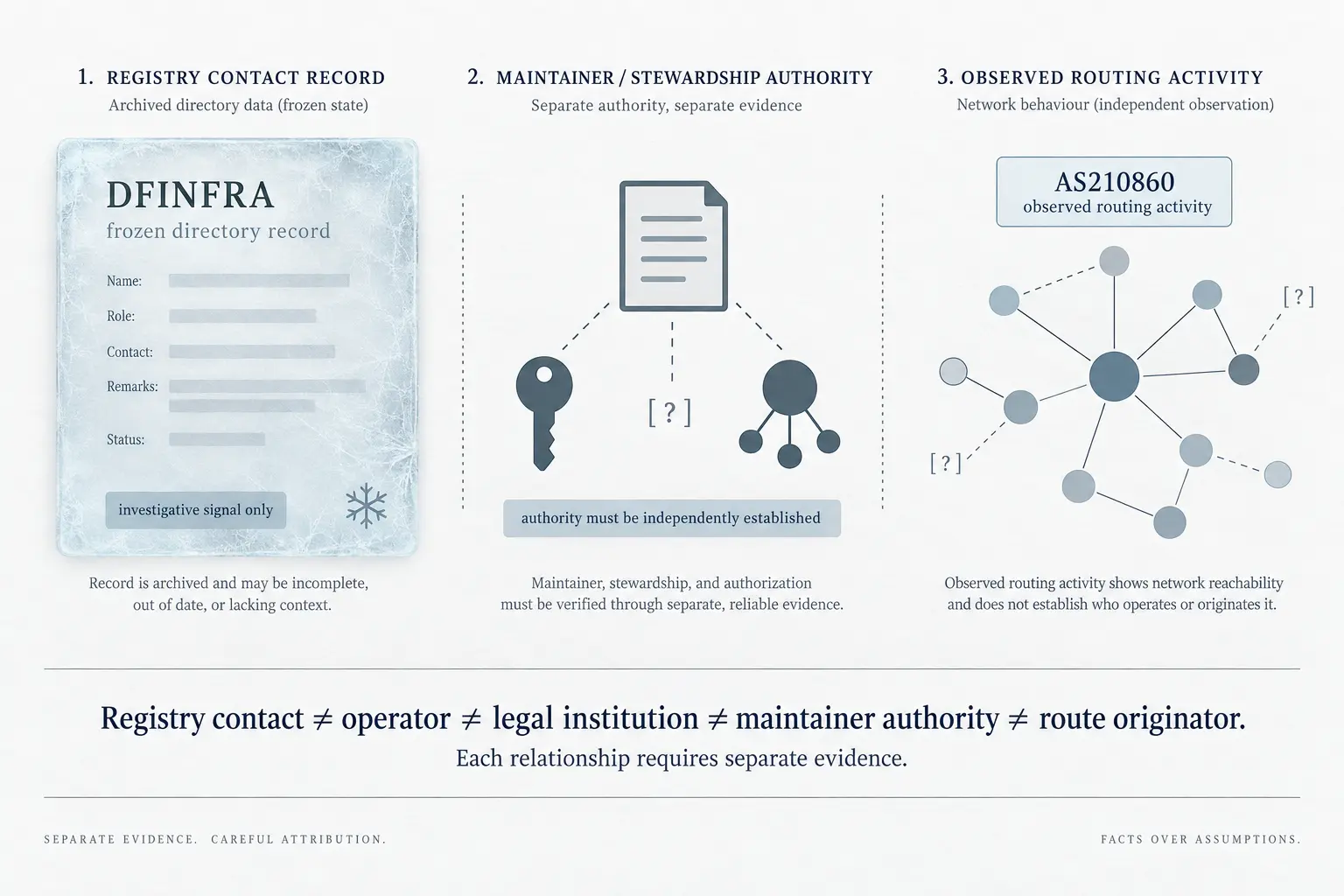
DFINFRA Is a Registry Signal, Not Yet Proof of an Operator
DFINFRA Is a Registry Signal, Not Yet Proof of an Operator intelligence summary explains the development, the public evidence available to readers, the organisations involved, the regional context, market exposure, and the infrastructure consequences that may follow. The Europe…

History
The File Ended, Then Continued: RFC 1952 and Gzip's Member Boundary
A `.gz` filename suggests one entity. RFC 1952 describes something more interesting: a procession of self-closing members. Finish one, place another immediately after it, and a decompressor can continue as though the file had acquired a new chapter. The old compressed bytes need…

Story
LACNIC’s Abuse-Contact Lockout Sits Outside the Policy Manual
LACNIC’s policy manual says when an abuse contact becomes noncompliant. A separate help page says the consequence is blocked access to MiLACNIC. The missing entity is not another reminder email. It is the public record that joins a rule to the administrative control it activates.

Global Institutional Trends
Who can challenge ISC’s practical authority?
ISC’s public pages show where its stewardship matters. They do not, by themselves, show who can contest consequential decisions or what remedy follows.

IETF
A migration measured in readable objects
Moving an old MIB into YANG can make a device easier to observe without moving the obligations attached to changing it. RFC 6643 makes that limited bargain explicit. The risk begins when a migration programme buys the first capability and declares the second complete.

Europe and Middle East Regional ISP Trends
AS210837’s Continuity Gap: What the Routing Record Can—and Cannot—Show
A documented historical network footprint has become a continuity question. For ROYA Communications and Internet Services Company Ltd, the difference between registry identity, historical routing visibility and current route evidence is more important than any single prefix…

Story
DATAMATIX and AS210973: What Public Routing Evidence Can—and Cannot—Prove
DATAMATIX and AS210973: What Public Routing Evidence Can—and Cannot—Prove intelligence summary explains the development, the public evidence available to readers, the organisations involved, the regional context, market exposure, and the infrastructure consequences that may…

IETF
Factory defaults can remove the way back
A factory reset can do precisely what its specification requires and still leave an operator unable to manage the device. RFC 8808 separates a return to preset configuration from two outcomes that the phrase “back to factory” tends to imply: a usable route back in, and data that…

IETF
A Cleared Incident Does Not Prove Which Command Cleared It
An incident client sends one `incident-resolve` request containing several incident numbers. Later, separate notifications arrive. Two records now say `cleared`; another remains `updated`. The network view is useful, but the decisive question has vanished between the command and…

History
The Key Centre Disappeared into the Tree. Its Authority Did Not: RFC 1949
Scaling usually sounds like subtraction: remove the bottleneck, spread the work, let the network carry the rest. RFC 1949 did spread multicast key distribution, but it could not subtract trust. By letting authenticated tree nodes pass group secrets and authorise later joins, the…

IETF
Ben Campbell and the Hundred-Percent Reduction That Did Not Prove Zero Traffic
The cleanest number on a Diameter console can be the most dangerous one. An overload report says `OC-Reduction-Percentage: 100`, and a post-incident slide turns that instruction into a finding: traffic fell to zero. Ben Campbell’s work on Diameter overload makes the narrower…

IETF
The old address plan survived the IPv6 launch
6rd let an operator introduce IPv6 without first replacing its IPv4 access network. The shortcut also gave an older address plan a continuing say over the size, lifetime and eventual migration of the new service.

IETF
A Capability Menu Is Not a Subscription Decision
An orchestrator sees a tidy answer before it opens a notification stream: this device supports HTTPS, XML or JSON, and two TLS versions. The discovery is valuable precisely because it is compact. It becomes dangerous only when a control system silently turns “listed” into…

History
The Password Was Correct Once. Acceptance Changed What Correct Meant: RFC 1938
Passwords usually sound like facts: either the claimant knows the right string or does not. RFC 1938 made that description incomplete. In its one-time-password system, a correct answer was consumed by success. The server replaced the value against which the next answer would be…

Story
ARIN’s RPKI Failover Test Left the Dependency Question Open
ARIN blocked access to its RPKI repositories for an hour, restored it, confirmed redundancy five minutes later and reported a return to baseline after another fifteen. That is unusually concrete resilience evidence. It is also narrower than the dependency question ARIN had…

IETF
The second login changes the security bargain
Keeping an IMAP connection open can save repeated setup work. It also removes a convenient security boundary: the assumption that one connection belongs to one user. The price of reuse is a complete account of what must be reset, what deliberately survives and who checks the next…

Story
RIPE Database 1.124.1 Fixed Certificate Selection. Its “No Evidence” Finding Needs a Search Boundary
RIPE NCC was right to ship a reported authentication vulnerability without waiting for a routine test interval. The next duty is different: show members what time, traffic and registry history were actually examined before “no evidence of exploitation” became the public…

IETF
Adam Roach and the Terminated Subscription That Did Not End the Resource
A control-room tile turns red: `Subscription-State: terminated`. Someone closes the incident because the monitored resource is presumed gone. Adam Roach’s SIP event specification permits no such shortcut. The subscription is certainly over; the resource may still exist, remain…