
Intelligence
Latest Articles
Latest intelligence on infrastructure operators, policy decisions, market moves, and digital power shifts.

Story
ARIN Kept Five Services Running Without Updates. Its Service-Level Report Has No Freshness Column
A registry can answer a question and still have nothing new to say. ARIN's planned July maintenance made that distinction visible: five reader-facing services remained operational while updates were not being published. The public service-level report measures availability well…

CASE FILE
The Packet Declared a Haptic Effect. The Device Still Had to Decide Whether to Render It: RFC 9993
A remote session marks one haptic unit as high priority. The packet is valid, the stream is negotiated and the receiver can decode it. None of that tells an actuator where on a body it may act, whether the requested amplitude is within the device’s envelope, whether a temperature…

History
The LANs the Host Was Not Meant to See: RFC 925 and the Cost of Hiding a Topology
An early Internet site could either expose every cable to the wider network or arrange its cables so that a host believed it lived on one large local network. RFC 925 chose the second illusion. It kept the host's ARP unchanged and made an intermediary discover, remember and…

CASE FILE
A Key Could Cross the Fabric. It Could Not Decide the Route: RFC 9992 and RIFT Authority
Two Top-of-Fabric nodes lose contact, each advertises the same RIFT key with a different value, and a leaf sees both. It must select one. A deterministic result is useful; it is not a declaration that the winning value is the current truth, that any receiver may act on it, or…

History
The Carrier Was Not the Connection: How RFC 892 Separated Transport State from the Network Path
One network connection could carry several transport conversations. One transport conversation could, in the most capable class, ride several network connections. RFC 892 treated those as inverse mappings rather than a contradiction: the carrier moved protocol units, while peer…

CASE FILE
The Private Key Never Left. Its Authority Did: RFC 9987 and the Transitive Trust of SSH Agent Forwarding
An engineer forwards a workstation’s SSH agent to a bastion. A process on that bastion cannot copy the private key, yet it may still ask the distant agent to sign a new authentication request. “No key exfiltration” is therefore an incomplete incident verdict: material custody and…

CASE FILE
The Domain Requested the Failure Report. The Receiver Still Had to Authorize Disclosure: RFC 9991 and DMARC Forensics
A mail receiver detects a genuine authentication failure in a forwarded calendar invitation. The author's domain has requested a forensic report at an external address. Sending the report could expose the invitation, its recipients and the forwarding path to a party that never…

IETF
Gavin Brown and the Successful Create That Did Not Yet Register a Domain
The server said the command had completed successfully. In the same breath, it said the action was still pending. RFC 8334 makes that apparent contradiction useful: an accepted application is evidence, but it is not yet a registered domain.

CASE FILE
SC100’s Draft Draws DNSSEC’s Boundary at the Primary Perspective. The Receipt Must Name It
SC100 passed its vote by unanimity among the members who participated, but on 31 August 2026 it was still an accepted draft under intellectual-property review. Its most useful clarification is not that “DNSSEC is required.” That duty already exists. It is that the duty belongs to…

Story
APNIC's EC Adopted Topic Shepherds. No Public Charter Says What a Shepherd Can Do
APNIC's Executive Council has chosen a sensible answer to a familiar board problem: give individual members continuing responsibility for important subjects. Its May minutes call them topic “Shepherds” and say they will lead discussions on allocated areas. The missing part is not…

IETF
Russ Housley and the MAC Address a Certificate Could Name but Not Make Unique
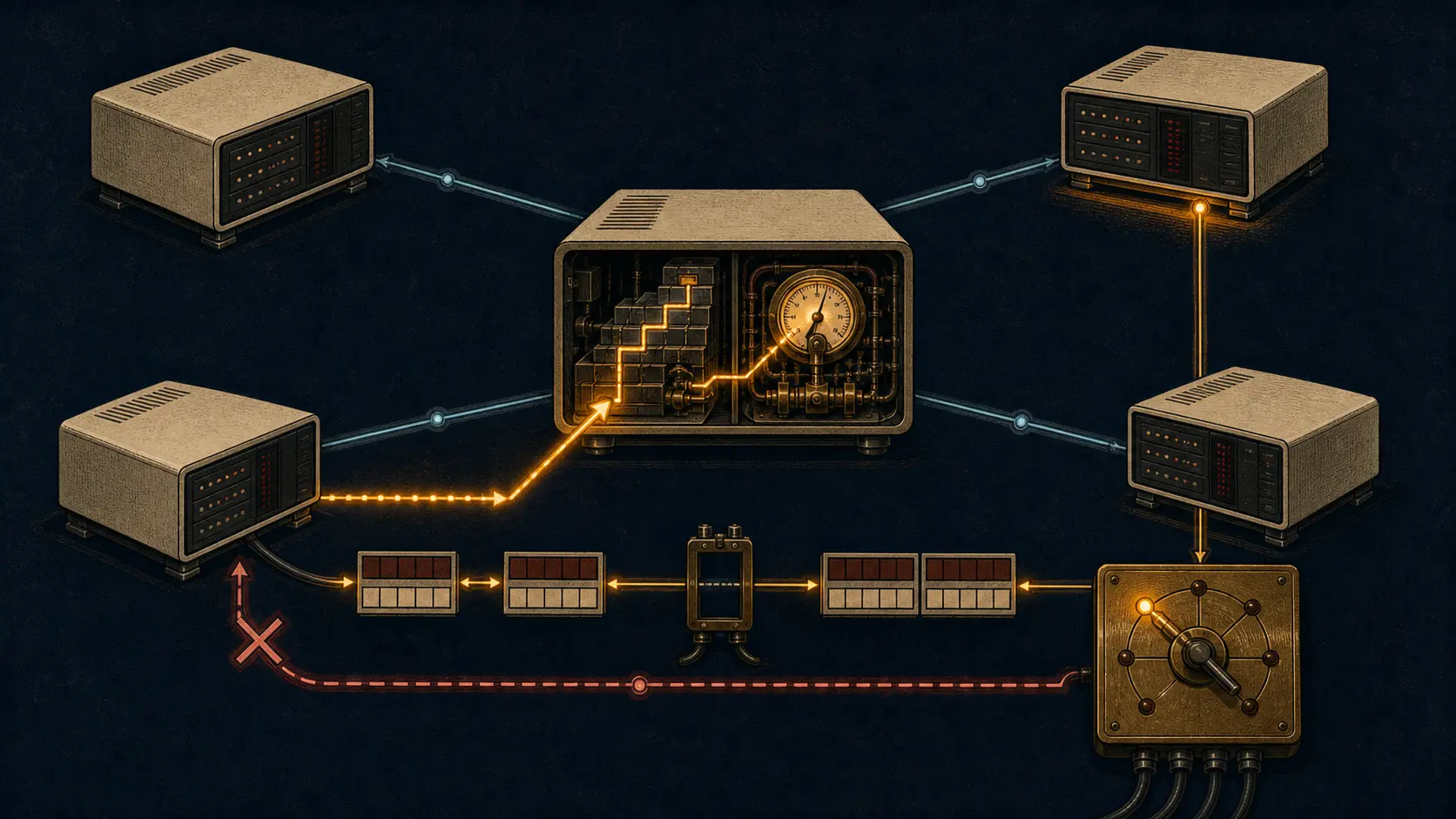
Six bytes can fit cleanly inside a certificate. The difficult part begins after they leave it: who assigned them, what interface is using them now, who observed that use, and why a local network should permit an action.
History
The Fastest Path Carried the Clock. It Did Not Choose the Master: How RFC 891 Bound Routing and Time to One HELLO
In the Fuzzball network, one HELLO could change both the route to a host and the clock offset associated with that route. The economy was deliberate, but authority remained divided: measured delay selected a path, configuration named the master, and the local clock decided…

CASE FILE
SC101 Closes a Domain-Control Gap. The Transition Still Permits Two Rulebooks
A certificate authority can now point to one current set of TLS Baseline Requirements while legitimately running one of two different domain-control derivation rules. SC101 made the safer order explicit: choose the validation method, follow a permitted CNAME path, then prune…

History
The Frame Was Longer Than the Datagram: How RFC 894 Kept Ethernet Padding Out of IP
An Ethernet interface could deliver 46 data octets even when the IPv4 datagram inside it ended sooner. RFC 894 did not resolve the mismatch by stretching IP. It assigned two rulers to two layers: Ethernet supplied enough zeroes to satisfy its physical minimum, while the IP Total…

CASE FILE
The Label Named the Encoding. It Did Not Name the Schema: RFC 9996 and Authority Behind a Protobuf Payload
A gateway accepts `application/protobuf`, the decoder returns a message value, and the request enters the business system. None of those successes establishes that the receiver used the producer's intended message definition. RFC 9996 gives Protocol Buffers a proper outer label.…

Story
AFRINIC's New-Member Portal Names Three Preflight Guides. All Three Links Return the Same 404
AFRINIC's application portal is online and unusually clear about what a prospective member should read before applying. The problem is in the handoff: process, eligibility and supporting documents are presented as three separate guides, but each link depends on the same page that…

IETF
Benoît Claise and the Augment the Base Module Could Not Name
A YANG module can list the modules it imports. It cannot, by reading itself, identify every external module that later inserts nodes into its schema tree. RFC 10035 makes that hidden direction reportable—one direct edge at a time.

Europe and Middle East National Telecom Trends
A rural 4G mast is not local coverage until the operator and location match
A mast can be live, a national target can be met and a particular phone can still lack usable service at the place that matters. Local acceptance begins only after the operator, place and context are named.

History
The First Answer Was Not the Last Word: How RFC 887 Separated Discovery from Confirmation
A host in 1983 could ask an entire local network who provided a service. Yet RFC 887 refused to treat the first name it heard as final truth. Broadcast discovery, an explicit negative answer, a third-party hint and a provider’s own confirmation were four different kinds of…

CASE FILE
WebDriver May Live at Candidate Recommendation. Cite the Snapshot
W3C's proposed Browser Testing and Tools charter makes an unusual choice explicit. WebDriver and WebDriver BiDi would be developed toward Candidate Recommendation, updated through Snapshots, and not deliberately advanced to Recommendation. That can fit technology implemented…