Summary
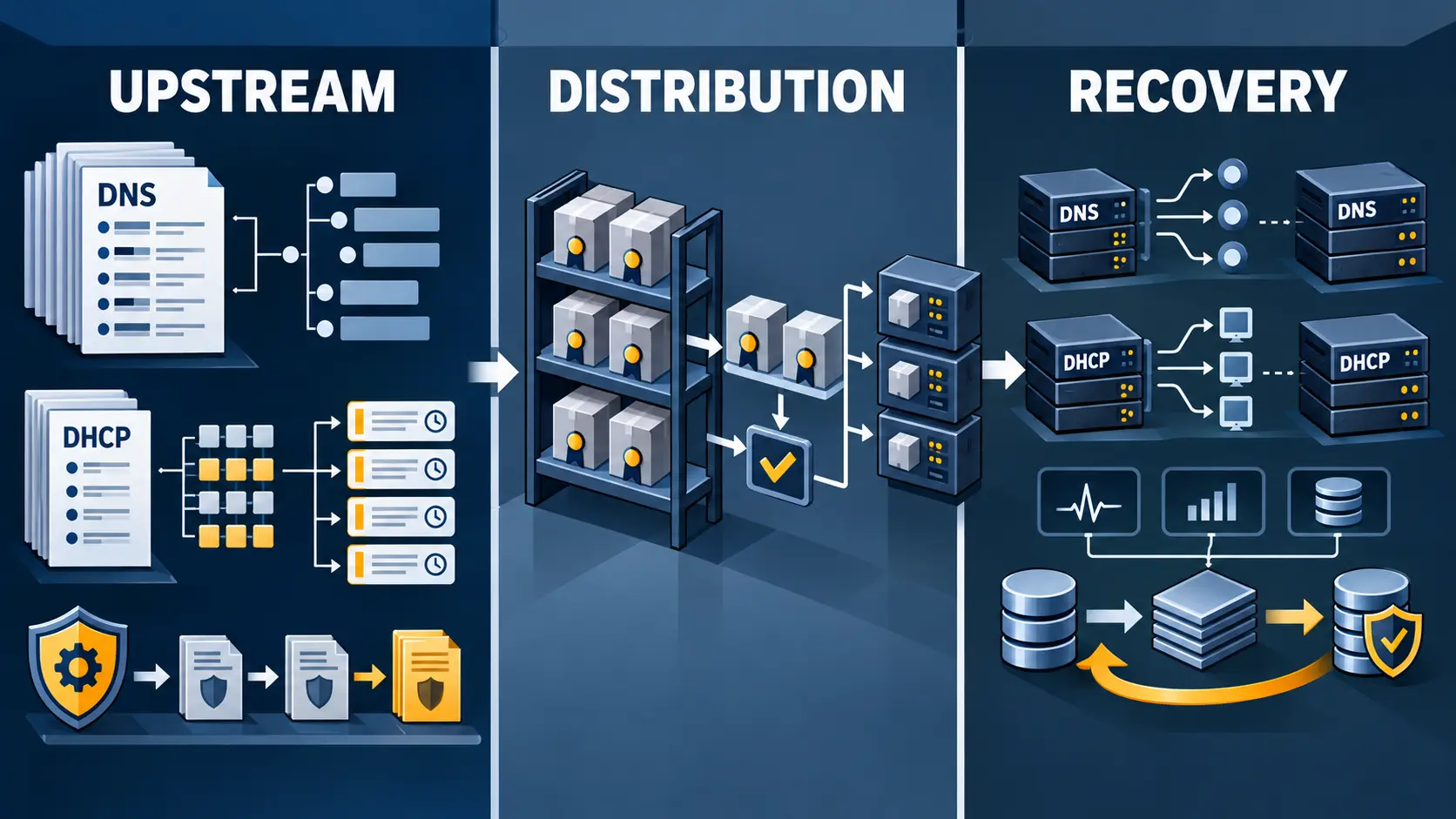
- Kea documents a specific control surface: HA peers exchange lease updates and coordinate through HTTP, heartbeats and state transitions; its Control Agent brokers JSON commands for supported runtime management; and D2 can automate DNS record updates when the surrounding authorization and authoritative-DNS configuration exists. ISC’s Kea overview Kea HA guide HA reference manual Control Agent documentation Control-channel documentation DHCP-DDNS documentation
- Netgate’s pfSense integration and OPNsense documentation demonstrate downstream platform support, but the reviewed public record does not quantify deployment prevalence, failover time, availability, labor savings or production-scale outcomes. Netgate announcement Netgate documentation OPNsense documentation
Kea matters less here as a feature list than as a shift in where DHCP operations can be controlled. ISC presents it as an open-source DHCPv4 and DHCPv6 server with modular extensions, management interfaces, high-availability capabilities, database integration and centralized-management features. ISC’s Kea overview Those descriptions establish what the software is designed to provide. They do not establish what a particular operator has enabled, how a deployment behaves under failure or whether the claimed control reduces operational work.
What Kea automates—and what remains external
The documented high-availability design is concrete. The libdhcp_ha hook library supports load-balancing and hot-standby modes. Cooperating servers exchange lease updates, communicate over HTTP, check heartbeats and move through defined states. Peer URLs, timing thresholds and server roles are explicit configuration elements. Kea HA guide HA reference manual
That is a coordination mechanism, not a measured availability guarantee. A deployment still needs correctly configured peers, network reachability, compatible versions, operational monitoring and a process for handling state transitions. The documentation describes the mechanism; it does not supply an independently measured recovery-time distribution or prove that the mechanism was exercised successfully in a named production environment.
The same boundary appears in management. Kea’s Control Agent exposes an HTTP-based REST interface that accepts JSON commands and brokers requests to configured Kea daemons. It does not itself allocate DHCP leases. Control Agent documentation The control channel documents commands including config-get, config-test, config-set and config-reload, supporting runtime configuration workflows. Control-channel documentation
An API can make a system easier to integrate with an orchestration layer. It does not, by itself, provide inventory, approval, desired-state reconciliation, permission governance, rollback or error recovery. Kea’s structured JSON configuration and supported configuration back ends can support automation, but configuration data, lease data and host-reservation data remain distinct concerns. Configuration documentation The operational result therefore depends on the systems and controls built around the daemon.
DHCP-DDNS makes the dependency chain visible in another way. Kea’s D2 component can process DHCP-generated name-change requests and automate forward and reverse DNS updates, provided the necessary authorization and authoritative-DNS configuration are in place. DHCP-DDNS documentation The software can remove repetitive record maintenance; it cannot independently guarantee that the DNS authority, credentials, conflict handling and monitoring around that workflow are correct.
Adoption is observable; outcome is not yet quantified
There is evidence that Kea has moved beyond an upstream repository. Netgate publicly documented adding Kea as a DHCP-server option in pfSense, describing a downstream integration and a migration path from the older ISC DHCP implementation. Netgate announcement Netgate also maintains operational documentation for using Kea in pfSense. Netgate documentation OPNsense provides a second downstream platform integration signal through its Kea documentation. OPNsense documentation
These records answer a limited but useful question: Kea is available through shipping network platforms, not only through ISC’s own documentation. They do not show how many installations use it, which features are enabled, whether high availability is common, or whether operators achieve better recovery or lower administrative cost. Platform integration is an adoption pathway, not a production-outcome study.
The reviewed source set also included Kea’s public source repository, which provides primary-source evidence of an open-source implementation and a place to inspect its hooks, control interfaces and tests. Kea source repository Source availability can help an operator evaluate behavior at a relevant release. It does not substitute for deployment telemetry or an independently documented operational comparison.
The evidence gap is the operational question
The public record reviewed for this briefing did not identify an independently authored quantitative case study establishing Kea’s production availability, failover time, deployment prevalence, administrative savings or large-scale operational outcomes. That is a limit of the reviewed evidence, not proof that no such evidence exists elsewhere.
For operators evaluating Kea, the next useful evidence is not another capability description. It is deployment-specific: the enabled release and hooks, the HA topology, observed state transitions, lease-consistency behavior during failure, configuration-change audit trails, DNS-update success rates and the time required to restore service. Those records would connect the documented control surface to a demonstrated result.
ISC’s Kea therefore represents an adoption and dependency pathway. Its mechanisms are technically legible, and downstream integrations make the pathway visible. The stronger claim—that Kea reliably improves availability, shortens recovery or reduces administrative effort at scale—remains unestablished by the public sources reviewed here.
Directory context: ISC-AGP1 Internet Systems Consortium Inc.
Sources: Kea overview; HA guide; HA reference; Control Agent; Control channel; Configuration; DHCP-DDNS; Source repository; Netgate announcement; Netgate documentation; OPNsense documentation.
Member Briefing
Deeper Profile Context
Sign in with the right membership level to unlock the full briefing and source notes.
Only for Strategic Circle
Strategic Circle
Open to all readers. Unlock profile briefings after joining and signing in.
Join Strategic CircleOnly for Leadership Alliance
Leadership Alliance
For qualified IP-asset owners and management; sign in to unlock alliance briefings.
Join Leadership Alliance