Summary
- Intertelecom's current return problem is not whether Ukraine still needs resilient communications. It clearly does. The problem is whether a small legacy wireless operator can capture enough of that need after shifting the mass-market mobile proposition onto a Kyivstar-hosted MVNO model.
- The public evidence points to a disciplined continuity business: low-price mobile and SIP plans, Odesa-facing local access, some residual IP network resources, legacy numbering and a support tail for older devices. It does not point to a company with enough visible cash flow to fund a broad independent national radio network, wartime power backup and large-scale equipment replacement.
- The investment judgment should therefore be conditional. Intertelecom is viable if it is priced and managed as an asset-light operator with local service labor and numbering value. It becomes fragile if management, lenders or regulators expect legacy spectrum alone to finance a return to infrastructure scale.
The Subscriber Is Paying For Continuity
The clean way to read Intertelecom is to start with the subscriber, not the license. A person who still keeps the service is probably not trying to maximize gigabytes per hryvnia against Kyivstar, Vodafone Ukraine or lifecell. That comparison is hard for Intertelecom to win directly. The national operators have far larger customer bases, much larger capital programs, deeper device ecosystems and measured mobile performance that dominates public visibility.
A customer who stays with Intertelecom is more likely solving a narrower problem: keeping a known number active, preserving a city-style calling pattern, using an inexpensive plan for a relative, holding a small-business voice line, maintaining a SIP setup, or buying support from a local operator that still answers through familiar channels.
That distinction matters because continuity can be valuable without being glamorous. Wartime Ukraine has made communications reliability a household and institutional concern. Power interruptions, damaged infrastructure, forced migration and network congestion all change what "good service" means. A cheap plan that keeps a number reachable, a technician who can install an outdoor receiver, or a voice service that keeps working after a device migration may matter more to some users than a premium bundle. Intertelecom's opportunity is to serve that slice without pretending it can outspend the national mobile groups.
The company itself now frames the mass-market mobile change as a new format. Its April 2025 customer notice says that since November 2024 it has provided mobile service as an MVNO using Kyivstar infrastructure. That sentence is the operating pivot. It moves Intertelecom away from the economic problem that strained legacy CDMA operators everywhere: the cost of maintaining a specialized radio network after the device market and consumer expectations moved elsewhere. But it also moves the company into a new dependency.
The network customers experience is now heavily tied to Kyivstar's coverage, technology roadmap, wholesale terms and 3G shutdown schedule.
The same notice makes the risk plain. Intertelecom warned that Kyivstar's planned 3G shutdown in a number of regions could temporarily limit mobile data for some Intertelecom customers, even while voice services remained available nationwide. That is not a detail; it defines the boundary of control. Intertelecom can own the customer relationship, number, bill, support flow and tariff design. It does not fully control the radio layer on which the mobile data experience rests. For a large mobile operator that would be a strategic weakness.
For a small continuity operator it can be a rational bargain, provided the wholesale cost is low enough and the promise to customers is modest enough.
The Old Network Still Explains The Company
Intertelecom's present should not be confused with a clean start-up MVNO. It is a legacy operator carrying the history, assets and obligations of an earlier technology cycle. The company describes itself as one of Ukraine's early CDMA mobile-service providers. It says it was founded in September 1998, connected its first subscriber in March 2001, became a national communications operator within several years, built a broad CDMA and 3G internet footprint and served more than half a million customers by 2010.
That history explains why the company still has older customers, older devices, local numbering assets and an Odesa-centered support identity.
It also explains the trap. CDMA once gave Intertelecom a differentiated wireless position, especially where fixed broadband was poor and GSM data was immature. But a differentiated radio standard becomes a burden when the handset market, application ecosystem and national operators move elsewhere. A customer who needs ordinary smartphone service wants SIM or eSIM activation, 4G data, roaming, app support and device choice. The old CDMA network could not carry that proposition indefinitely without a level of reinvestment that would be hard to justify against much larger mobile rivals.
The company's public support pages still carry this long tail. Manuals and drivers for older Huawei, ZTE, Novatel, Pantech and other 3G devices remain visible. That is not just nostalgia. It is evidence of customer-service drag. Every legacy device category creates calls, replacements, migrations and disappointment when a user expects modern mobile data. The economic question is whether Intertelecom can convert that legacy base into GSM, SIP, fixed wireless or fiber customers faster than the support burden erodes margins.
This is why the GSM move is economically rational even if it reduces infrastructure pride. A small operator's best use of capital may be to migrate customers out of obsolete hardware and onto a host network, while preserving the parts of the relationship that still have value: number continuity, local support, simple billing and selected business voice features. A failed migration would lose customers to larger operators. A successful migration creates a smaller but cleaner book of subscribers whose expectations match what Intertelecom can profitably supply.
Spectrum Is An Option, Not The Engine
The regulator record shows a company managing spectrum obligations, not a company simply expanding. NCEC reissued Intertelecom-related licenses in October 2024, including radio-relay, CDMA-800 and broadband wireless access in Odesa. A separate NCEC decision terminated two cellular radio licenses in Odesa region at the company's request. Older regulator decisions show CDMA-800 license adjustments, reductions by region or bandwidth and terms that ran toward 2026. NCEC also noted that at the end of 2024 CDMA-800 service was still provided by International Telecommunications and Telesystems of Ukraine, a small and shrinking club.
That mix of reissue, termination and historical reduction points to a careful spectrum cleanup. Spectrum can be valuable, but only if it can be converted into revenue-bearing service under current technology and current capex constraints. A license is not the same as a funded network. In wartime conditions, a radio access network needs power backup, batteries, generators, site access, security, spares, field labor, backhaul and customer devices. It must also compete with national operators that already have wide 4G coverage and clear 5G optionality when conditions allow.
The public record does not show Intertelecom with enough scale to carry that burden nationally.
This does not make the licenses irrelevant. Local wireless rights in Odesa, radio-relay rights or remaining CDMA-related permissions may still support niche service, migration, backhaul, fixed-wireless continuity or future bargaining. Numbering resources also matter. Older regulator decisions allocated local number capacity in Odesa and nearby districts. A number that public agencies, clinics, utilities or older customers already know can have economic value even when the radio technology behind the original service changes. But this is option value and continuity value. It is not proof that a spectrum-led rebuild would earn a return.
The investor error would be to look at the word "spectrum" and assume hidden upside. In a large operator, spectrum is an input into network capacity and market share. In Intertelecom's current position, spectrum is more likely a constrained asset that must justify every hryvnia of upkeep. The better test is brutal: does a given license directly protect a paying customer base, reduce wholesale cost, create local fixed access, or support an enterprise continuity product? If not, the company should avoid spending scarce money to defend it for sentimental reasons.
The Tariff Wall Is Low
Intertelecom's tariff pages show why the return must come from discipline rather than scale fantasy. The flagship consumer offer visible on the home page and tariff pages is around 200 UAH per 30 days, with unlimited in-network calls, 1,000 minutes to mobile numbers and 10,000 MB. The detailed plan also says that after 40 GB of total monthly internet traffic, including additional services, data is slowed to 256 Kbps. A separate starter-pack presentation shows a lower 120 UAH monthly framing with more data, while a promotional voice plan sits at 50 UAH per month and a SIP plan at 120 UAH.
Those are retention and acquisition prices, not infrastructure-rebuild prices. They may be sensible if the radio access cost is mostly wholesale and variable. They are much harder to reconcile with a stand-alone network that must absorb power, repair, tower, backhaul and equipment replacement costs. Even the 200 UAH plan is only roughly in line with the ARPU zone of the national mobile market, while lacking the scale that lets large operators spread network investment over tens of millions of customers.
The data allowance matters. A 10 GB headline bucket and a 40 GB fair-use cap are consistent with a service that must control wholesale data exposure. Kyivstar's public 4Q25 material showed mobile data usage of 14.7 GB per customer per month and mobile ARPU of 161.1 UAH. Vodafone Ukraine reported ARPU of 145.2 UAH in Q1 2026. Intertelecom cannot price far above those benchmarks without losing ordinary smartphone customers, but it also cannot allow unlimited heavy usage if it pays a host network for capacity. That is the MVNO squeeze.
The logical response is segmentation. Low-price voice customers should not be sold a fantasy of premium data. SIP customers should be sold reliability, multichannel use and number continuity. Odesa fixed-wireless and GEPON customers should be sold address-specific access where Intertelecom can actually install, support and repair. The company should measure value by contribution margin after support and wholesale costs, not by headline subscriber count. A small profitable base is better than a larger base that churns when it discovers the service is not a full national mobile substitute.
Repair Labour Is The Product No One Can Ignore
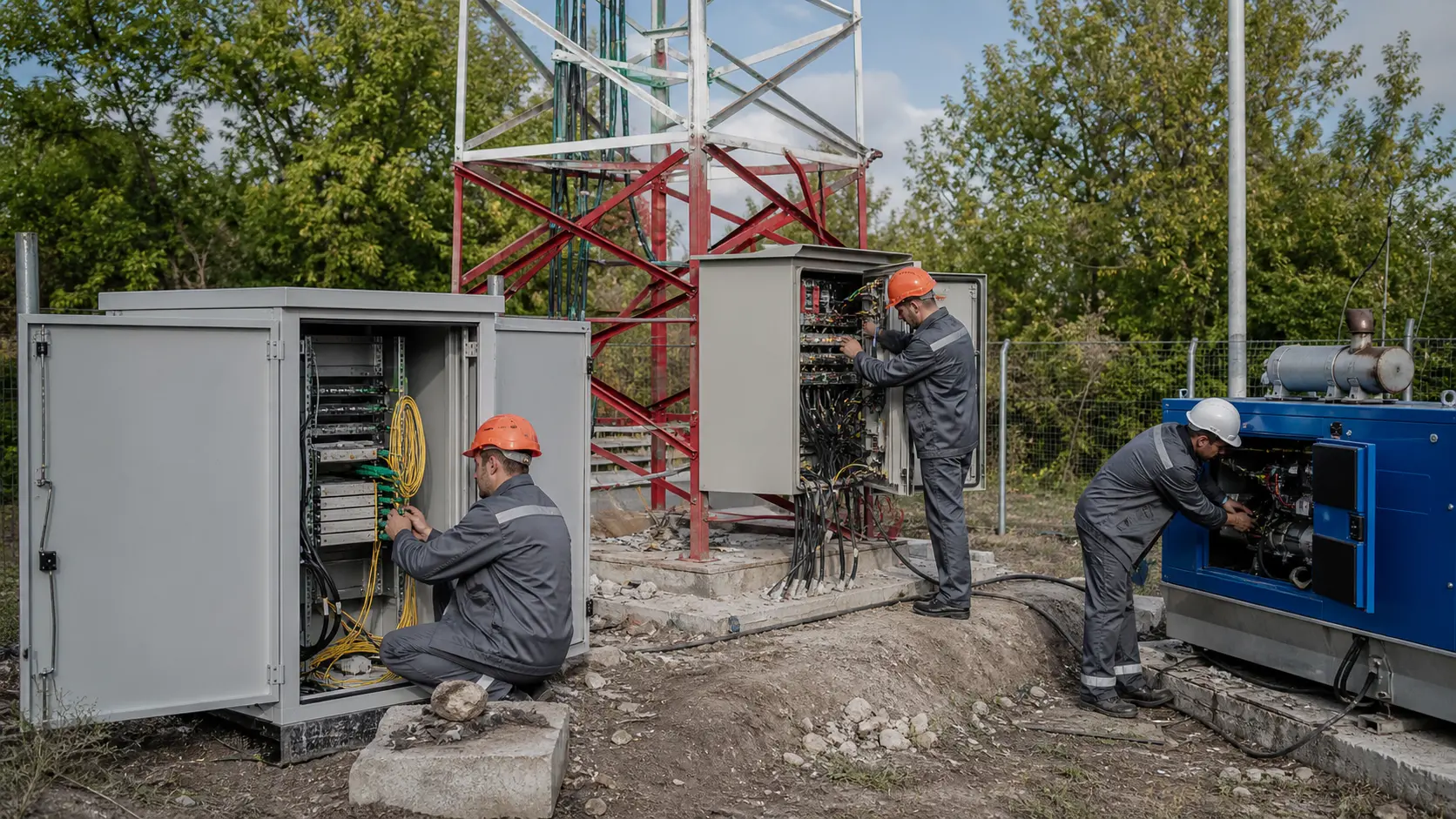
Wartime telecom economics are physical. The relevant cost is not only spectrum rent or wholesale data. It is the human and logistical cost of keeping service usable when electricity, transport, spare parts and site access are unreliable. Large operators have made energy resilience a central expense. Vodafone Ukraine explicitly points to costs for power, energy resilience, personnel and spectrum rent. Kyivstar's parent highlights investments in resilience, solar assets and new connectivity options. Those facts set the competitive environment in which Intertelecom must operate.
Intertelecom's local pages point to a more modest but still real labor model. Its home Wi-Fi product is presented for Odesa region, with technician visits to install, configure and test equipment. Its GEPON page describes fiber access and plans from 10 Mbps to 200 Mbps, with the underlying technology capable of much more. The public service-center selector exposes Odesa and Odesa region. These details suggest a company whose defensible operating surface is local and service-heavy, not purely national and app-based.
That can be a strength. A local technician who can make an outdoor receiver work, a support team that understands legacy numbers, and a business voice product that keeps a small office reachable can produce loyalty that a generic mobile bundle does not. But it is labor-intensive. The technician visit must be priced, routed and completed efficiently. Spare equipment must be available. Failed installations must not consume the margin from several months of service. Local fixed access must be dense enough to avoid driving all over the region for low monthly fees.
The same logic applies to device migration. Intertelecom's older device ecosystem creates a customer-care job that national operators may not want. If Intertelecom can migrate those users to SIM, eSIM, SIP or fixed access with low friction, it can harvest the trust built by the old network. If it leaves them confused by 3G shutdowns and device incompatibility, the old network becomes a liability. The company has to sell continuity while quietly retiring the cost structure that made continuity expensive.
Kyivstar Is Both Supplier And Alternative
The MVNO model makes Kyivstar the decisive supplier. Kyivstar is not a neutral utility. It is Ukraine's leading digital and mobile operator, with about 22 million mobile customers, around 1.2 million home-internet customers, 2025 revenue of USD 1.157 billion, 96.2 percent 4G population coverage and a 4G customer base above 15 million. VEON reports Kyivstar as Ukraine's market leader with 47 percent subscriber share. Kyivstar also competes for the same humans who might consider an Intertelecom SIM or eSIM.
This dual role defines Intertelecom's strategic ceiling. Using Kyivstar infrastructure gives Intertelecom national GSM reach without funding a national radio network. It may also make Intertelecom's service more credible after CDMA. But every retail promise now has to fit what Kyivstar allows technically and commercially. If Kyivstar shuts down 3G in a region, Intertelecom must manage the customer impact. If wholesale terms tighten, Intertelecom's gross margin can compress. If Kyivstar bundles more aggressively, many customers can skip the intermediary and buy directly from the host.
The answer is not to pretend the dependency does not exist. The answer is to make Intertelecom valuable in ways Kyivstar is less focused on. That means city-number continuity, SIP and multichannel calling, low-touch eSIM activation for narrow use cases, small-business voice, local Odesa installation, public-sector continuity and patient migration for legacy customers. Intertelecom should not try to out-market Kyivstar on national mobile performance. It should make the customer's switching problem smaller than the incumbent's promotional advantage.
There is also a reputational benefit to the dependency. Kyivstar has public quality awards and wide coverage recognition. If Intertelecom can honestly say the mobile access layer rides on that infrastructure, it inherits some coverage credibility. But that inherited credibility works only if the service limitations are plain. Customers will forgive a narrower value proposition more easily than a surprise data limitation. The tariff architecture and support scripts have to match the real operating boundary.
The National Alternatives Are Too Strong For A Broad Attack
The competitive field leaves little room for a small operator to win by breadth. NCEC's 2025 annual report puts Ukrainian mobile-service revenue at 80.4 billion UAH and electronic-communications capex at 33.9 billion UAH. Interfax-Ukraine's report of NCEC data lists 2025 telecom-service revenue of 44.16 billion UAH for Kyivstar, 25.59 billion UAH for Vodafone Ukraine and 15.74 billion UAH for lifecell. The same report lists capex of 14.19 billion UAH, 7.69 billion UAH and 4.06 billion UAH for those three respectively.
Against that, public registry aggregation shows Intertelecom 2025 revenue of 138.558 million UAH and net profit of 9.746 million UAH. Those figures may not map perfectly to operating segments, but the order of magnitude is decisive. Intertelecom's visible annual revenue is less than many months of a national operator's capex. It is also less than 0.2 percent of Ukraine's 2025 mobile-service revenue. That does not make the company worthless. It makes the wrong strategy obvious.
Vodafone Ukraine and DVL/lifecell also narrow the space. Vodafone reported Q1 2026 revenue of 7.3 billion UAH, ARPU of 145.2 UAH and continuing investment in network resilience. Its H1 2025 release showed 15.4 million customers and 3.52 billion UAH of investment. DVL Telecom says its Ukrainian group serves more than 13 million customers through lifecell and Datagroup-Volia, backed by USD 435 million of EBRD and IFC financing. DVL's combination of mobile, fixed broadband, TV and enterprise connectivity creates exactly the convergent alternative that could absorb customers who want more than a cheap voice line.
Public measurement signals reinforce this hierarchy. NCEC and UCRF monitoring focused on large-scale measurements across major operator networks. nPerf's public Ukraine mobile coverage selector lists Lifecell, Kyivstar Mobile and Vodafone Mobile, not Intertelecom. Kyivstar says Ookla recognized it for best mobile network, coverage and speed in H1 2025. These are not perfect independent investment facts, and competitor announcements are promotional. But as market signals they are consistent: the public mobile-performance contest is between the national operators.
Intertelecom's rational competitive posture is therefore not confrontation. It is adjacency. It can sit beside the national operators as a cheap continuity wrapper, a number-preservation specialist, a local fixed-access installer, a SIP provider and a migration service for customers who do not want to start over. That is less exciting than a comeback story, but it is much more economically plausible.
Public Customers Help, But They Do Not Save The Model
Public-sector continuity is part of the assignment because it is one of the few areas where small communications providers can matter beyond their retail scale. Clinics, utilities, schools, municipal services and local agencies often need working telephone lines, known numbers and low-friction renewals more than they need a premium consumer app. Public procurement records visible through aggregators show Intertelecom-related tender participation, including small communications-service contracts and public customers. That confirms use, but not transformation.
The amounts visible in public summaries are useful rather than dominant. They show that institutions still buy services from the company. They do not prove a large anchor customer that can fund a network rebuild. This matters because public-sector relationships can create false comfort. A provider can point to many tenders and still have a small revenue base if each contract is modest. The operational burden of serving public entities can also be high: paperwork, invoicing, service-level expectations and support calls may be heavy relative to monthly revenue.
The better interpretation is that public customers are a retention channel and credibility asset. They can stabilize a base of numbers and services. They can justify support labor in Odesa and other pockets. They can create references for SIP, fixed voice and backup connectivity. But they should not be treated as a substitute for unit economics. Every public account still needs a gross margin after wholesale access, device replacement, support and administration.
The public-sector opportunity also argues for honesty in product design. A school or clinic buying a known number and backup voice path should not be sold a consumer-style data bundle as the main value. It should be sold the continuity of being reachable, the simplicity of support and the clarity of what happens when a host network changes technology. In that market, trust is worth more than speed claims.
The Financial Base Looks Too Small For Heavy Capital
The public financial picture is not detailed enough for a full valuation, but it is detailed enough to reject a heavy-capex assumption. Opendatabot shows 2025 revenue of 138.558 million UAH, net profit of 9.746 million UAH and assets of 38.851 million UAH for the legal company. YouControl records large authorized capital, Cyprus corporate shareholders, zero state share, VAT registration, 13 trademarks and many licenses. Those records tell us Intertelecom is a real corporate vehicle with a long legal history. They do not show spare cash for national infrastructure renewal.
At visible profit scale, even modest network events can matter. A few major equipment replacements, battery programs, truck rolls, site leases, legal disputes or migration campaigns could absorb annual profit. The company may have financing arrangements, related-party support or segment-level cash flows not visible in public snippets. But absent disclosure, the prudent assumption is that capex must be highly selective.
This is why the MVNO transition is financially coherent. It converts a large fixed-cost problem into a smaller commercial problem. Instead of funding every radio site, Intertelecom pays for access and focuses on acquisition, retention, billing and service. That can work if wholesale terms are favorable and customers are low-to-moderate data users. It fails if customers behave like heavy mobile broadband users while paying low tariffs.
The same capital discipline should apply to fixed access. Odesa Wi-Fi and GEPON can earn a return where density, installation cost and support load make sense. They become dangerous if deployed as a broad buildout without enough local density. The public pages show address checking and technician testing, which is the right kind of friction. It is better to reject an uneconomic address than to add a customer who will never repay the installation cost.
Churn Is The Hidden Cost
The arithmetic of a small continuity operator is less about the advertised monthly fee than about how many months a customer stays after migration, how often that customer calls for help and how much wholesale network use the plan creates. A 200 UAH plan can be attractive if it keeps a low-data voice customer for years with little support. The same plan can be unattractive if the customer expects heavy mobile broadband, needs device troubleshooting, complains about regional 3G shutdown effects and leaves after one or two billing cycles. The headline tariff is only the first line of the income statement.
This is why Intertelecom's old customer base is both asset and risk. Legacy customers may be less price-sensitive because they value a number, a habit or a known support route. They may also be expensive because the migration from old devices and old expectations requires education. The company has to identify which customers are worth saving. A pensioner using voice, a small office using SIP, a clinic preserving known lines, or a household needing an Odesa wireless installation can be profitable if the service is stable.
A customer who wants unlimited smartphone data at the lowest price is more likely to destroy margin or churn to a national operator.
The MVNO move changes churn economics. Before the transition, losing a customer could mean stranded network cost on an owned access layer. After the transition, losing a customer may be less damaging if wholesale cost is variable. But acquisition cost still matters. SIM cards, eSIM support, call-center time, number-porting work, marketing pages, payment support and complaints all consume cash. A low-price promotional offer can make sense only if it buys durable tenure or moves a legacy user into a cheaper support state. If it merely attracts bargain hunters who churn when another operator discounts, it weakens the business.
This also affects how Intertelecom should think about public and business customers. The best institutional customer is not necessarily the largest by line count. It is the customer that renews, pays predictably, uses support in a manageable way and values continuity enough not to rebid every tiny price difference. A small municipal or medical account with stable voice lines can be better than a consumer-data cohort that constantly tests the limits of the host network. The product should be built around retention quality, not retail noise.
Device policy is part of the same calculation. Every old modem or handset that remains active can extend revenue, but it can also extend confusion. Intertelecom should make migration offers that reduce future support load: eSIM where users can handle it, physical SIM where needed, SIP for fixed voice, and local fixed access where the installation creates a durable relationship. The company's public pages already show several paths. The economic task is to push each customer toward the path with the lowest lifetime support cost for the value they actually need.
There is a subtle pricing opportunity here. Continuity customers can accept small premiums if the promise is honest and specific. They are not buying "best network" claims. They are buying a low-drama transition, a number that keeps working, a technician who arrives, or a voice platform that does not force them to rebuild their office. A 20 or 30 UAH monthly difference may matter less than avoiding a failed migration. But that premium can be charged only if Intertelecom's service experience is better than the paperwork and support burden of moving to a national operator directly.
The Residual Network Footprint Is Real But Narrow
Intertelecom should not be described as a purely virtual brand. RIPE network data shows AS31343 held by Intertelecom and announced in July 2026, with several visible IPv4 prefixes and an IPv6 allocation. Whois data for one Intertelecom address range ties the resource to Ukraine and the company's maintainer. That evidence matters because it shows that some network operations, address resources and technical identity remain alive. The company is not only a reseller page with a logo.
But IP routing evidence is not the same as mobile access scale. An autonomous system and a few prefixes can support corporate services, management systems, fixed access, hosting, voice platforms, customer portals or internal operations. They do not prove that Intertelecom controls a modern nationwide radio network. In fact, the coexistence of a live AS and an MVNO mobile model supports the narrower thesis: Intertelecom still has technical assets, but the most capital-intensive consumer mobile layer has shifted to a host.
That distinction should guide the company's capital choices. IP resources, SIP platforms and local access networks can be maintained at a scale compatible with Intertelecom's visible revenue. A national radio rebuild would be a different undertaking. It would require a site portfolio, active equipment, spectrum modernization, field force coverage, power backup, customer-device compatibility and marketing scale. The public technical footprint is meaningful for continuity services; it is not enough to infer broad mobile independence.
The same is true of fixed wireless and GEPON. These are real infrastructure products, but their economics are local. A dense Odesa neighborhood with available crews, known buildings and manageable backhaul can work. A scattered rural buildout with long truck rolls and low monthly fees can fail. Intertelecom's address-check and technician-test language is therefore more important than a generic coverage claim. The company appears to know that availability must be verified at the address level. That is a healthier posture than promising universal access.
The residual network footprint also gives Intertelecom bargaining value. A small operator with numbering, IP resources, local access, business voice and a known brand can partner, resell, host, migrate and package services. It can provide a layer of customer intimacy over a larger network. It can keep some technical autonomy in routing and voice. Those are real assets in a war-disrupted market where not every customer wants to become just another account inside a giant operator.
Still, the asset must be monetized. A live AS that does not support profitable services is overhead. A license that does not protect revenue is cost. A service center that does not reduce churn is rent and payroll. A technician route that does not pay back installation cost is charity. Intertelecom's management problem is to turn every residual asset into a specific cash-flow role. The company does not have the visible financial room to carry symbolic infrastructure.
Regulation Rewards Clarity
Ukraine's electronic communications framework is moving toward more formal registers, reporting and European integration. NCEC's 2025 annual report highlights sector growth, 738 regulator decisions and the "Roaming like at home" milestone from January 2026. Legal changes to provider-register procedures also point to a more structured reporting environment. That context favors operators that can clearly define what they provide, where they provide it and under which license or notification.
For Intertelecom, regulatory clarity is not only compliance. It is strategy. The company must separate four things that can otherwise blur: hosted mobile service, residual spectrum rights, local fixed access and business voice/numbering. Each has a different cost structure and customer promise. A hosted mobile plan depends on Kyivstar infrastructure. A local wireless or fiber product depends on Intertelecom installation and repair. SIP depends on internet access, numbering and voice-platform reliability. Spectrum rights depend on regulator permission and actual economic use.
Blurring these boundaries would create operational and reputational risk. A customer who believes Intertelecom controls the national mobile radio network may blame the company for host-network technology changes. A regulator may expect spectrum to be used efficiently. A business customer may need to know whether a voice service depends on fixed internet, mobile access or both. The more precise Intertelecom is, the easier it is to price and support each product.
The war adds another regulatory and reputational layer. Communications providers are part of national resilience. That does not mean every small operator should receive capital for every legacy asset. It means operators should preserve useful services, avoid misleading claims and invest where their local knowledge or assets actually improve continuity. Intertelecom has a plausible role in that ecosystem if it stays specific.
What Would Reverse The Judgment
The bearish version of this essay would say Intertelecom is merely a shrinking CDMA legacy brand wrapped around a host network. That is too simple. Several facts could reverse the cautious judgment.
The first would be a disclosed MVNO agreement with Kyivstar that gives Intertelecom durable access to 4G and voice services on terms that leave healthy gross margin after realistic data use. If Intertelecom can buy capacity predictably and keep churn low, the small tariff base becomes more attractive. The second would be evidence of net customer growth after the GSM and eSIM migration, especially MNP inflows from users who actively choose Intertelecom rather than merely failing to leave.
The third would be audited segment data showing that SIP, numbering, public customers and local fixed access produce recurring cash flow well above the thin profit visible in public summaries.
A fourth reversal fact would be a funded modernization plan for specific spectrum. Not a vague claim that spectrum is valuable, but a regulator-approved and financed plan that converts legacy rights into current revenue. That could mean local fixed wireless, enterprise backup, backhaul, or a partnership where another operator values the rights. The fifth would be large public or enterprise contracts that anchor repair labor and continuity economics without relying on low-price consumer data.
The opposite facts would make the judgment harsher: continued license terminations without replacement economics, customer complaints tied to host-network changes, shrinking public-service presence, rising wholesale data costs, no evidence of 4G migration, or support pages that remain dominated by obsolete equipment. Intertelecom does not need to become large to be investable. It does need to prove that the remaining customer base is intentional, not stranded.
Judgment: A Small Operator Can Be Useful Without Being Expansive
Intertelecom's best future is not a return to the old national CDMA story. That story belonged to a different device market, a different spectrum cycle and a different competitive structure. The current evidence supports a narrower company: a Ukrainian continuity operator with legacy trust, numbering assets, SIP and business voice products, Odesa-facing local access, residual internet resources and a Kyivstar-hosted mobile path.
That is enough to matter. In a country where communications continuity is not abstract, a small operator that keeps numbers reachable, installs local access carefully and migrates legacy customers honestly can provide real value. But the return must be earned through restraint. Low monthly tariffs cannot carry inflated network ambitions. Spectrum rights must be treated as working assets or options, not trophies. Repair labor must be priced. Host-network dependency must be disclosed through product design. Public-sector continuity must be served, not romanticized.
The clear judgment is therefore conditional but firm. Intertelecom can fund continuity if it remains asset-light, local where it has real crews, and exact about what it controls. It is unlikely to fund broad spectrum renewal, wartime power hardening and independent national mobile competition from the visible revenue base. The company should make the subscriber's reason for staying explicit: not the fastest network, not the deepest bundle, but a service that keeps a line, a number and a local relationship alive at a price that both sides can sustain.
Sources
- https://www.intertelecom.ua/
- https://www.intertelecom.ua/aboutcompany
- https://www.intertelecom.ua/aboutcompany/history
- https://www.intertelecom.ua/aboutcompany/lawinfo
- https://www.intertelecom.ua/view/news/Informuvannya-pro-zminy-v-dostupi-do-mobilnoho-internetu-ta-perekhid-na-4G
- https://www.intertelecom.ua/tariffs/clients
- https://www.intertelecom.ua/view/tariff/IT_vsesvit_bazovyy_peredplata
- https://www.intertelecom.ua/taryf_it_vsesvit_bazovyy
- https://www.intertelecom.ua/view/tariff/akcionyi
- https://www.intertelecom.ua/view/tariff/SIP_Vsesvit_Bazovyy_miskyy
- https://www.intertelecom.ua/tariffs/biznes
- https://www.intertelecom.ua/home_internet_wifi
- https://www.intertelecom.ua/gepon
- https://www.intertelecom.ua/esim
- https://www.intertelecom.ua/contacts/contactu-company
- https://www.intertelecom.ua/contacts/sales
- https://www.intertelecom.ua/INFO/drivers
- https://opendatabot.ua/c/30109015
- https://youcontrol.com.ua/catalog/company_details/30109015/
- https://nkek.gov.ua/npas/pro-rozghliad-zaiav-tov-intertelekom-shchodo-pereoformlennia-litsenzii
- https://nkek.gov.ua/npas/pro-rozghliad-zaiavy-tov-intertelekom-pro-prypynennia-dii-litsenzii
- https://nkek.gov.ua/npas/risennia-no-339-vid-08092020-pro-licenzuvannia-u-sferi-koristuvannia-radiocastotnim-resursom-ukrayini
- https://nkek.gov.ua/npas/risennia-no-365-vid-06082019-pro-licenzuvannia-u-sferi-koristuvannia-radiocastotnim-resursom-ukrayini
- https://nkek.gov.ua/news/nkek-prodovzhuie-zabezpechuvaty-kontrol-za-vykonanniam-rcs
- https://nkek.gov.ua/news/pidsumky-zasidan-nkek-vid-02-zhovtnia-2024-roku
- https://nkek.gov.ua/npas/risennia-no-458-vid-05092017-pro-reguliuvannia-nomernogo-resursu
- https://nkek.gov.ua/pro-nkek/zvity-nkek/rz2025
- https://nkek.gov.ua/news/yakist-mobilnoho-zviazku-v-ukraini-rezultaty-monitorynhu-nkek-za-2025-rik
- https://www.ucrf.gov.ua/pres-centr/news/ponad-pivmiliona-vymiriuvan-iakosti-zviazku-proviv-udtsr-u-2025-rotsi
- https://zakon.rada.gov.ua/go/z1002-25
- https://www.undp.org/ukraine/publications/mobile-communications-and-internet-access-ukraine-results-sociological-survey
- https://stat.ripe.net/data/as-overview/data.json?resource=AS31343
- https://stat.ripe.net/data/announced-prefixes/data.json?resource=AS31343
- https://stat.ripe.net/data/whois/data.json?resource=195.128.182.8
- https://stat.ripe.net/data/network-info/data.json?resource=195.128.182.8
- https://www.nperf.com/uk/map/UA/-/-./signal
- https://investors.kyivstar.ua/
- https://investors.kyivstar.ua/news-releases/news-release-details/kyivstar-revenue-rises-26-yoy-digital-and-connectivity-drive
- https://www.sec.gov/Archives/edgar/data/2062440/000206244026000006/kyiv-20251231.htm
- https://www.sec.gov/Archives/edgar/data/2062440/000162828026017498/kgl_4q25xrelease.htm
- https://www.veon.com/integrated-annual-report-2025/
- https://www.veon.com/newsroom/press-releases/veon-2025-integrated-annual-report-record-digital-growth-sovereign-ai-and-kyivstar-listing-define-a-transformative-year
- https://www.vodafone.ua/company/investors/financial-results
- https://www.vodafone.ua/news/business-invest/vf-kv-2026
- https://www.vodafone.ua/news/business-invest/vodafone-u-1-pivrichchi-2025-roku-investuvav-ponad-35-mlrd-grn-v-ekonomiku-ukrani
- https://www.dvltelecom.com/
- https://horizoncapital.com.ua/news/consortium-led-by-xavier-niel-completes-acquisition-of-dvl/
- https://www.ebrd.com/news/2024/ebrd-and-ifc-support-landmark-telecom-transaction-in-ukraine.html
- https://en.interfax.com.ua/news/telecom/1156661.html
- https://en.interfax.com.ua/news/telecom/1156657.html
- https://kyivstar.ua/news/id250820251500
- https://www.vodafone.ua/news/business-invest/vodafone-vyznano-liderom-z-yakosti-fiksovanoho-internetu-v-ukraini