
Summary
- RFC 1070 encapsulated OSI network-layer packets in IP so implementers could test OSI routing across the existing Internet without modifying Internet gateways. IP supplied a subnetwork; EON supplied a different logical topology.
- An IP address, an EON address, a
core.EONentry, a local SNAcP cache and an ES/IS announcement each established a different fact. The memo's stale-list example showed that physical reachability could persist while role and one-hop membership diverged.
The warning appears before the mechanism. RFC 1070, published in February 1989, called its methods suitable only for limited experimentation and unsuitable for an operational environment. That sentence matters because the design was meant to make an immature network layer easy to disturb. Implementers needed a large, varied topology in which to change roles, test routing exchange and observe failure. Replacing the software in existing IP gateways would have made the experiment realistic by putting the working Internet at risk.
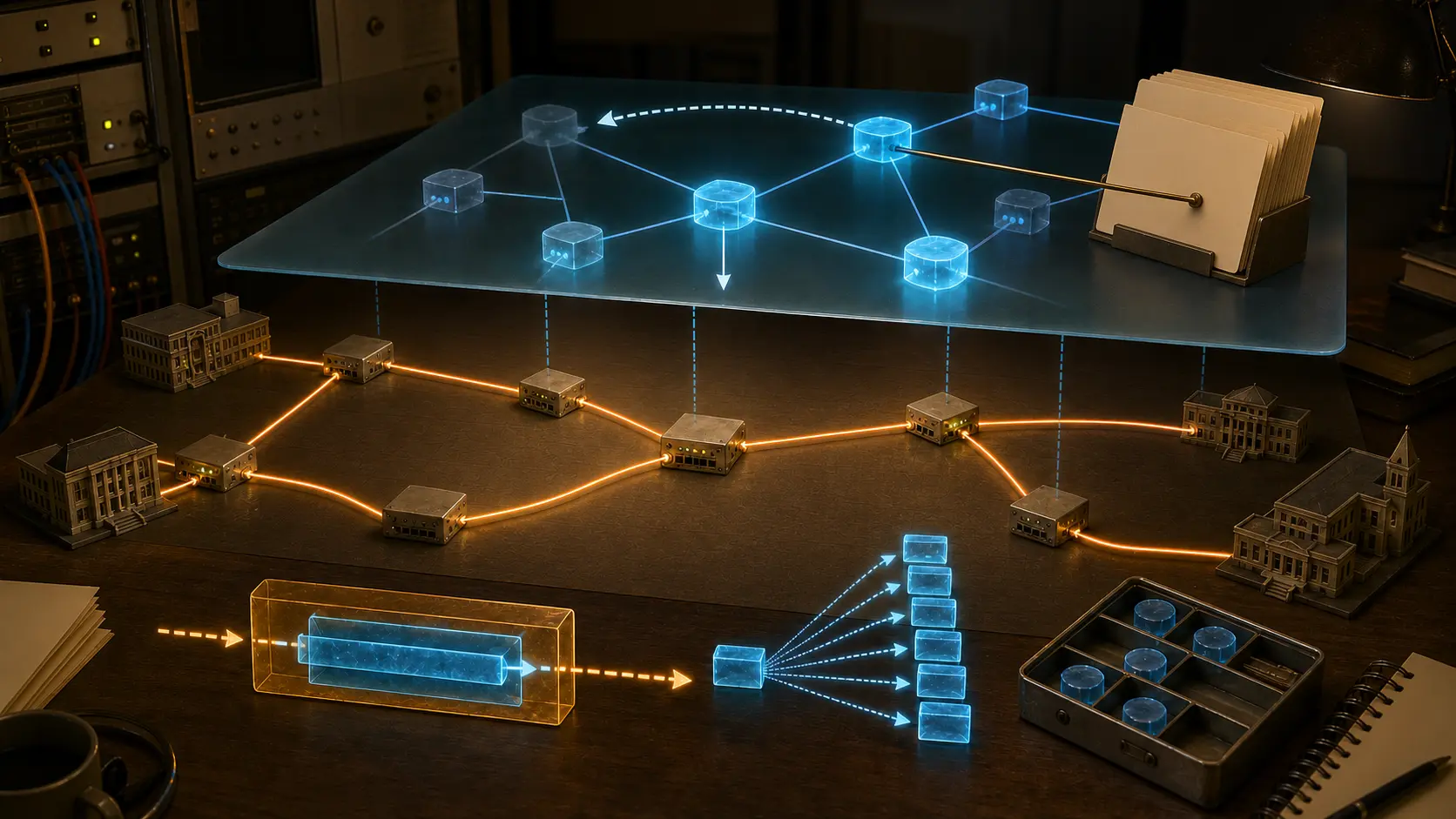
The alternative was to borrow the Internet's connectivity while leaving its gateways alone. A complete OSI connectionless network-layer PDU—CLNP, ES-IS or IS-IS—would be placed inside an IP datagram. Sites would run the OSI protocols directly on local links and invoke the Internet only when an IP gateway separated them. The memo called that carrier the “IP subnet.” It called the experiment above it EON, the Experimental OSI-based Network.
A reachable address was not yet an EON neighbour
This use of subnet was deliberately logical. Almost any system at a participating site might be reachable through IP, RFC 1070 observed, while only a configured subset would consider itself directly connected to the IP subnet for OSI testing. A machine could present itself as an OSI end system, an intermediate system or both. It could change that role without moving on the physical Internet.
Direct EON put each ISO-gram in the data field of an IPv4 datagram and used protocol number 80. The designers wanted the OSI layer to perform fragmentation so that its behavior could be exercised, but they could not prevent IP fragmentation and therefore still required reassembly below. Even here, the layers produced different evidence: an IP fragment arriving did not prove that the enclosed OSI PDU had been reassembled, accepted or routed.
Addressing made the carrier usable without erasing that separation. The EON NSAP format followed RFC 1069 and embedded the four-octet Internet address near its end. The corresponding subnetwork attachment address could therefore be derived algorithmically. Initial local-area fields were zero, and IANA assigned the routing-domain number. The mapping answered where an IP datagram could be sent. It did not answer whether that destination was currently an ES, an IS, a one-hop EON peer or a useful route.
RFC 1070 was explicit about what it was not doing. It did not propose production scale, arbitrary NSAP formats, mandatory support for every OSI routing protocol, IP routing algorithms for the ISO-grams, or IP-to-CLNP gatewaying. The Internet was not being renamed an OSI network. It was supplying a packet service underneath an experiment that retained OSI routing and addressing.
SNAcP manufactured the broadcast subnet that IP did not promise
The OSI routing exchanges assumed broadcast-subnetwork meanings such as “all end systems” and “all intermediate systems.” The IP substrate did not give EON those groups. RFC 1070 inserted a small SubNetwork Access Protocol, SNAcP, between the OSI connectionless layer and IP.
Each SNAcP kept a cache of Internet addresses that its local system considered reachable in one ISO 8473 hop. For an individual destination, it sent one copy. For all ESs, all ISs or broadcast, it replicated the ISO-gram to the cached addresses. A short header carried version, address semantics and an ISO Fletcher checksum. On receipt, the local SNAcP always accepted individual and broadcast traffic, while acceptance of the all-ES and all-IS forms depended on whether the machine was configured for those roles.
The apparent broadcast network was therefore an act of replication plus local interpretation. A packet sent to every cached address was evidence that the sender's cache had a membership view. Acceptance was evidence about the receiver's role configuration. Neither event established that all possible participants existed in the cache, that their roles were current or that an OSI route would be learned.
Error handling preserved the same layering. RFC 1070 suggested that destination-unreachable, parameter-problem or time-exceeded indications from ICMP could mark a cached peer unusable; source quench could do so temporarily. It left the response local. “Inform network management” might mean a console line, counter, log, local process—or nothing. When an address was unusable, SNAcP omitted it from replicated traffic and returned an error for individual traffic. An IP-layer observation altered a local model of the experimental link, but only through policy.
One list bootstrapped topology; another merely helped people
A core system needed peers before routing exchange could teach it peers. RFC 1070 therefore assigned IANA four files. core.EON and core.EON-UDP supplied addresses considered logically one ISO hop away for the two experiments. hosts.EON and hosts.EON-UDP listed participating end systems for applications and human users. The host lists were explicitly not used by the OSI connectionless network layer.
The distinction was sharper than the filenames suggest. Inclusion in core.EON did not mean a machine was a gateway or even an IS; it could be an ES, an IS or both. A new core participant could operate before its entry was distributed, but rebooting peers would not know to send it initial ESH or ISH configuration messages. The file was operational boot knowledge, not a complete description of role. The host list was descriptive convenience, not routing input.
RFC 1070's hypothetical Fordor site turns these abstractions into an evidence test. Address 192.5.2.1 begins as an IS and core system; 192.5.2.2 begins as an ES. They reverse roles while their physical Internet connectivity remains unchanged. If IANA's list is not updated immediately, other core systems continue to send configuration messages to .1, which now replies as an ES. They do not know to contact .2, so the new IS appears unreachable in the EON topology even though it remains IP-reachable.
When .2 boots and advertises through the OSI routing exchanges, intermediate systems can answer and update their caches. The logical links then appear. No cable was repaired and no IP route necessarily changed. What changed was the evidence available to the network layer: registry seed, role announcement and learned one-hop state.
UDP access produced a parallel experiment, not a fallback identity
Some implementers had a system interface to UDP but not direct access to IP. EON-UDP placed the OSI NPDU in a UDP datagram on port 147 and put SNAcP above UDP. RFC 1070 called the rest of the experiment identical, but it also said the two forms did not interoperate directly. A gateway might have been built; its design and routing were out of scope. EON and EON-UDP were distinct experiments for different implementation constraints, with separate core and host lists.
This boundary also separates RFC 1070 from nearby work. RFC 1006 carried OSI transport service over TCP so session and higher layers could run on a TCP/IP internetwork. RFC 1070 carried OSI network and transport layers over the IP internetwork. RFC 1069 described use of Internet routing and addressing in a gateway forwarding CLNP; RFC 1070 described OSI routing and addressing in such forwarding. Similar ingredients did not imply the same layer of experiment.
Sources and limits
RFC 1070 is a proposal and experimental scenario. It documents the intended mechanism and a hypothetical topology, not broad EON adoption, production fitness or a causal step toward a named modern overlay. RFC 994 and RFC 995 supply the contemporary CLNP and ES-IS specifications; they do not prove that a particular EON participant behaved correctly. The Fordor addresses illustrate stale control state and are not an incident report.
The historical claim is narrower and more useful. A network can be used as a link by another network without becoming that network. Reachability, address mapping, admitted membership, configured role, cached adjacency and learned route remain separate observations—even when they share the same packet.
Member Briefing
Deeper Profile Context
Sign in with the right membership level to unlock the full briefing and source notes.
Only for Strategic Circle
Strategic Circle
Open to all readers. Unlock profile briefings after joining and signing in.
Join Strategic CircleOnly for Leadership Alliance
Leadership Alliance
For qualified IP-asset owners and management; sign in to unlock alliance briefings.
Join Leadership Alliance