
Open standards body with worldwide implementation impact.
Governance / IETF
IETF
IETF governance intelligence tracks institutions, policy processes, standards activity, registry operations, accountability disputes, and implementation signals that affect internet infrastructure. BTW.
GlobalProtocol GovernanceInteroperability Risk

Protocol process and standards legitimacy.
Spec-to-implementation gap across vendors and operators.
Major standards shifts usually affect systems over 120d+ cycles.
Latest Coverage
Latest from IETF
519 articles

IETF
INTAREA Adopted a Registry Cleanup. IANA Has Not Applied It.
An Internet-Draft can acquire a working group without changing a single live registry. That is what happened on 11 September: INTAREA published its version of a proposal to close one legacy list, assign procedures to three others and remove a fifth. The institutional handoff is…

IETF
DANCE 14 Turns Four TLSA Outcomes Into a Two-Way Server Decision
Four DNS observations can now enter the same TLS policy gate. The latest DANCE client-authentication draft tells a server what to do when it receives anything other than a DNSSEC-validated TLSA record set: abort, or continue while treating the client as unauthenticated. Revision…

IETF
EDE 33 Can Show an NTA Without Showing It Changed the Answer
A new DNS diagnostic can make a hidden exception visible without explaining its effect. EDE 33 tells a client that a covering Negative Trust Anchor was active when a resolver generated a response. The current draft also allows the signal when the exception made no material…

IETF
The OpenPGP Stub Travels. The Secret Key Does Not.
OpenPGP is considering a standard way to carry a secret-key record without carrying the secret. That is useful precisely because it preserves a boundary: a transferable stub may identify the public key and say that the secret component lives in an external device, yet it cannot…

IETF
A Subject Line Cannot Open a DNSOP Adoption Call
For 98 minutes on 9 September, an email archive carried a title that sounded like an official process event. Then a DNSOP chair drew the boundary: authors may introduce a draft and ask whether the work belongs, but the chairs issue calls for adoption. The correction matters…

IETF
ACTN’s Abstract Topology Is a Policy View, Not a Physical Inventory
An optical controller may show a coordinator that two packet edges could be connected while withholding the fibres, wavelengths and vendor-specific constraints underneath. That abstraction is not a defective inventory. It is a deliberately governed view. The evidentiary mistake…

IETF
RTCP Can Carry a Resolution Request, Not an Energy-Savings Claim
A new RTCP feedback format gives a video receiver a precise way to ask for fewer frames or fewer pixels. That is useful running code. It is not an energy meter. The governance problem begins when a standards-compliant request, or the sender’s acknowledgement of it, is promoted…

IETF
The IETF Approved an ML-DSA RFC, Not a Deployment Recommendation
A standards body can finish a specification without finishing everybody’s risk decision. On 10 September, the IETF released the hold on *Use of ML-DSA in TLS 1.3* and approved it for publication as an Informational RFC. Three identifiers are already visible in the TLS registry.…

IETF
The IAB’s ISE Survey Needs a Public Interpretation Rule
The Internet Architecture Board has opened an anonymous survey about what it should value in a future Independent Submissions Editor. The link may travel widely, some people may receive it more than once, and the IAB correctly says the exercise is not a vote. That design can…

IETF
The Channel Ended. The Claims Kept Moving: RFC 9781 and the UCCS Source Break
A verifier can receive an authenticated, integrity-protected claims set and still lose the basis for that assurance one function call later. RFC 9781 makes this boundary unusually concrete: tag 601 identifies an unprotected CWT Claims Set whose protection belongs to a channel…

IETF
The Header Found the Verifier. It Did Not Earn the Decision: RFC 9782
An API gateway can read `application/eat+cwt`, select a handler and produce a clean routing log before anyone has established what the bytes contain. RFC 9782 makes that first step interoperable. Its importance lies equally in what it refuses to collapse: a media type can name a…

IETF
IETF Opened an AI Standards List Without Defining Its Decision Path
The IETF has given a disputed question a dedicated address. On 9 September, its Secretariat created `[email protected]` for discussion of artificial intelligence in the standards process. That is a useful institutional act: it makes participation and the public archive…

IETF
The Hidden Service Answered. The Onion Key Had Not Yet Spoken: RFC 9799
The hidden service answered over Tor, the ACME account was valid, and the final CSR was ready. None of those facts yet proved that the applicant controlled the `.onion` identity. RFC 9799 makes that missing proof explicit—and shows why issuance authority, descriptor visibility…

IETF
IETF–W3C: A Relationship Record, Not a Single Institution
The label “IETF–W3C” compresses two standards institutions into one directory entry. The public record supports a narrower description: the organizations have documented channels of cooperation, but the evidence reviewed does not establish one legal entity, one administrative…

IETF
A Physical-Site Receipt Can Be External to the Issuer—and Still Controlled by the Site Owner
Revision 03 of a proposed receipt for work at physical sites fixes several ambiguities with admirable candour. It also names a trust edge its own bytes cannot carry. A transparency service may be independent of the receipt issuer yet operated by the owner of the site whose…

IETF
ALLDISPATCH Is a Routing Forum, Not a Standards Authority
The IETF-Wide Dispatch session can influence where emerging protocol proposals go next, but its leverage lies in routing and coordination—not in independently approving standards.
IETF
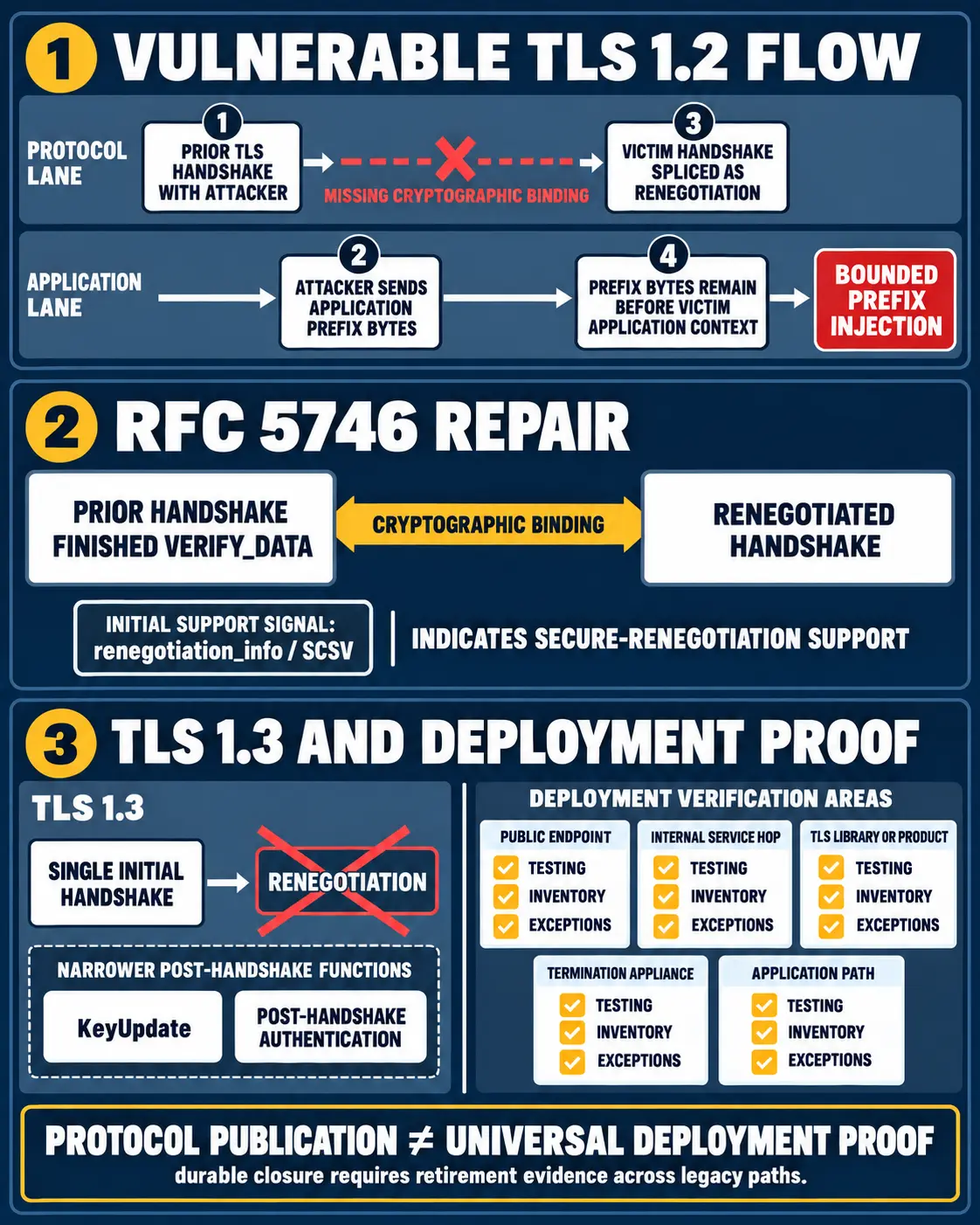
TLS Renegotiation Was Repaired. Deployment Closure Is a Separate Claim.
The IETF repaired a dangerous ambiguity in TLS renegotiation. That repair changed the protocol. It did not, by itself, prove that every older library, appliance, endpoint and application path had stopped accepting the unsafe behavior.

IETF
A New MOA PDU Can Withdraw Authority. Its Validation Order Is Still Missing
Revision 01 of a proposed RPKI-to-router message now tells a cache how to withdraw all or part of a Mapping Origin Authorization and tells a router when stale MOA data must disappear. That is useful state discipline. But the draft places the order and fallback between MOA and…

IETF
An IETF Draft Names a Conflict-of-Interest Gap. Authority Should Trigger the Safeguard
Revision 07 of an individual IETF process draft adds only one short paragraph on conflicts of interest. The paragraph is enough to expose a larger design problem: the IETF has several concrete conflict policies, but each belongs to a defined body or corporate role. A general…

IETF
DNS Types 69 and 70 Delegate Meaning but Do Not Name the Registry Version
A signed DNS record can preserve every octet and still leave one historical question outside the signature: which edition of an external registry gave those octets meaning? Two newly assigned resource-record types make that boundary concrete. UNECE is now type 69 and ISO is type…
Member Unlock
Restricted Profile Intelligence
Login is required to unlock full profile briefings and deep-dive sections.
Strategic Circle Briefing
Join to unlock strategic briefings after signing in.
Join Strategic CircleLeadership Alliance Briefing
For qualified IP-asset owners and management; sign in to unlock alliance briefings.
Join Leadership Alliance