
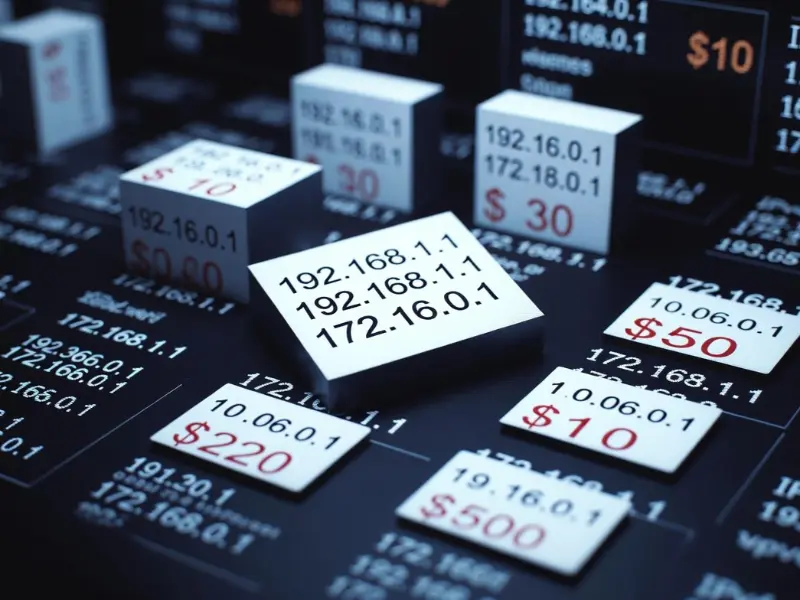
- IPv4 addresses in 2026 continue to trade as scarce digital assets with quantifiable market value, influenced by block size, demand and alternative technologies.
- Enterprises must balance asset ownership, recurring income through leasing and strategic financial planning within the structural constraints of the IPv4 ecosystem.
IPv4 value in a constrained internet economy
The exhaustion of the global free pool of IPv4 addresses has shifted these identifiers from a technical utility to a form of digital capital embedded in balance sheets and secondary markets. Scarcity has become a structural condition of the Internet’s registry system, not a temporary bottleneck.
Market data from 2025 shows that the purchase price for IPv4 addresses remains in the tens of dollars per address, with larger blocks typically commanding lower per-unit prices than smaller ones. For example, average values range roughly between $30 and $40 per address, though regional variation exists and some blocks trade for more depending on size and demand. Smaller blocks such as /24 (256 addresses) remain relatively expensive on a per-address basis.
Lease markets reflect a different valuation dynamic: relatively low monthly costs signal ongoing operational demand but also the structural reality that access to IPv4 space is increasingly an operational expenditure rather than a one-off capital cost. Typical lease rates average around $0.40–$0.50 per address per month in many regions, underscoring how IPv4 inventory can generate recurring income for holders.
Also Read: What makes an IP address a form of digital capital
Case study: Translating scarcity into financial streams
Larus — a Hong Kong-based company widely reported in industry news — aggregated a portfolio of over 10 million IPv4 addresses acquired through AFRINIC region allocations. Instead of using all these addresses operationally, the company leased blocks to global enterprises and ISPs, capturing ongoing lease revenue tied to scarcity rather than enabling immediate resale. This approach illustrates how IPv4 holdings can function as long-term revenue streams, especially where enterprises face persistent demand for IPv4 compatibility.
This does not imply that leasing is an optimal economic decision in isolation. Rather it reveals how the structural limitations of the IPv4 regime shape financial incentives: ownership retains optionality, transfer markets realise one-off capital, and leasing creates recurring operating cash flow. These choices must be assessed within broader corporate finance strategies, particularly as price trends show some softening in purchase values for large blocks while lease demand remains steady.
Also Read: How does an IP address contribute to fraud detection?
Beyond spot prices: Asset and strategy
In 2026, the value of an IPv4 address cannot be reduced to a spot price quoted on a marketplace. It functions simultaneously as a balance-sheet asset, a source of recurring operating income when leased, and a structural constraint imposed by an Internet architecture that does not permit clean exit.
Ownership preserves optionality in a finite system. Leasing converts that optionality into predictable cash flow. Selling realises capital at the cost of future participation. None of these choices resolve scarcity.
Instead, they reflect how enterprises adapt financially to a registry system where addresses cannot be replenished and IPv4 compatibility remains mandatory. As outlined in BTW’s analysis of IP addresses as digital capital, valuation in this context is shaped less by technical utility than by governance structure, coordination limits and the absence of meaningful alternatives.