
- Earth observation satellites capture high-resolution images of the Earth’s surface for applications in environmental monitoring, disaster response, urban planning, and agriculture.
- Weather satellites monitor atmospheric conditions and meteorological parameters to predict and track weather phenomena like storms, hurricanes, and climate trends for accurate weather forecasting.
- Satellites support scientific research in astronomy, Earth sciences, climate studies, and space exploration by providing data for experiments, analysis, and study of phenomena inaccessible from the ground.
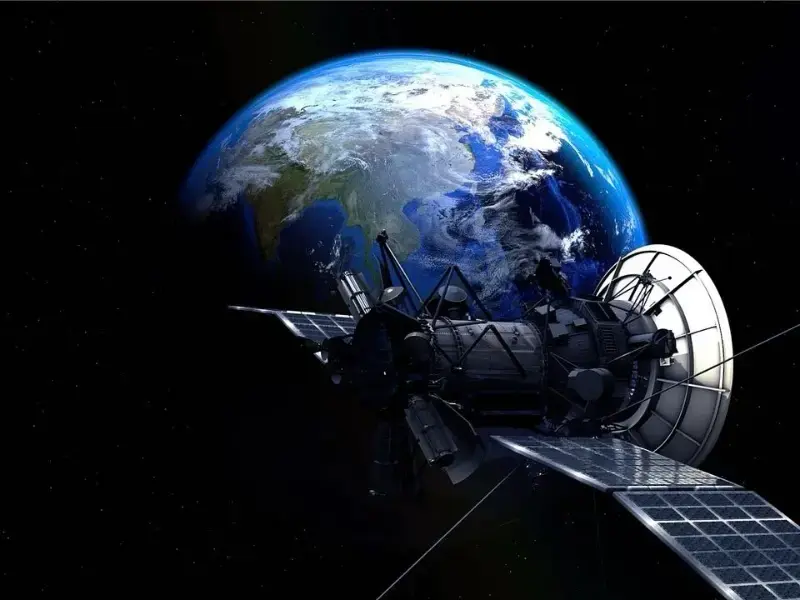
A satellite is an independent communications system that can receive messages from Earth and retransmit them by utilising a transponder, which is a radio signal receiver and transmitter combined into one unit.
When a satellite is launched, it must endure the shock of being propelled into orbit at a speed of 28,100 km/h and a hostile space environment where it may be exposed to radiation and extremely high temperatures for the duration of its anticipated 20-year operating life. Furthermore, because satellite launches are highly costly and dependent on weight, they must be light. Satellites need to be compact and built of strong, lightweight materials to fulfil these requirements.
Launch and orbit
Satellites are meticulously designed and constructed before being launched into space atop powerful rockets. The selection of the satellite’s orbit is crucial and depends on its intended purpose. Geostationary orbits keep satellites fixed above a specific point on Earth, ideal for communication purposes. Polar orbits provide global coverage for Earth observation and scientific research, while low Earth orbits enable faster data transmission for navigation systems like GPS.
Communication
Communication satellites serve as vital links in the global communication network, relaying signals between different locations on Earth. These satellites receive signals from ground stations, amplify them, and transmit them back to designated locations. This technology enables a wide range of communication services, including television broadcasts, internet connectivity, telephone communications, and secure military communications.
Also read: What is satellite technology?
Navigation
Navigation satellites, such as the iconic Global Positioning System (GPS), have transformed how we navigate the world. By receiving signals from multiple satellites and triangulating their positions, GPS receivers can pinpoint their exact location on Earth with remarkable precision. This technology has applications in aviation, maritime navigation, surveying, and emergency response systems.
Earth observation
Satellites equipped with advanced imaging sensors capture detailed images of the Earth’s surface for a myriad of applications. These high-resolution images are invaluable for environmental monitoring, disaster response, urban planning, agriculture, and land-use management. Satellite imagery provides crucial data for decision-making processes and helps monitor changes in the Earth’s ecosystem over time.
Weather forecasting
Weather satellites play a pivotal role in monitoring atmospheric conditions, cloud cover, and other meteorological parameters from space. By observing weather patterns and changes in real-time, meteorologists can predict and track weather phenomena such as storms, hurricanes, and climate trends. This data is essential for issuing accurate weather forecasts, early warnings for natural disasters, and climate research.
Also read: Google Pixel 9 could gain satellite SOS feature
Scientific research
Satellites are indispensable tools for scientific research across various disciplines. They enable astronomers to study distant galaxies, Earth scientists to monitor climate change and natural disasters, and researchers to explore remote regions of the planet. Satellite data is instrumental in advancing our understanding of the Earth, the universe, and the impact of human activities on the environment.
Data transmission
Satellites facilitate the transmission of data over vast distances without the need for physical infrastructure on the ground. This capability is particularly valuable in remote or inaccessible areas where traditional communication networks are limited or non-existent. Satellite-based data transmission is vital for connecting remote communities, supporting emergency communication services, and enabling global connectivity in challenging environments.