
Summary
- What it says: Hire Electronic & Networking is a small Bangladeshi ISP operating in Sarishabari, Jamalpur, and Mymensingh.
- Main topic: Network-resource evidence
- Context: Telecommunications / Company research / Asia-Pacific
Thesis
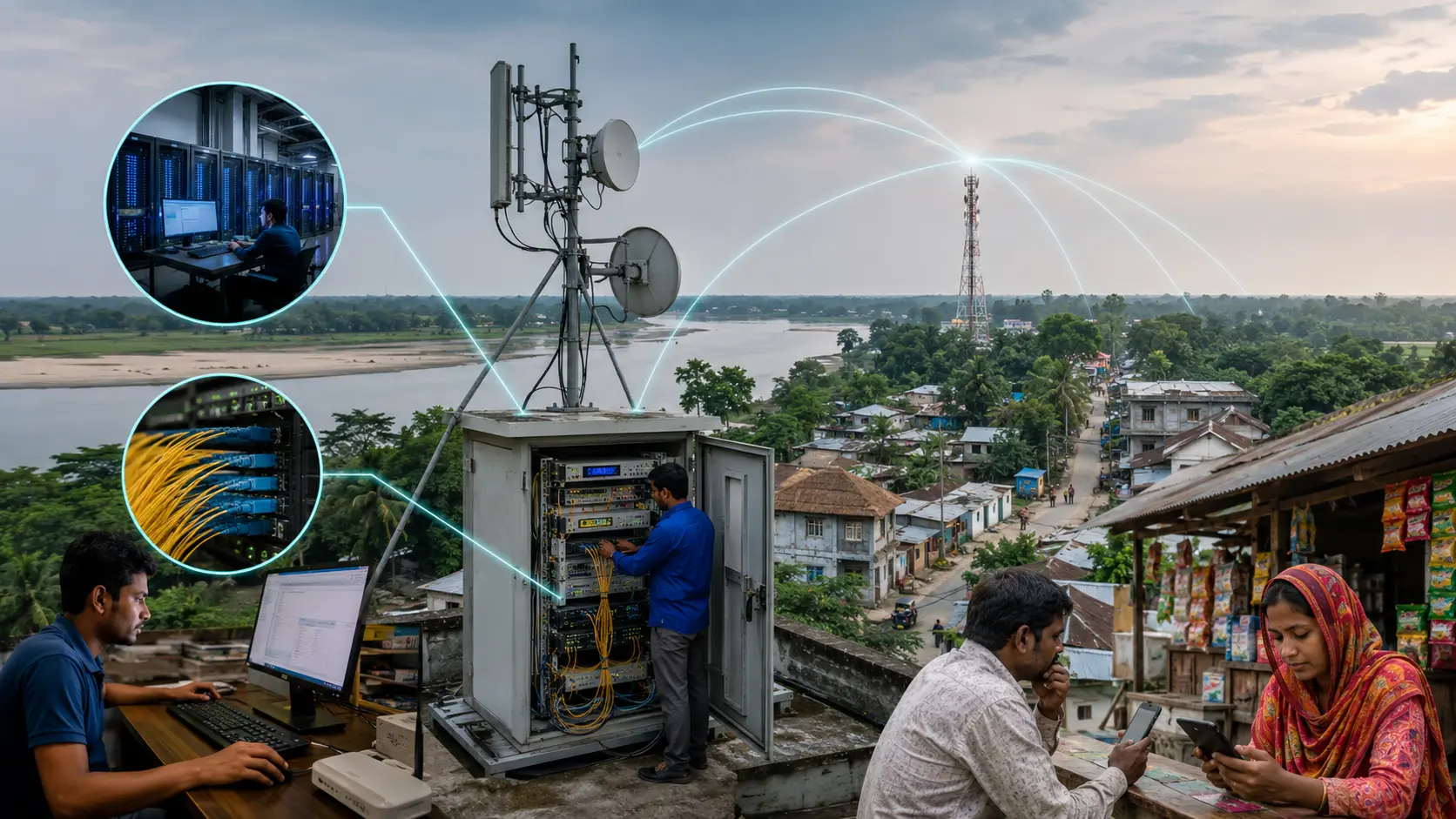
Hire Electronic & Networking is economically interesting because it is not a large operator. It is a small, locally legible access provider with just enough public routing independence to appear in the global Internet control plane, while remaining commercially dependent on upstream transit, domestic interconnection, local trust, on-the-ground service quality, and the regulated retail economy.
Public data suggest a Bangladeshi fixed broadband operator centered on Sarishabari, Jamalpur, and Mymensingh, using the names “Hire Electronic & Networking,” “Hira Electronics & Networking,” and variants of “HIRA Electronices & Networking.” The strongest registry anchor is the APNIC organization entity ORG-HA80-AP, which registers “Hire Electronic & Networking” as a Bangladeshi LIR in Shimla Bazar, Sarishabari, Jamalpur, with the email domain hiraelectronicsandnetworking.com.
The economic thesis is that Hire/Hira is a microcosm of Bangladeshi ISP local bargaining. The operator can signal legitimacy via an ASN, APNIC number resources, valid RPKI prefixes, BTRC/ISPAB registrations, a retail website, local offices, online bill payment, and a customer app. Yet the bargaining stack remains asymmetric.
It appears to originate only two /24 IPv4 prefixes and a /48 IPv6 prefix, and the major public BGP sources observe Windstream Communication Limited as its active upstream path; bgp.tools also places AS150747 in route-set contexts, including AS149765:AS-CORONETIIG-BD, which is a Coronet IIG route registry hint rather than evidence of current affiliation or direct transit.
This matters for the local connectivity economy. In Bangladesh, a small access ISP typically does not win by owning scarce international capacity, submarine landing assets, or metropolitan fiber ducts. It wins by controlling the last-mile relationship: installation, repair, payment collection, local latency, real-IP availability, cached/local content, and the trust that a technician will answer the phone. Hire/Hira’s public materials sell exactly that: residential and business broadband, fiber optic delivery, local media services connected to BDIX, gaming support, online support, bill payment, and a promise of prompt help.
The unresolved facts are as economically important as the resolved ones. The public record does not establish a clear corporate control chain, current shareholders, funding, M&A history, upstream contract terms, the NTTN provider, exact subscriber count, real churn rate, on-the-ground capex, service-level data, or whether the Coronet route-set hint reflects a current, past, backup, or merely administrative relationship. What can be seen is sufficient to classify the company as a small, formalized local ISP whose public route visibility exceeds its likely wholesale bargaining power. That is the central intelligence finding.
Identity, Naming, and Operating Legal Entity
The target can be identified with moderate confidence, but not with the clean identity profile of a large listed telecom. The first RDAP/WHOIS clue points to the APNIC handle ORG-HA80-AP. The APNIC WHOIS entity gives the organization name as “Hire Electronic & Networking,” country Bangladesh, address “Shimla Bazar, Sarishabari, Jamalpur,” telephone +8801811100001, and an administrative email at hiraelectronicsandnetworking.com. The entity was last modified on 5 September 2023.
The market-facing operational name appears more often as “Hira Electronics & Networking” or “HIRA Electronics & Networking.” The company website welcomes users to “HIRA Electronices & Networking,” uses the same domain hiraelectronicsandnetworking.com, and lists Internet, broadband, Web, networking, software, online support, 24/7 customer service, media services, and an office at 92/B/2 C.K. Ghosh Road, Sadar, Mymensingh. The ISPAB membership page registers “Hira Electronics & Networking,” gives Mr. Kousik Dey Sarker as the named person, states membership number G-123, displays the emailhenbd.isp@gmail.com, and describes the BTRC license type as “Nationwide,” while leaving several company detail fields incomplete.
The BTRC divisional ISP license list is the strongest public regulatory anchor for the licensing geography. In the BTRC list dated 23 December 2024, row 184 registers “Hira Electronics & Networking” in Mymensingh division with an address at Shimla Bazar, Sarishabari, Jamalpur, and license number 14.32.0000.702.45.394.21.095.
The columns in the same row list “License Validity” as 3 July 2023 and “Date of Next Renewal” as 4 July 2023; since the column labels and dates are contradictory within a 2024 list, the cautious interpretation is not to declare the license expired, but to note that the public list reports a divisional license entry with renewal-date ambiguity.
The identity thus has three layers. The registry layer says “Hire Electronic & Networking.” The retail layer says “Hira Electronics & Networking,” with a visible spelling variation. The regulator/member layer says “Hira Electronics & Networking,” with a disagreement between the BTRC divisional entry and the ISPAB “Nationwide” wording. In economic terms, this ambiguity is not cosmetic. For a large operator, name variation would generally be a disclosure weakness.
For a local ISP, it is often an ordinary feature of a business sufficiently formal to obtain number resources and a license but not institutionalized enough to maintain uniform public documentation across APNIC, BTRC, ISPAB, PeeringDB, Google Play, web pages, and channel registrations.
There is also a website copy anomaly. The home page and the “about” page of the company website contain references to “Sky Net BD” or “SkyNetBD,” including language that says Sky Net BD is a leading broadband provider in Sarishabari and that SkyNetBD started in 2016. This does not prove a predecessor, merger, reseller relationship, or fraudulent identity. It could reflect template reuse, legacy brand copy, an older local operating label, or text reused by a web developer. It is still economically significant because small retail ISPs sell trust locally.
A customer may care less about clean corporate naming than whether the line works, but counterparties, regulators, upstream providers, payment processors, and anti-abuse services care more about registry cleanliness. The naming evidence supports a cautious conclusion: the operating entity is real enough to have an ASN, APNIC resources, a BTRC registration, ISPAB membership, a PeeringDB profile, a website, and an app, but its public corporate disclosure remains thin.
What the Company Appears to Sell
The company appears to sell fixed broadband access, local area network services, and a bundle of conveniences for small ISP customers. The website describes “high-quality high-speed broadband,” “Web,” “networking,” “software,” “IT solutions,” “online support,” “24/7 customer service,” and media services such as FTP, streaming, torrent, and live TV.
The services page states that it provides high-speed broadband in Sarishabari, Jamalpur, offers IT solutions, provides free real IP for residential users on plans above 1,500 Tk, uses fiber optics for most business and residential connections, offers backup power for special business and residential users, and helps with network, routing, and gateway issues.
The product surface is thus broader than a mere access pipe but narrower than an enterprise operator. The likely core revenue is monthly residential and small-business broadband. Adjacent revenue or retention sources are business connections, real IP, backup-power links, IT/network support, local content servers, online bill payment, and app-based account management. The company’s public plans page lists residential/business plans from 25 Mbps at 500 Tk per month to 75 Mbps at 2,000 Tk per month, each marketed with unlimited data, FTP access, online gaming, Google apps, and Facebook access.
These prices reveal the commodity nature of local fixed broadband. The 25 Mbps, 30 Mbps, 35 Mbps, 40 Mbps, and 50 Mbps plans all sit near 20 Tk per advertised Mbps per month; the 65 Mbps and 75 Mbps plans cost more per advertised Mbps. This does not reveal actual committed throughput, contention ratio, or wholesale cost. It shows that the retail conversation is centered on advertised Mbps and bundled local content, not on clean enterprise service-level metrics.
In such a market, differentiation is pushed to non-price attributes: whether the line is installed quickly, whether the router is configured correctly, whether a technician arrives during an outage, whether gaming latency is tolerable, whether a real IP can be provided, and whether payment friction is low.
The company’s app reinforces this reading. The Google Play listing for “Hira Electronics,” developed by TNRSOFT and powered by “Smart ISP,” indicates that customers can manage connections, pay bills, submit support requests, view bill history, and manage profile/account information; the app had only 50+ downloads in the Play listing and was updated on 17 November 2025. Economically, an app with low public download numbers is not evidence of a large digital customer base.
It is evidence that a small provider adopts off-the-shelf ISP management software to reduce billing friction, formalize service tickets, and appear more trustworthy to end users. The relationship with the software provider is also a dependency surface: a small ISP can digitize customer operations without building software in-house, but it becomes dependent on a third-party billing/support stack.
Geography and Market Segment
The public footprint points to Sarishabari, Jamalpur, and Mymensingh rather than a nationwide access footprint. The APNIC organization entity and the BTRC divisional license list both point to Shimla Bazar, Sarishabari, Jamalpur. The company contact page lists a Sarishabari office at Aramnogor Bazar with coverage including Aramnogor Bazar, R.U.T School Road, and Jalupara; it also lists a corporate office in Mymensingh on C.K. Ghosh Road covering the Mymensingh City Corporation area, and a Shimla Bazar office marked “Coming Soon.”
PeeringDB adds a self-described market claim: the AS150747 profile states that the network is one of the leading ISPs in Mymensingh division and serves more than 5,000 residential users in Mymensingh and Jamalpur. This is not audited evidence. PeeringDB data are typically entered by the operator. Nonetheless, it is commercially informative because the claim is internally plausible for a small local ISP: large enough to warrant an ASN and a public PeeringDB entry, small enough that the public routing table shows only a tiny address footprint.
The operational geography matters because the economics of fixed broadband in Bangladesh vary sharply between dense urban wards, district towns, and semi-rural clusters. In a dense urban area, the last-mile cost per customer can be amortized over apartment buildings and short cable runs. In smaller towns and bazaar-centered coverage, customer acquisition and maintenance depend more on physical drops, poles, splices, field technicians, and local reputation.
Hire/Hira’s pages emphasize specific local markets and office locations rather than a wide national enterprise reach, which is consistent with a local access network business whose moat is local familiarity and the path to the customer, not ownership of nationwide backbone assets.
The geography on the contact page also indicates a possible operational evolution. The Sarishabari office resembles the original local access base, while the Mymensingh corporate office suggests expansion into a larger divisional city where business customers and higher-density residential clusters can improve ARPU and reduce per-customer maintenance cost. The reference to a trade license in the website footer and the Mymensingh address further support a more formal retail presence than a purely informal reseller operation.
Network Evidence: Small but Globally Visible
The most important hard infrastructure evidence is AS150747. bgp.tools identifies AS150747 as “Hire Electronic & Networking,” registered on 6 February 2023, active, APNIC region, “eyeball,” with two IPv4 prefixes and one IPv6 prefix. It lists active IPv4 routes as 103.82.202.0/24 and 103.82.203.0/24, and the IPv6 route as 2001:df1:ec40::/48, all with valid RPKI certification. Hurricane Electric’s BGP Toolkit similarly shows AS150747 as Bangladesh-based, originating two IPv4 prefixes and one IPv6 prefix, with all originated routes RPKI valid and zero RPKI invalid originated routes.
The IPv4 footprint is tiny: two /24s amount to 512 IPv4 addresses before any internal reservation, infrastructure assignment, static customer assignments, NAT gateways, and business-use allocation. The APNIC inetnum view for 103.82.202.0–103.82.203.255 registers 512 addresses, netname HIRAELECTRONICSANDN-BD, country Bangladesh, geolocation near Jamalpur, and assignment to Hire Electronic & Networking.
For a provider claiming thousands of residential users, the arithmetic implies one of three conditions: carrier-grade large-scale NAT, selective public IPv4 allocation only to paying or higher-tier customers, or additional leased/private addressing not visible as originated by AS150747. The services page claim that real IP is free only for residential users on plans above 1,500 Tk aligns with this scarcity logic.
IPv6 is present but not necessarily proven at retail scale. APNIC registers the IPv6 allocation 2001:df1:ec40::/48 to Hire Electronic & Networking, and BGP sources show the IPv6 route as originated and RPKI valid. This is a positive routing-hygiene signal. But a routed /48 does not by itself prove that residential subscribers receive IPv6 prefixes, that customer routers are configured for IPv6, or that support staff can troubleshoot dual-stack service. In many small ISP markets, IPv6 visibility appears first in routing registrations and only later, unevenly, at the customer edge.
The policy environment may accelerate this: the BTRC draft FTSP guidelines include IPv6 adoption among the performance considerations for renewal.
Route visibility also shows dependence. Hurricane Electric observes one BGP peer for AS150747, Windstream Communication Limited AS139009, for both IPv4 and IPv6. bgp.tools lists Windstream as the observed upstream and also shows Speed Communication AS149452 in the peers section, though its upstream summary remains centered on Windstream. For economic analysis, the cautious conclusion is that Hire/Hira’s public Internet reach is not visibly multi-homed across multiple independent global transit paths. It has enough independence to originate its own prefixes, but visible path diversity is limited.
CAIDA’s AS Rank profile reinforces the small network classification. It records AS150747 in Bangladesh with a very small customer cone and degree profile, and with 512 IPv4 addresses in the prefix count. CAIDA metrics are inference-based and should not be read as financial statements, but they are consistent with the observed picture: a local access ASN, not a transit hub.
The Coronet Hint: Route-Set Economics, Not Ownership Proof
The relationship clues provided by the user include Coronet Corporation Limited and CORONET CORP LTD. The public evidence supports a routing-directory relationship, not a clear ownership or affiliation conclusion. bgp.tools lists AS150747 as a member of several AS-SETs, including the APNIC as-set as149765:as-coronetiig-bd. It also lists other route-set memberships, including sets associated with DTLIIG, GMAX, and Windstream contexts.
Coronet itself is a significant infrastructure counterparty in Bangladesh. Its PeeringDB profile describes Coronet as an Internet infrastructure provider in Bangladesh, operating IIG AS149765 and nationwide retail ISP AS138640, claiming more than 3 Tbps of live traffic, CDN/content peering, and a presence in facilities in Singapore, Mumbai, Kolkata, and Delhi. The Coronet website presents Coronet Corporation Ltd. as a Bangladeshi IIG/IP transit company offering MPLS, IPLC, Global Ethernet, DIA, and IP transit services.
bgp.tools identifies AS149765 as Coronet’s APNIC region ASN, registered in 2022, with originated prefixes and valid RPKI route assets.
The economic interpretation is precise. Inclusion in AS149765:AS-CORONETIIG-BD suggests that Hire/Hira has appeared in a route-filtering, customer, partner, or propagation context related to Coronet. It does not, by itself, prove current active upstream service from Coronet, current ownership by Coronet, exclusivity, or customer volume. In the public BGP views examined here, Windstream is the directly observed upstream of AS150747.
This distinction matters because route-set membership and route visibility are bargaining tools. A small ISP with its own ASN and prefixes can be added to upstream route filters, switch or supplement upstream providers, and preserve customer addressing if it changes wholesale providers. This improves optionality relative to a reseller that uses only an upstream provider’s address space. But optionality is not the same as bargaining power.
If the ISP has a single visible upstream, small volume, limited address space, and no public IX presence, upstream providers still control pricing, traffic quality, route reach, DDoS management, and international congestion risk.
Windstream as Visible Upstream and What It Implies
Windstream Communication Limited AS139009 appears as the main visible upstream. Hurricane Electric’s AS139009 page shows Windstream as a Bangladeshi network with 57 originated prefixes, 1,115 announced prefixes, no RPKI invalid originated prefix in that view, and hundreds of observed BGP peers. The same Windstream page includes Hire Electronic & Networking AS150747 among the connected AS entries, including in IPv6 peer/customer lists.
This supplier relationship is economically more important than Hire/Hira’s retail website. Upstream transit determines the quality and cost floor of the local ISP’s Internet access. If Windstream is the only practical wholesale path, Hire/Hira can market 25–75 Mbps plans, local FTP, gaming, and support, but it cannot fully control international latency, upstream congestion, route leaks, DDoS mitigation, or price changes. The local ISP’s own brand is blamed for problems caused upstream because residential customers perceive the service as a single retail product.
The independent ASN partially mitigates this. If Hire/Hira used only address space provided by Windstream, changing upstream would be more disruptive. With AS150747 and its own APNIC resources, the company can in principle announce its prefixes via another IIG/transit provider, add a second upstream, or modify routing policy without renumbering all customers. This is a genuine economic asset. But the asset is modest: only two /24 IPv4 prefixes and one /48 IPv6 prefix are visible, and public PeeringDB data show no exchange point or interconnection facility for AS150747.
The bargaining equation is therefore asymmetric. Hire/Hira can threaten to move routes more credibly than a pure downstream reseller, but wholesale providers can still price based on the small volume and operational dependence. The small ISP’s best leverage is not global transit volume; it is the ability to aggregate enough local subscribers to be worth serving, to pay reliably, and to avoid causing abuse, outages, or support costs for the upstream.
Bangladesh’s Licensing Stack and Structural Dependence
Bangladesh’s ISP architecture makes local providers structurally dependent on licensed upstream and transmission layers. The BTRC guidelines for ISPs stipulate that Nationwide, Divisional, District, and Upazila/Thana ISP licensees must be connected to licensed IIG operators for international Internet bandwidth and connected to a national Internet exchange for domestic inter-operator traffic. The same guideline context describes the use of licensed transmission/network layers, including NTTN leasing, in the system architecture for ISPs.
This structure separates customer ownership from upstream control. Local ISPs own or operate the customer relationship and access edge; IIGs and other upstream categories control international bandwidth; NTTN/fiber transport providers control parts of the backhaul; the economics of domestic NIX/BDIX-type exchanges influence the cost and latency of local content. Hire/Hira’s public services page reflects this architecture by marketing BDIX connectivity, Gbps connectivity with IIG, local FTP/Web/torrent/live TV services, and game servers.
For a small access provider, the key economic problem is the margin squeeze between retail price caps and upstream/input costs. The ISP must fund customer acquisition, installation labor, drop cable or fiber, ONUs/routers, splicing, poles/rights-of-way if applicable, local backup power, bill collection, repair calls, upstream bandwidth, NTTN/backhaul, license compliance, and staff. If retail plans cluster around 500–1,000 Tk for mass-market segments, the provider must intelligently oversubscribe capacity and reduce costly traffic.
Local caches, BDIX-connected content, FTP/media servers, and game servers are not just marketing features; they are margin-protection devices.
That is why the company’s “media services” claims are important. The home page states that it offers FTP, streaming, torrent, and live TV services; the services page extends this to FTP servers, web streaming, torrent servers, live TV servers, BDIX connectivity, Gbps connectivity with IIG, and a CS:GO game server. The business logic is simple. Domestic or LAN traffic is cheaper and more controllable than international transit. If customers can watch content, download files, or play games via local paths, the ISP reduces upstream load and improves perceived speed.
The legal status of particular content libraries is not established in the examined sources, so the correct intelligence posture is not to allege infringement; it is to note that local media servers are economically important and can become a legal/regulatory risk if content rights are weak.
Retail Pricing Evidence and Margin Pressure
Hire/Hira’s published broadband prices show a constrained retail market. The listed plans are 25 Mbps for 500 Tk, 30 Mbps for 600 Tk, 35 Mbps for 700 Tk, 40 Mbps for 800 Tk, 50 Mbps for 1,000 Tk, 65 Mbps for 1,500 Tk, and 75 Mbps for 2,000 Tk per month. These are mass-market prices, not enterprise DIA prices. They likely rely on contention, local caching, and customer behavior patterns rather than one-to-one reserved capacity.
The key feature of the pricing grid is not sophistication; it is the narrowness of differentiation. Many tiers are simple 20 Tk increments per advertised Mbps. This makes the product easy to sell and compare but hard to defend. If a competitor offers 35 Mbps for 600 Tk or 50 Mbps for 800 Tk, customers can pressure the provider quickly unless they value service reliability, local content, real IP, or trust in the technician. In such markets, the “unit” sold is not just bandwidth. It is a bundle of speed, availability, local latency, installation trust, payment convenience, and social proof.
Public market commentary points to broader sector margin pressure. A 2025 report syndicated by The Daily Star via SAMENA indicated that the proposed BTRC telecom guideline amendments would impose a 5.5% annual revenue share and a 1% social obligation fund contribution, and cited ISP industry concerns that margins were already thin, with an ISPAB figure describing margins around 5–6%. A separate Daily Star commentary argued that the proposed revenue share and price controls could erode ISP profitability, make small ISPs vulnerable, and hurt network upgrades and IPv6 adoption.
These sources are industry-facing commentary and should be read as claims within a policy debate, not as verified financial evidence. They are nonetheless useful because they describe the pressure mechanism visible in Hire/Hira’s public pricing: retail rates are politically and competitively constrained while network input and compliance costs remain significant.
The supplier side also matters. If upstream IIG, NTTN/backhaul, and domestic interconnection costs do not fall in proportion to retail prices, the local ISP’s gross margin is compressed. If the provider adds customer support, backup power, and real-IP features without pricing them correctly, higher-value users can consume more of the scarce resources. Hire/Hira’s “free real IP for residential users on plans above 1,500 Tk” offer is an example of rationing a scarce input through tier design.
The scarce input is not simply an address; it is the support burden and abuse exposure associated with directly exposing a customer to the public Internet.
Customer Switching Costs: Low Contractual Friction, High Local Friction
The residential broadband customer can often switch providers in formal terms. Monthly fixed broadband is not a deeply locked-in product compared to mobile spectrum, enterprise MPLS, or data center colocation. But the practical switching costs are higher than the contract implies. A household must arrange installation, agree to new cable or fiber drop work, configure or replace a router, learn a new payment channel, risk downtime, and test whether gaming, video, Facebook, YouTube, local media, and remote work perform as advertised. These costs are individually small but meaningful in local markets.
Hire/Hira appears to reinforce switching costs through service bundling. It markets BDIX/local content, FTP, streaming, torrent, live TV, gaming, real IP, backup power for some users, and support for routing/gateway issues. For a price-sensitive residential user, this creates soft lock-in. The alternative ISP may offer the same advertised Mbps, but may not have the same local FTP server, the same technician responsiveness, the same real-IP policy, the same gaming latency, or the same informal relationship with the customer.
The online billing channel also matters. The website contains a bill payment page with acceptance language for privacy, terms, and refund policy, and the app enables bill payment, support requests, bill history, and account management. These tools are unlikely to create strong lock-in by themselves, especially with a small visible app download base. Their economic value is operational: fewer manual collections, fewer billing disputes, better service-ticket tracking, and a more professional appearance. In a market where trust is local and informal, even modest formalization can reduce churn.
Business and small-enterprise customers face higher switching costs than residential users. They may need public IP addresses, port forwarding, stable upload, availability during power events, and faster outage response. Hire/Hira’s services page specifically mentions real IP, backup power for business/special residential users, and resolving network/routing/gateway problems. These are not high-end enterprise SLAs, but they are exactly the pain points that make a small business reluctant to switch if the current provider is “good enough.”
Retail Trust and the Contradiction of Formal Routes with Informal Presentation
Hire/Hira’s public evidence presents a distinctive contradiction. Its routing posture is relatively formal: an ASN, an APNIC organization entity, APNIC addressing resources, valid RPKI routes, a PeeringDB profile, a BTRC registration, ISPAB membership, and a customer app. Its public retail presentation, however, includes spelling variations, “SkyNetBD” copy, uneven page hygiene, odd external references on the contact page, and incomplete fields in the public member directory.
This contradiction is commercially revealing. In a highly formal enterprise market, poor web hygiene would materially reduce buyer trust. In a local residential broadband market, the trust mechanism is different. Customers rely on neighborhood experience, installation speed, phone responsiveness, technician familiarity, and the visible presence of a local office. The website footer phones, local addresses, bill-pay page, and service descriptions may matter more than corporate polish.
That said, an informal presentation creates counterparty risk. Upstream providers, CDNs, anti-abuse services, regulators, and large enterprise customers assess registry accuracy and compliance discipline. Here, the APNIC IPv6 WHOIS view is concerning because the IRT and abuse role entries indicate that the mailboxadmin@hiraelectronicsandnetworking.comis invalid, with modification dates in 2025. An invalid abuse contact does not prove poor network operation, but it weakens the trust chain. It can slow abuse handling, increase the likelihood of upstream intervention upon complaints, and make the operator look less mature during license migration or enterprise sales.
Retail trust and wholesale trust are thus different assets. Hire/Hira may have enough retail trust to retain local subscribers while having poor public administrative hygiene. Over time, this gap can become costly. If Bangladesh’s license reforms make renewal, IPv6 adoption, compliance records, and formal ownership more important, the cost of weak documentation increases.
Route Visibility: Credibility Without Full Independence
AS150747 gives Hire/Hira more visibility than many informal local access providers. The company is not invisible behind another ISP’s ASN; it originates its own routes. The prefixes are RPKI valid, which reduces the risk that major route validators reject its announcements and signals basic routing governance. This is a genuine asset. It allows the company to participate in the global routing system as a named network and gives wholesale providers a clean entity to include in route filters.
But route visibility is not the same as network power. PeeringDB’s AS150747 profile reports no public exchange point or interconnection facility. Hurricane Electric observes only one BGP peer. A network with a single visible upstream and no exchange structure has limited ability to optimize traffic directly. It depends on upstream providers for international path quality, domestic reach beyond its local arrangements, CDN access, and resilience.
PeeringDB lists AS150747’s network type as Cable/DSL/ISP, traffic level as 10–20 Gbps, traffic ratios as mostly inbound, and geographic scope as Asia Pacific. These fields are useful but self-reported. The 10–20 Gbps claim may describe aggregated access network traffic, local content, peak traffic, or an ambitious/rounded estimate; it should not be mechanically equated to an international transit commitment.
For a local ISP with 512 visible IPv4 addresses and a self-declared 5,000+ residential users, the most plausible economic interpretation is that a large share of traffic is either NATed, local, cached, domestically exchanged, or otherwise not equivalent to dedicated upstream capacity per subscriber.
This is where route visibility affects margin. A visible ASN and valid RPKI prefixes aid upstream switching and credibility. Local content and domestic exchange reduce costly upstream load. A small IPv4 pool forces NAT and makes real IP a premium feature. The absence of a public exchange/facility point limits independent peering. The result is a business whose technical legitimacy is real but whose economics are still governed by wholesale dependence and access network execution.
DNS, Hosting, and IP Reputation Signals
The public IP reputation and hosting footprint is limited. IPinfo pages for 103.82.202.0/24 and 103.82.203.0/24 identify AS150747 as Hire Electronic & Networking, but show no reverse DNS entries and no hosted domains in those IPinfo views; they show a small number of pingable IPs and no router IPs. IPinfo’s AS-level page shows pingable IP examples with low latency from Dhaka for some IPv4 addresses and a Chennai vantage point for an IPv6 address, consistent with a Bangladeshi access network rather than a major hosting platform.
A derived 2IP/APNIC view of the range 103.82.202.0–103.82.203.255 lists several domains found in the range, including healthparadisebd.com, hisab-e.com, bgrefine.com, ehospital.cloud, epharma.cloud, and wisebitbd.com. This creates a mixed signal. One source sees no hosted domains; another reverse-domain-type view associates multiple domains. The correct interpretation is not that Hire/Hira runs a significant hosting business. It is that some addresses in the range have been associated with domains or services, while the dominant public signal remains fixed ISP access.
AbuseIPDB contains at least one low-severity signal: IP 103.82.203.165 is identified as belonging to Hire Electronic & Networking, fixed ISP use type, in the Sarishabari/Mymensingh division, with 11 reports and an abuse confidence score of 1%. This is not a major abuse finding. Small residential ISPs commonly generate scattered reports from infected customer devices, misconfigured routers, scanning, or NATed users. The more important issue is process: if the APNIC abuse contacts are invalid, even low-level abuse can become harder to resolve and can harm upstream trust.
No credible public evidence examined here established a major outage, litigation, procurement dispute, security incident, license enforcement action, or quality-of-service scandal specifically involving Hire/Hira. The absence of evidence should not be over-interpreted. Local ISP disputes often occur through Facebook groups, phone calls, regulator complaints, or informal community channels that may not be indexed or durable. The economically relevant finding is simply that the public negative record is thin, while administrative contact hygiene shows a visible weakness.
Ownership, Management, Funding, and Control
The ownership record is not resolved. The ISPAB profile names Mr. Kousik Dey Sarker in connection with Hira Electronics & Networking, states membership number G-123, and gives contact information, but it also shows missing fields for directors, addresses, and other details. PeeringDB’s AS150747 profile lists S.A.M Bashir as the technical contact and uses the emailadmin@hiraelectronicsandnetworking.com. The APNIC organization entity provides role and address information but does not resolve beneficial ownership or corporate control structure.
No public source examined here established outside funding, bank debt, investor ownership, acquisition by a larger operator, sale to Coronet, sale to Windstream, or consolidation into a larger ISP platform. The Coronet evidence is a route-set hint; the Windstream evidence is visible upstream connectivity; neither is ownership evidence.
This uncertainty matters economically because control of a small ISP is often operational rather than financial. The person who controls supplier contracts, field teams, license deposits, route entities, billing software, and local customer relationships may be more important than a formal org chart. If the operator is founder-owned and locally managed, it may accept lower margins to defend its customer base and cash flow. If it is rolled up by a larger regional provider, the economics shift to purchasing leverage, standardized billing, and network consolidation.
If it depends on an upstream sponsor or reseller arrangement, its pricing freedom may be narrower than the public retail page suggests.
In the absence of funding evidence, the safest model is a founder-owned, closely held local ISP economy. Capital is likely deployed in access network rollout, customer premises equipment, local servers, small offices, and working capital rather than in large backbone infrastructure. The business advantage is not balance-sheet scale; it is local execution plus a network identity formal enough to purchase upstream service as a recognized ASN.
Competition, Substitutes, and Buyer Power
The BTRC divisional license list shows a crowded provider environment around the same regulatory category. Adjacent entries in Mymensingh division include several named ISPs, such as Virtual Communications, Matrix BD Network, HK Online, Space Walker, Sentinel Broadband, Star Link Communication, and others. Specific street-by-street or neighbourhood competitive overlap is not proved by the license list, but the list demonstrates a fragmented environment of licensed providers. Fragmentation increases buyer power because households and small businesses can compare advertised speed and monthly price across local alternatives.
Substitutes also come from mobile broadband and larger fixed operators. A Daily Star commentary discussing broadband economics in Bangladesh cited the context of fixed broadband penetration and speed, and noted expert estimates of broadband cost around 400–500 Tk per month. Mobile data is not a perfect substitute for a residential fixed connection, especially for multi-device use, video, gaming, and work-from-home, but it is a price and availability benchmark. In low-income or low-usage households, mobile data can delay fixed broadband adoption. In higher-usage households, fixed broadband wins on perceived unlimited usage and local content.
Buyer power is highest in the mass residential segment. Customers compare Mbps and monthly bill. They may tolerate occasional service degradation if the price is low, but they can churn when repeated outages, slow evening speeds, or poor support break trust. Buyer power is lower among customers who need real IP, stable upload, predictable gaming latency, or reliable business connectivity. Hire/Hira’s service messaging targets exactly those friction points: fiber optics, real IP, backup power, routing/gateway support, BDIX, gaming, and local content.
Supplier power is likely stronger than buyer power in the cost stack. International transit and domestic backbone are not controlled by the small ISP. The regulatory architecture requires connectivity to licensed upstream structures, and proposed license changes can alter fees, revenue share, and license categories. When buyer power pushes retail prices down and supplier power keeps wholesale/input costs rigid, margin pressure on smaller providers increases. The only local defenses are density, low churn, operational discipline, domestic traffic localization, selective premium features, and possibly consolidation.
Regulation and the Upcoming Licensing Regime
Bangladesh’s telecom licensing framework is in transition. BSS reported in April 2025 that the BTRC has proposed to restructure the telecom licensing system, reducing or reorganizing categories and phasing out old IGW, IIG, ICX, and NIX licenses after expiry, with new categories such as access network service provider, national internet connectivity service provider, and international connectivity service provider.
The BTRC draft policy paper outlines fixed telecom service provider categories, including district-level fixed service providers that can deploy wireline fiber or fixed wireless technologies and procure international bandwidth from ICSP or FTSP structures.
For Hire/Hira, the policy question is not abstract. The BTRC draft FTSP guidelines indicate that existing Nationwide and Divisional ISP licensees can migrate to FTSP, while District and Upazila/Thana ISPs can migrate to district-level FTSP structures; they also tie renewal performance to compliance history and IPv6 adoption. If Hire/Hira is treated as a Divisional ISP, its migration path, fees, rollout obligations, revenue share, and permitted service scope may differ from a Nationwide ISP or a District FTSP. That is why the gap between the BTRC divisional listing and the ISPAB member “Nationwide” wording is economically important.
Industry commentary indicates that the proposed fees and revenue share are controversial. The SAMENA/Daily Star report noted that the proposed guidelines included a 5.5% annual revenue share and a 1% social obligation fund contribution, with operators warning that small providers have thin margins. It also described proposed FTSP and district FTSP fees, license terms, bank guarantees, and rollout targets. The Daily Star commentary argued that price caps combined with revenue share could discourage investment, crowd out small ISPs, and delay network upgrades.
The policy transition could create three outcomes for a business like Hire/Hira. First, compliance costs could rise and force formalization: cleaner records, valid abuse contacts, IPv6 deployment, more documented ownership, and clearer license status. Second, consolidation could accelerate if small ISPs cannot absorb the fees, reporting, and upgrade obligations. Third, better-defined district/FTSP categories could legitimize local SMEs and allow them to expand with clearer rights if the fee structure is manageable.
Hire/Hira’s public evidence places it near the margin between these outcomes: formal enough to survive as a recognized provider, but small enough to be exposed to policy cost increases.
Business Model Mechanics
The revenue logic is likely a mix of mass-market subscriptions and selective premium features. The visible residential/business plans generate monthly recurring revenue. Real IP, business connections, backup power, and specialized network support allow some price discrimination. Local media and gaming features reduce churn and protect perceived value. Online billing reduces collection friction. The company’s own ASN and IP resources reduce dependence on upstream address space and make wholesale provider switching more feasible.
The cost logic is layered. At the edge, the provider incurs installation labor, drop cable or fiber, customer equipment costs, splicing/maintenance, field support, power protection, office presence, and customer support. In the middle, it needs local aggregation, routing, switching, monitoring, and possibly servers for FTP, media, cache, billing, and gaming. Upstream, it pays for international bandwidth via licensed structures, domestic interconnection, and transport/backhaul. Regulation adds license fees, compliance overhead, and potential revenue-share obligations.
Gross margin pressure appears in the gap between advertised speed and economically sustainable delivered capacity. A 50 Mbps plan at 1,000 Tk cannot be sustained as dedicated international capacity for every subscriber. The provider must rely on statistical multiplexing, local traffic, domestic peering, cache hits, and user behavior. This is not a sign of misconduct; it is how consumer broadband works. The question is whether oversubscription is managed well enough that customers perceive reliable service at peak hours.
Procurement leverage is limited but not zero. Hire/Hira’s own APNIC resources and ASN give it some ability to shop among upstream providers or to be listed in multiple AS-SETs. bgp.tools shows AS150747 in several AS-SETs, including Coronet-related and other IIG/route-filtering contexts, while the observed active upstream remains Windstream in the major public views. This gives the provider more flexibility than a pure reseller, but not the leverage of a multi-homed, exchange-connected, high-volume network.
Alternative Hypotheses
The first hypothesis is that Hire/Hira is a simple licensed local ISP with its own ASN and customer base in Jamalpur/Mymensingh. This is the best-supported view. It is supported by APNIC organization data, BTRC license registration, ISPAB membership, AS150747 routing, the company website, PeeringDB profile, plan pricing, local offices, and the customer app.
The second hypothesis is that Hire/Hira is operationally connected to a predecessor or a parallel local brand, possibly “SkyNetBD,” based on the website text. This is plausible but unproven. The “about” page states that SkyNetBD started in 2016 and the home page describes Sky Net BD in Sarishabari, while the domain and footer point to Hira. The economic implication would be continuity: an older informal or local brand may have been formalized into the current licensed/APNIC-visible operator. But without filings, archived pages, or owner statements, it remains a hypothesis.
The third hypothesis is that Hire/Hira has a significant wholesale relationship with Coronet. This is supported only at the route-directory level. AS150747 is listed as a member of as149765:as-coronetiig-bd, and Coronet is a major IIG/IP transit provider. But the public BGP observations examined here show Windstream as the visible upstream, so Coronet must be treated as a possible route-filter, past, backup, administrative, or wholesale-context lead rather than a current upstream conclusion.
The fourth hypothesis is that the PeeringDB traffic and subscriber claims overstate current scale. PeeringDB states 10–20 Gbps traffic and more than 5,000 residential users, but the network visibly originates only 512 IPv4 addresses and a /48 IPv6, with no public IX or facility presence. This does not mean the claim is false. It means the claim likely refers to access network or aggregate traffic rather than public address count, and may rely on NAT, local content, BDIX traffic, or caches.
The fifth hypothesis is that the operator is under administrative compliance pressure. The BTRC list renewal-date ambiguity, incomplete ISPAB fields, website inconsistencies, and the APNIC invalid abuse mailbox point in this direction. This is not evidence of a regulatory breach in itself. It is a warning that the public compliance surface is uneven, which could matter if the BTRC tightens license migration and renewal conditions.
What the Evidence Proves, Suggests, and Does Not Prove
The evidence proves that there exists an APNIC-registered organization called Hire Electronic & Networking connected to Bangladesh, Shimla Bazar/Sarishabari/Jamalpur, and the domain hiraelectronicsandnetworking.com. It proves that AS150747 exists, originates two /24 IPv4 prefixes and a /48 IPv6 prefix, and has valid RPKI route origins in the examined public sources. It proves that the BTRC divisional ISP list includes Hira Electronics & Networking in Mymensingh division, and that ISPAB has a member profile under a closely matching name.
The evidence strongly suggests that the company operates as a local fixed ISP serving Sarishabari/Jamalpur and Mymensingh, selling residential and business broadband, local content/media, support, real IP on higher plans, and app/bill-pay conveniences. It also suggests that the operator’s public route independence is real but narrow: its own ASN and routes are visible, but upstream diversity and public peering are limited.
The evidence does not prove current ownership, effective control, financial scale, profitability, exact subscriber numbers, upstream contract terms, the NTTN partner, precise network topology, customer churn rate, quality of service, or the legal status of local media content. It does not prove that Coronet owns, controls, or currently transits Hire/Hira. It does not prove that Windstream is the sole operational upstream in all circumstances; it proves that Windstream is the observed upstream in the examined public BGP sources.
The evidence also does not prove that the company is distressed. A small public footprint is normal for a local ISP. The most useful finding is the exposure: a small address pool, limited upstream visibility, poor public documentation hygiene, price-sensitive retail plans, and a regulatory environment that could increase formal compliance costs.
Economic Reading: What Hire/Hira Reveals About Local Connectivity in Bangladesh
Hire/Hira reveals that the local connectivity economy in Bangladesh is driven by the gap between customer control and upstream stack dependence. The local ISP controls installation, the household relationship, local support, and the perceived service bundle. It does not control the economics of international bandwidth, domestic transport costs, or the regulatory design of upstream licensing. This gap is the central source of margin pressure on smaller providers.
The company also illustrates why route visibility is valuable but. An ASN and valid RPKI prefixes give a small ISP institutional identity. They allow the network to appear in BGP tools, route sets, APNIC registrations, and PeeringDB. They improve credibility with upstream providers and technically aware customers. But without multiple active upstreams, public IX presence, or significant traffic volume, the ASN does not make the provider powerful. It makes the provider legible.
Upstream bargaining appears to work through optionality rather than scale. The Coronet route-set hint, the Windstream active upstream evidence, and the multiple AS-SET memberships suggest that a small ISP can maintain routing relationships or filter readiness in several wholesale contexts. But because the active public path is concentrated, the operator’s day-to-day bargaining power is likely limited. If the upstream raises prices or quality deteriorates, switching is possible but not frictionless.
Customer switching costs are real but soft. They come from installation, trust, local content, support, real IP, gaming routes, and payment habits rather than long contracts. Hire/Hira’s product materials are therefore rational: they emphasize not only Mbps, but also local servers, BDIX, gaming, real IP, backup power, and customer service. These features increase perceived value without forcing the company to own national infrastructure.
Retail trust is local and operational. The company’s web hygiene is uneven, but its local office/contact footprint and formal routing/license registrations can coexist. For households, the decisive trust test is whether the Internet works tonight and whether someone answers tomorrow. For upstream providers and regulators, the decisive trust test is valid contacts, clean routing, paid bills, and license compliance. Hire/Hira’s public record shows strength in basic routing and weakness in administrative polish.
The small provider margin problem is structural. Retail prices are constrained by household affordability, competition, and policy pressure. Wholesale inputs and compliance costs are less flexible. Local content and domestic traffic exchange reduce costs, but cannot eliminate the need for upstream capacity. IPv4 scarcity creates another constraint: with only 512 visible IPv4 addresses, real IP must be rationed or monetized, while CGNAT increases operational complexity.
The broader policy reading is that Bangladesh’s license restructuring could separate resilient local operators from fragile ones. Providers with clean records, real subscriber density, IPv6 progress, valid abuse contacts, upstream optionality, and disciplined billing may survive or be consolidated on favorable terms. Providers with weak documentation, poor routing hygiene, thin margins, and limited compliance capacity may be pushed to sale, merger, informality, or exit. Hire/Hira sits in the middle: visible, formal, and locally rooted, but still small and dependent.
Evidence Register
- APNIC WHOIS organization entity ORG-HA80-AP: identifies “Hire Electronic & Networking,” Bangladesh, address Shimla Bazar/Sarishabari/Jamalpur, phone, email domain, and 2023 modification date.
- bgp.tools AS150747 page: identifies Hire Electronic & Networking, ASN 150747, active APNIC registration, upstream summary, originated IPv4/IPv6 prefixes, valid RPKI status, and AS-SET memberships including as149765:as-coronetiig-bd.
- Hurricane Electric BGP Toolkit AS150747 page: confirms a Bangladeshi AS, two IPv4 prefixes, one IPv6 prefix, valid RPKI originated routes, and the observed Windstream peer/upstream.
- APNIC/2IP view of 103.82.202.0–103.82.203.255: confirms 512-address IPv4 allocation, AS150747, netname HIRAELECTRONICSANDN-BD, Jamalpur geolocation, and domain association signals.
- APNIC IPv6 WHOIS for 2001:df1:ec40::/48: confirms IPv6 allocation and records invalid administrative/abuse mailbox signals.
- CAIDA AS Rank AS150747: third-party metric showing a small AS profile and 512 IPv4 address count.
- PeeringDB AS150747: operator-entered profile describing Hire/Hira as Cable/DSL/ISP, 10–20 Gbps traffic level, mostly inbound traffic ratio, 5,000+ residential users, open peering policy, and no public IX or facility entry.
- Hira Electronics & Networking home page: retail description of broadband, Web, networking, software, online support, customer service, media services, local fiber/CAT-5E/CAT-6 claims, Mymensingh address, and trade license reference.
- Hira services page: describes broadband in Sarishabari, real-IP policy, fiber optic use, backup power for some users, routing/gateway support, BDIX, IIG connectivity, FTP, streaming, torrent, live TV, and game server.
- Hira “about” page: describes SkyNetBD legacy/brand text, local broadband positioning, media services, real IP, port forwarding, and gamer-oriented latency claims.
- Hira plans/pricing page: lists residential/business plans from 25 Mbps/500 Tk to 75 Mbps/2,000 Tk, with unlimited data and local service bundles.
- Hira contact page: lists Sarishabari office, Mymensingh corporate office, coverage areas, phone numbers, and a Shimla Bazar office marked “Coming Soon.”
- Hira bill payment page: shows online payment flow and policy acceptance language.
- Google Play listing for “Hira Electronics”: customer app by TNRSOFT/Smart ISP for bill payment, support requests, bill history, and account management, with low public download count and a 2025 update.
- ISPAB member page for Hira Electronics & Networking: lists member name, Mr. Kousik Dey Sarker, membership number G-123, email, mobile, “Nationwide” license wording, and incomplete company fields.
- BTRC divisional ISP license list dated 23 December 2024: registers Hira Electronics & Networking in Mymensingh division with address Shimla Bazar/Sarishabari/Jamalpur and license number.
- BTRC ISP guideline document: stipulates that ISP licensees must be connected to licensed IIGs for international bandwidth and to a national Internet exchange for domestic inter-operator traffic.
- BTRC ISP guideline screenshot context: shows system/network architecture including licensed IIG connectivity, transmission network leasing context, NIX connection, and ISP service scope.
- BTRC draft FTSP guidelines: describes migration paths for existing ISP licensees and ties renewal performance to compliance and IPv6 adoption.
- Bangladesh Network and Telecom Licensing Policy document 2025: describes district FTSP/fixed telecom structures, fiber/wireless fixed access services, and international bandwidth procurement via new upstream categories.
- BSS report on BTRC license restructuring: describes proposed simplification of license categories and transition from old IIG/NIX-related categories to new access, national connectivity, and international connectivity categories.
- SAMENA/Daily Star report on proposed guideline economics: describes proposed 5.5% revenue share, 1% social obligation fund, FTSP/district FTSP fees, and industry concerns about thin ISP margins.
- Daily Star commentary on broadband policy: discusses price controls, profitability pressure, fixed broadband penetration/speed context, and risks to small ISPs and upgrades.
- Financial Express report on BTRC subscriber updates: notes BTRC broadband reporting cadence and subscriber rebound context, useful for reading market measurement limitations.
- Coronet PeeringDB profile: describes Coronet as an IIG and national ISP operator with significant traffic, CDN/content peering, presence in international facilities, and an open/direct peering posture.
- Coronet Corporation website: describes Coronet as a Bangladeshi IIG/IP transit company offering MPLS, IPLC, DIA, Global Ethernet, and IP transit.
- bgp.tools Coronet AS149765 page: confirms Coronet AS149765 registration, route assets, and evidence of valid RPKI prefixes.
- Hurricane Electric BGP Toolkit Windstream AS139009 page: identifies Windstream’s Bangladeshi network, route/peer scale, and includes Hire Electronic & Networking among connected AS entries.
- IPinfo 103.82.202.0/24: identifies prefix as AS150747/Hire Electronic & Networking and shows limited reverse DNS/hosted domains visibility.
- IPinfo 103.82.203.0/24: identifies prefix as AS150747/Hire Electronic & Networking and shows limited reverse DNS/hosted domains visibility.
- IPinfo AS150747 pingable IP examples: gives external latency observations for several AS150747 addresses.
- AbuseIPDB 103.82.203.165: records a low-confidence abuse signal for a Hire Electronic & Networking IP, useful as a limited reputation data point.
Watchpoints
- License migration classification. If the BTRC treats Hira as Divisional, District, Nationwide, FTSP, or District FTSP under the new framework, the fee burden, rollout obligations, service rights, and consolidation pressure change. The BTRC divisional record and ISPAB nationwide wording must be reconciled.
- Renewal-date clarification. The validity and next renewal dates reported in the BTRC list are ambiguous. A confirmed renewed license would reduce regulatory risk; an expired or disputed status would materially weaken the business.
- Abuse contact remediation. The APNIC invalid mailbox signal is a low-cost, high-importance fix. A valid abuse/admin contact would improve upstream trust, compliance posture, and business credibility.
- Upstream diversification. A second active upstream visible in BGP, or a shift from Windstream to Coronet or another IIG, would alter bargaining power and resilience. Route-set membership alone is not enough; active path diversity is the trigger.
- Coronet relationship becoming operationally explicit. Evidence that Coronet is a current transit provider, investor, acquirer, or strategic sponsor would materially alter the reading of procurement leverage and consolidation risk.
- IX or facility presence. PeeringDB currently shows no exchange point or interconnection facility. Any BDIX, IX, data center, or facility listing would strengthen the case for lower traffic cost and better route control.
- IPv6 to the customer edge. The routed /48 is useful, but a customer-facing IPv6 deployment would reduce IPv4 scarcity pressure and support future compliance claims.
- IPv4 expansion or monetization. Additional IPv4 resources, leased address space, or stricter real-IP pricing would reveal whether public address scarcity constrains premium customers.
- Plan pricing revision. A move above the current 500–2,000 Tk tiers would signal either improved local pricing power or cost pass-through; a downward move would indicate intensified competition and margin compression.
- App adoption and payment integration. A significant rise in app downloads, digital payments, or automated support would suggest reduced collection friction and improved retention. Consistently low adoption would keep operations labor-intensive.
- Local content/legal risk. FTP, torrent, live TV, and media server offerings are economically useful for retention and transit cost reduction. Any rights dispute, takedown pressure, or enforcement action would weaken a key differentiation tool.
- Mymensingh expansion density. More offices, customer claims, or coverage in the Mymensingh City Corporation would improve unit economics through density; scattered expansion would increase the maintenance burden.
- NTTN/backhaul cost changes. Any regulatory or supplier change in transmission pricing would directly affect gross margin because the small ISP cannot fully offset input shocks through retail pricing.
- Sector consolidation. Acquisition by a larger ISP or merger with neighboring providers would likely improve procurement leverage and billing systems, but could dilute the local trust advantage.
- Quality-of-service complaints. Public clusters of outage or support complaints would be more economically significant than isolated abuse reports because local ISP churn is driven by repeated reliability failures.
- Policy fees and revenue share. The final adoption of revenue-share, social obligation, bank guarantee, or rollout fee obligations would be a direct margin trigger for smaller providers.
- Power resilience. Evidence of backup power at nodes and offices would strengthen the business customer case; outages linked to weak power would push business users toward larger providers.
- Route hygiene continuity. Continued valid RPKI announcements are positive. Any RPKI invalid, route leak, or prolonged route withdrawal would harm both wholesale trust and high-value retail customer confidence.