
Summary
- HeungKong's subsidiary has no downstream customer orders for the 27MW of data-centre capacity it plans to take from China Mobile Ningxia, leaving utilisation as the central commercial risk.
- The RMB795.6 million figure is expected expenditure over five years, not revenue, and the disclosed payment mechanics could add debt and financing costs before demand is established.
- The risk is amplified by a 61.6% fall in HeungKong's 2025 revenue, continuing losses and a sharp share-price rise that has pushed its valuation above its real-estate peer group.
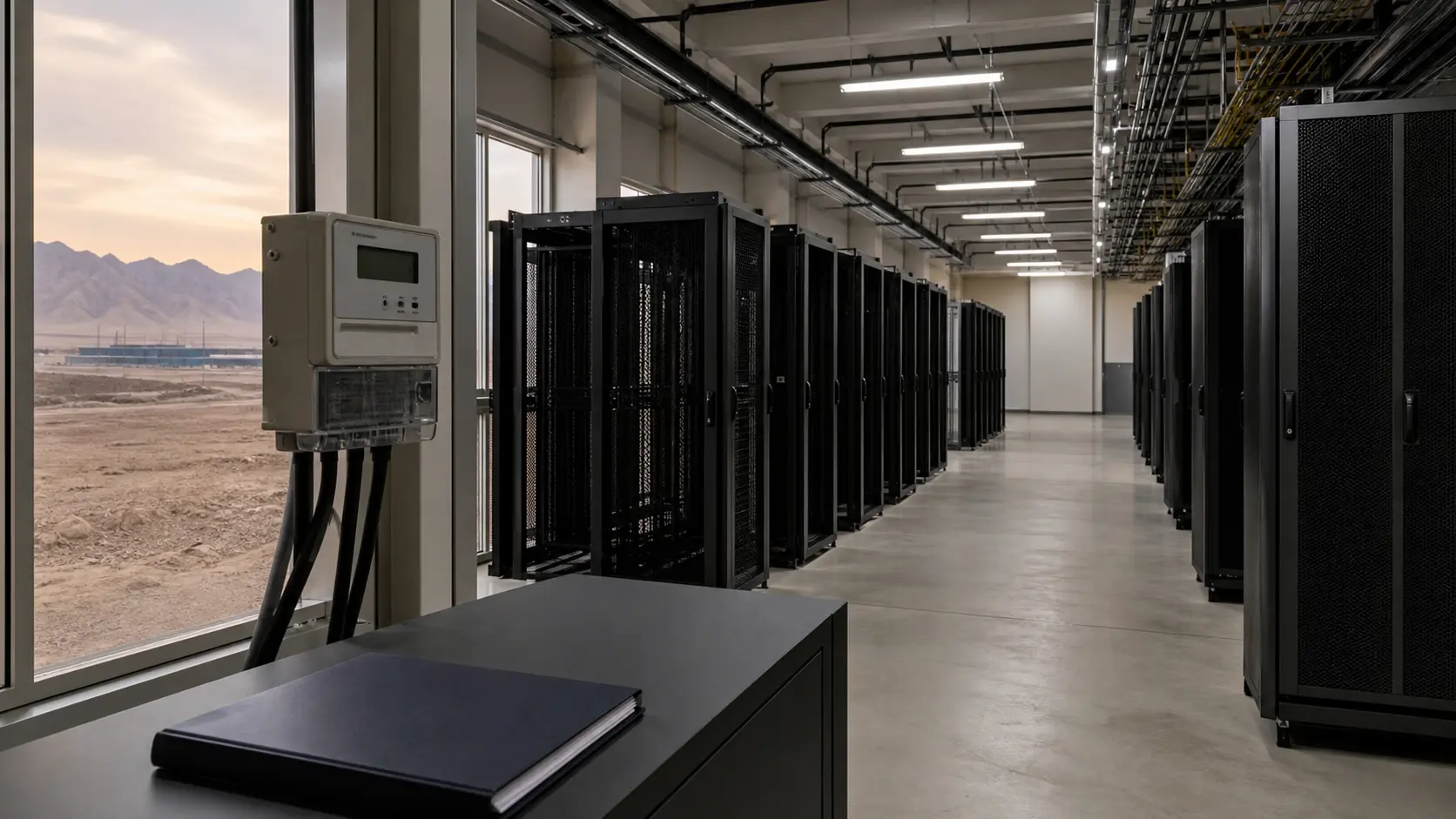
Before Shenzhen HeungKong Holding sells a kilowatt of data-centre capacity, it faces the prospect of paying for one. Its wholly owned subsidiary, Guangzhou Xiangjiang Yunhan Technology, has agreed to take up to 27MW of capacity at China Mobile Ningxia's West Cloud Base data centre in Zhongwei. Yet HeungKong said it had secured no downstream internet data-centre customer orders when it issued a fresh trading-risk notice on 17 July.
That is the essential fact for investors. The agreement creates a potentially substantial recurring cost, while the revenue needed to absorb it remains unproven.
The cost arrives before the demand
The contract prices capacity at RMB491.14 per month per kilowatt, including electricity, cabinet modification and IT operations. At the full 27MW, that rate implies about RMB13.26 million a month and matches the disclosed five-year expected spend of RMB795.65 million. Those are calculations from the stated price and capacity, not a company forecast of realised payments.
The payment structure is not a simple, immediate bill for the whole amount. Capacity is to be delivered in batches, and the final amount depends on orders placed by Xiangjiang Yunhan. Each batch begins its own five-year service term after delivery and acceptance. The contract also says that, after the first batch has been fully delivered and a five-month ramp period has elapsed, usage should reach at least 90% of the total 27MW, with settlement at that floor if utilisation falls short. On the disclosed unit price, 90% would equate to roughly RMB11.93 million a month.
The actual timing and amount remain contingent on delivery, acceptance and how the agreement is implemented.
This makes utilisation more important than the headline contract value. China Mobile Ningxia is supplying the facilities and associated services. Xiangjiang Yunhan must find customers, price its offer above the capacity and operating cost, and finance the gap between committing capacity and collecting customer cash. Without orders, the asset is not a source of contracted revenue for HeungKong; it is an exposure to fixed or semi-fixed payments.
A demanding balance-sheet backdrop
The scale looks more consequential when set against HeungKong's current financial position. The company reported 2025 revenue of about RMB1.44 billion, down 61.6%, and a net loss attributable to shareholders of roughly RMB88.3 million. First-quarter 2026 revenue fell another 31.7% to about RMB242 million, while the attributable loss was about RMB22.0 million. HeungKong expects a first-half attributable net loss of RMB18 million to RMB25 million.
The full RMB795.65 million is spread over five years and should not be compared with one year's revenue as if it were due at once. Even so, the implied average annual spend of about RMB159.1 million would equal roughly 11% of 2025 revenue. That comparison is illustrative: final expenditure, timing and accounting treatment will depend on the capacity ordered and delivered.
HeungKong itself warned that monthly payments could affect funding security and financing, increase debt and add finance costs. It also identified a regulatory dependency: Xiangjiang Yunhan may need licences or approvals before providing service access. A delay there could leave the company paying for capacity it cannot yet commercialise.
The market has priced the promise quickly
The warning followed a 33.04% rise in HeungKong's shares from 15 July. Its price-to-book ratio reached 1.747 on 16 July, compared with 0.82 for the real-estate industry group cited in the filing. The company said its core operations and operating environment had not materially changed from earlier disclosures.
That gap between market enthusiasm and operating evidence raises the standard for the next disclosure. A customer name alone would not settle the question. Investors need the contracted load, price, service term, delivery schedule, customer credit quality and gross margin after the China Mobile Ningxia charge. Without those details, an order may validate demand but not profitability.
What to watch next
The clearest positive signal would be firm downstream orders arriving before material capacity payments begin. Order size matters: a small initial customer would not remove the exposure created by a 27MW plan. The delivery and acceptance schedule will show when monthly charges and the utilisation floor become economically relevant.
Licensing progress, financing arrangements and any change to the contract's capacity or minimum-settlement terms also bear watching. So does cash generation from HeungKong's existing business. A data-centre expansion can diversify a property-heavy company, but only if sales, funding and delivery stay aligned. For now, the filing shows the reverse sequence: capacity first, customers later.
Sources
- HeungKong stock-trading risk notice, Shanghai Securities News, 18 July 2026
- HeungKong major-contract announcement, Shanghai Securities News, 17 July 2026
- CFi filing mirror with the 17 July 18:55:37 China Standard Time publication timestamp
- Shanghai Securities News report on the underlying contract, 16 July 2026
