Summary
- HPE announced a US$1.2 billion order from Vultr for AMD Helios AI Rack by HPE systems at Vultr data centres in the United States. HPE called it its first order for the new system.
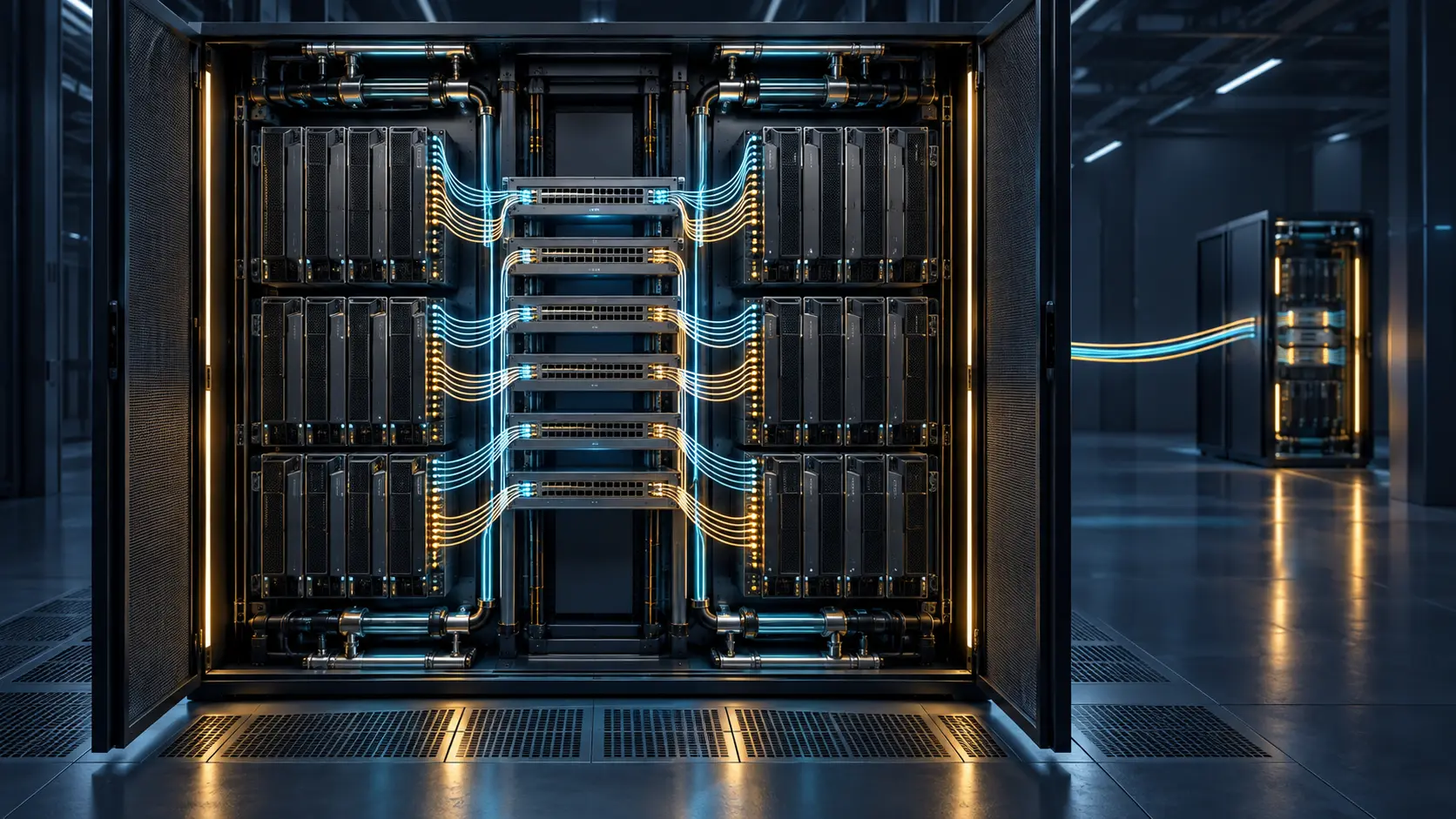
- HPE says each rack contains 72 AMD GPUs and six Juniper QFX5252 scale-up Ethernet switch trays connecting those GPUs. The network is part of the system architecture, not an accessory described outside it.
- The announcement does not give rack count, shipment or acceptance dates, a networking revenue allocation, deal margin, or evidence that the racks are installed and producing customer workloads.
The number that catches the eye is US$1.2 billion. The more revealing unit is six: HPE says every AMD Helios rack it is supplying includes six QFX5252 switch trays to connect all 72 GPUs. That ratio makes the commercial point more clearly than the press-release headline. HPE is not merely placing ordinary data-centre switches beside somebody else’s accelerator order; its Juniper networking is described as part of the rack’s scale-up fabric. But the order’s total value still does not tell an investor what that fabric is worth to HPE, or when it becomes revenue.
HPE’s 30 September announcement says Vultr ordered AMD Helios AI Rack by HPE systems for its US data-centre locations. It describes a rack with AMD Instinct MI455X GPUs, EPYC “Venice” CPUs, Pensando Vulcano AI NIC networking and ROCm software, alongside HPE’s six QFX5252 trays. HPE Services is to support deployment and liquid cooling. The product is therefore a joint operating proposition: AMD supplies the reference architecture and named compute, NIC and software elements; HPE adds branded system engineering, scale-up switching and services; Vultr is the customer that intends to make the capacity available through its cloud.
That distinction matters because AMD presents Helios as a rack-scale reference design for OEMs and ODMs to build into their own branded systems, not as a single AMD product sold complete. HPE’s June description of the QFX5252 calls it a scale-up module for the Helios rack. In other words, the commercial offer bundles technologies whose boundaries still matter. GPU count alone cannot establish the network topology, and six switch trays do not disclose how the selling price, supplier cost, software, cooling or service work is divided.
The release leaves the most basic conversion questions unanswered. It does not say how many racks make up the order, how deployment is phased, what triggers shipment or customer acceptance, or how payments relate to those steps. Without a rack count or comparable unit price, dividing US$1.2 billion into an implied cost per rack would be guesswork. Without a product allocation, calling the full amount Networking revenue would be wrong. Nor does HPE publish order-specific gross profit, operating profit, working-capital needs or realized performance.
HPE announced the order on the same day it raised its fiscal 2027 Networking outlook. The company’s earlier 2 September call said the Helios opportunity was not in the framework then being discussed and anticipated a ramp beginning around year-end 2026 and through 2027. The later announcement changes the evidence: there is now a first order. It does not, however, reconcile how that order is treated in the new forecast, how much belongs to the Networking segment, or when the system will be recognized in reported results. The outlook remains a segment-level management estimate, not a deal-level bridge.
For Vultr, the decisive step is turning rack engineering into saleable cloud capacity. Dense accelerator systems have to arrive, connect, cool, operate and be supported as one service. A scale-up fabric that lets GPUs exchange data is useful only if the complete configuration behaves reliably under the workloads customers pay to run. HPE says its services will reduce deployment and operating risk; that is a vendor description of the offer, not evidence of an accepted installation or measured uptime.
Vultr had already described a Helios collaboration with AMD in July, but that earlier customer statement also does not establish the schedule or economics of this HPE order.
The order is a meaningful design win because it puts HPE networking inside the rack-level proposition and may test whether the company can sell compute, switching, liquid cooling and services together. What it cannot yet prove is that the system has shipped, that customers are using it, or that the network component carries attractive margins. The next evidence should identify racks delivered and accepted, clarify the accounting and product perimeter, and report operating measures such as availability, workload performance and utilization.
Until then, US$1.2 billion describes the announced order—not the value of HPE’s network business within it.
Sources
Member Briefing
Deeper Profile Context
Sign in with the right membership level to unlock the full briefing and source notes.
Only for Strategic Circle
Strategic Circle
Open to all readers. Unlock profile briefings after joining and signing in.
Join Strategic CircleOnly for Leadership Alliance
Leadership Alliance
For qualified IP-asset owners and management; sign in to unlock alliance briefings.
Join Leadership Alliance