
RIR Watchdog
Five regional sessions tracking allocation policy, board legitimacy, and institutional continuity.
Open RIR WatchdogGovernance
The internet runs on institutions most people never see. We follow the regional registries, ICANN, the IETF and the operator communities through every board vote, policy fight and court case, and tell you what each move means for your network.

Latest Coverage
9,368 articles

IETF
A laptop changes networks and asks whether its existing IPv6 addresses still belong on the new link. A server answers `Success`. The tempting conclusion is that the leases are safe. RFC 9915 says something narrower: the addresses fit the link, while every old lifetime keeps…

CASE FILE
A two-line certificate-profile ballot exposes a larger evidence problem. SC-104 would relax the outer requirement for Authority Information Access, but it would not equalise the two services that may sit inside it—and neither the ballot nor the certificate alone can say what a…

CASE FILE
RFC 9938 maps the work a DetNet Controller Plane may need to do. It does not publish the protocol solution, admit a real flow, retain a reservation at every hop or certify a customer's result.

CASE FILE
RFC 9504 makes a stateful PCE more useful in GMPLS networks. It does not turn a protocol exchange into an institutional transfer of authority, or a desired LSP into an operating service.

History
A route can name a direction for a packet and, in one historical experiment, it could also trigger a request to an external switch. Neither act put a usable circuit under the packet. RFC 1306 is valuable because it keeps the states visible: lookup, request, attempted…

NPNOG
npNOG-11 put sponsor recognition on the conference clock in three five-minute blocks. That makes commercial visibility measurable. It does not, by itself, show that sponsors controlled what the technical programme said.

CASE FILE
An IGP can publish an algorithm number, a definition, a participating node and a reachable prefix with great precision. Those records matter. They can still be mistaken for a journey that has not happened. RFC 9502 is useful because it makes the missing work visible: a usable IP…

History
In RFC 1204, a positive reply to a username was designed not to answer the obvious question. A message-posting server was advised to say `250` when the name was syntactically sound even if it did not recognise the account. The ambiguity protected the user database. Only the next…

IETF
An IP packet can carry the L4S identifier all the way across a network even when one operator deliberately sends it through the Classic queue. That is not a contradiction. It is the clue that a packet's declared treatment, its actual queue and its measured delay are three…

IDNOG
IDNOG's published 2024 package reserved a 20-minute opportunity to present a sponsor's products for its top paid tier, creating a commercial route into conference attention that its public record does not clearly separate from the Program Committee route for other speakers.

CASE FILE
CMS can now carry an ML-KEM recipient path under RFC 9936. An inspectable recipient record can identify a certificate or public key and the ciphertext made for it; it cannot, by itself, certify private-key custody, successful local processing or an organizational decision.

CASE FILE
Internet Society’s new procedure puts real discipline around an exceptional Board power, but it leaves one consequential choice behind the curtain: the professional search may proceed without a public call. Candidate privacy can remain intact while the route, funnel and final…

History
An operator can learn a great deal from a device that describes its management surface. It may tell a station which MIB groups it implements, which entities are unavailable, which values it can read, and which values it will accept in a write. That knowledge prevents a management…

IETF
A digital credential can carry a valid signature, match a familiar type and inherit rules from that type's metadata. None of those facts answers the institutional question of whether this issuer was entitled to make this credential. The IETF's latest SD-JWT VC draft draws that…

CASE FILE
In a delay-tolerant network, the word *received* can sound more conclusive than it is. A node has a copy. A status report may say so. A dashboard may turn that report green. But receipt is not a transfer of custody, a promise to retain the copy, proof that a destination…

CASE FILE
A registered IPv6 prefix can be an important routing fact inside a low-power network. It is not a public title to the prefix, proof that every router accepted a path, a delivery receipt, or evidence that a service behind it worked.
History
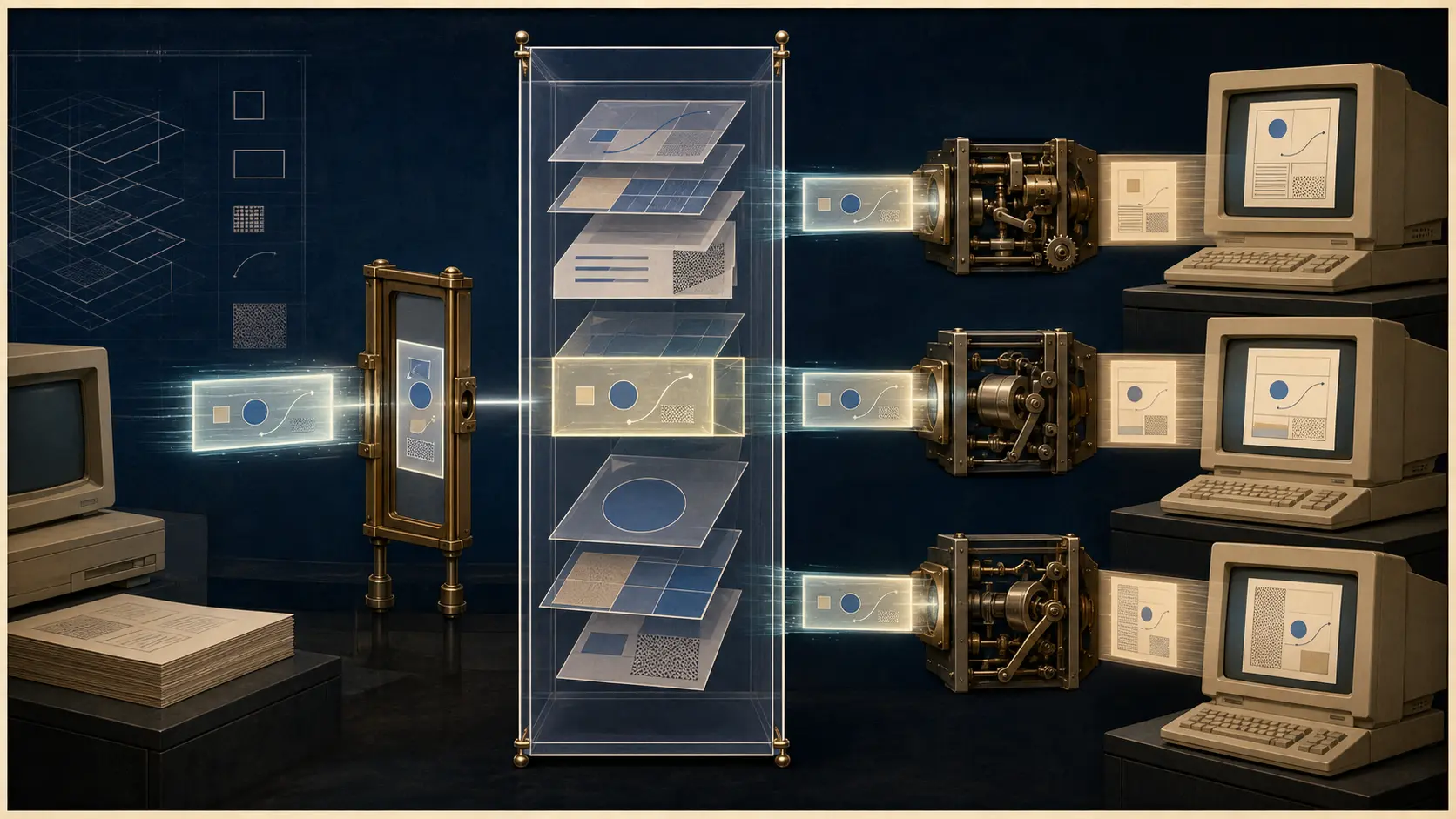
In 1990, a document could be perfectly legible to an international encoding standard and still lack a shared idea of a paragraph. RFC 1197 recorded why that was not a contradiction. Office Document Architecture supplied an abstract model; useful exchange required a narrower…

IETF
A management system can hold a perfectly valid UDP endpoint configuration while the machine is listening somewhere else—or nowhere at all. RFC 9984 makes the common vocabulary portable, but it deliberately leaves the runtime testimony to the system that executes it.

History
An outage does not pause at a shift change. It does not become one event merely because several people call about it, and it does not become repaired because somebody has recorded an escalation. In 1992, RFC 1297 treated the trouble ticket as something more modest and more…

CASE FILE
A secure group can arrive at a new cryptographic state with impressive precision: a Commit has been processed, keys have advanced, the group context has changed and a new epoch exists. None of that, by itself, tells an organisation that its people have agreed, understood…
Session Map
Five regional sessions tracking allocation policy, board legitimacy, and institutional continuity.
Open RIR WatchdogLong-cycle governance dossiers with legal, election, and institutional stress analysis.
Open Case FileMembership, charter, and resource-governance intelligence from the NRS ecosystem.
Open NRS SessionDNS coordination, accountability frameworks, and global multi-stakeholder process dynamics.
Open ICANN SessionProtocol standardization trajectory and interoperability risk under fragmented policy conditions.
Open IETF SessionLong-cycle infrastructure history used for governance interpretation and structural forecasting.
Open History SessionOperator-level implementation intelligence from APRICOT plus regional and national NOG ecosystems.
Open NOGs Session