
RIR Watchdog
Five regional sessions tracking allocation policy, board legitimacy, and institutional continuity.
Open RIR WatchdogGovernance
The internet runs on institutions most people never see. We follow the regional registries, ICANN, the IETF and the operator communities through every board vote, policy fight and court case, and tell you what each move means for your network.

Latest Coverage
9,366 articles

IETF
An IM certificate can say that a key is meant for an instant-messaging identity. That narrower purpose is useful security design. It does not say that an application submitted a message, that a service accepted it, or that any person received and read it.

IETF
A JMAP client that sees a new state string has learned something important: its local view may no longer match the server. That is a signal to synchronize. It is not, by itself, a record of which message changed, which mailbox moved, which principal made a request, which policy…
Story
APNIC prop-165 version 4 would let an organisation eligible for an initial IPv6 allocation request one IPv4 `/24` for transitional functions in an IPv6-only deployment. The proposal is still under discussion: its practical significance lies less in the size of the grant than in…

IETF
A second certificate request can be validly signed by an already certified signature key, yet that signature is only an assertion—not technical proof—that the requester controls the different private key behind the requested key-establishment certificate. RFC 9883 defines how a…

History
TCP once treated a reset that landed anywhere inside the receive window as sufficiently believable to tear down a connection. RFC 5961 replaced that destructive shortcut with a narrower rule: exact sequence alignment could act immediately; merely plausible input had to survive a…

History
The same sequence range crossed the network twice. The acknowledgment that returned proved the bytes had arrived, but not which transmission had earned the reply. Karn's rule turned that uncertainty into a discipline: delivery evidence could advance while the round-trip estimator…
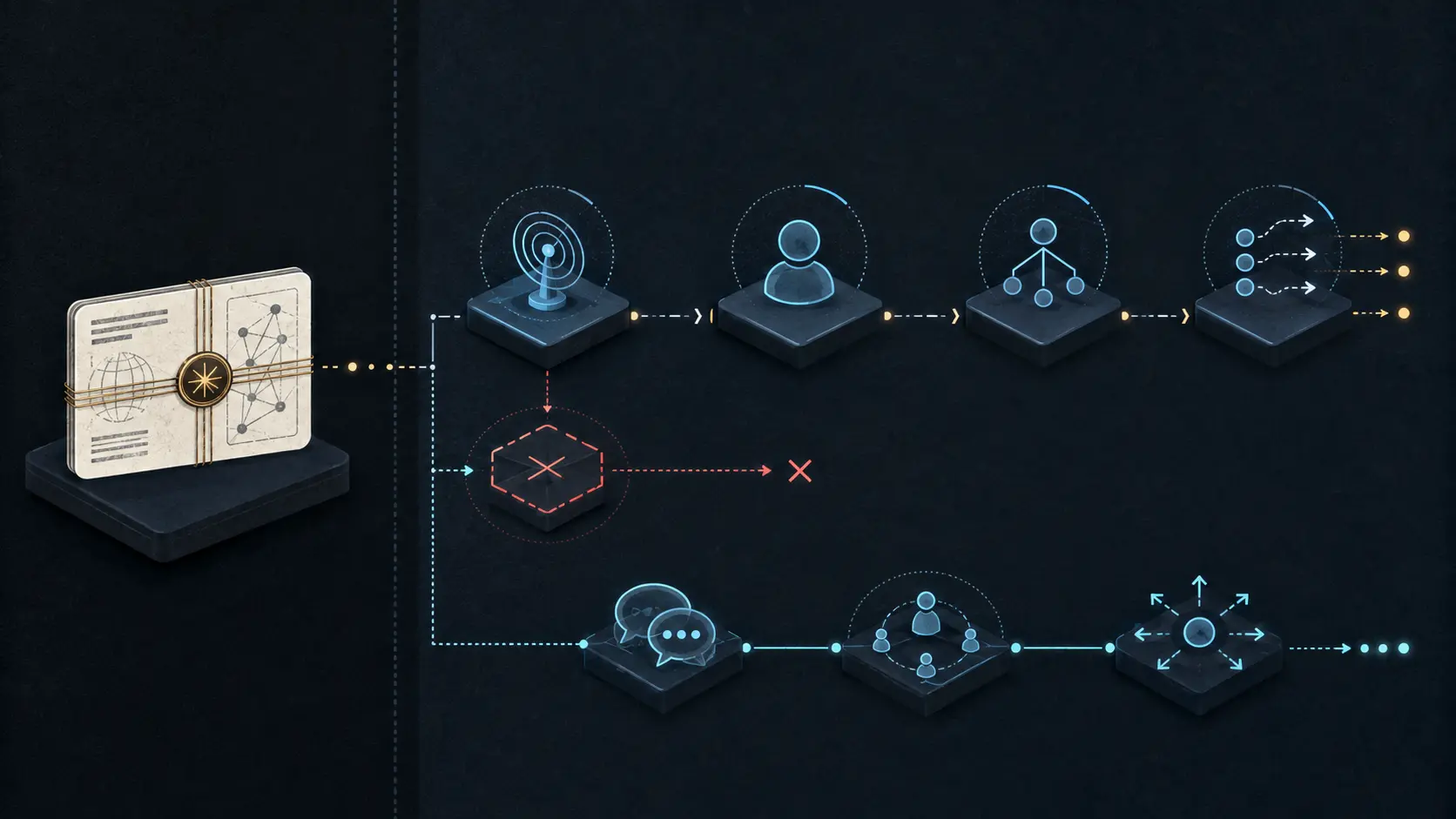
Number Resource Society
An RPKI relying party can validate every byte of a Ghostbusters Record and still not know whether anyone is watching the listed channel when action is needed. The signed entity solves discovery of minimal CA-maintainer contact data; operational accountability begins where that…

IETF
Two CMS systems choose ML-DSA-65 for identical content, yet verification fails when one signs a final implicit-tag representation and the other verifies the complete DER SignedAttrs value with its explicit SET OF tag. The algorithm is the same; the signed byte domain is not.

Story
One word inside a nested APNIC record carries real evidentiary weight, but less than its everyday meaning may suggest. The RDAP role `registrant` identifies the entity recorded for a registration; it does not turn the response into a corporate-ownership register or a live map of…
Story
AFRINIC’s final 2026 candidate slate said Stephen Musa Honlue and Nitin Kelawon Sookun would be deemed elected unopposed to the NRO NC/ASO AC, while voting would still decide the duration of their terms. The Election Guidelines page linked as the basis for that procedure returned…

Number Resource Society
An RPKI trust-anchor operator can publish a successor key without making every relying party ready to use it. The transition is a sequence of verified observations, not a launch date: a defensible record must show what was announced, what remained stable, which validators crossed…

History
A one-byte write did not need a universal delay timer. It needed a rule about whether the connection already had data in flight. Nagle's answer made acknowledgment state—not the wall clock—the gate for another short TCP segment.

Story
APNIC prop-164 would let account holders begin with IPv6 allocations smaller than `/32` while preserving room for growth. The proposal may improve Whois and RDAP accuracy, but its durable test is whether reserved address space becomes a visible, reviewable registry commitment…

Story
One ARIN RDAP record points sideways to ARIN’s older Whois REST service. That link is useful, but it does not turn two views from the same registry into two independent witnesses.

IETF
The Algorithm Name Is Not the Certificate Profile: RFC 9881 and ML-DSA in PKIX intelligence summary explains the development, the public evidence available to readers, the organisations involved, the regional context, market exposure, and the infrastructure consequences that may…
AFNOG
AfNOG’s mailing-list page sets clear expectations for a technical community: keep discussion operational, avoid disrespect, and do not use the list for blatant product marketing. The published page establishes the rules. It does not explain the procedure used when a post is…

Number Resource Society
An RPKI publication server can accept an authenticated update atomically while relying parties still hold an earlier repository view. That is not necessarily a contradiction or a failure. It is a boundary between different authorities, protocols and observation times. A useful…

IETF
RFC 10037 lets a registry publish configured DNS time-to-live values through RDAP. That sounds like a small JSON extension. Its more important effect is to expose a piece of registry policy without pretending that a registration-data service is watching the live DNS. The…

IETF
Two implementations can claim the same Thing model yet disagree on the wire: one chooses a URL and JSON payload convention, while the other expects a numeric identifier and different invocation rules. The gap appears when a protocol binding was implicit rather than versioned and…

Story
A field called `name` invites more confidence than it deserves. In LACNIC’s live RDAP record for `200.0.0.0/21`, the value is simply the address interval written as a label. It identifies a registration record; it does not settle who legally owns the addresses or who operates the…
Session Map
Five regional sessions tracking allocation policy, board legitimacy, and institutional continuity.
Open RIR WatchdogLong-cycle governance dossiers with legal, election, and institutional stress analysis.
Open Case FileMembership, charter, and resource-governance intelligence from the NRS ecosystem.
Open NRS SessionDNS coordination, accountability frameworks, and global multi-stakeholder process dynamics.
Open ICANN SessionProtocol standardization trajectory and interoperability risk under fragmented policy conditions.
Open IETF SessionLong-cycle infrastructure history used for governance interpretation and structural forecasting.
Open History SessionOperator-level implementation intelligence from APRICOT plus regional and national NOG ecosystems.
Open NOGs Session