
Strategic Circle Briefing
Join to unlock strategic briefings after signing in.
Join Strategic CircleGovernance / RIR Watchdog
Five regional registries decide who gets IP addresses and on what terms. We watch ARIN, RIPE NCC, APNIC, AFRINIC and LACNIC — elections, transfer rules, fees and failures — so you see the change before it reaches your allocation.

Latest Coverage
3,279 articles

Story
AFRINIC's first policy meeting after recognition faced an institutional test disguised as calendar arithmetic. Three proposals arrived on the public list only ten or eleven days before the 27 April 2005 policy session. The meeting discussed them, but it did not convert that…

Story
AFRINIC’s decision to lift the standard annual fee for a Medium local internet registry from USD 5,000 to USD 6,500 looks precise, but precision in a price is not the same as precision in its justification. The surviving record makes it possible to see how the charge…

Story
AFRINIC’s decision to reduce its annual fee for membership without allocated number resources from US$400 to US$100 was more than a price edit and less than a constitutional revolution. Read against the constitution in force immediately before the decision, it lowered the cash…

Story
AFRINIC’s first regional Board renewal after recognition as an Internet registry delivered a named primary, a named alternate and a five-person Central Africa slate. It did not leave a reproducible public count. More awkwardly, the AFRINIC-2 report calls the contest Seat 5 while…

Story
On 25 April 2005, AFRINIC acquired an equal three-person place in the NRO Number Council, whose members also served as the ICANN ASO Address Council. That institutional equality was real, but it was never a blank cheque: the AFRINIC Board appointed and could replace only one…

Story
AFRINIC’s April 2005 renewal of Board Seat 6 returned the same two Mauritius-coded directors chosen at the founding election, satisfying the visible regional design while leaving a harder question unanswered: which member organisations authorised the ballot, and how did their…

Story
AFRINIC’s April 2005 Number Council election was published as open to anybody, with geography on the voter side. AFRINIC never published the voter roll, ballot design or verification method, so 104 candidate-vote units cannot be turned into voters, turnout or a continental…

Story
When AFRINIC joined the Number Resource Organization in April 2005, it entered an annual chair rotation behind the four institutions already in the queue. That ordering was real: it delayed AFRINIC’s turn to convene meetings and represent the NRO. But it was also bounded. The…

Story
AFRINIC joined the NRO in 2005 on a symbolic initial contribution whose amount the four founding registries were to set within ninety days. The agreement is public; the amount, method, decision record and payment trail never were. And no accounting arrangement gave anyone…

Story
AFRINIC's first public policy-and-member meeting did not turn everyone in Dakar into one constitutional body. Attendance, policy participation, corporate membership, election eligibility, election administration and Board power were six separate authorities, and none of them made…

Story
AFRINIC's own report says it ran English and French LIR training in Maputo on 23 April 2005, about 25 people in each room. Two rooms prove delivery. They do not prove equal courses, equal teachers or equal learning — and they did not hand the registry a mandate to speak for a…

Story
ICANN’s 21-day consultation on AFRINIC drew 23 in-window messages from 19 people. With no denominator, no recorded reply and no traceable change, it is evidence of participation, not a regional mandate.

Story
At AFRINIC-3, entities accepted the case for direct IPv4 assignments to qualifying end-user organisations, but the consequential word in the record is not “implemented”—it is “consensus,” the first of four states in a chain whose missing links still matter.

Story
AFRINIC's April 2005 joinder to the Number Resource Organization was no ceremonial welcome and no charter to govern African networks. It was a short, precise bargain about voice, money, procedure and remedies—and it set hard limits on what the collective machinery could ever…

Story
On 21 February 2005, AFRINIC became the primary processor of African registry services while its final recognition was still pending and incumbent registries still reviewed allocation decisions. The six-and-a-half weeks that followed reveal precisely what a regional registry can…

Story
The Ledger Moved Before the Networks Did: AFRINIC’s First Post-Recognition Allocation intelligence summary explains the development, the public evidence available to readers, the organisations involved, the regional context, market exposure, and the infrastructure consequences…

Story
AFRINIC-3 brought policy discussion, IPv6 advocacy, registry reporting, training, partnership-making and Internet-governance debate into the same Cairo venue. That concentration made the meeting useful, but it did not create a single electorate or a continental mandate. The…

Story
AFRINIC’s December 2005 launch of 6Mandela promised meetings, training, operational research and transition test beds for IPv6. The surviving public record is much clearer about the ambition than about the institution built to deliver it: it names neither an approved charter, a…

Story
AFRINIC’s appointment of Haitham El-Nakhal as a PDWG Co-Chair produced a clear officeholder but an unclear public account of the process: one eligible candidate, two advertised seats, a rule prescribing acclamation, and a result announced as consensus.
Story
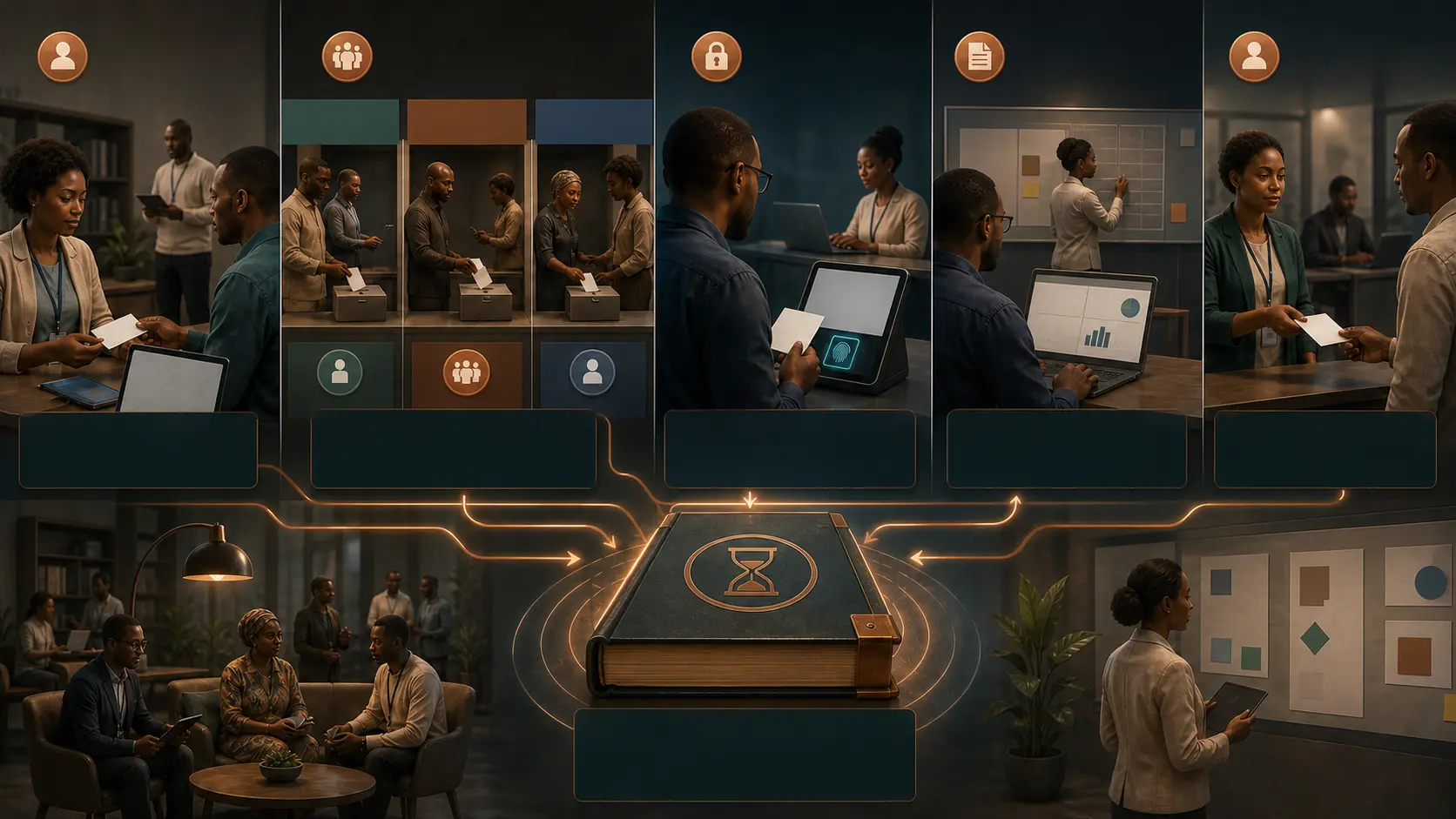
AFRINIC's election rules for 2026 did more than tell people how to choose officeholders. They placed three different constituencies beneath one temporary instrument, turned vote rank into unequal years of institutional influence, and gave excluded candidates no published route of…
Member Unlock
Login is required to unlock full profile briefings and deep-dive sections.
Join to unlock strategic briefings after signing in.
Join Strategic CircleFor IP-asset owners and leadership teams: alliance briefings, private reports and direct analyst support.
Join Leadership AllianceSession Map
North America governance, transfer-market behavior, and member process monitoring.
Open ARINAccountability, member visibility, and implementation signals across the RIPE NCC region.
Open RIPE NCCAllocation pressure, policy adaptation, and Asia Pacific institutional execution.
Open APNICElection process, legal continuity, and board legitimacy under institutional stress.
Open AFRINICInstitutional adaptation and ICP-2 governance trajectory in Latin America.
Open LACNIC