
Single-stack monitoring for RIR governance continuity.
Governance / RIR Watchdog
RIR Watchdog
RIR Watchdog governance intelligence tracks institutions, policy processes, standards activity, registry operations, accountability disputes, and implementation signals that affect internet infrastructure. BTW.
ARINRIPE NCCAPNICAFRINICLACNIC

Institution legitimacy and policy execution quality.
Decision-critical policy and control changes.
Primary-source reporting plus structural interpretation.
Latest Coverage
Latest from RIR Watchdog
2,421 articles

Story
From Bangkok to Brisbane: What APNIC’s Relocation Changed
Moving the secretariat made APNIC more enforceable without making it a regional government.

Story
APNIC’s Tokyo Prototype and the Search for a Legal Home
Before APNIC had a durable legal container, its Tokyo pilot was already making registry decisions that mattered.

Story
RIPE NCC’s First Mandate: Service Bureau or Regional Sovereign?
The founding record separates consequential registry authority from network control, property rights, and territorial jurisdiction.

Story
Why Amsterdam Became Europe’s Number Registry Capital
Amsterdam became the RIPE NCC’s home through practical advantage, institutional continuity and path dependence—not a recorded constitutional choice by Europe’s networks.

Story
RIPE as a Forum, RIPE NCC as a Corporation: The Separation That Blurred
RIPE’s open forum can shape policy without possessing legal personality, while the RIPE NCC can employ staff, hold assets, enter contracts and operate the registry without turning every corporate act into a community decision. That division is defensible and productive. Its…

Story
Europe’s Last /8 and the End of RIPE NCC’s Founding Assumption
*On 14 September 2012, RIPE NCC did not run out of every usable IPv4 address. It crossed into a different allocative regime: a registry designed to evaluate and satisfy documented need began rationing its final /8 through one capped /22 allocation per Local Internet Registry. The…

Story
The Contributors Committee Before RIPE NCC Membership
*Before the RIPE NCC became a Dutch membership association, its institutional centre was a committee of service contributors operating beneath the legal umbrella of RARE and then TERENA. Those contributors exercised consequential influence over budgets, tariffs, activities and…

Story
Cloud NAT control and credible exit for LACNIC-region workloads
During a migration or acquisition, enterprise architecture and procurement teams can discover that compute is easier to rebuild than public network identity is to move. In the LACNIC region, the useful unit is platform-controlled public-identity cost per workload and credible…

Story
LACNIC utilisation audits in the acquisition data room
In the disputed data room of an acquisition, a restructuring or an insolvency sale, the first LACNIC utilisation question is rarely whether a network has behaved with abstract efficiency; it is whether a buyer, lender or independent reviewer can trace each retained or contested…

Story
Shared IPv4 identity under LACNIC scarcity when CGNAT failures become evidence disputes
The useful scene begins after the network has apparently behaved. A support representative and a network-operations technician are reconstructing a failed customer session: the access line is up, the router has not gone dark, ordinary web pages load, and yet a payment login…

Story
Who ultimately carries dual-stack costs under LACNIC IPv4 scarcity?
The cost of two stacks rarely appears on one invoice. It is scattered through support, equipment, contracts and recovery until a customer or application finally bears it.

Story
Island network redundancy and the LACNIC record that must survive restoration
An island can buy a second path and still own only one failure. Redundancy has value only when network identity survives the clock between breakage and restoration.

Story
Why IPv6 deployment does not end LACNIC's IPv4 dependency problem
A second protocol can be fully deployed without making the first commercially disposable. The real transition clock stops only when the last revenue-critical IPv4 dependency can be retired.

Story
Emerging-market growth when LACNIC-recognised identity lags demand
Demand can be signed faster than public network identity can be made usable. For a growing operator, the gap is an option cost paid before the next customer produces revenue.
Story
Equal LACNIC charges and unequal burdens in low-income markets
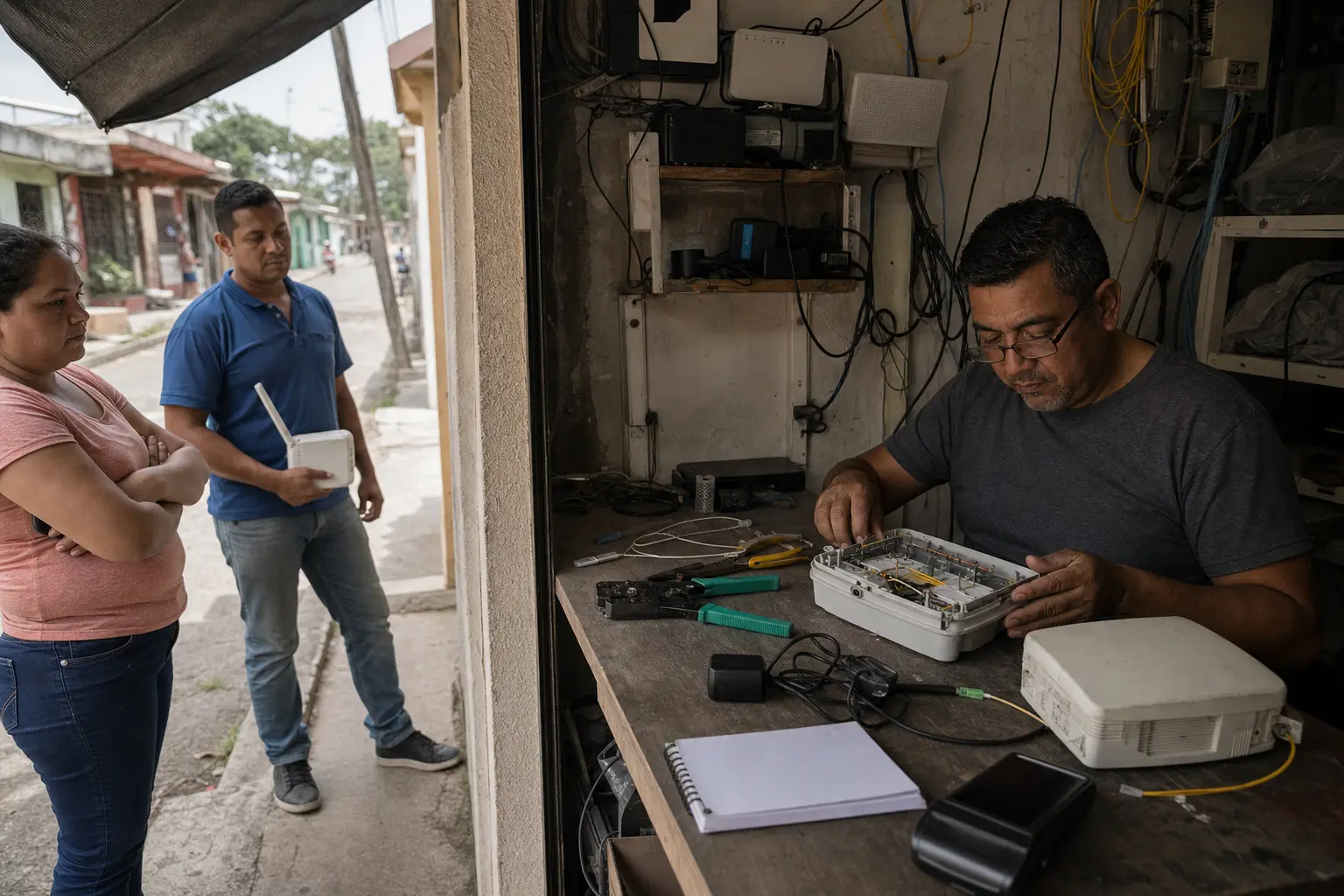
Equal nominal charges are not equal burdens. A hard-currency network obligation divided by a soft-currency customer bill becomes a regressive claim on service quality and expansion.

Story
Rural connectivity under LACNIC scarcity when few lines carry fixed obligations
A rural network can travel farther than its revenue. When few active lines must carry every tower, truck roll and address dependency, scarcity becomes a unit-cost problem.

Story
Small ISP entry in the LACNIC region before the first invoice
Before a small ISP can send its first invoice, it must finance an identity, an upstream, usable addresses and a stack of proof. Scarcity turns that waiting time into incumbent advantage.

Story
IPv4 brokers and the line LACNIC must hold as ledger keeper
IPv4 brokers exist because search, trust and proof are costly. Their market can reduce friction only if the registry stays a ledger rather than a moral authority over trade.

Story
How LACNIC registry decisions travel into customer continuity risk
A registry decision is several contracts away from an end user. The distance does not remove the liability; it merely hides who pays when network identity stops travelling.

Story
Why the title-insurance analogy matters for LACNIC address records
The title-insurance analogy is not a claim that IP addresses are land. It is a way to see why record history, authority and correction matter to scarce-number markets.
Member Unlock
Restricted Profile Intelligence
Login is required to unlock full profile briefings and deep-dive sections.
Strategic Circle Briefing
Join to unlock strategic briefings after signing in.
Join Strategic CircleLeadership Alliance Briefing
For qualified IP-asset owners and management; sign in to unlock alliance briefings.
Join Leadership AllianceSession Map
Registry Sessions
ARIN
North America governance, transfer-market behavior, and member process monitoring.
Open ARINRIPE NCC
Accountability, member visibility, and implementation signals across the RIPE NCC region.
Open RIPE NCCAPNIC
Allocation pressure, policy adaptation, and Asia Pacific institutional execution.
Open APNICAFRINIC
Election process, legal continuity, and board legitimacy under institutional stress.
Open AFRINICLACNIC
Institutional adaptation and ICP-2 governance trajectory in Latin America.
Open LACNIC