
Strategic Circle Briefing
Join to unlock strategic briefings after signing in.
Join Strategic CircleGovernance / RIR Watchdog
Five regional registries decide who gets IP addresses and on what terms. We watch ARIN, RIPE NCC, APNIC, AFRINIC and LACNIC — elections, transfer rules, fees and failures — so you see the change before it reaches your allocation.

Latest Coverage
3,211 articles

Story
Most of ARIN’s remaining legacy IPv4 paperwork is attached to small blocks. Most of the addresses are elsewhere. A new registry slide deck puts 23 very large blocks at the centre of the job.

Story
ARIN’s election is doing double duty: choosing leaders and deciding which long-absent voters keep their General Member status. The escape hatch is almost comic. A blank ballot counts.

Story
The latest RIPE NCC register has a suddenly crowded End User column. Twenty-three were added to its frozen list in September, alongside five members. The switch that moved was at the registry desk: who may receive or transfer number resources.

Story
Four separate /24 blocks contain the addresses in a /22. ARIN says its waiting-list rules still forbid handing all four to one qualified applicant when they are not contiguous. The applicant can take a single /24 and leave the queue. At ARIN 58, staff finally put that little…

Story
Receive one IPv4 block; try to transfer another later in the year; discover the whole organization is still inside ARIN’s waiting period. The manual hides the clock under sender rules, and ARIN says some new holders missed it. Staff has now put an uncomfortable second question on…

Story
Last year, Yes returned the excess to members. This October, the Board wants the same button to keep an estimated €1 million in reserves for IT investment; under Yes, members cover any 2027 deficit.

Story
AFRINIC wants its policy meetings clear of competing dates and announced a year ahead. The proposal sounds tidy until two useful events want the same week: then someone has to decide what counts as a clash, whose calendar wins, and who gets to call an exception unavoidable.

Story
Network teams rarely get one clean switch to flip when a data service retires. ARIN’s result gives them three separate jobs: wait for an RWhois migration tool, check Whois-RWS feature parity and training, then watch RDAP adoption before Port 43 returns to consultation. The…

Story
APNIC prop-168 v004 would let some account holders grow their IPv4 holdings to a combined /22, while reserving a separate /12 for a much later IPv6-transition purpose. The draft’s real test is how APNIC would manage those two claims on a finite pool—and explain who qualifies…

Story
An IPv6-only network can still need a small IPv4 foothold: a resolver, mail gateway, monitoring system or connection to a service that has not made the same transition. APNIC proposal prop-165 v004 would offer eligible new IPv6 networks one IPv4 /24 for that work. Its hardest…

Story
A proposed /22-to-/24 change would lower one eligibility threshold while preserving other tests and exclusions. ARIN’s own staff review raises a separate question: what quantity of out-of-region space could that threshold support?

Story
Six seats are up for election at RIPE NCC’s October General Meeting, but the ballot will not redraw the Arbiter Panel’s jurisdiction. The procedure calls its process “arbitration” while expressly placing it outside Dutch civil-law arbitration; the practical test is the remedy…

Story
APNIC’s policy page says the directory-usage proposal was implemented on 30 June 2026. The approved text, however, joined public WHOIS/RDAP statistics to a separate MyAPNIC view for each resource holder. The Executive Council’s record treated those outputs differently; the public…

Story
ARIN recorded 78,234 transferred IPv4 `/24s` across its 2025 inter-RIR flows. The total is easy to quote and easy to misread: most listed outflow went to LACNIC, while most listed inflow came from RIPE NCC. Direction carries the story that a single net figure loses.
Story
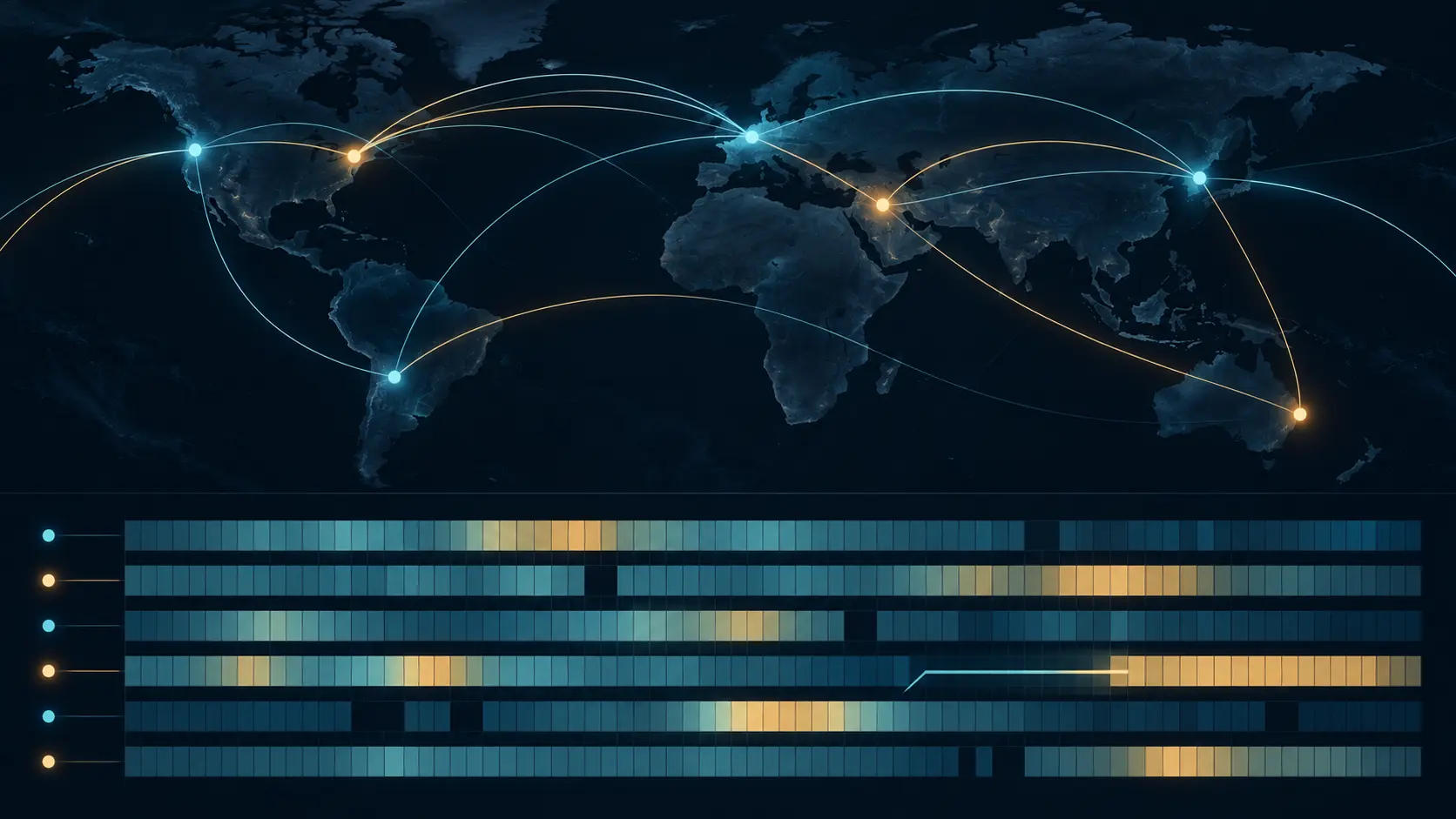
When a network path slows, an average rarely tells an operator when the change began or which measured corridors shifted. RIPE Atlas’s new view makes that existing evidence easier to trace—but the baseline still comes from the selected time window.

Story
AFRINIC’s own policy record raises a practical question about the IPv4 held for Internet exchange points: can the community see which parts are used, which remain contiguous, and who is waiting? Until that picture is public, a debate over whether a `/16` should become a `/15` is…

Story
RIPE NCC plans to add a synthetic BGP hold timer inside the RIS processing pipeline. Its own changelog records a peer’s routes persisting in bview after de-peering; public records do not show whether the planned change targets that exact case.

Story
After discovering PHP vulnerabilities, RIPE NCC took two Academy addresses and the NRO and ASO websites offline as a precaution. Its status page separately listed the RIPE Database, RPKI and LIR Portal as operational—a distinction that clarifies the reported scope while leaving…

Story
APNIC’s post-roll account follows 50 networks that looked poorly prepared before the DNS root-key change. Their measured acceptance later moved above a majority threshold. That trajectory shows why readiness signals need a clock, a follow-up path and a precise definition of what…

Story
AFRINIC’s audited accounts show three different signals: income edged higher, the surplus before finance items contracted sharply, and cash generated from operations fell further. A currency swing softened the annual decline without reversing it.
Member Unlock
Login is required to unlock full profile briefings and deep-dive sections.
Join to unlock strategic briefings after signing in.
Join Strategic CircleFor IP-asset owners and leadership teams: alliance briefings, private reports and direct analyst support.
Join Leadership AllianceSession Map
North America governance, transfer-market behavior, and member process monitoring.
Open ARINAccountability, member visibility, and implementation signals across the RIPE NCC region.
Open RIPE NCCAllocation pressure, policy adaptation, and Asia Pacific institutional execution.
Open APNICElection process, legal continuity, and board legitimacy under institutional stress.
Open AFRINICInstitutional adaptation and ICP-2 governance trajectory in Latin America.
Open LACNIC