
Single-stack monitoring for RIR governance continuity.
Governance / RIR Watchdog
RIR Watchdog
RIR Watchdog governance intelligence tracks institutions, policy processes, standards activity, registry operations, accountability disputes, and implementation signals that affect internet infrastructure. BTW.
ARINRIPE NCCAPNICAFRINICLACNIC

Institution legitimacy and policy execution quality.
Decision-critical policy and control changes.
Primary-source reporting plus structural interpretation.
Latest Coverage
Latest from RIR Watchdog
2,388 articles

Story
RIPE Database Is Switching to OIDC. Maintainer Authority Does Not Move With the Session
RIPE NCC plans to replace a site-wide cookie with an OIDC session for interactive RIPE Database use. That can improve authentication, but the harder acceptance question begins after login: which `mntner` authorises this identity to change this entity, under which session regime…

Story
RIPE Closed RRC18 With a Restart. Fourteen Minutes Later It Opened a Similar RRC24 Incident
RIPE NCC restored one RIS collector by restarting two backend services while its cause remained unknown. Its next public incident post described the same publication symptom at a very different collector and warned that the fault might not stop there. The sequence makes…

Story
ARIN Closed the ROA Wording Fix. The Published Example Drops the Mask Interval
ARIN answered a precise operator complaint in five weeks and marked the documentation repair complete. That is the constructive part of the record. The harder question is why the live example no longer contains the length boundary that made the requested correction capable of…

Story
AFRINIC's upd-to Receives Failed Update Notices, Not Database Authority
An unexpected Whois update can place a complete rejected entity in somebody's inbox. AFRINIC's `upd-to` field explains why that person received the warning; it does not identify the sender, confer a credential or prove that the attempted change ever reached the registry.

Story
ARIN Added §4.10 Misuse to Its Fraud Process. Its Form Names Two Other Cases
ARIN now tells the public that misuse of reserved address pools, including space issued under NRPM §4.10, belongs inside its fraud-reporting process. Follow the link to the live intake form, however, and the explanatory copy still names only fraudulently obtained resources and…

Story
RIPE's member-of Proves Authorized Set Membership, Not Live Route Propagation
RIPE's member-of Proves Authorized Set Membership, Not Live Route Propagation intelligence summary explains the development, the public evidence available to readers, the organisations involved, the regional context, market exposure, and the infrastructure consequences that may…

Story
APNIC's ASPA Lists Authorized Providers, Not Observed Transit
APNIC's ASPA Lists Authorized Providers, Not Observed Transit intelligence summary explains the development, the public evidence available to readers, the organisations involved, the regional context, market exposure, and the infrastructure consequences that may follow. The Story…

Story
APNIC Adopted a Foundation Liaison. The Public Record Stops Before the Protocol
APNIC has done the difficult part that institutions often avoid: it identified an old role with no settled scope, named the governance risks around it, and formally adopted a replacement. The next part was deliberately separated. Observer attendance, confidentiality and…

Story
APNIC Put 23 September and 17 August in One Payment Notice
A service notice should let a Member decide when to act. APNIC’s current online-payment notice instead presents one four-hour window in its identity and timetable, then names a different day in the description. The responsible conclusion is not to choose between them. It is to…

Story
ARIN's Retired Origin AS Field Recorded a Possibility, Not a Live Route
Old registration exports can preserve an `Origin AS` value long after ARIN removed the field. The label looks authoritative, but ARIN defined it as an optional holder-supplied list of ASNs from which a block might originate. It was neither a cryptographic authorization nor a…

Story
LACNIC Whois created Dates the Registry Record, Not the Network's Launch
A timestamp precise to the second can look like a birth certificate. In LACNIC registration data, however, `created` dates the record for an address block. It does not reveal when the holder was founded, when engineers switched on a network, when the addresses were first used, or…

Story
AFRINIC’s 5% Early-Payment Discount Runs on Two Invoice Clocks
AFRINIC's renewal calendar begins with an invoice released in November and rewards payment received by the end of December. Its accompanying prose sets the reward against a different entity: the date of the invoice. Those statements can belong to a perfectly coherent billing…

Story
The final RIR governance draft needs an implementation register
The 1 September 2026 FINAL DRAFT strengthens oversight, but Section 1.3 leaves the operational bridge to future Implementation Procedures. A public register could show what has been adopted, what remains procedural work and what resource holders can actually verify.

Story
AFRINIC Whois org-type Classifies a Registry Relationship, Not Legal Corporate Form
AFRINIC’s `org-type` field looks deceptively familiar: a short label attached to an organisation record. Its proper use is narrower. It helps describe how that record sits inside the registry’s resource and membership system; it does not answer the legal, ownership or operational…

Story
The New RIR Draft Has Two Review Limits—and No Public Counter
Three requests can cite the same duty, concern the same registry and arrive in the same audit cycle. Under the recommended RIR Governance Document, whether the third may proceed depends on two clocks and on who counts as the same initiator. The draft supplies the limits. It does…

Story
RIPE Database mnt-ref Authorises an Organisation Reference, Not Corporate Control
An accepted `org:` link in the RIPE Database has passed a meaningful authorisation test. That makes it evidence of an approved database reference—not a shortcut to proving ownership, group membership or control of the network behind the record.

Story
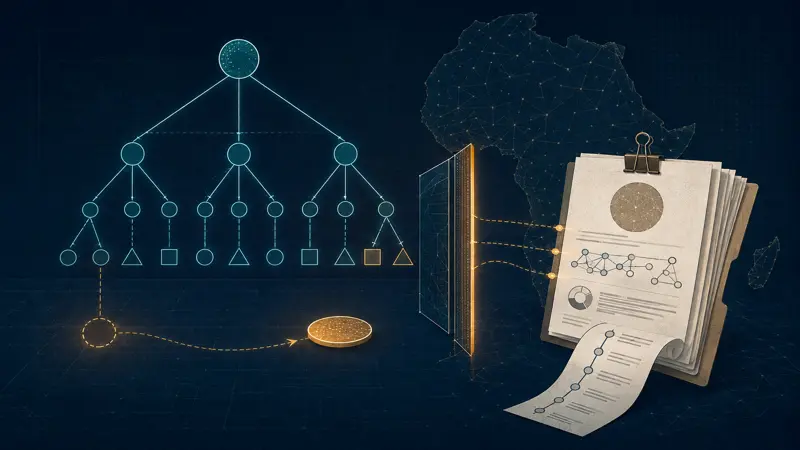
AFRINIC’s CEO handover needs a public transition ledger
AFRINIC announced Mike Silber as CEO Designate on 24 August 2026. Because he is due to assume office on 1 January 2027, the interval should be documented as a governed transition rather than treated as an already completed change of leadership.
Story
AFRINIC’s AS-SET restoration exception needs a decision receipt
A narrow continuity exception could preserve a deleted flat-name entity—but without a bounded evidentiary record, it may reopen the legacy namespace risk the proposal leaves in place.

Story
APNIC’s NIR RDAP Redirect Finds a More-Specific Record, Not a Network Operator
A redirect from APNIC to an NIR-specific RDAP host is an evidence trail about where registration data is served. It can lead to a narrower record without proving who currently routes, owns or operates the network.

Story
LACNIC Made Merger Transfer Fees Equal. It Did Not Make the Payment Rules Equal
A price list can make two transactions look alike long before their obligations are alike. LACNIC has put merger, acquisition and name-change transfers on the same published fee bands as ordinary IPv4 transfers and has attached both to an annual inflation clock. Yet the public…
Member Unlock
Restricted Profile Intelligence
Login is required to unlock full profile briefings and deep-dive sections.
Strategic Circle Briefing
Join to unlock strategic briefings after signing in.
Join Strategic CircleLeadership Alliance Briefing
For qualified IP-asset owners and management; sign in to unlock alliance briefings.
Join Leadership AllianceSession Map
Registry Sessions
ARIN
North America governance, transfer-market behavior, and member process monitoring.
Open ARINRIPE NCC
Accountability, member visibility, and implementation signals across the RIPE NCC region.
Open RIPE NCCAPNIC
Allocation pressure, policy adaptation, and Asia Pacific institutional execution.
Open APNICAFRINIC
Election process, legal continuity, and board legitimacy under institutional stress.
Open AFRINICLACNIC
Institutional adaptation and ICP-2 governance trajectory in Latin America.
Open LACNIC