
Single-stack monitoring for RIR governance continuity.
Governance / RIR Watchdog
RIR Watchdog
RIR Watchdog governance intelligence tracks institutions, policy processes, standards activity, registry operations, accountability disputes, and implementation signals that affect internet infrastructure. BTW.
ARINRIPE NCCAPNICAFRINICLACNIC

Institution legitimacy and policy execution quality.
Decision-critical policy and control changes.
Primary-source reporting plus structural interpretation.
Latest Coverage
Latest from RIR Watchdog
2,388 articles

Story
APNIC’s leadership-diversity consultation needs a measurable participation funnel
APNIC has documented who joined the first stage of its leadership-diversity consultation and what barriers they described. The next test is whether it can connect outreach, participation and proposed remedies to a broader leadership pipeline without identifying individual…
Story
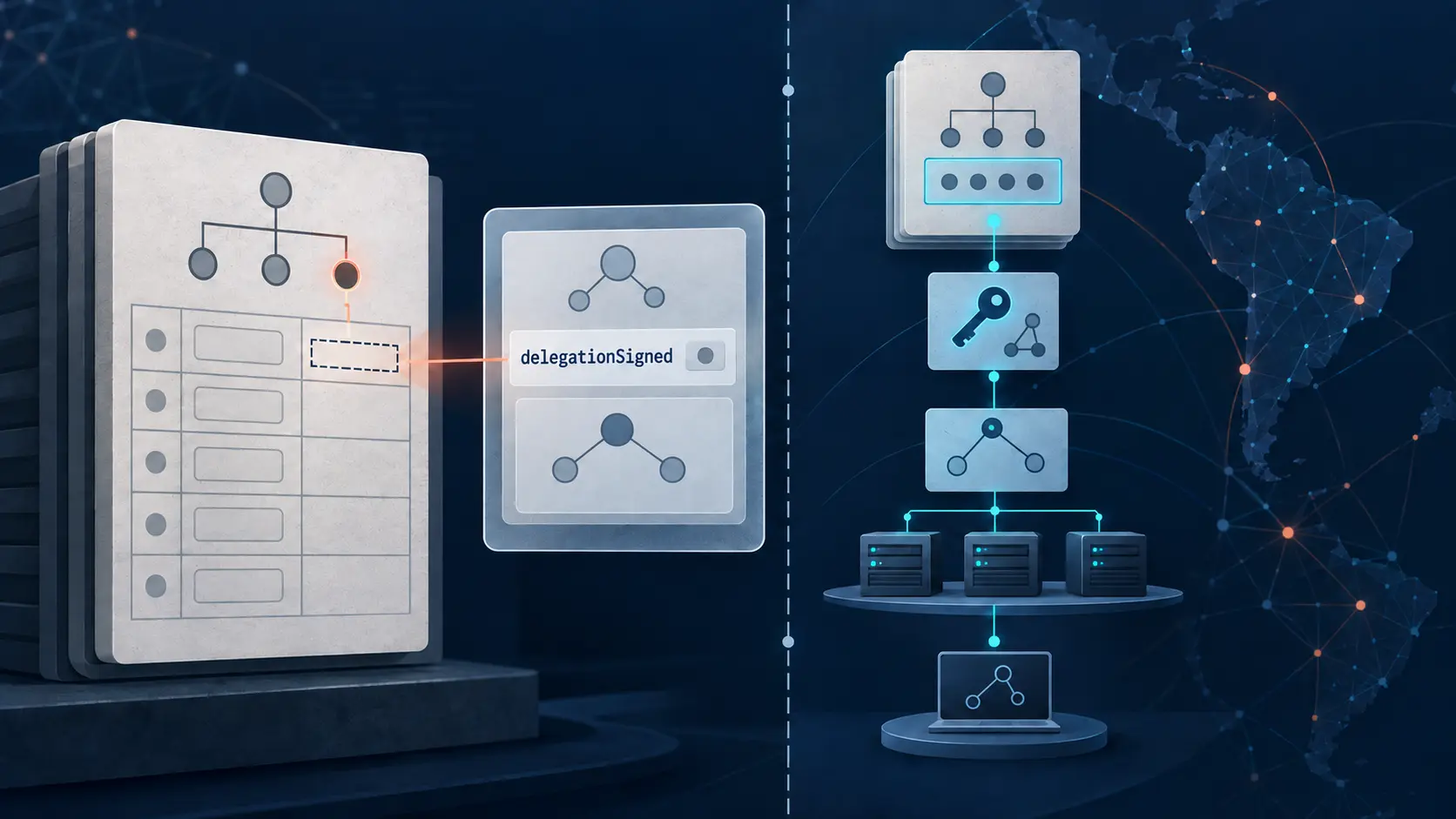
LACNIC's RDAP delegationSigned Records Parent DS Presence, Not DNSSEC Validation
A boolean in a registry response can look like a verdict on the security of a DNS chain. LACNIC's RDAP `delegationSigned` field answers a narrower question: whether the registration view reports DS records in the parent. It does not run a resolver, test the child keys or prove…

Story
AFRINIC’s bylaw rewrite needs an issue-to-decision map
AFRINIC’s Bylaws Review Committee extended consultation to 30 August while two consequential legal questions remained under consideration. The next public document should show how each material issue moved from comment to decision—even where the legal advice behind that decision…

Story
AFRINIC’s RPKI Guide Names a Validator Retired in 2021. The Link Now Runs Routinator
The hyperlink works. That is precisely why the documentation error is easy to miss: AFRINIC’s main RPKI guide preserves the name of one product while sending the reader to a different implementation.

Story
ARIN Described a Two-Person Rule for AI Drafts. It Did Not Describe the Receipt
ARIN’s public answer was unusually concrete: generative AI may assist a narrow class of drafts, the drafter remains responsible, and a second person reviews the result before release. The missing piece is not another principle but the durable record that proves those decisions…

Story
RIPE Atlas Says “Dissimilar” Probe Selection Is Complete. Its Public API Does Not Name the Selector
RIPE Atlas Says “Dissimilar” Probe Selection Is Complete. Its Public API Does Not Name the Selector intelligence summary explains the development, the public evidence available to readers, the organisations involved, the regional context, market exposure, and the infrastructure…

Story
APNIC’s NIR SIG Asked Four Charter Questions. Its Deck Shows One Unlabelled Result
An APNIC 62 charter-review deck asks seven National Internet Registries four different questions, then places one 86% support chart beside them without saying which question it answers. The proposed charter may still deserve support. But if the NIR SIG is to consolidate views for…

Story
LACNIC Deferred Its $2,100 IPv6-Only Fee to 2029. The 2020 Notice Still Ends the Waiver in 2026
The lower 2026 price is not an accounting mistake. It is the result of a unanimous Board decision that shifted the final step of LACNIC’s IPv6-only discount from 2026 to 2029. The documentary problem is quieter: the original notice remains public with the old endpoint, while the…

Story
AFRINIC’s new Appeal Committee needs a public case clock
AFRINIC constituted a five-member Appeal Committee on 28 August 2026. With every appointment ending on 31 December, the public record needs a procedural clock that shows whether an appeal can be received, reviewed and closed without exposing protected evidence or deliberations.

Story
AFRINIC’s 2025 Receivables Were Almost All Past 60 Days. June’s Zero Bad-Debt Line Does Not Close Them
A dash can look like an ending. AFRINIC’s first-half 2026 report shows no actual bad-debt expense, yet its last audited balance sheet carried USD 561,761 of gross trade receivables more than 60 days old. Those are different accounting states. A privacy-safe cohort rollforward…

Story
The RIR Draft Calls the System Bottom-Up. Status-Change Consultations Stay Optional
The recommended RIR Governance Document describes the Internet Numbers Registry System as open and bottom-up. A few pages later, its new Article 2.7 says neither the RIRs nor ICANN are obliged to consult their communities when assessing a proposal to recognise or derecognise a…

Story
RIPEstat Is Rebuilding Routing History to Enable CSP. The New View Needs a Parity Record
A safer browser should not leave an operator wondering whether a changed graph reflects changed routes or changed presentation. RIPE NCC has a sound reason to replace legacy RIPEstat visualisations. Routing History is precisely where the migration needs a small public receipt…

Story
RIPE NCC Publishes in Eight Languages. English Still Has Final Say
RIPE NCC now advertises information in eight languages and is recruiting community volunteers to translate material about its Information Services. The invitation broadens access, but the Language Centre’s own disclaimer fixes a sharp boundary: translated pages are informational…

Story
ARIN’s Ombuds Reports Reach the Board. The Public Record Does Not Track the Advice
ARIN’s minutes show that outside advice about the safety and conduct of its meetings does not disappear into a ceremonial file: recommendations have changed practice, some have met practical limits, and the Board is now considering the programme’s scope, continuation and…

Story
ARIN Lets You Name a ROA. Its Online Search Still Ignores the Name
ARIN Lets You Name a ROA. Its Online Search Still Ignores the Name intelligence summary explains the development, the public evidence available to readers, the organisations involved, the regional context, market exposure, and the infrastructure consequences that may follow. The…

Story
APNIC’s Definition Page Shows a Draft. Its Official Text Is Still Active
APNIC built one definition document so the same words would not acquire different meanings as they crossed policy files. The document now has a different problem. Its main web page presents version 004 as a draft; its stable official-text address still presents version 003 as…

Story
APNIC’s Online SIG Ballot Still Requires In-Person Attendee Check-In
APNIC 62 opened its SIG ballot online on 8 September. That describes the voting medium, not the electorate: an individual conference attendee still has to be in Mumbai, check in at the registration desk and show a record of participation in an earlier APNIC or APRICOT meeting.…

Story
AFRINIC's Six-Month Implementation Rule Has Two Start Dates
A policy clock is useful only when the institution and its community can identify the event that started it. AFRINIC's current Consolidated Policy Manual starts its six-month implementation expectation at the end of Last Call. AFRINIC's current public explanation starts it at…

Story
A 90-Day RIR Emergency Can Be Renewed Without Another All-Community Process
The recommended RIR governance draft gives an emergency service arrangement a 90-day interval and a route to renewal. It also changes the participation rule at that boundary: engagement with every RIR community is mandatory after initiation, but another such process after renewal…

Story
LACNIC Says to Email the Bulk WHOIS Form. The Same Page Says Email Is Not Accepted
LACNIC’s public instructions give a Bulk WHOIS applicant two doors and no label for the threshold between them. The signed form is to be emailed first, the original is to be posted after approval, yet the same page ends by saying emailed forms are not accepted. The problem is not…
Member Unlock
Restricted Profile Intelligence
Login is required to unlock full profile briefings and deep-dive sections.
Strategic Circle Briefing
Join to unlock strategic briefings after signing in.
Join Strategic CircleLeadership Alliance Briefing
For qualified IP-asset owners and management; sign in to unlock alliance briefings.
Join Leadership AllianceSession Map
Registry Sessions
ARIN
North America governance, transfer-market behavior, and member process monitoring.
Open ARINRIPE NCC
Accountability, member visibility, and implementation signals across the RIPE NCC region.
Open RIPE NCCAPNIC
Allocation pressure, policy adaptation, and Asia Pacific institutional execution.
Open APNICAFRINIC
Election process, legal continuity, and board legitimacy under institutional stress.
Open AFRINICLACNIC
Institutional adaptation and ICP-2 governance trajectory in Latin America.
Open LACNIC