
Single-stack monitoring for RIR governance continuity.
Governance / RIR Watchdog
RIR Watchdog
RIR Watchdog governance intelligence tracks institutions, policy processes, standards activity, registry operations, accountability disputes, and implementation signals that affect internet infrastructure. BTW.
ARINRIPE NCCAPNICAFRINICLACNIC

Institution legitimacy and policy execution quality.
Decision-critical policy and control changes.
Primary-source reporting plus structural interpretation.
Latest Coverage
Latest from RIR Watchdog
2,388 articles

Story
ARIN Let Consultant Hiring Advance Before the Control Plane Vote.
ARIN’s draft Board minutes preserve an awkward but legitimate sequence: outside-consultant hiring could keep moving while the Registry Control Plane itself awaited a detailed plan and a later approval meeting. The issue is not whether preliminary expertise is useful. It is how…

Story
AIRRS Sends “amp;profile”. RIPEstat’s Real AFRINIC Profile Returns 500
A regional statistics portal can look complete while the choice that is supposed to make it regional never reaches the service under the expected name. AIRRS currently demonstrates that uncomfortable distinction: seven tabs can arrive, yet the evidence says they came through…

Story
APNIC 62 Had Seven Policy Proposals. Two Had No Consensus Call.
APNIC’s conference report does something more useful than recording winners and losers. It preserves a third procedural state. Prop-165 and prop-172 were discussed, but no consensus call was held. The next record should explain where that state leads without pretending it means…

Story
AFRINIC’s Co-Chair Calendar Leaves 7½ Days After Nominations Close. Its Suggested Vetting Period Is Two Weeks.
The number is not evidence of a rushed decision. It is evidence of an unexplained join. AFRINIC has published a precise closing time, a precise slate time and an indicative vetting duration that does not fit between them unless some work happens before the door closes.

Story
RIPE NCC’s AuthDNS Ledger Counts 43 Nodes but Not the Eyeball Coverage They Deliver
RIPE NCC has made the objective unusually clear: put AuthDNS where poorly served networks can actually reach it. Its public inventory can show that 43 hosted instances are operational. What it cannot yet show is whether each new map pin changed the anycast catchment that matters.

Story
RIPE’s IPv6 PI Draft Reserves Growth Space. Partial Transfers Can Make It Unusable.
RIPE’s current IPv6 PI proposal tries to make future growth easier by reserving a larger nibble-boundary envelope around a new assignment. Its own impact analysis identifies the catch: if the assigned block can be transferred in pieces, the untouched reservation may no longer be…

Story
LACNIC’s IPv6 Clock Subtracts 210 `/32`s Without Showing Which Fragments Count
IANA’s allocation clock for LACNIC reaches a reassuringly precise answer: 978,428 units of `/32` space remain available. The public rows beneath it supply exactly the 210-unit subtraction that produces that number. Yet most of those fragments are not labelled `available` in…

Story
ARIN Says Sponsors Need 60 Days. Its ARIN 58 Page Is Still Open at 42.
ARIN’s sponsorship page presents an opportunity and a cutoff as if both were current: it is seeking sponsors for ARIN 58, yet says sponsorships must be finalized 60 days before the event. The page served after that boundary needs one more field—a dated status that says what, if…

Story
ARIN’s ASPA Change Is a Set Decision. It Needs a Diff Receipt
Changing one upstream in an ASPA is not the digital equivalent of adding a name to a contact list. The operator is replacing a signed statement about the whole provider set. ARIN can acknowledge the transaction, yet the operator still needs evidence of what changed, what was…

Story
LACNIC’s Highest Risks Have Two Clocks and No Public Start Point
LACNIC has put unusually sharp time limits around its most serious residual risks. Its public Board record says what must happen immediately, within 90 days and in less than 120 days. What it does not publish is the event from which either clock is counted—a small omission that…

Story
APNIC Reported 60 Atlas Probes Distributed and 23 Deployed. The Missing Unit Is the Cohort
A probe in a box is an opportunity to measure the Internet. A probe that has connected, remained available and filled a blind spot is measurement capacity. APNIC’s 2025 reporting places 60 distributed devices beside 23 deployed ones, but does not publish the join that would tell…
Story
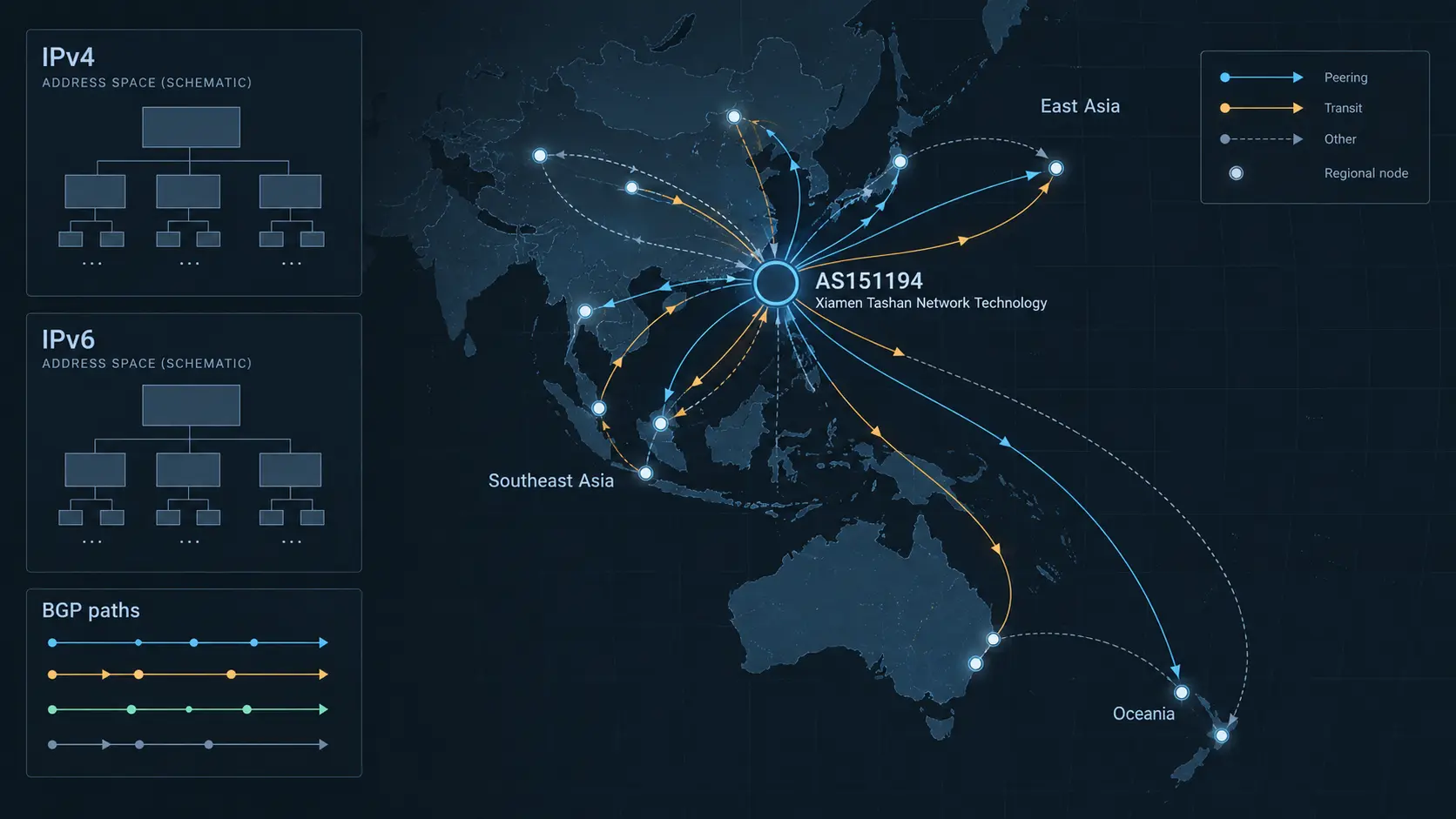
Xiamen Tashan Network Technology and the Evidence Gap Around AS151194
Xiamen Tashan Network Technology and the Evidence Gap Around AS151194 intelligence summary explains the development, the public evidence available to readers, the organisations involved, the regional context, market exposure, and the infrastructure consequences that may follow.…

Story
APNIC's NIR Co-Chair Was Re-elected Without an Online Ballot—By Rule
APNIC 62's linked result sheet contains four polls but no NIR SIG contest. That blank is not a missing tally. It is the visible edge between two procedures: contested positions go to the online system; one confirmed candidate goes to acclamation in the SIG room.

Story
AFRINIC’s Green Status Page Leaves a Website Incident in “Recovering”
AFRINIC’s public status API says every system is go. The same API says a July website incident is still present, still recovering and has never ended. Both statements cannot serve as the final operational record without a rule that explains how they reconcile.

Story
AFRINIC's Arabic Policy Index Returns 404 While English Tracks Seven Live Proposals
A policy register can be authoritative in one language and still become unreliable evidence in another. On 11 September, AFRINIC's English current-proposals index answered normally; the official Arabic route did not answer with an older table, a move notice or an English…

Story
Rapport Tests Cache Survival. Its Missing-Manifest Warning Is Still Commented Out
LACNIC’s young RPKI test suite preserves the right routes when a manifest disappears; the quieter question is whether the person responsible for those routes is demonstrably told why they are now coming from cache.

Story
RIPE NCC's Archived May GM Page Is Showing October's Live Registration Table
The October 2026 General Meeting page carried a live country-by-country registration count. At the same instant, the archived page for May displayed precisely the same 37 rows and 231 votes, although May's final report records 3,421 registrations and 3,049 ballots cast. The…

Story
ARIN’s 2026 Candidate Forum Page Still Carries the 2025 Voting Window
ARIN opened registration for an October forum on its 2026 Board candidates. The event page gets the year, forum date and subject right, then tells readers that voting runs from 30 October through 7 November—the window ARIN published for 2025, not the 22–30 October window on its…

Story
RIPE NCC's Admin WebUI Fills Automation Gaps. Retirement Needs an Exception Ledger
The revealing phrase in RIPE NCC’s current registry plan is not “technical debt” but “admin-like capabilities”: the old interface carries operational exceptions that a cleaner replacement could otherwise erase from view.

Story
LACNIC Listed 32 Resources for December Revocation. That Is Not 32 Cases.
A new LACNIC cohort places 32 number-resource records on one 90-day clock. The table is useful precisely because it is public. Its limit is just as important: a row identifies a resource, not the recovery case behind it.
Member Unlock
Restricted Profile Intelligence
Login is required to unlock full profile briefings and deep-dive sections.
Strategic Circle Briefing
Join to unlock strategic briefings after signing in.
Join Strategic CircleLeadership Alliance Briefing
For qualified IP-asset owners and management; sign in to unlock alliance briefings.
Join Leadership AllianceSession Map
Registry Sessions
ARIN
North America governance, transfer-market behavior, and member process monitoring.
Open ARINRIPE NCC
Accountability, member visibility, and implementation signals across the RIPE NCC region.
Open RIPE NCCAPNIC
Allocation pressure, policy adaptation, and Asia Pacific institutional execution.
Open APNICAFRINIC
Election process, legal continuity, and board legitimacy under institutional stress.
Open AFRINICLACNIC
Institutional adaptation and ICP-2 governance trajectory in Latin America.
Open LACNIC