Summary
- Chris Woodfield's ARIN-prop-353, dated 2 August 2026, defines out-of-region use as "The sole use of ARIN-allocated resources in, or advertisement from, locations outside of the ARIN region."
- The Advisory Council accepted it as a draft on 17 September 2026. The page carrying the draft's current text, dated 22 September 2026, reproduces his problem statement, prints the shepherds Gus Reese and Bill Herrin, and defines the same term as "The sole use of ARIN-allocated resources in locations outside of the ARIN service region" — no advertisement, and the region is now the service region.
- ARIN's own Policy Development Process says authorship of the words ends at acceptance, so the honest question is not why a name left the page. It is whether the harm Woodfield described still fits the definition the registry now prints. Tyler O'Meara's one-line proposal from 2024 shows the same process delivering an author's operative sentence to adoption untouched.
Two definitions, one problem statement
The proposal page for what ARIN files as ARIN-prop-353 carries a date, 2 August 2026, and one line of attribution: "Proposal Originator: Chris Woodfield." Its problem statement is narrow and practical. Section 9 of the Number Resource Policy Manual sets requirements for out-of-region use "but does not include a definition of the term," and a reader could reasonably worry that simultaneous use inside and outside the ARIN region gets treated as out-of-region use. His policy statement then answers the problem with words, including advertisement.
The Public Policy Mailing List announcement records what happened next: "On 17 September 2026, the ARIN Advisory Council (AC) accepted ARIN-prop-353: Define Out Of Region Use as Draft Policy." It was posted on 22 September 2026, reproduces the draft's problem statement and policy statement, and names no author of the draft.
On the numbered draft page, the problem statement is the one Woodfield wrote — Section 9 sets requirements, defines nothing, and simultaneous use is the worry. Below it, "Shepherds: Gus Reese, Bill Herrin" sits immediately above "Current Text (22 September 2026)." The policy statement adds a definition to Section 2 reading "The sole use of ARIN-allocated resources in locations outside of the ARIN service region," and excludes simultaneous use both inside the ARIN region and in other registries' service regions.
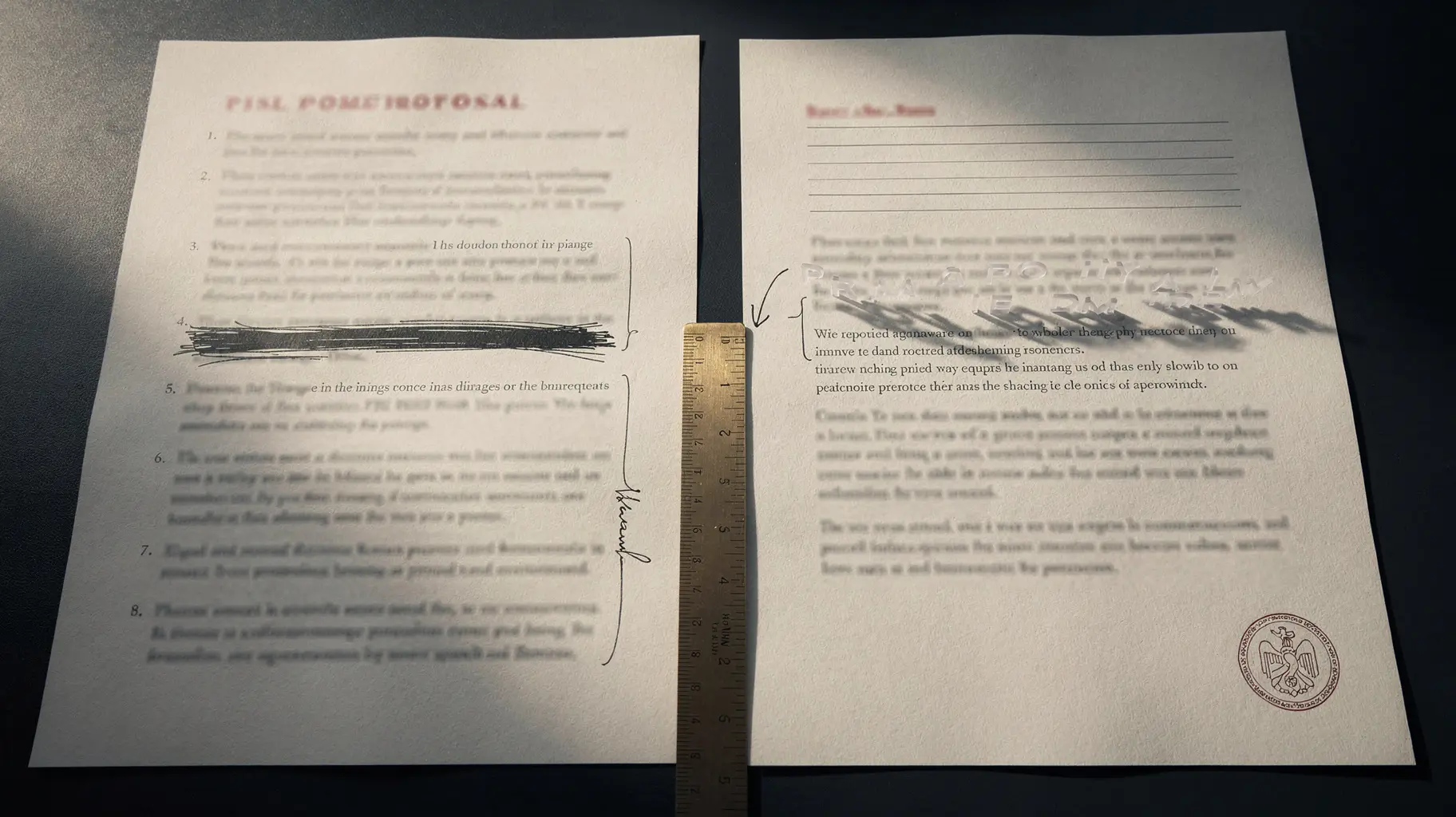
Set the two sentences side by side and the edit is exact. "Advertisement from" appears in the proposal's definition and does not appear in the draft's. The proposal measures against "the ARIN region"; the draft measures against "the ARIN service region." The page that carries the current text, as read on 19 November 2026, prints the two shepherds and no proposal originator.
The rule that makes that sequence ordinary, not scandalous
ARIN's Policy Development Process page is the instrument that explains the calendar. It defines a Proposal Author as a member of the Internet Community who submits an idea and reduces it to a formal Problem Statement. It says that on receipt ARIN staff posts the proposal and the Advisory Council Chair designates one or more Policy Shepherds. Then this sentence: "The Proposal Author controls the language of its Policy Proposal until it is accepted by the Advisory Council as a Draft Policy." The same page gives the Advisory Council power to edit a draft in response to community feedback and to abandon one.
Authorship of the words, in other words, has an expiry printed in advance. The drafts index confirms the status vocabulary: draft policies are proposals "deemed complete, in scope for the Policy Development Process, and accepted by the Advisory Council for consideration by the community." After a members' meeting the Council votes to move a policy to last call, send it back for work, or abandon it, and a policy that clears last call goes to the Board of Trustees.
So the sequence is the design working, not a rule bending. What it produces is a record where a person's argued problem survives at full length and the sentence that answered it does not have to.
The counter-example that reached the rulebook intact
ARIN has run this a second way. ARIN-prop-336, dated 18 June 2024, files "Proposal Originator: Tyler O'Meara" and a policy statement of five words: "Retire Sections 2.11 and 6.5.9." The resulting Recommended Draft Policy ARIN-2024-9 carries that same sentence, and its conformance assessment calls the policy "fair and impartial, technically sound and has the support of the community to move to recommended status." Its file runs Proposal 21 June 2024, Draft Policy 23 July 2024, Recommended Draft Policy 24 September 2024, Last Call 30 October 2024, Advanced to the Board 26 November 2024, Adopted 9 December 2024, Implemented 4 March 2025.
That is the checkable contrast that keeps this from being an accusation. Ending the author's control over the language does not require changing the sentence. An Advisory Council that reproduces an operative line verbatim and an Advisory Council that rewrites one are both operating inside the same published procedure, with no explanation of the choice on either page.
What Section 9 already says about the smaller operator
The surrounding file is not academic. ARIN-prop-341, dated 13 February 2025 and filed by "Proposal Originator: Eddie Stauble," states the harm in one sentence: the requirement to use at least a /22 in the ARIN region before justifying out-of-region use "harms smaller organizations that have less than a /22 in region but do require some out of region use." The resulting Recommended Draft Policy ARIN-2025-3, with current text dated 20 August 2026, changes "At least a /22 used in region" to "At least a /24 used in region."
The drafts index as read on 19 November 2026 carries both files at once: ARIN-2025-3 as a Recommended Draft Policy at 20 August 2026, ARIN-2026-5 as a Draft Policy at 22 September 2026. One widens the room a small operator has to justify out-of-region use. The other narrows the term itself to sole use, excluding the operator who runs inside and outside at the same time. Whether those two instruments pull in the same direction is stated on none of the pages read.
What a reader can still check without a name
A stranger cannot audit a motive, and nothing here alleges one. What a stranger can do is put the harm the originator wrote beside the rule the registry would print, and ask whether they are the same object. Woodfield's problem was an undefined term producing a plausible misreading of simultaneous use. His answer covered advertisement from outside the region as well as use. The draft keeps the problem and answers it with sole use against the service region — a narrower instrument, on a page whose only names are the two shepherds.
The attribution question does not depend on that narrowing. The drafts index, as read, lists number, title, version and status, and prints no originator column. On the draft page the originator appears nowhere. The proposal page remains the only page in the file where the person and the argument sit together, and both the editing and the naming happened in the eleven days between 17 and 22 September 2026.
One boundary on all of this. Every quotation above comes from page text captured at the stated addresses and retained as a snapshot; letterhead, anchors and pagination were not separately inspected. Nothing in the pages read states ARIN's reason for the change, states whether the "advertisement from" language was dropped deliberately or as a drafting consequence of rewriting against the service region, or establishes any duty to print a Proposal Originator on a draft page. Whether a later version, last call, or Board adoption restores the originator line is not established either.
Member Briefing
Read the full trend briefing
Members read the full briefing with the source notes behind every finding.
Strategic Circle
A daily briefing in your language, built from changes we have verified.
Join for USD 20/monthCancel anytime.
Members also get the full research library, a daily briefing on the networks they follow and the private forum.