
Cross-jurisdiction governance and policy interface.
Governance / ICANN
ICANN
ICANN governance intelligence tracks institutions, policy processes, standards activity, registry operations, accountability disputes, and implementation signals that affect internet infrastructure. BTW.
GlobalDNS GovernanceAccountability

Institutional structure, policy process, and accountability trust.
Multi-stakeholder legitimacy and process clarity.
Structural policy changes usually materialize in 120d+ cycles.
Latest Coverage
Latest from ICANN
302 articles

ICANN
ICANN Counted 1,616 Applications. It Had Not Added 1,616 TLDs.
Reveal Day will make the 2026 new-gTLD round visible. Visibility matters: it exposes applicants, proposed strings and collisions to scrutiny. But the number now circulating is a receipt for paid applications entering a long process, not a measure of namespaces operating in the…

ICANN
The Internet Society's Two Accountability Stories: What Its Own By-Laws Establish — and What It Demands at the UN
The Internet Society (ISOC) is one of the most publicly vocal advocates of open, transparent, inclusive and accountable decision-making about the Internet. Its own governing instruments — the Amended and Restated By-Laws, the trustee-selection procedures and the…

ICANN
The Remedy That Has Never Been Used: Whether the Draft RIR Governance Document's Derecognition Machinery Is Actually Operable
Every accountability system is judged not by the rules it writes but by whether anyone has ever made those rules work. The *Governance Document for the Recognition, Operation, and Derecognition of Regional Internet Registries* — Version 3, dated 1 September 2026 and labeled FINAL…

ICANN
If JPRS Fails, Who Keeps .jp Running? Reading the Successor Machinery in the .jp Record
Japan Registry Services Co., Ltd. (JPRS) has operated .jp since 1 April 2002 under an unusually public set of governing instruments. But the question of what happens if JPRS itself fails — bankruptcy, insolvency, or a decided re-transfer — has not previously been the subject of…

ICANN
The Route From UA Indicators to National Statistics Has No Agreed Convener
A country-comparable statistic needs more than a plausible test. A September exchange between a regional intergovernmental body and ICANN leaves the institutional route from Universal Acceptance indicators to an ITU dataset unsettled.

ICANN
An Advisory Committee, a Line of RDAP Output, and the Quiet Grammar of Registry Authority
On 7 July 2026, the 80th JP Domain Name Advisory Committee agreed that it is appropriate for JPRS's RDAP service to display the managing designated registrar name in JP domain name query results. The instrument chain behind that one line of output — memorandum, advisory…

ICANN
The Second Face of JPRS: The Contract Track That Sits Beside Japan's .jp Mandate
Japan Registry Services Co., Ltd. is usually described in one sentence: it runs .jp. That sentence covers only half of the company's authority. The other half is not delegated by anyone — it is bought, signed and renewed, and it is policed by a different institution with a…
ICANN
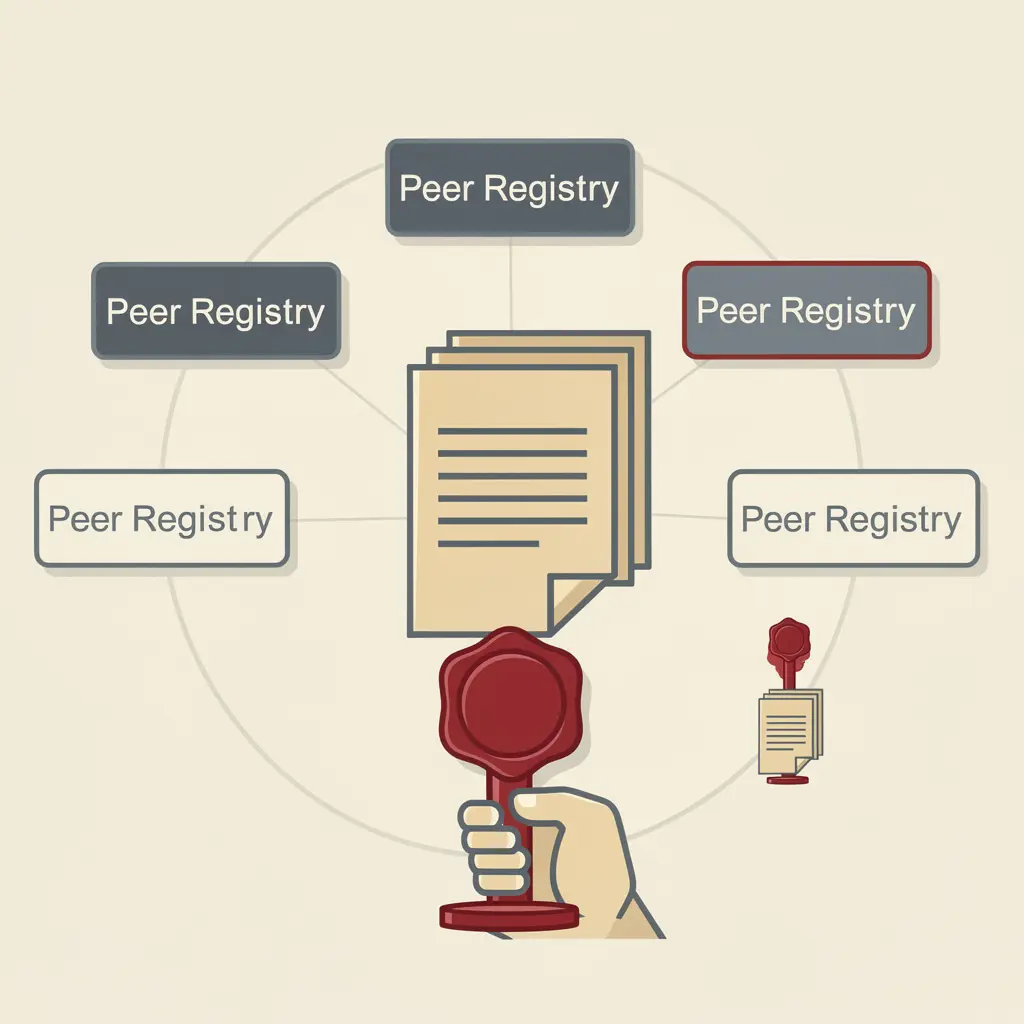
Who Grants and Revokes RIR Authority: Inside the Governance Document That Would Replace ICP-2
For twenty-five years, the rules governing how a Regional Internet Registry is created have lived in a single, short document adopted in 2001. The instrument that would replace them — and, for the first time, write down how a registry could lose that status — is still a draft.

ICANN
Who Controls the .jp Registry? The Instrument Chain Above JPRS
Japan Registry Services Co., Ltd. (JPRS) sits at the center of a layered control surface for the .jp country-code top-level domain: IANA and ICANN grant its international authority, JPNIC and Japan's government can challenge it, and a 2025–2026 evaluation cycle plus a second…

ICANN
Challenging a .jp Registration Just Got Easier: What the 2026 JP-DRP Rules Revision Actually Changed
Japan's procedure for disputing ownership of a .jp domain name was quietly modernised this spring — but its most consequential limits were left exactly where they were.

ICANN
What the IGF's Paper Trail Says About Its Permanence
The Internet Governance Forum never had a constitution. Its authority comes from a chain of documents, each of which can be read for what it actually grants, orders or refuses. Reading that chain in full — the 2005 Tunis Agenda paragraph that created the forum, the General…

ICANN
The Coalition Clause: What the Empowered Community's June–July 2026 Instruments Certified — and Refused
In June 2026, a single ICANN instrument recorded in its own operative words that the Empowered Community's rejection power had failed to activate: the Rejection Process on the Standard Bylaws Amendment to Article 27 "has been terminated," because not one other Decisional Entity…

ICANN
Who Holds the Keys to .jp: An Instrument-by-Instrument Audit of JPRS's Registry Authority
Japan Registry Services Co., Ltd. (JPRS) operates the .jp country-code top-level domain, but the company's public profile as a registry says little about where its authority actually comes from, who can challenge it, and what has changed on that control surface recently. This…

ICANN
The Root-Server Governance Model Has a Comparison Problem, Not an Adoption Date
The ICANN Board Chair has acknowledged unresolved differences between a proposed root-server governance structure and the advisory criteria meant to test it. The public account identifies the comparison but leaves its disputed rows unnamed.

ICANN
ICANN90 Has a Host. That Is Not a Transfer of Policy Authority
The Adelaide announcement identifies who will help put on ICANN's 2027 annual meeting. The useful governance question is where that practical role ends—and who remains accountable for the meeting and its decisions.

ICANN
Netpia's Cure Has Two Access Doors That a Payment Cannot Open
ICANN's new notice is formally anchored in unpaid accreditation fees. Its reader-facing significance lies elsewhere too: the public lookup and the route to request nonpublic data need separate evidence that they work.

ICANN
ICANN's Empowered Community rejection machinery failed for want of a second supporter: the Article 27 petition, the ASO decline and the ECA termination
On 9 June 2026 at 06:59 UTC, the Empowered Community Administration certified that the Rejection Process against the ICANN Board-approved Standard Bylaws Amendment to Article 27 had ended. The petition died not on its merits but on arithmetic: only one of the five Decisional…

ICANN
ICANN Can Declare Its Own Breach. The Remedy Still Needs Someone Else to Act.
A finding of breach is binding. The repair is only a recommendation. The .WEB record and one terminated community petition show where ICANN's accountability stops being automatic.

ICANN
Ghana’s DNSSEC Rate and Nigeria’s Signed Zone Are Different Kinds of Progress
ICANN’s latest account of African DNS security puts mobile-network resolvers beside a country-code registry. The gains are real but belong to different operators and measure different parts of a secure lookup.

ICANN
A DNS-Abuse Check Meets the Boundary Between Sister Registrars
A new public comment asks ICANN to look past a registrar's individual accreditation when the same company controls another registrar. The question is not whether every domain sharing an attribute is suspect; it is which institution must investigate an evidenced campaign when a…
Member Unlock
Restricted Profile Intelligence
Login is required to unlock full profile briefings and deep-dive sections.
Strategic Circle Briefing
Join to unlock strategic briefings after signing in.
Join Strategic CircleLeadership Alliance Briefing
For qualified IP-asset owners and management; sign in to unlock alliance briefings.
Join Leadership Alliance