
Strategic Circle Briefing
Join to unlock strategic briefings after signing in.
Join Strategic CircleGovernance / Case File / AFRINIC Saga
AFRINIC Saga governance intelligence tracks institutions, policy processes, standards activity, registry operations, accountability disputes, and implementation signals that affect internet infrastructure.

Latest Coverage
518 articles

Story
ICANN's 28 May clarification draws a hard line around what it says it did not do: it did not endorse AFRINIC candidates, design the election or pay for Smart Africa's candidate work. The harder accountability question begins on the other side of that line, where ICANN's documents…

Story
One day before four scheduled ten-minute decisions on four years of audited accounts, the Number Resource Society gave AFRINIC members an unusually precise action plan: vote against each proposal, demand the authority and transaction records behind the spending, reserve rights…

Story
In one short agenda slot, AFRINIC’s members were asked to hand the current, contested Board two levers over the scrutiny of its own stewardship: the choice of external auditor and the price paid for that audit. The notice proves that the delegation was proposed. It does not prove…

Story
The order that put ICANN inside the AFRINIC winding-up litigation is only two pages long. Its decisive sentence does not endorse a theory of stewardship, continuity or ownership. It says the respondent was no longer objecting, so the Court granted ICANN leave to intervene.

Story
AFRINIC’s published 2025 schedule is precise enough to reveal where most of its “Other Expenses” sat, yet too aggregated to show the chain from member money to service output. AFRINIC should reconcile the one-dollar difference, separate accounting assurance from transaction…

Story
AFRINIC has disclosed a precise receiver-fee figure for its 23 June 2025 Board election, but precision is not the same as an accountable transaction: the public record still does not show the order, rate, work, invoice, approval and payment trail that would explain what the…

Story
AFRINIC’s own unaudited account assigns fourteen costs to its 23 June 2025 Board-election exercise. The numbers reconcile; the authority, performance and surviving benefit behind them do not yet reconcile in the public record.

Story
Six months after AFRINIC ratified a policy that keeps resources issued from its pool inside regional transfer channels, its own case list still labels a lawsuit against that ratification as ongoing. The policy-development record can show how a proposal advanced; it cannot by…

Story
AFRINIC’s five disclosed lines for its September 2025 Board-election rerun reconcile exactly, but the clean addition sits inside a much less complete chain of contracting, approval, payment, audit and member review. The distinction matters because a registry’s role as ledger…

Story
AFRINIC’s direction that members should not answer an enquiry unless it was formally sanctioned by AFRINIC turned a narrow privacy question into a test of institutional authority: who may verify a private registry’s public election record, on what evidence, and under whose…

Story
AFRINIC announced a person for every elected Board seat on 12 September 2025, but its own notice withheld every candidate total promised by the election guidelines. That omission matters because the notice was only one transition in a longer chain—from seven contested seats and…

Story
AFRINIC’s first regional Board renewal after recognition as an Internet registry delivered a named primary, a named alternate and a five-person Central Africa slate. It did not leave a reproducible public count. More awkwardly, the AFRINIC-2 report calls the contest Seat 5 while…
Story
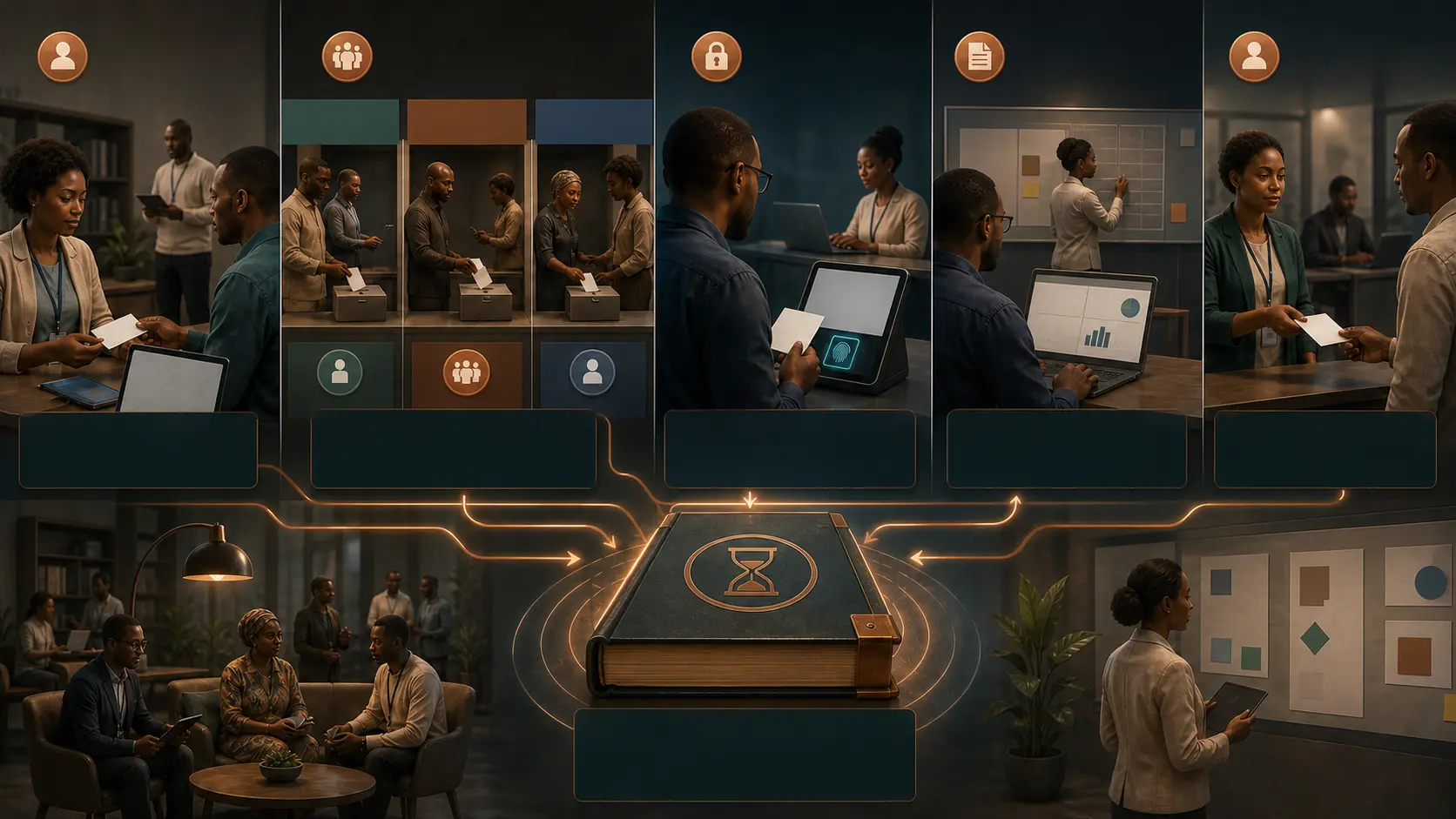
AFRINIC's election rules for 2026 did more than tell people how to choose officeholders. They placed three different constituencies beneath one temporary instrument, turned vote rank into unequal years of institutional influence, and gave excluded candidates no published route of…

Story
AFRINIC’s members elected Daniel K. Nanghaka, Afaf El Maayati and Maud Adjeley Ashong Elliot to a committee designed to advise, not govern. Their staggered expiries make the order of victory visible, but unpublished aggregate voting statistics and an unfinished public record of…

Story
On 1 April 2026, AFRINIC’s Board named four people to the committee that would decide which candidates could advance toward seven governance and policy positions. The public evidence showing how the screeners themselves were selected, classified and recused is thin. That…

Story
AFRINIC’s proposed compliance dashboard can help members find inaccurate records, understand which adopted rule is being checked, receive notice and correct evidence. That is useful registry administration. It must end there. AFRINIC is a record-keeper, not a sovereign, and it…

Story
An election can produce winners and still fail to prove that the electorate was treated fairly. The missing fact is often not the numerator on the results page but the denominator underneath it: every organisation entitled to participate, every application accepted or refused…

ICANN
ICANN's warning after the AFRINIC election crisis showed that recognition review is no longer theoretical. It also exposed the harder question: if AFRINIC were found unable to provide regional registry services, who would receive the records, who would operate the services, what…

Afrinic SAGA
AFRINIC's legal bill becomes more intelligible when divided by the organisations sustaining the registry, but the calculation also exposes a missing denominator, unequal fee incidence and the absence of a member-level account of what the expenditure achieved.

Afrinic SAGA
The way out of registry failure is not a rival database launched overnight, but a verified transfer of service in which operators can move while uniqueness, disputes and running-network state remain intact.
Member Unlock
Login is required to unlock full profile briefings and deep-dive sections.
Join to unlock strategic briefings after signing in.
Join Strategic CircleFor IP-asset owners and leadership teams: alliance briefings, private reports and direct analyst support.
Join Leadership AllianceChronology
8 April 2005
Formal accreditation: AFRINIC is officially recognised as the fifth RIR by ICANN.
March 2018
Allegations of bullying and sexual misconduct are raised by a staff member.
April 2019
AFRINIC senior staff member Ernest Byaruhanga is found to have stolen 4.1 million IPv4 addresses, many later used to host gambling and pornography websites.
October 2019
Eddy Kayihura replaces Alan Barrett as CEO and dismisses Byaruhanga; later election process moves become a central governance dispute point.
July 2021
The Supreme Court of Mauritius rules the AFRINIC board invalid due to quorum and term issues; the CEO is suspended and board seats become vacant.
June 2022
The Supreme Court again rules the board invalid; directors' terms eventually expire, leaving AFRINIC without a functioning board or CEO.
September 2023
Virasami Vasoo Deven is appointed Official Receiver by the Supreme Court of Mauritius to restore governance and arrange board elections.
2024-2025
Board election process remains under high scrutiny as legal and procedural disputes continue to shape AFRINIC's recovery path.