
Strategic Circle Briefing
Join to unlock strategic briefings after signing in.
Join Strategic CircleCase file
The AFRINIC crisis is a fight over whom Africa's internet registry answers to: its members, or the people who run it. In 2020 AFRINIC's management accused a member, Cloud Innovation, of breaking its policies, and in 2021 moved to put it out at its "sole discretion". The Supreme Court of Mauritius stopped it, recorded that its own order was "deliberately flouted", and in 2023, on Cloud Innovation's application, placed AFRINIC in receivership. An election was thrown out in 2025 over one disputed proxy. The rerun gave seven of the eight seats to candidates endorsed by an alliance of governments, and whether that Board was validly appointed is still before the Court. This file sets out the record: every date, every court order, and what is still to be decided.

Timeline
A company in Mauritius, a member since 2013, and addresses misappropriated from inside.
AFRINIC
It is a private company limited by guarantee: "African Network Information Centre (AfriNIC) Ltd", file C49338 at the Registrar of Companies.
SourcesWhat AFRINIC is
ICANN
AFRINIC had already been a company in Mauritius for a year. ICANN does not own it and is not one of its members.
SourcesICANN and AFRINIC
Cloud Innovation
It signs the same Registration Service Agreement as every other network. AFRINIC allocates it four address blocks, in July 2013, December 2014, December 2015 and September 2016: 6,291,456 addresses, every one registered by AFRINIC through its own process.
SourcesThe four blocks
AFRINIC
AFRINIC later wrote that the misappropriation had come to light around mid-2019, and that a former employee was found to have done it.
SourcesAFRINIC's audit
Letters, a termination, and court orders that were defied.
AFRINIC
The letter judged where an address is used by the country in which a network's number is registered. Cloud Innovation answered every point on 13 July 2020: "we strongly deny having acted in any way in breach of the Agreement, Policy Manual and/or the By-laws".
SourcesThe letter of 23 June 2020The reply of 13 July 2020Did Cloud Innovation break the rules?
AFRINIC
The audit found them "misappropriated from AFRINIC's pool of resources and attributed to organisations without justification". AFRINIC's published account of the audit names no company.
SourcesAFRINIC's audit
AFRINIC
The letter demanded an answer to what the Court later called "purported breaches", or termination at AFRINIC's "sole discretion". It was sent, the Court noted, "when access to justice was very limited".
Court
On Cloud Innovation's application, the Judge in Chambers restrains AFRINIC from terminating, suspending or revoking its membership.
Sources2022 SCJ 253, page 9
Cloud Innovation
The petition is SC/COM/PET/000275/2021. The order on it comes nearly four years later.
SourcesThe court cases
Court
No attorney had been appointed under the Deposit of Powers of Attorney Act: a power of attorney Cloud Innovation could not provide during the lockdown that began the day management wrote. It appeals the next day.
Sources2022 SCJ 253, page 10
AFRINIC
With immediate effect, and 90 days before the addresses are reclaimed. Cloud Innovation is told just past midnight.
Sources2022 SCJ 253, page 11
Court
The Judge in Chambers restrains AFRINIC from acting on the resolution, from reclaiming the addresses and from cutting Cloud Innovation off from the WHOIS database. The order is served the same day. The Court later records that AFRINIC "failed to comply with the aforesaid order and deliberately flouted the duly served order dated 13 July 2021".
Court
Its representative undertakes to comply and is told the consequences of a breach. Cloud Innovation reported that its membership was restored only that night, after a warning of contempt proceedings.
Court
On Cloud Innovation's application, in support of its claim for damages over the termination, at two Mauritian banks.
SourcesThe order of 23 July 2021
AFRINIC
It writes that websites on Cloud Innovation's addresses carry illegal content and demands to know why the company does not monitor them. Cloud Innovation hosts no websites: its customers are network operators serving hundreds of millions of end users in 60 countries. It asked management to say within four hours which addresses were involved, so the sites could be shut down. Management refused.
AFRINIC
Before a registrar, not before the Judge who recorded it. The Court: "I will not comment on the propriety of the procedure adopted to withdraw an undertaking given before a Judge although I cannot turn a blind eye in the interests of fairness and justice."
Sources2022 SCJ 253, pages 13–16
Court
After management wrote that Cloud Innovation's services "may come to an end at any time", the Judge in Chambers bars AFRINIC from terminating the membership pending the final determination of the dispute.
Sources2022 SCJ 253, pages 1 and 10
Ministers lobbied, a judgment, and a registry running out of directors.
Cloud Innovation
AFRINIC's last members' meeting before the receivership was held that month.
SourcesThe statement
Others
Through the Number Resource Organization, they back international-organisation status for AFRINIC, call Cloud Innovation's litigation vexatious and suggest that government authorities review the affidavits filed in court. The Ministry of Foreign Affairs replied that the request "cannot be entertained".
SourcesThe pattern
Court
In 2022 SCJ 253 the Court rejects the objection, raised in AFRINIC's name, that the company was abusing its process, declines to treat it as a vexatious litigant and warns that upholding the objection "would imperil the future administration of justice".
Sources2022 SCJ 253The record
AFRINIC
The post has been vacant since this date.
SourcesThe Receiver
One member goes to court for AFRINIC itself.
Cloud Innovation
AFRINIC had no chief executive and had held no members' meeting since June 2022. Cloud Innovation applied "for the purpose of holding the ring" and paid for the case itself. Lawyers acting in AFRINIC's name answered by demanding USD 100,000 in security for costs.
SourcesWho asked for the Receiver?
Court
AFRINIC's lawyers cannot rely on a 2021 board resolution to appear for it.
SourcesThe ruling
Court
It finds the orders sought "fully justified, reasonable, and fair", appoints the Official Receiver to preserve AFRINIC's assets and see that elections are held under its constitution within six months, and bars AFRINIC from "relocating and/or subject itself to a takeover or merger, or restructuring".
Court
In 2024 SCJ 473 the Court of Civil Appeal upholds Cloud Innovation's objections, restores the receivership order and gives the Official Receiver two months to complete the election.
Sources2024 SCJ 473The record
Court
"Seven IP addresses have been issued without my permission", he says. On Cloud Innovation's motion, the Court orders the election by the end of June 2025 and rules that those admitted as members without his consent since 19 September 2023 have no vote.
SourcesThe transcriptThe order
A register order, an annulled vote and a rerun without proxies.
Court
He replaces the Official Receiver, in SC/COM/MOT/000082/2025.
SourcesThe Receiver
Court
Nearly four years after the petition of 24 May 2021.
SourcesThe record
Court
The order varies that of 4 April. AFRINIC's Receiver signs a written undertaking to rectify its records within 15 days, and the Court records it.
SourcesThe order of 11 June 2025Why Cloud Innovation is on the register
Others
One for each Board seat.
SourcesSmart Africa and AFRINIC
Court
Cloud Innovation was not a party. The ruling deals with the category of an entry made at the Registrar, which it calls a "wrong classification", and refuses ICANN's demand to dismantle the nominations committee, calling the insistence "inappropriate". It does not vary or cancel the order of 11 June.
Receiver
Voting is suspended on the day, and AFRINIC's Receiver then annuls the whole Board election over "one disputed proxy". No result has ever been declared.
SourcesThe electionsCloud Innovation's objection, 26 June 2025
ICANN
ICANN writes that it is "formally putting AFRINIC on notice that a compliance review may well be necessary": a review of whether AFRINIC still meets the criteria on which it was recognised.
SourcesICANN and AFRINIC
Cloud Innovation
With registry services carried on without interruption. It petitions the Court that month (SC/COM/PET/000508/2025) and, on 14 July, asks ICANN and the Number Resource Organization to designate a successor registry so that African networks keep their service.
Receiver
AFRINIC's constitution says a member votes "either by e-voting, by being present in person or by proxy", and the Court had ordered an election under that constitution. He obtains an extension of his mandate to 30 September 2025 without the knowledge or consent of Cloud Innovation, on whose application the receivership began.
Court
The Judge in Chambers restrains the inspector appointed under the Proclamation from carrying out any inspection under that mandate. Cloud Innovation's constitutional complaint: the measures would call into question judgments the courts had already delivered and set up a parallel system of justice. The inspector withdrew by a letter of 18 August 2025.
Receiver
Voting runs from 10 to 12 September under the Receiver's rules. One seat is never put to a vote. AFRINIC's announcement of 15 September gives eight names and no tally. Smart Africa, an alliance of 40 governments, welcomes the result: "seven out of eight coalition-endorsed candidates elected".
Court
The application, SC/COM/MOT/000757/2025, is fixed for hearing on 26 November 2025. Cloud Innovation opposes it: the departures from the constitution exceeded the Receiver's mandate and breached the Court's orders. Judgment is awaited.
SourcesIs the Board valid?
A Board before the Court, a rule, and a demand sent to ministers.
AFRINIC
In AFRINIC's own words, "AFRINIC-issued IPv4 cannot be transferred out of the region". Its own assessment said why: "AFRINIC will not lose its current resource members to other RIRs in outgoing transfers."
SourcesThe transfer policy
Receiver
Without notice, an interim order against Cloud Innovation over a press release published by LARUS, a separate company. It restrains statements attributing to the Court an approval that nobody claimed. It is an interim order, not a final judgment, and Cloud Innovation has applied to have it stayed, reviewed or discharged.
SourcesThe recordThe interim order
AFRINIC
The eight seats filled in the rerun were not put to a vote, and whether those directors were validly appointed is still before the Court.
SourcesThe 2026 elections
AFRINIC
"With the consent of the Receiver", to take office on 1 January 2027: chosen by a Board whose own appointment no court has yet declared valid.
SourcesThe Receiver
Court
The 15 days AFRINIC undertook had passed without rectification, so Cloud Innovation executed the judgment. The Court draws up its order as a rule, witnessed by the Chief Justice: AFRINIC's register of members is to be rectified to add Cloud Innovation as its member, in the category of Member.
Others
The only other members on AFRINIC's record are its eight directors.
SourcesThe Registrar's record
Receiver
His legal notice asks the Registrar to remove Cloud Innovation at once, with copies to the Prime Minister, the ICT Minister, the Attorney General and the State Law Office. AFRINIC's own statement names no court order for the removal it demands.
Cloud Innovation
"If thousands of members qualify for registration, put thousands of names on the register." On 3 November it announces that it will take the Receiver's conduct to the Court that appointed him and ask for his removal.
SourcesStatement of 1 November 2026Communiqué of 2 November 2026Communiqué of 3 November 2026
AFRINIC
The list on its website holds 2,592 organisations, Cloud Innovation among them. The register kept under the Companies Act names eight directors and one company.
SourcesAFRINIC's members
Member Unlock
Login is required to unlock full profile briefings and deep-dive sections.
Join to unlock strategic briefings after signing in.
Join Strategic CircleFor IP-asset owners and leadership teams: alliance briefings, private reports and direct analyst support.
Join Leadership AllianceLatest Coverage
518 articles

Story
AFRINIC shows why the first economic decision in scarce-address governance is often the framing decision: whether a dispute is named as conservation, liquidity, development, abuse, compliance, fairness, capital control or institutional legitimacy. Scarcity, anti-abuse and…

Story
Chair discretion in AFRINIC's policy process is not mere meeting management; in a scarce-address registry, rulings on scope, objections, last call and rough consensus can move economic value without a formal vote.

Story
Receiver-continuity is the institutional backstop that appears when a registry company can no longer rely on ordinary boards, banking authority and member governance to keep the public ledger functioning.

Story
Dispute resolution is the market infrastructure behind a scarce-resource ledger: it determines whether contested IPv4 records become bounded evidence problems or institution-wide risk premiums.

Story
AFRINIC’s governance crisis has turned a routine registry service into a market risk. Reverse DNS must be protected from leverage and from the disputes over AFRINIC’s Board and elections.

Story
AFRINIC's board failures were priced into every block: enforcement without prudence, opaque legal spending and an annulled election. Credible oversight must narrow the registry's power.

Story
AFRINIC's captive members fund a monopoly ledger they cannot leave, yet weak elections, opaque legal spending and receivership have left them without control of it.

Story
AFRINIC's election machinery has already failed once in public: the Receiver annulled the June 2025 vote, published no record that would let members test that decision, and Cloud Innovation does not recognise the board announced in September 2025.

Companies
The board's disputed path to office affects trust, continuity, and policy authority in Africa's internet governance.

Story
AfriNIC's receivership has become a governance-risk entity because the receiver-run election process is now itself under legal challenge.

Companies
AfriNIC sits at the centre of African internet-number governance, and its board legitimacy affects registry trust, policy execution and resource governance.

Global Cloud Services
softbank DREAM CLOUD INNOVATION LIMITED company intelligence explains what the organisation operates, where it is exposed, and how its services, customers, partnerships, ownership signals, public evidence, and market role connect to internet infrastructure. The summary helps…

Companies
Benjamin Mark Roberts is a Kenya-based digital-infrastructure advisor, listed by AFRINIC as its Seat 7 director, whose public record links registry governance with practical African backbone, peering and policy experience. AFRINIC identifies him as Principal Advisor at Digital…

Companies
Adewole David Ajao is a Nigerian Internet-infrastructure and governance operator whose public record now has a concrete AFRINIC board surface. AFRINIC's 2025 election portal lists him as the elected candidate for Board Seat 8, while the candidate profile places him at Google as a…

Companies
Kayemba Laurent Ntumba is a DRC internet-operator and governance figure whose public profile now sits inside AFRINIC's disputed board. AFRINIC candidate and board material identifies him as Microcom's managing director, ISPA-DRC president, FEC telecom-committee vice-president, a…
Companies
The 11 June 2025 Supreme Court order finally directed Cloud Innovation’s inclusion as a company-law Member; later category correction and attempted administrative removal do not reopen that decision and require competent-court relief.
Companies
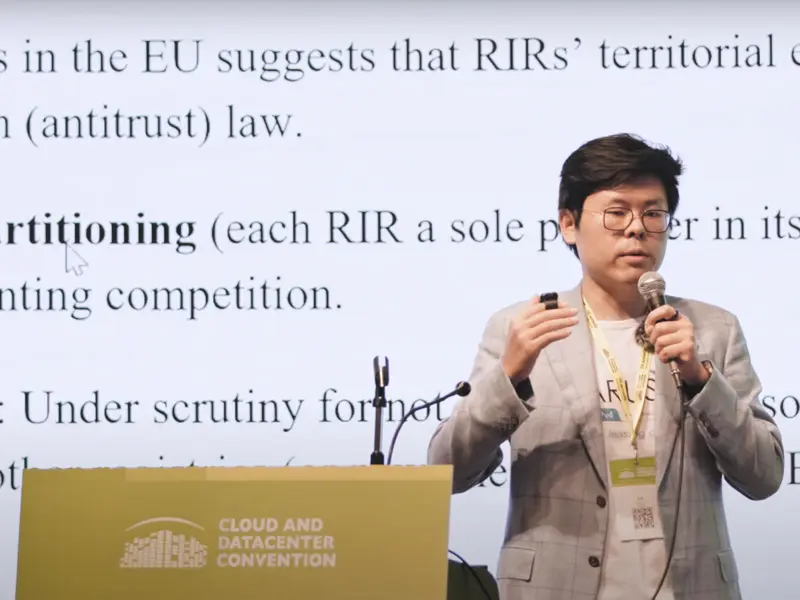
Smart Africa has cast AFRINIC's crisis as a digital-sovereignty issue and backed election and reform activity. Lu Heng and Cloud Innovation argue that this risks politicising a technical registry hosted in Mauritius.
Companies
This board came out of the September 2025 rerun after the Receiver annulled the June 2025 election. Cloud Innovation does not recognise it as lawfully constituted.

Africa Institutional
Lu Heng is a key figure in global internet governance, challenging traditional systems and pushing reform in IPv4 resource management.

Global Cloud Services Trends
Lu Heng argues his role in IPv4 markets was inevitable, highlighting the structural forces driving decentralised Internet governance.