
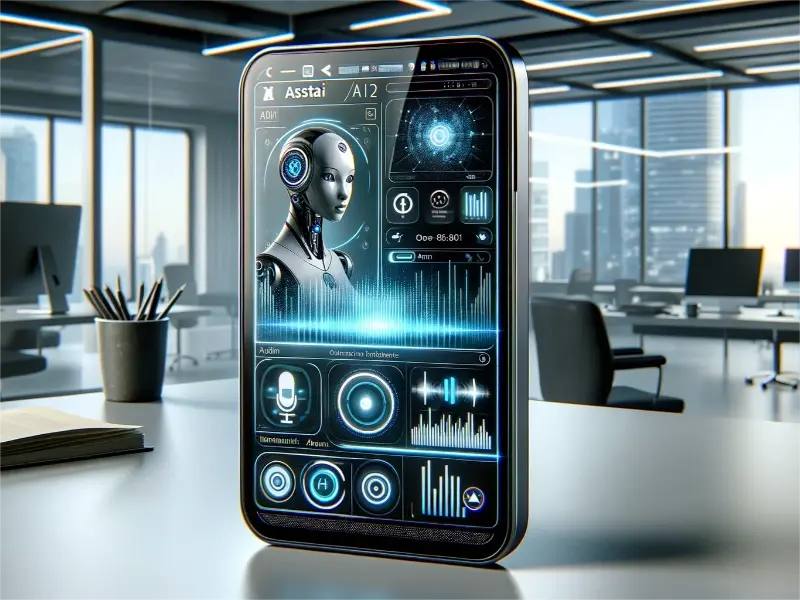
- Project Astra is Google DeepMind's real-time multimodal agent: it watches through a camera, listens through a microphone, and answers in conversation — no typing, no prompt engineering, no tab switching.
- Unveiled at Google I/O on 14 May 2024, it ran on a Pixel and on prototype smart glasses, holding roughly ten minutes of visual context in testing.
- The headline isn't the demo. It's latency: Google says it roughly halved response time, which is the difference between an assistant and a party trick.
On 13 May 2024, OpenAI demoed GPT-4o and made a spectacle of how fast it could talk. The next morning, Google walked on stage at I/O, pointed a camera at the world, and had an agent answer out loud before the audience finished being impressed. Project Astra was born in the least subtle way imaginable: as a latency contest.
That framing matters, because Astra is easy to misread. It is not a chatbot with a webcam bolted on, and it is not — yet — a product. It is Google DeepMind's research prototype for what an assistant looks like when you stop typing at it and start living in front of it: a multimodal agent that sees, hears, remembers and reasons in the same conversational beat.
What Project Astra actually is
Strip away the stagecraft and Astra is a pipeline. A camera streams frames. A microphone streams audio. A Gemini model — Gemini 1.5 Pro in the I/O demos — fuses both into a running context it can reason over, in the same way Gemini's ballooning context windows let it swallow far more input than its predecessors.
Ask Astra what it is looking at and it answers out loud. Ask it what it saw a minute ago and it still knows. That second part is the interesting engineering: the memory is not a database lookup but a rolling buffer of what the camera has already seen, which is why Demis Hassabis could tell reporters the prototype held roughly ten minutes of visual context in testing. Ten minutes is not much. Ten minutes is also the entire difference between a tool that answers a question and a tool that follows a conversation.
The demo: a speaker, a line of code, a pair of glasses
The I/O walkthrough was deliberately mundane, which is what made it land. The agent identified a speaker sitting in front of the camera. It spotted a camera lens in the room. It read code off a monitor and explained what the function did. It found a pair of glasses on a desk and said so — then, in the flourish everyone remembers, the same agent ran on a prototype pair of smart glasses, camera and microphone built in, no phone held aloft like a divining rod.
That last detail is the strategic tell. Google is not really selling a demo; it is staking a claim on the form factor. The assistant of the next five years is not a rectangle you stare at. It is a thing you wear, and it is always on.
Multi-step reasoning is the quiet part
Astra's other advance is multi-step reasoning: the ability to plan, act, remember and revise inside a single exchange rather than resetting after every prompt. That is what lets it chain a visual observation into a decision — see the entity, recall the earlier context, answer the question — without a human stitching the steps together.
This is where the marketing and the engineering diverge, and where BTW's read is blunt: reasoning demos are cheap, and every lab has one. What is expensive is doing it fast enough that the pause does not break the spell.
Latency is the whole ballgame
Google said it roughly halved the response latency of the underlying models for the Astra demo. Half. Fixate on that number, because it is the one that decides whether any of this ships.
A multimodal assistant that thinks for four seconds is a search engine with a camera strapped to it. One that answers in under a second is a colleague. Every meaningful use case — walking down a street, fixing a machine, reading a label in a supermarket — collapses the moment the agent makes you wait, because humans do not pause mid-stride to accommodate a data centre.
Also read: McDonald's & Google AI integration: Will promised benefits materialize?
Google's competitive edge — and the asterisk
Google's advantage here is not a single model. It is the stack: in-house TPUs, Gemini, Android, Pixel hardware, Search, and Cloud, all under one roof. Nobody else can move a capability from research paper to phone to glasses to data centre without leaving the building. That is a real moat, and Astra is the demonstration that the moat has water in it.
The asterisk is equally real. Astra was a prototype with no shipping date and no price. A camera that remembers raises questions Google has not fully answered — what is stored, where, and for how long. Battery life on glasses remains the industry's oldest unsolved problem. And demo conditions are curated: good lighting, cooperative entities, a script. Production is a harsher critic than any keynote audience.
Also read: Google AI System Raises Copyright Concerns
The chat box had a good run
Astra's real claim is not that Google built a smarter model. It is that the interface is disappearing — the keyboard first, then the screen, eventually the phone itself. Once the assistant can see what you see and hear what you hear, the prompt stops being a sentence you compose and becomes a situation you are already in.
Which is why the benchmark that matters from here is not a leaderboard score. It is how long you stand there, mid-sentence, waiting for the world to answer back.




