
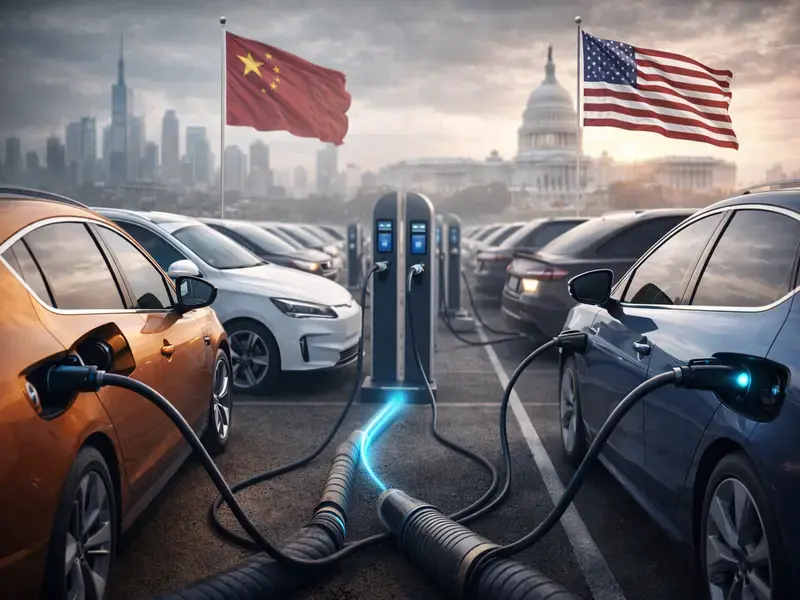
Global EV sales slow as China and US demand softens is profiled by BTW Media because public-source evidence links it to internet infrastructure, governance, operational dependencies, or market visibility.
Global EV sales slow as China and US demand softens is tracked as a internet infrastructure institution within the internet infrastructure ecosystem.
Global EV sales slow as China and US demand softens has public-source relevance to network operations, governance, dependency mapping, or market structure.
Global EV sales slow as China and US demand softens is tracked as a internet infrastructure institution within the internet infrastructure ecosystem.
Public-source signals support medium-impact monitoring for infrastructure visibility and dependency analysis.
Global EV sales slow as China and US demand softens is profiled by BTW Media because public-source evidence links it to internet infrastructure, governance, operational dependencies, or market visibility.
Public-source signals support medium-impact monitoring for infrastructure visibility and dependency analysis.
| 0.90–1.00 | A | High — direct sources |
| 0.75–0.89 | A/B | Strong |
| 0.55–0.74 | B/C | Medium |
| 0.35–0.54 | C/D | Weak–medium |
| 0.10–0.34 | D | Weak signal |
| 0.00–0.09 | D | Internal monitoring |
Mixed-source
- Electric vehicle sales growth weakened amid slower demand in China and the United States
- The shift raises concerns about pricing pressure and profitability across the sector
What happened: A pause after rapid growth
Global electric vehicle (EV) sales growth faltered in January as weaker momentum in China and the United States weighed on the market, according to a Reuters report.
The EV sector has expanded quickly over the past several years, supported by subsidies, regulatory targets and automakers’ aggressive electrification strategies. However, the latest monthly data suggests the pace is becoming less predictable, with the world’s two largest car markets showing softer demand at the start of 2026.
China remains the dominant EV market globally, but purchasing activity slowed after a strong end to the previous year. In the United States, demand was also more subdued as consumers reacted to pricing levels and financing conditions. Europe, by contrast, provided relatively steadier support, partially offsetting declines elsewhere.
The slowdown affects both established manufacturers and newer entrants, many of whom rely on sustained volume growth to justify heavy investment in battery plants and production capacity. According to Reuters, the figures indicate a moderation rather than a collapse, but the shift has prompted closer scrutiny from investors.
Also Read: US and China Opt Out of Military AI Principles at Global Summit
Also Read: China blocks Nvidia H200 AI chips despite US export clearance
Why it’s important
The EV industry has been built on expectations of continuous expansion. A deceleration in the two largest markets complicates that narrative and highlights the sensitivity of adoption to pricing and incentives.
From a financial perspective, slower growth increases margin pressure. Manufacturers must continue funding battery development and factory conversion while competing on price to stimulate demand. If volumes plateau, the path to profitability becomes longer, particularly for companies without large combustion-engine revenues to subsidise the transition.
The development also matters for supply chains and infrastructure planning. Charging networks, battery suppliers and raw-material producers have scaled operations based on rising demand curves. A more volatile adoption cycle could lead to overcapacity in some segments and shortages in others.
More broadly, the January figures suggest the EV transition may evolve unevenly across regions rather than following a single global trajectory — a shift that could reshape investment strategies throughout the automotive and energy ecosystem.
Core Entity Brief
- Entity: Global EV sales slow as China and US demand softens
- Subject Type: Internet infrastructure institution
- Region: Asia Pacific
- Classification: Institution Type
Service Surface / Control Surface
- Public records support monitoring of governance, service, and infrastructure control surfaces.
Governance and Policy Surface
- Public-source signals support medium-impact monitoring for infrastructure visibility and dependency analysis.
- Operational criticality: Medium
- Time horizon: Quarter (30-120d)
Decision Trigger Matrix
- Monitoring focuses on verified service continuity, governance changes, and relationship signals.
Current state favours active tracking due to infrastructure relevance.
Public-source signals support medium-impact monitoring for infrastructure visibility and dependency analysis.
Long-cycle infrastructure decisions likely to remain path-dependent.
Member Unlock
Restricted Profile Intelligence
Login is required to unlock full profile briefings and deep-dive sections.
Only for Strategy Circle
Strategic Circle Access
Open to all readers. Unlock profile briefings after joining and logging in.
Join Strategic CircleOnly for Leadership Alliance
Leadership Alliance Access
For owners and management of IP-holding companies. Login required to unlock.
Join Leadership Alliance


