
Summary
- Global AKAR aims to make selected Eutelsat ground facilities available to more satellite operators while continuing to support existing networks and customers.
- More than100operational antennas by end 2029 is a deployment target. The commercial question is how shared access becomes a dependable service.
A ground antenna can be available on a network map yet unavailable for a particular customer's contact. Eutelsat and Skynopy's Global AKAR partnership brings that distinction into focus: opening an existing ground footprint to more users creates an allocation business, not simply a larger inventory of dishes.
The companies announced the agreement on 9 September 2026. Selected Eutelsat facilities would support a broader range of satellite operators and applications while retaining their existing responsibilities. Skynopy contributes orchestration software and virtualized modem technology, giving operators one interface for accessing ground infrastructure.
That model can reduce the need for each constellation customer to build and operate a dedicated ground system. But the same announcement explicitly preserves Eutelsat's own network and customer requirements. The value of third-party access will depend on how those commitments coexist, not on the fiction that a shared facility has unlimited time.
A larger programme, not a first experiment
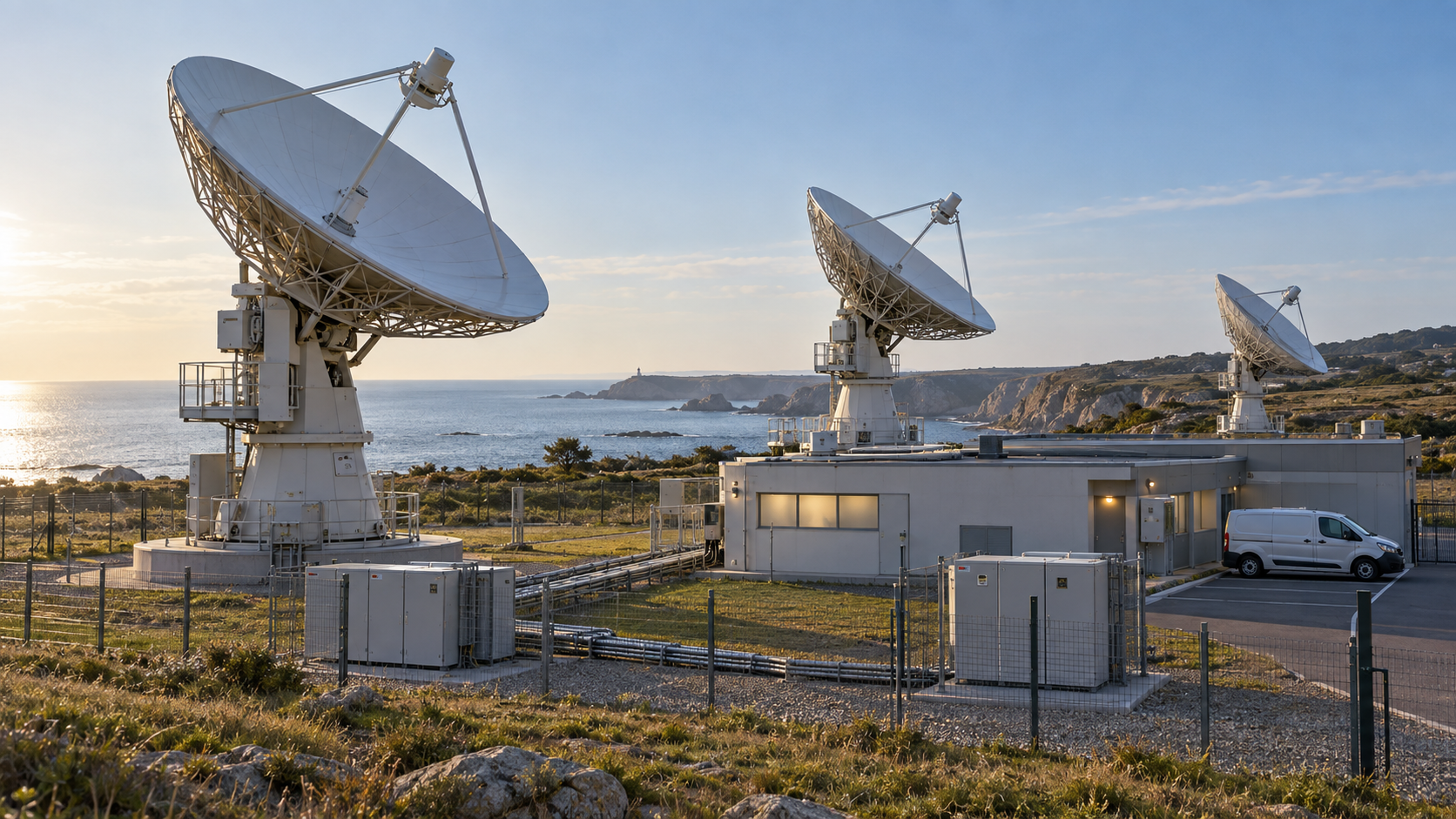
The plan calls for more than 100 operational antennas at selected sites by the end of 2029, serving missions in the S, X and Ka bands. Antennas are not sites, and the target is not a statement that the network already exists.
Global AKAR follows an initial three-antenna Earth-observation proof of concept, according to Eutelsat. The collaboration itself is older: Skynopy's 28 January 2026 announcement about supporting Airbus Defence and Space's Pléiades Neo services already described AKAR work with Eutelsat. The September news is the wider programme, not a newly invented partnership or a new Airbus order.
Eutelsat says the service is designed for data latency below three minutes and throughput up to 10 Gbps. These are design ambitions, not independently measured results across a completed network. The latency figure should not be confused with consumer internet ping, nor the throughput figure with capacity reserved for every customer.
One interface still needs an operating agreement
Skynopy's own service description combines time-shared antennas with proprietary stations. It also lists pre-mission radio and antenna choices, modulation and coding, and satellite-to-ground integration tests. A single interface can simplify access without removing those physical and technical conditions.
The release does not provide prices, the selected-site list, reserved contact capacity or rules for competing requests. It does not explain whether a missed contact would trigger an alternative opportunity or any compensation. Those omissions are not evidence of a dispute; they identify the terms a customer would need before treating a global footprint as a dependable delivery schedule.
For Eutelsat, this is a way to extend the use of existing infrastructure. For satellite customers, it offers an alternative to owning the whole ground segment. Whether the two interests align will be determined by usable access at the required time.
Sources and scope
The Eutelsat announcement establishes the new programme and its targets. Skynopy's service description explains the generic shared-access model. Its January Airbus announcement establishes earlier commercial activity and AKAR collaboration, not September deployment results.
Member Briefing
Deeper Profile Context
Sign in with the right membership level to unlock the full briefing and source notes.
Only for Strategic Circle
Strategic Circle
Open to all readers. Unlock profile briefings after joining and signing in.
Join Strategic CircleOnly for Leadership Alliance
Leadership Alliance
For qualified IP-asset owners and management; sign in to unlock alliance briefings.
Join Leadership Alliance