
Summary
- Grayscale AI Compute ETF is not a new fund. On 22 September, the former Grayscale Bitcoin Miners ETF changed its name, ticker from MNRS to GCPU, underlying index, objective, principal strategy and 80% policy.
- Its index may admit a digital-infrastructure transition company on the basis of a disclosed, contracted or announced move into AI or high-performance computing before that move is implemented or generates meaningful revenue.
- The current Indxx page shows 27 constituents. Its five displayed largest weights—CoreWeave, Nebius, Hut 8, DigitalOcean and IREN—sum to 40.51% by arithmetic and put native AI-cloud businesses beside companies with mining roots.
- The fund charges 0.59%. Its prospectus carries forward MNRS’s history: $9.901m of net assets at the end of 2025 and 65% portfolio turnover for the partial year. Those figures are inherited evidence, not current GCPU scale or performance.
The label moved first
Grayscale introduced GCPU as an exchange-traded route into the data centres, power and compute capacity behind artificial intelligence. That description is directionally clear. It is also incomplete without the words printed immediately beneath the new name in the 22 September prospectus: “Formerly Grayscale Bitcoin Miners ETF.”
This was a mandate conversion, not a blank-sheet launch. The board had approved changes to the name, underlying index, investment objective, principal strategies and 80% investment policy on 7 July. A July supplement initially pointed to about 15 September. An August supplement moved the date to about 22 September and changed the ticker from MNRS to GCPU. The old Indxx Bitcoin Miners Index gave way to the Indxx High Performance Computing Index.
The distinction matters because names describe a classification while facilities produce the cash. A former miner can possess scarce power, land, grid connections and buildings. Those are valuable inputs. They are not yet liquid-cooled halls, installed accelerators, commissioned networks, accepted customer capacity or recognised AI revenue. Renaming the fund changes the portfolio rule in a day; changing the underlying businesses requires capital, engineering and customers.
The eligibility rule reaches ahead of the accounts
Under normal conditions, GCPU puts at least 80% of net assets, including investment borrowings, into index constituents or instruments with similar economic exposure. The index covers high-performance computing, AI cloud, accelerated-computing infrastructure and supporting hardware and services. It also covers “digital infrastructure transition companies”—businesses rooted in cryptocurrency mining, blockchain infrastructure or adjacent markets that have disclosed, implemented or contracted a move towards AI, GPU cloud, HPC or AI data centres.
The revenue taxonomy looks precise. Pure Plays derive at least 50% of revenue from the theme. Quasi Plays derive at least 20% but less than 50%. Marginal Plays derive less than 20%. Yet the third bucket contains an important temporal exception: a transition company can qualify because it has publicly disclosed, contracted or announced a transition.
The prospectus states the boundary unusually plainly. A company may enter on the basis of a transition it has not implemented, and there is no assurance that the move will be completed or generate meaningful revenue. That does not make the rule deceptive. It makes the product’s risk legible. The index is not confined to proven AI operators; it also owns an option on organisational conversion.
That option should be measured as a ladder, not a slogan. An announcement is evidence of intent. A signed customer or power contract adds counterparties and obligations. Funded capital spending makes execution possible. Delivered and accepted megawatts prove physical progress. Recognised AI revenue proves commercial use. Segment margin and cash return show whether the conversion creates rather than consumes value. Each rung is useful, but none may be substituted for the next.
Two taxonomies occupy the same portfolio
Grayscale’s launch announcement says approximately half of target portfolio weight is intended for businesses built around GPU cloud and AI hosting from inception. The remainder is intended for digital-infrastructure operators transitioning from activities including bitcoin mining.
The legal index rules organise companies differently. Pure, Quasi and Marginal are revenue-exposure buckets. Native versus transition describes corporate origin and operating history. A transition company is not automatically Marginal, and a native AI company is not automatically Pure. The marketing half-and-half picture therefore cannot be reconciled to the prospectus’s 15% combined cap on Quasi and Marginal names without a constituent-level classification table.
That is not necessarily a contradiction. It is a missing map. The public material reviewed for this article does not identify each company’s Pure, Quasi or Marginal status, show the revenue denominator used, or separate contracted future capacity from operating AI revenue. Investors can see names and weights; they cannot yet reproduce the classification decision.
The difference becomes important at rebalance. The index selects up to 30 Pure Plays by company market capitalisation, fills any remaining places with Quasi Plays and then Marginal Plays, and reconstitutes quarterly. Pure-Play securities have an 8% cap at the weight calculation. Quasi and Marginal names together have a 15% cap and a 4.5% single-name cap. Live weights can drift after calculation, so a screen above 8% is not by itself evidence of a rule breach. It is evidence that a current holdings page and a rebalance file answer different questions.
Forty cents of every visible dollar sit in five names
When frozen for this article, the Indxx page displayed 27 constituents and only its five largest weights: CoreWeave at 8.36%, Nebius at 8.30%, Hut 8 at 8.11%, DigitalOcean at 8.01% and IREN at 7.73%. Together they make 40.51%.
That snapshot expresses the fund’s dual path more clearly than its name. CoreWeave and Nebius make the native AI-compute route visible. Hut 8 and IREN bring mining ancestry into the same top-five list. DigitalOcean adds established cloud infrastructure. One ticker therefore contains businesses with different starting assets, customer clocks, financing needs and evidence burdens.
The concentration is not merely thematic. The index page reported a beta of 3.59 year to date and 3.64 for one year against the Indxx 500 total-return index, with standard deviation of 74.34% and 75.04% over those periods. Those are provider statistics for the index as of the last trading day, not GCPU returns or a forecast. They nonetheless warn against reading “infrastructure” as a synonym for low-volatility utility assets.
The prospectus makes the structural point more directly. The fund is non-diversified and may concentrate where the index concentrates. As of 27 August, the index was concentrated in the Software industry, with significant exposure to Software & Services and Information Technology. The physical story may be power and buildings; the market classification and price behaviour can still resemble a concentrated technology trade.
MNRS remains in the financial history
The new prospectus charges a 0.59% management fee and total annual operating expenses of 0.59%. Its financial highlights do not begin on 22 September. They preserve the old fund’s record under the heading “Grayscale Bitcoin Miners ETF.”
MNRS commenced operations on 30 January 2025. At 31 December 2025, it reported net assets of $9.901m, an ending NAV of $30.00 and a 19.18% total return for the partial period. Portfolio turnover was 65%, excluding in-kind transactions. None of those figures describes the newly reconstituted portfolio today. Together they prove that GCPU inherited a vehicle, shareholders, operating history and trading record rather than beginning with an empty ledger.
That inheritance cuts both ways. An existing shell can spare a sponsor the work of launching another fund and can preserve exchange, service-provider and shareholder continuity. But the historical chart crosses a strategy boundary. Pre-change performance belongs to a bitcoin-miner mandate; post-change performance belongs to an AI-compute index. A continuous price series is not a continuous economic experiment.
The same caution applies to digital-asset exposure. GCPU does not invest directly in digital assets or related derivatives. It may still own companies whose legacy, transitional or current operations involve mining, blockchain infrastructure or proprietary digital-asset holdings. The absence of bitcoin on the fund’s balance sheet does not remove bitcoin-linked operating and valuation risk from every constituent.
A power contract is not an AI receipt
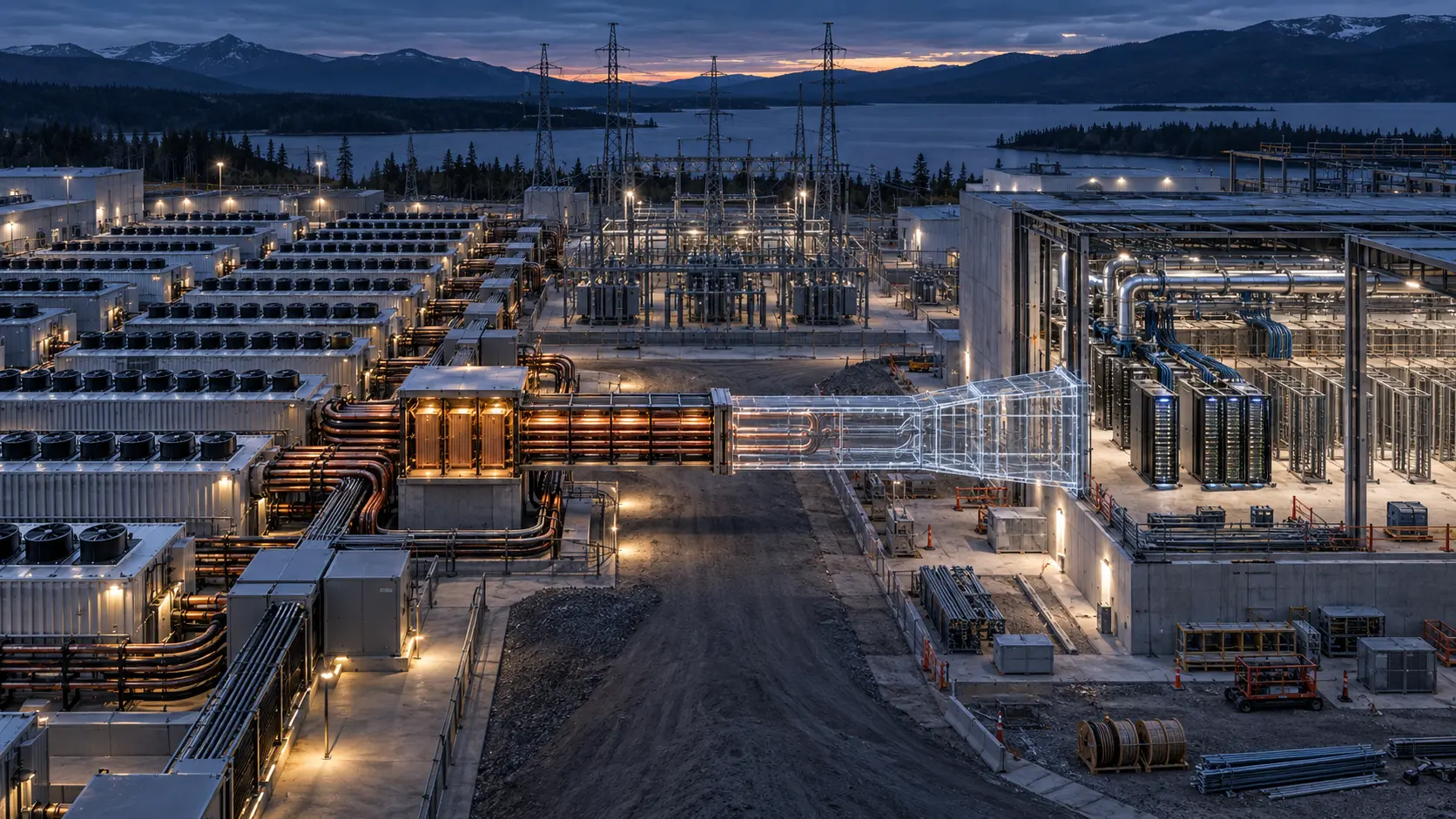
The miner-to-compute thesis begins with a real scarcity. Grid connections can take years; powered land and substations cannot be summoned by software. A miner that already controls energy and a site may reach the starting line faster than a greenfield developer.
The prospectus also lists what the starting line omits. Facilities may require substantial retrofits. AI workloads need specialised cooling, networking, hardware, personnel and reliability. Customers must be secured and capacity accepted. Capital must arrive before revenue, sometimes years before. Legacy equipment or power arrangements may be unsuitable and may lose value if conversion is delayed.
These frictions turn the transition sleeve into a financing and execution portfolio. The most useful quarterly question is not whether a company repeated the words “AI” or “HPC”. It is which obligation became irreversible: a funded build, installed hardware, customer acceptance, recognised revenue or positive cash return. Until then, an announced transition is an option whose exercise price remains uncertain.
GCPU does not conceal that uncertainty. Its legal document states it. The analytical error would be to let the new name erase the warning.
Sources
Member Briefing
Deeper Profile Context
Sign in with the right membership level to unlock the full briefing and source notes.
Only for Strategic Circle
Strategic Circle
Open to all readers. Unlock profile briefings after joining and signing in.
Join Strategic CircleOnly for Leadership Alliance
Leadership Alliance
For qualified IP-asset owners and management; sign in to unlock alliance briefings.
Join Leadership Alliance