
Summary
- Galco Industrial Electronics is best understood as a downtime-insurance distributor for maintenance, repair, operations and automation buyers: its value proposition is not simply that a part exists in a web cart, but that stock, technical support, repair services, vendor access and logistics can reduce the time a line, machine, panel or facility system remains idle.
- The company has evidence of scale, but not the scale of the broadest industrial catalogs: public materials describe Galco as founded in 1975, headquartered in Madison Heights, Michigan, serving more than 100,000 customers in some accounts, offering millions of products, and supporting customers through distribution, repair, field service, engineered systems and custom control panels. Core public evidence includes https://www.galco.com/, https://www.automate.org/companies/galco-industrial-electronics, https://www.prnewswire.com/news-releases/galco-celebrates-50-years-of-industrial-distribution-302524635.html and https://businessinfocusmagazine.com/2024/10/enabling-the-world-today-for-a-better-tomorrow/.
- The economic test is whether Galco can convert a maintenance buyer's uncertainty into a faster correct action: same-day or expedited shipment, cross-referencing, technical support, send-in repair, on-site repair, engineering help and access to authorized product lines all matter more when the alternative is a stopped conveyor, a disabled variable-frequency drive or a legacy control panel with no obvious modern substitute.
- Its risks are equally operational: catalog competitors such as AutomationDirect, Grainger, McMaster-Carr and DigiKey already compete on price, stock, speed and web convenience; Galco's website and order flow depend on cloud-fronted services; and customer signals are mixed enough that buyers should watch whether service quality keeps pace with private-equity-backed expansion, acquisitions and a larger digital catalog.
The buyer is pricing the stopped machine, not the part
Picture the buyer at 8:10 a.m. on a Monday. A packaging line has stopped because a variable-frequency drive is faulting. The maintenance crew can bypass part of the process for a few hours, but the workaround is slow, the line supervisor is watching the day slip, and the plant manager wants a believable recovery time. The buyer sees a cheaper catalog listing. The buyer also sees Galco, a specialist distributor that claims same-day shipment, industrial repair capability, field service, technical support and a dense product catalog for automation and control components. If the unit price is the only metric, the cheaper listing wins.
If the plant is losing production by the hour, the relevant metric becomes time to a correct, working outcome.
That distinction is the reason Galco matters. The company is not a glamour technology platform, and it does not need to be one. It sits in the unglamorous but economically sharp layer between industrial equipment makers, maintenance teams, panel builders, system integrators and facilities that need replacement parts to keep physical operations running. Galco's public positioning is clear: the company sells industrial automation, control and electronic components, and it pairs that catalog with repair, field service and engineering support. The Association for Advancing Automation member profile describes it as an e-commerce-driven, MRO-focused distributor of electrical and electronic control, automation, motion-control and power-transmission products, with cross-referencing, technical support, custom control panel solutions, engineered systems, and send-in and on-site repair; the public profile is at https://www.automate.org/companies/galco-industrial-electronics.
The buyer's problem is that industrial downtime has a different cost curve from ordinary procurement. A cheap component that arrives late, fails compatibility checks, or forces an engineer to spend a day reconciling a part number can be expensive even when the invoice looks good. A supported component that costs more can be cheap if it restores throughput before a production window closes. Siemens' 2024 downtime study puts the macro version of that problem in stark terms, estimating that unplanned downtime costs the world's 500 largest companies $1.4 trillion annually and 11 percent of revenue; the report is available at https://assets.new.siemens.com/siemens/assets/api/uuid%3A1b43afb5-2d07-47f7-9eb7-893fe7d0bc59/tcod-2024_original.pdf. Galco is not selling to only those giant plants, but its buyer logic depends on the same arithmetic: one hour saved can overwhelm a modest price difference.
The useful procurement formula is simple enough to write on a whiteboard: expected production value at risk, plus idle labor, plus scrap, plus premium freight, plus customer or schedule penalties, multiplied by the number of hours a sourcing decision might save or lose. A small manufacturer may not have the dramatic per-hour losses of a major automotive plant, but the buyer still faces a local version of the same trade. If the plant loses even a few thousand dollars per hour when a machine is idle, a same-day supported order that avoids one bad substitution can be worth more than a visibly cheaper quote.
If the application is low-value, the part is fully specified, and the machine can wait, the premium disappears. Galco's commercial proposition lives inside that probability-weighted gap.
This is also why the cheapest line item can be the wrong managerial signal. Purchasing departments are trained to challenge variance against a catalog benchmark, and that discipline is useful for planned spend. Emergency MRO buying is different. The buyer is not only purchasing an object; the buyer is choosing a recovery path under uncertainty. A strong distributor reduces the number of unresolved questions before the order is placed, which means the maintenance team spends less time turning a box into a restart.
The invoice should therefore be judged against avoided hours and avoided rework, not just against the first web price a search returns.
The practical decision often starts with a question that looks small. Is this the right replacement for a discontinued drive? Does the breaker match the panel and duty cycle? Can a repair buy enough time while capital approval moves? Is the current model available, or should the buyer choose a modern equivalent? Will an expedited shipment leave today, and is there anyone who can answer the phone if the order detail is wrong? Galco's edge is strongest when the customer needs confidence across those questions, not merely a checkout button.
That makes Galco a useful BTW entity because it exposes how service continuity in small and mid-sized industrial operations is protected. The industrial internet conversation often focuses on sensors, analytics and predictive maintenance. Yet many stoppages still end with a buyer trying to source a physical part, a technician trying to understand a failure mode, and a plant weighing whether to repair, replace or redesign. The control surface is not only the machine; it is the commercial infrastructure that can find, ship, repair or substitute the thing that keeps the machine useful.
Galco's business model is a specialist MRO spread
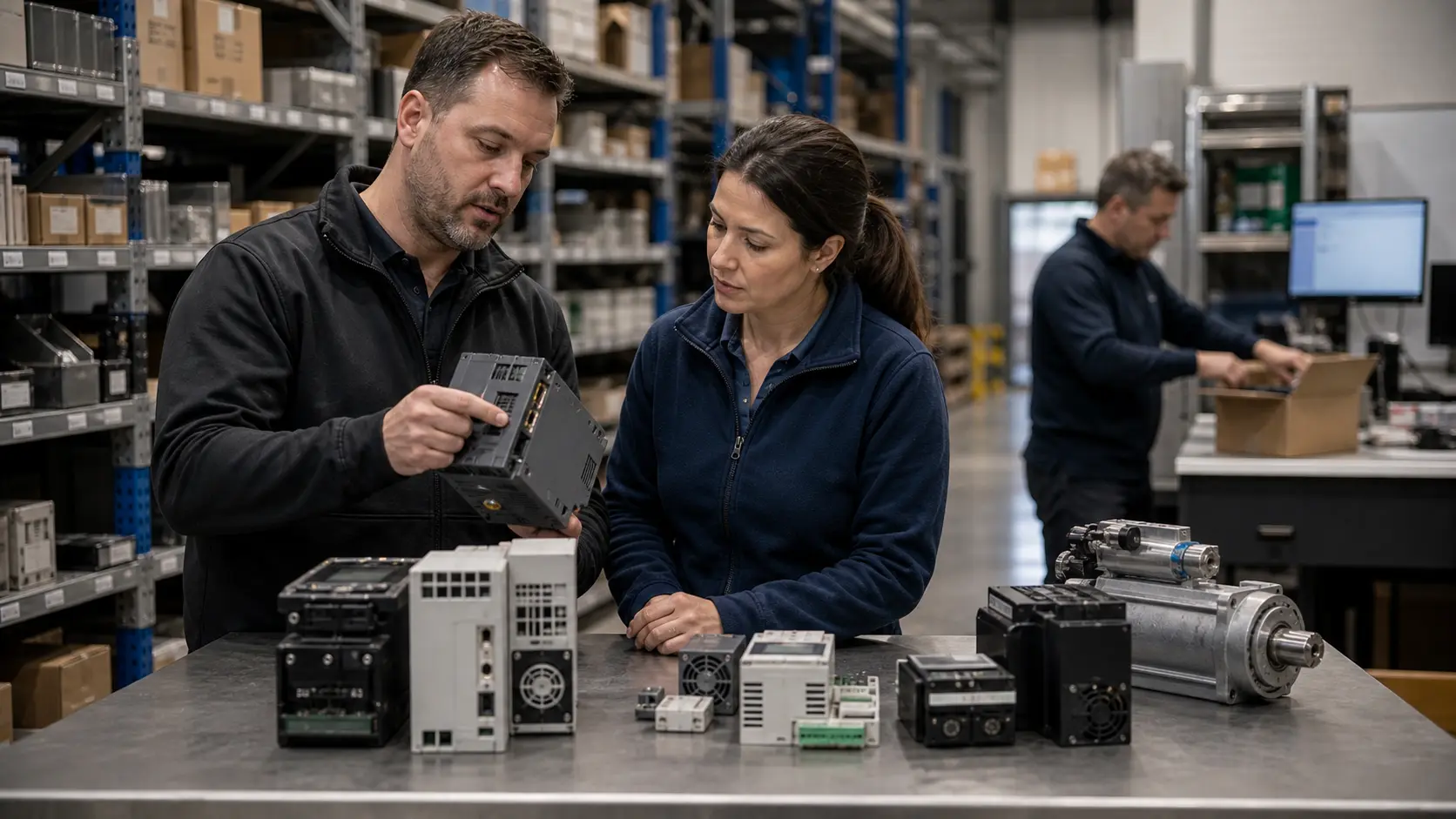
Galco's model combines several revenue streams that reinforce one another. First, it sells industrial automation and electrical control products: drives, motors, PLCs, HMIs, circuit protection, relays, sensors, power supplies, enclosures, connectors, tools and related categories. Second, it earns on services around that product base: repair, field service, engineered automation systems and custom control panels. Third, it uses technical support and product data as a retention mechanism.
The customer who calls for a difficult cross-reference today may return for a larger order tomorrow because the distributor has become part of the maintenance routine.
Public ownership history reinforces that this is a distribution business with private-equity economics, not a small local counter alone. A Freeman Spogli release from February 2020 said Galco had been acquired by Freeman Spogli, management and other investors, and described Galco as an e-commerce-driven, MRO-focused distributor of electronic industrial control and automation components with more than 3 million SKUs and more than 64,000 customers; the release is at https://www.prnewswire.com/news-releases/galco-industrial-electronics-inc-has-been-acquired-by-freeman-spogli--co-and-management-300998218.html. AEA Investors, a prior owner, describes Galco as a direct marketer of industrial electronic components focused on control and automation categories serving maintenance and repair applications; that portfolio note is at https://www.aeainvestors.com/portfolio/galco-industrial-electronics-inc/.
The spread in this model is not merely gross margin on parts. It is the margin that comes from being useful at the moment when the customer cannot afford a false economy. Galco can justify price if it can prove stock depth, part-number accuracy, technical help, repair alternatives and reliable shipment. The buyer may still demand competitive pricing, but the benchmark is not only a low-cost site. It is the all-in cost of the maintenance decision: freight, internal labor, downtime, scrap, risk of the wrong item, rework, and the reputational cost to the maintenance team if the fix misses the promised restart time.
That model also creates a data asset. An e-commerce distributor sees search behavior, obsolete part demand, substitute demand, recurring failures and brand-level supply gaps. Galco's public materials emphasize product information management, enterprise resource planning, e-commerce and digital merchandising investments. Industrial Distribution reported in 2024 that Galco added more than 8,000 SKUs, partnered with 14 manufacturers and invested in product information management, enterprise resource planning, e-commerce and digital merchandising; the report is at https://www.inddist.com/operations/news/22887775/galco-expands-its-product-line. Those investments matter because an MRO buyer does not merely need a large catalog. The buyer needs the catalog to be searchable, accurate and connected to availability, documentation and technical context.
The company also appears to be extending its service base through acquisitions. Modern Distribution Management reported in March 2025 that Galco acquired Brozelco, a Tennessee-based industrial automation distributor with engineering, system integration, fabrication and contracting expertise; the article is at https://www.mdm.com/news/mergers-acquisitions/galco-acquires-fellow-automation-distributor-brozelco/. PR Newswire reported in December 2025 that Galco acquired Ad-Tech CCI, a Harrisburg, Pennsylvania distributor of industrial controls, automation components and identification products; the release is at https://www.prnewswire.com/news-releases/galco-partners-with-ad-tech-cci-inc-302646414.html. Those moves point to a strategy of buying regional technical relationships, not just adding web traffic.
For a maintenance buyer, acquisitions can be good or bad. They can widen local coverage, line-card access and specialized repair capacity. They can also create integration risk if systems, customer service norms or technical teams do not align. The right interpretation is not simply that Galco is growing. It is that Galco's promise now depends on combining local expertise, acquired capabilities and centralized e-commerce reliability without letting the customer feel the joins.
Stock depth is the first insurance layer
The most direct insurance Galco sells is available stock. A distributor cannot reduce downtime with a product it cannot ship or a substitute it cannot identify. Galco's own search visibility and third-party profiles point to millions of products and same-day shipping claims. Trustpilot's Galco page, while based on only two reviews and therefore weak as a customer-satisfaction measure, repeats the external claim that Galco is an authorized distributor of 2.3 million parts with in-stock quantities ready for immediate same-day shipping; that page is at https://www.trustpilot.com/review/galco.com. The Freeman Spogli release used the higher figure of more than 3 million SKUs as of 2020. Different public counts likely reflect how suppliers, listed products, stocked items and purchasable SKUs are defined. The important point is not a single precise number. It is that Galco wants the buyer to see breadth as protection against line-stopping scarcity.
The warehouse evidence supports that position. Industrial Distribution reported in 2022 that Galco opened a new Madison Heights distribution center to support growth, supply-chain disruption and a broader selection of products. The report said the facility was near Galco's global headquarters, doubled the size of the previous facility, included more than 350 authorized product lines from more than 670 brands, and was expected to allow more than 1,000 orders each day; the article is at https://www.inddist.com/operations/news/22197654/galco-opens-michigan-distribution-center. A buyer does not experience those facts as a balance-sheet item. The buyer experiences them as the probability that a needed item can move today instead of turning into a multi-week sourcing exercise.
The stock question is more complex in automation than in general industrial supply. A plant can often substitute a common fastener, hose or hand tool. It cannot always substitute a PLC module, servo drive, safety relay or human-machine interface without firmware, wiring, rating, enclosure and commissioning consequences. The older the machine, the more the buyer may need a source that understands both current parts and legacy part numbers. Galco's public position around hard-to-find products and cross-referencing is therefore central, not ornamental.
There is a hidden balance-sheet logic here. A plant can carry its own spare inventory, but spare parts tie up capital, require storage discipline and become obsolete. A distributor like Galco offers a pooled inventory alternative: the buyer pays for a part when needed, and Galco bears the working-capital burden of holding or accessing stock across many customers. That is valuable when the part's failure probability is low but the downtime cost is high. It is less valuable for common, cheap, high-turn items that a plant can stock itself or buy faster from a local branch.
The strongest Galco order is therefore the awkward middle case: expensive enough that the plant does not want one of every replacement on the shelf, critical enough that a failure hurts, specialized enough that broadline catalogs may not give sufficient confidence, but common enough across industry that Galco can carry or source it. Drives, controls, power components and panel hardware often sit in that middle zone.
Technical support changes the unit of competition
Catalog competition is usually measured by price, availability and freight. Galco tries to change the unit of competition by adding technical support. The Association for Advancing Automation profile describes cross-referencing, technical support, engineered systems and repair services. Business in Focus quoted Galco's leadership arguing that many distributors can answer when a customer looks for parts online, but fewer provide deep support and expertise; that profile is at https://businessinfocusmagazine.com/2024/10/enabling-the-world-today-for-a-better-tomorrow/. For a plant buyer, that support has monetary value only if it prevents delay or error.
The most valuable support interventions are often mundane. A technician may need to know whether a newer drive can replace an obsolete model without changing the panel. A buyer may need to distinguish a manufacturer lead time from distributor stock. A facility may need a repair evaluation because a replacement is not available or requires too much recommissioning. A panel shop may need terminal markers, labels or power supplies that match an existing build standard. In those cases, the person who can translate a failed part into a defensible order is part of the product.
That matters because automation parts carry a high penalty for wrongness. The wrong relay, sensor, breaker or drive may physically fit and still fail the application. It may be rated incorrectly, require different accessories, or trigger a second round of troubleshooting. When a maintenance buyer chooses a cheaper listing, the buyer is implicitly accepting more responsibility for part verification. If the buyer's team has enough in-house expertise, that may be rational. If the team is thin, young, overloaded or dealing with legacy equipment, a technically supported order can be cheaper in total.
The labor issue is important. Many manufacturers have lost experienced maintenance workers to retirement, turnover or competition from higher-paying industrial employers. That shifts value toward distributors and service providers that can provide application knowledge at the point of purchase. A broadline catalog may be excellent for known items; a specialist distributor is more useful when the item must be identified, substituted or repaired under time pressure.
There is also an internal-politics angle. The maintenance buyer must defend the order to purchasing, accounting and operations. A higher quote from a specialist distributor can look vulnerable if the finance team sees a cheaper listing. The best defense is not brand loyalty. It is a downtime calculation: expected hours saved multiplied by the plant's hourly loss, adjusted for the probability that the specialist order avoids a mistake. If a $2,000 price premium has a meaningful chance of saving even one hour on a high-value line, the premium is not waste. It is insurance.
Same-day and expedited shipping sell probability, not certainty
Shipping claims sit at the center of the downtime-insurance story. Galco's search snippets say orders placed by 5 p.m. Eastern ship the same day by UPS Ground, 3-Day Select, 2-Day Air or Next Day Air, and some product pages indicate orders placed by 5:00 p.m. Eastern ship that day. A buyer should treat that as a service promise for eligible in-stock orders, not a guarantee that every industrial problem can be solved overnight. Still, the claim matters because it frames Galco against the buyer's alternatives.
The alternatives are strong. AutomationDirect markets low prices, free technical support and free two-day delivery on qualifying orders; its home page is https://www.automationdirect.com/adc/home/home. Grainger says most in-stock orders that arrive by 5 p.m. local time can receive next-day delivery under its shipping policy; that policy is at https://www.grainger.com/content/mc/policies/delivery. McMaster-Carr says 98 percent of products ship from stock and deliver same or next day; its delivery page is https://www.mcmaster.com/info/delivery/. DigiKey describes itself as a global authorized distributor with more than a million in-stock parts from thousands of suppliers; its home page is https://www.digikey.com/.
Those peers show that speed alone is not enough. Galco must compete on speed plus industrial fit. McMaster-Carr is famously fast for broad plant supplies. Grainger has branch density, contracts and account infrastructure. AutomationDirect is a price and documentation machine in controls. DigiKey is a high-service electronic component distributor. Galco's defensible space is narrower: parts and services for industrial automation and control buyers who want vendor access, technical translation, repair choices and stock in one place.
The buyer's freight decision also depends on geography. Galco's headquarters and public distribution evidence cluster in Madison Heights, Michigan, with added distribution and acquired locations. PR Newswire's 2025 anniversary release said Galco operated a 70,000-square-foot facility and three additional distribution centers in Michigan, Missouri, Ohio and Tennessee; that release is at https://www.prnewswire.com/news-releases/galco-celebrates-50-years-of-industrial-distribution-302524635.html. The Ad-Tech acquisition adds a Harrisburg, Pennsylvania presence. A plant in the Midwest or Mid-Atlantic may read that network differently from a plant on the West Coast.
Expedited shipping is also a probability service. Weather, carrier exceptions, cut-off times, hazmat rules, order verification and payment holds can still interfere. A reliable distributor reduces the chance of delay, but it cannot abolish logistics risk. That is why the best maintenance teams do not rely on emergency orders alone. They combine critical spares, preventive replacement, vendor relationships, repair options and multiple supplier accounts. Galco is one layer in that redundancy model.
Repair turns the order into an option contract
Galco's repair services are crucial because the best downtime decision is not always new replacement. The company's public pages and search snippets describe repair for PLCs, VFDs, HMIs, servo systems, CNC controls, motors and control panels. The FAQ search result says Galco repairs more than 2,000 brands of industrial electronics at its Madison Heights facility, including drives, PLCs, HMIs, servo motors, CNC controls and circuit boards. Business in Focus says customers can send products for evaluation and that complete refurbishments carry 18-month warranties. These claims make repair part of the purchase calculus.
Repair changes the buyer's options in three ways. First, it can return a legacy system to service when a new replacement is unavailable or too disruptive. Second, it can create a spare: the failed unit can be repaired after a replacement is installed, then kept as inventory for the next failure. Third, it can expose whether the failure is local to the component or symptomatic of a broader machine issue. A replacement order alone may restart the line, but it may not answer why the component failed.
The repair option is especially important for older equipment. Many plants run machines long after the original controls generation has moved on. A current product may require a retrofit, software changes, wiring updates or operator retraining. If the plant's priority is to finish the week's production, repairing the existing unit can be the lower-risk path. If the same failure repeats, engineered modernization may be the better long-term answer. A distributor that offers both repair and engineered systems can keep both choices in view.
The economics resemble an option contract. The buyer pays for evaluation, repair or replacement depending on what the failure demands. The value is flexibility under uncertainty. A cheap catalog listing provides a part. A repair-capable distributor can provide a decision tree: repair this, replace that, cross-reference here, modernize later. The buyer still must test whether Galco executes that promise consistently. But strategically, the ability to present repair and replacement together is more valuable than a catalog-only offer for many maintenance situations.
There is also a trust issue. Repair requires the customer to ship a failed component, wait for diagnosis and accept the service provider's view of what is wrong. That can be uncomfortable if the line is down. The provider must communicate clearly on evaluation, timing, warranty, cost and replacement alternatives. Any gap in communication can turn repair from insurance into another source of delay. This is where public review signals, technical staffing and customer service discipline matter.
Vendor access and authorized lines reduce counterfeit and mismatch risk
Industrial controls are not only expensive; they are trust-sensitive. Counterfeit, gray-market, misrepresented or damaged components can create safety, uptime and warranty problems. Galco's line-card and authorized-distributor claims are therefore part of its value. In the 2022 distribution center article, the company said its growing inventory included more than 350 authorized product lines from more than 670 brands. The 2024 Business in Focus profile says Galco works closely with more than 450 suppliers.
Search snippets and profiles mention brands such as ABB, Eaton, WAGO, Pilz, Control Techniques, Siemens and others across product categories.
Authorized access matters most when the buyer needs confidence that a part is genuine, supported and documented. It also matters when manufacturer technical support or warranty depends on channel integrity. For some urgent MRO purchases, buyers knowingly accept surplus or secondary-market risk because the official channel cannot supply the item. But that risk should be priced openly. If a distributor can provide authorized stock or a documented repair path, the buyer is buying lower uncertainty.
The Ad-Tech acquisition is relevant because it adds another category of vendor and service access. PR Newswire said Ad-Tech's product offering includes circuit breakers, contactors, PLCs and I/O devices, power supplies, relays, sensors, terminal blocks and related components, along with custom labels and terminal markers. For panel builders and maintenance teams, those are not exotic products; they are the small components that determine whether a panel build or repair is neat, compliant and serviceable. The acquisition also suggests that Galco sees identification and panel-building support as part of the downtime story.
Vendor access can be overclaimed by any distributor. Buyers should ask specific questions: Is this part in authorized stock? Is it new, refurbished, repaired, surplus or substitute? What warranty applies? Is documentation available? Is the manufacturer still supporting this line? Is there a recommended replacement? Galco's value is strongest when it answers those questions clearly before the buyer has to discover ambiguity on the plant floor.
E-commerce reliability is now a plant dependency
Galco's model depends heavily on its website. That is convenient for buyers, but it also creates an operating-surface risk. A maintenance buyer who searches, checks availability, downloads documentation, requests repair or places an urgent order through the site is depending on Galco's digital service layer. If that layer is slow, unavailable, overprotected by a challenge page, or out of sync with real stock, the distributor's physical inventory becomes harder to use.
Public DNS and HTTP observations on July 6, 2026 show that galco.com and www.galco.com resolve to Cloudflare IP addresses, use Cloudflare nameservers, and return Cloudflare challenge headers to command-line requests. The domain's MX points to Microsoft's protection service, and public TXT records reference a wider software stack including Microsoft, Zendesk, Mailchimp, SendGrid, HubSpot-related email infrastructure, Atlassian, New Relic, Google verification, Apple domain verification, 1Password verification and other services. Those observations do not indicate a problem by themselves. They indicate that Galco's commerce and communication surface depends on multiple cloud and SaaS providers.
For readers focused on data sovereignty and locality, the point is practical. A Michigan-headquartered distributor with warehouses and repair staff in the United States can still run customer-facing order, support, marketing, monitoring and email workflows through globally distributed infrastructure. That is normal in 2026. It also means uptime, access controls, telemetry, customer data handling and cross-border service dependencies are part of the reliability story. The buyer's plant may be local; the order path may not be.
Cloudflare protection is a double-edged tool. It can improve resilience against hostile traffic and improve site performance. It can also create friction if legitimate users, automated procurement systems or technical document fetches are challenged unexpectedly. A human buyer using a browser may never notice. A plant purchasing workflow that relies on saved links, ERP punchout behavior or scripted availability checks might notice quickly. The same is true for product information accuracy. If the web catalog is stale, a buyer can believe a part is available when the fulfillment reality is different.
This digital dependency changes how to judge Galco. It is no longer enough to ask whether the company has stock and knowledgeable people. A buyer should also ask whether the site is reliable during urgent searches, whether account pricing appears correctly, whether order status and repair status are visible, whether technical documentation is accessible, and whether phone support can take over when the web flow fails. The article's opening buyer does not care which cloud provider is involved. The buyer cares whether an order can be placed, verified and tracked when the line is down.
Customer and employee chatter is a watchpoint, not a verdict
Unofficial market signals around Galco are mixed and should be treated carefully. Trustpilot shows only two reviews and a 2.9 score, with Trustpilot itself warning that small review counts may not be representative. The page is still useful because it shows a thin public customer-review footprint for a company whose service promise depends on trust, but it is not enough to prove broad customer dissatisfaction or satisfaction. Better Business Bureau lists Galco Industrial Electronics as not accredited, with an A-minus rating and a note about failure to respond to one complaint; the BBB profile is at https://www.bbb.org/us/mi/madison-hts/profile/electronic-equipment-repair/galco-industrial-electronics-inc-0372-90015486. That is a modest caution, not a decisive negative.
Employee-review chatter is also mixed. Indeed reviews include positive comments about history, recognition and operational upgrades, but also complaints about management, staffing, morale and customer-service knowledge. The Indeed page is at https://www.indeed.com/cmp/Galco-Industrial-Electronics-1/reviews. Those reviews are subjective, may be stale, and may overrepresent unhappy employees. Still, for a distributor whose value depends on skilled staff and responsive service, labor sentiment is not irrelevant. If technical employees leave faster than the company can replace them, support quality can erode even while the catalog grows.
The fair conclusion is not that Galco's service is poor. It is that public signals should make buyers verify the service promise through actual order behavior. How quickly does Galco respond to a hard cross-reference? Does repair communication match the quoted timing? Are expedited orders fulfilled as promised? Do sales and technical teams coordinate, or does the customer repeat the same issue? Does the website match warehouse reality? Buyers can answer those questions with a small number of test orders before depending on Galco for a critical outage.
The same caution applies to private-equity-backed growth. Freeman Spogli ownership and acquisitions can provide capital, systems and expansion discipline. They can also create pressure for revenue growth, integration and margin management. The buyer does not need a theory about private equity. The buyer needs observable service metrics: on-time shipment, fill rate, repair turnaround, technical accuracy, warranty handling and issue escalation.
Federal and institutional demand adds a credibility signal
Galco also has public evidence of institutional demand. USAspending lists Galco Industrial Electronics Inc. with UEI SAW3RDA3TK47, legacy DUNS 010869477 and an address at 1001 E Lincoln Ave, Madison Heights, Michigan; the recipient page is https://www.usaspending.gov/recipient/503e68c5-f2bb-c4d5-2e3e-f3dbb64fb929-P/latest. Sweetspot's federal-contractor profile summarizes Galco as registered under UEI SAW3RDA3TK47 and CAGE 0ABG8, with primary NAICS 423690 and federal award history; that profile is at https://www.sweetspot.so/markets/federal/contractors/galco-industrial-electronics-inc-saw3rda3tk47/.
Federal activity does not prove superior service. It does show that Galco's identity and product categories are visible in public procurement data, and it suggests the company can transact with institutions that require formal vendor identifiers. That matters for universities, utilities, contractors and government-adjacent facilities that cannot simply buy from any website. A distributor that can support account controls, tax documentation, procurement identifiers and formal invoicing has an advantage over a one-off marketplace seller in those environments.
Institutional customers also tend to care about documentation. A part order may need a quote, purchase order, warranty record, product sheet and shipping record. A repair may need a report or traceable communication. Galco's product documentation and technical content become part of that compliance burden. If documentation is easy to retrieve, the buyer saves administrative time. If it is scattered or blocked by site friction, the buyer pays for that friction internally.
The institutional angle also explains why Galco's service promise cannot be reduced to "cheap parts online." A local government facility, food plant, university, hospital contractor or utility maintenance team may value vendor reliability, account handling and support more than the lowest visible price. That does not make price irrelevant. It means the buyer is optimizing for a procurement system as well as a machine restart.
Competition is teaching customers to expect speed and low friction
Galco competes in a market where customer expectations have been reset by several kinds of distributor. Broadline suppliers teach buyers that next-day delivery and account infrastructure should be normal. Automation specialists teach buyers that documentation, phone support and low-cost controls can be packaged efficiently. Component distributors teach buyers that enormous stock databases and same-day shipment are table stakes. Marketplaces teach buyers to compare price instantly, even when the comparison is not technically equivalent.
AutomationDirect is a particularly important reference because it competes on value in industrial automation. Its site promises best prices on PLCs, HMIs, enclosures and more, plus free technical support and free two-day delivery on qualifying orders. That combination attacks the idea that support must always cost more. Galco must therefore show that its support, repair and hard-to-find inventory justify any premium above AutomationDirect or similar alternatives.
Grainger and McMaster-Carr are different threats. They are not always the best source for specialized automation questions, but they are exceptional habit-formers. A plant buyer who has learned that McMaster-Carr can deliver many plant items same or next day may bring that expectation to every MRO category. A Grainger account with next-day delivery, branch pickup and corporate pricing can become the default for urgent purchases. Galco must win the cases where specialized product knowledge, line-card access or repair makes it more reliable than a generalist.
DigiKey and other electronics distributors matter for controls, sensors and components. They are strong at authorized stock, datasheets and global component availability. But the plant-maintenance buyer may need a more complete industrial context than a board-level component source provides. Galco's opportunity is to bridge that gap: enough e-commerce speed to feel modern, enough industrial context to avoid the wrong order, and enough repair and field-service capability to stay relevant after the box ships.
The risk is that every competitor keeps improving. If broadline distributors add better automation support, if automation specialists add more repair options, if manufacturers sell direct with better same-day availability, or if marketplaces improve authorized-stock filtering, Galco's premium space narrows. The company must keep proving that it is not just another catalog with a specialist logo.
The cost base is inventory, people, freight and systems
Galco's cost base is visible in the work it promises. Inventory requires working capital, warehouse space, purchasing discipline and supplier relationships. Technical support requires experienced staff who understand products, failure modes and substitutions. Repair and field service require technicians, test equipment, warranty handling and scheduling. E-commerce requires product data, search, account pricing, cybersecurity, monitoring and integration with fulfillment. Acquisitions require integration, management attention and capital.
That cost structure explains why Galco cannot always be the cheapest listing. A low-price catalog can run leaner if it avoids repair complexity or deep human support. A marketplace seller can underprice authorized distributors by carrying surplus, gray-market or limited-service inventory. A local electrical supplier can be faster for common items if the branch has stock. Galco's margin must pay for breadth and support, and buyers should expect that to show up in quotes.
The question is whether the cost base creates measurable buyer value. A warehouse that holds the right slow-moving spare is valuable. A warehouse that holds the wrong long tail is expensive. A technical team that prevents one wrong drive order is valuable. A technical team that responds too slowly is overhead. A repair shop that returns a legacy unit reliably is valuable. A repair shop that misses timing without clear communication creates distrust. A website that makes product discovery faster is valuable. A website that blocks urgent access becomes a liability.
Galco's 2024 product-line expansion and system investments show the company understands that scale depends on data quality as much as shelf space. Adding SKUs without clean attributes, compatibility data, documentation and availability signals can make a catalog harder to use. The most important operational question is therefore not "how many products?" It is "how many urgent maintenance problems can the catalog, staff and warehouse solve quickly and correctly?"
Freight is another cost and value lever. Same-day shipment is expensive to execute because it requires cut-off discipline, pick-pack accuracy and carrier integration. Expedited freight can preserve customer uptime but can also eat margin if errors force reshipment. In emergency orders, a distributor's mistake is costly for both sides: the customer remains down, and the distributor pays in freight, credits and damaged trust.
The strongest use cases are urgent, technical and asymmetric
Galco's strongest use case has three features. First, urgency: the buyer needs an answer now, not next week. Second, technical ambiguity: the buyer needs help identifying, substituting or repairing a part. Third, asymmetric loss: the cost of delay or mistake is much larger than the price difference between suppliers. When all three are present, Galco's downtime-insurance argument is compelling.
Examples include a failed VFD on a production line, a legacy PLC module whose exact replacement is scarce, a control panel needing a mix of breakers, relays, labels and power supplies, a servo repair where a new replacement might require recommissioning, or a facility system that needs safe on-site troubleshooting. The buyer is not asking "where is the cheapest item?" The buyer is asking "which path gets us running with the least total risk?"
Galco's weaker use cases are ordinary replenishment, fully specified commodity purchases and price-sensitive planned projects where the buyer has time to compare. If the plant knows the exact item, has no urgency, and can wait for a lower-cost source, Galco may lose unless its account pricing is competitive. If a manufacturer can sell direct with better technical support, Galco may lose. If a local branch has the part on the shelf, Galco may lose. That is not a flaw. It is the boundary of the model.
The buyer should therefore segment spend. Use Galco where uncertainty, downtime and technical risk are high. Use cheaper catalog sources where specifications are certain and time is less critical. Use local branches where immediate pickup is decisive. Use direct manufacturer channels where warranty, firmware or complex application support requires it. The best procurement strategy is not loyalty to one supplier. It is a map of which supplier reduces which risk.
What would change the judgement
Several facts would change the assessment of Galco. The most positive would be hard evidence of operational reliability: published fill rates, same-day shipment performance, repair turnaround distributions, warranty outcomes, customer retention, or independent customer surveys with meaningful sample sizes. A distributor whose public claim is downtime reduction would strengthen its case by quantifying how often it delivers the promised time savings.
Another positive would be clearer digital transparency. Real-time stock status, explicit cut-off rules, repair status tracking, visible warranty terms and better public documentation reduce buyer uncertainty. If Galco's website can make urgent procurement self-service without hiding the path to human support, the company can compete more effectively against both broadline speed and specialist support.
Negative evidence would include persistent customer complaints about wrong stock status, poor communication, missed expedited shipments, repair delays, weak technical knowledge or warranty disputes. Employee churn among technical, warehouse or customer-service teams would also matter because Galco's value depends on people, not just software and shelves. Integration problems after acquisitions would matter if customers see fragmented systems or inconsistent service.
Supply-chain shifts could also change the picture. If manufacturers reduce distributor allocations, favor larger national chains, or push direct e-commerce, Galco's vendor access may weaken. If industrial customers standardize on newer control platforms with easier substitution and better manufacturer support, repair-heavy legacy demand could decline. Conversely, if aging equipment remains in service longer because capital budgets tighten, Galco's repair and hard-to-find parts model becomes more valuable.
Macroeconomic conditions matter as well. In a downturn, buyers may push harder on unit price and delay upgrades, which can increase repair demand but pressure margins. In a capital-spending cycle, engineered systems and modernization could grow. Tariffs, freight disruption and component shortages can make stockholding more valuable, but they can also raise inventory risk. Galco's 2022 and 2024 public comments about supply-chain disruption and product-line expansion show that management has been responding to that environment, but the execution burden remains high.
Why BTW tracks Galco
BTW tracks Galco because the company sits at a critical but often invisible junction in industrial continuity. The public conversation about manufacturing resilience tends to emphasize large OEMs, automation platforms and predictive analytics. Galco represents a more practical layer: the distributor, repair shop, technical support desk and e-commerce catalog that turn a failed component into a restart plan. For small and mid-sized operations, that layer can be the difference between a contained maintenance event and a missed production day.
The control surface is broad. Galco influences which replacement parts buyers choose, how quickly they can access stock, whether they repair or replace, which manufacturer lines get visibility, how legacy systems remain supportable, and how urgent orders move through a cloud-dependent commerce stack. Its role is not to own the plant. Its role is to reduce the time and uncertainty between failure and restoration.
That is why the article's title matters. Galco's parts order competes on downtime, not catalog price. The buyer who treats it as a pure price comparison may miss the point. The buyer who treats every Galco quote as automatically justified may also miss the point. The rational approach is to price the avoided downtime, test the service promise, and use Galco where its stock, support, repair and logistics reduce total risk more than they add invoice cost.
In that frame, Galco is neither a simple reseller nor a guaranteed rescue service. It is a specialized infrastructure provider for maintenance decisions. Its public facts show a company with long history, private-equity-backed growth, warehouse expansion, acquisitions, technical services and a large digital catalog. Its market signals show competition, service-quality watchpoints and dependence on cloud-fronted commerce. The investment-quality question is whether Galco can keep turning those assets into faster correct outcomes for buyers under pressure.
For the plant maintenance buyer at 8:10 a.m., the answer is practical. If Galco can confirm the right part, ship it today, offer a repair path, and answer the technical question that prevents a second failure, the higher price may be a bargain. If it cannot, the cheaper catalog source may be just as good. The company's future depends on how often it makes the first outcome real.