
Summary
- Farlep-Invest’s Q1 2026 issuer report states that Vodafone Gigabit Net home-internet customers can remain online for more than 100 hours during central-power outages. It does not define that statement as a universal, address-level service commitment.
- The filing reports UAH 119 million-plus of quarterly infrastructure investment, GPON coverage of 1.96 million households, 238,000 GPON subscribers and more than 98,000 newly passed households in 22 cities.
- The same report says 95% of Vega customers use GPON or GEPON and 62 mobile base stations were connected to GPON during the quarter, widening the fixed network’s operational relevance.
- Buyers and public-interest users need the power-domain, premises-equipment, load, maintenance and remedy boundaries behind the headline number before treating it as continuity evidence.
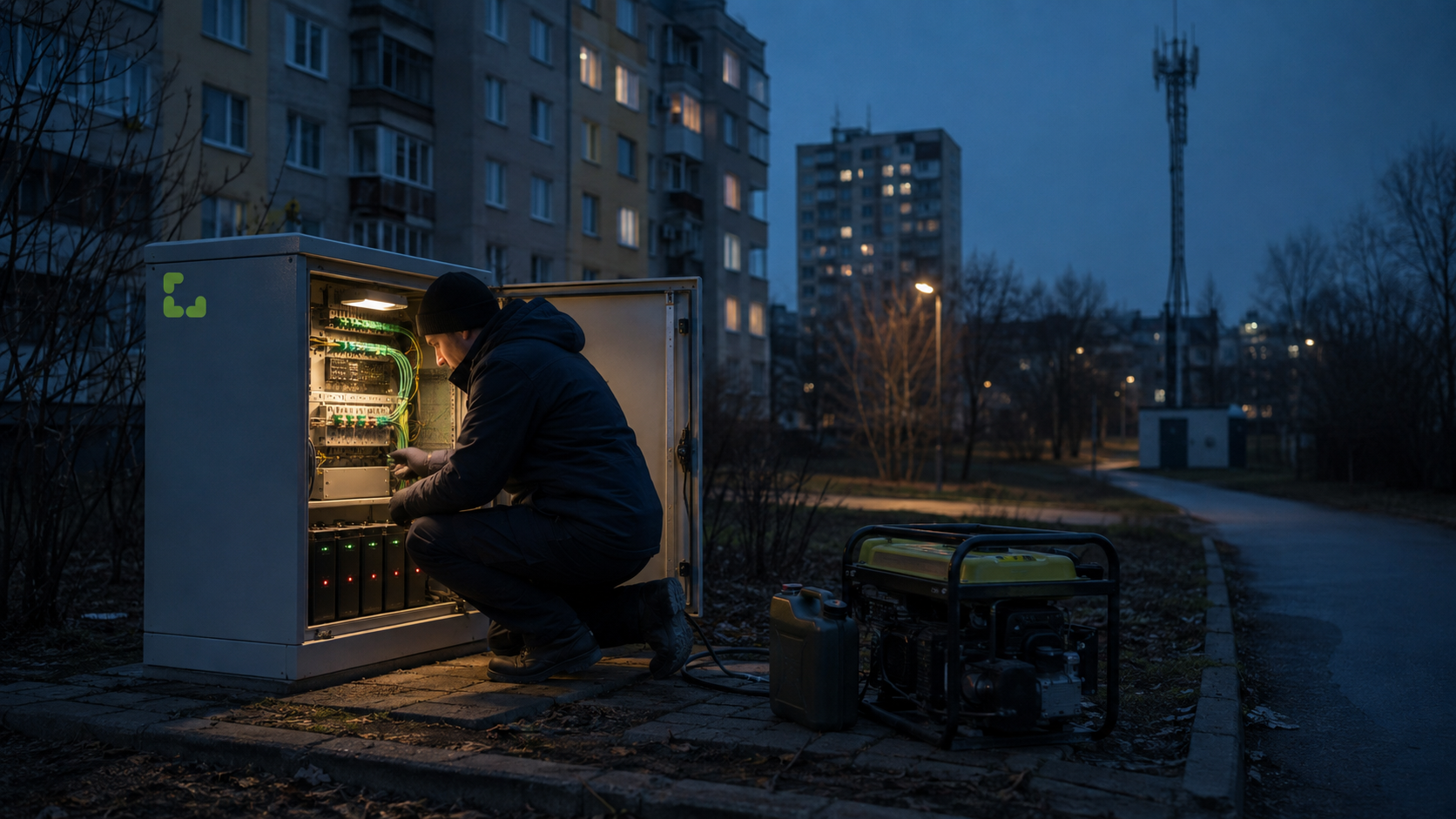
One hundred hours is long enough to sound like a service promise. In the Q1 2026 issuer report, Farlep-Invest’s management says customers of Vodafone Gigabit Net home internet can remain connected for more than 100 hours even when central electricity is unavailable. The statement sits inside a broader account of investment in energy resilience and GPON expansion. It is an operator-authored claim, not an independently measured result or a published guarantee for every address.
That distinction matters because an internet session crosses several power domains. The passive fibre between a home and a splitter may need no field power, but the optical line terminal, aggregation equipment, transport nodes and service platforms do. The optical terminal and Wi-Fi router inside the customer’s premises also need electricity. A generator or battery at one node cannot establish how long the entire chain will remain available. The filing does not specify the protected topology, design load, battery condition, generator refuelling, maintenance regime or the customer-side assumptions behind the 100-hour figure.
The surrounding numbers nevertheless show that this is more than a marketing footnote. The report states that Farlep-Invest invested more than UAH 119 million in telecom infrastructure in the first quarter of 2026. It reports quarterly revenue of UAH 267.604 million and OIBDA of approximately UAH 69.6 million. Management identifies GPON coverage expansion and subscriber growth as principal revenue drivers.
The access programme is large by the company’s own account. GPON coverage reached 1.96 million households across its regions of presence, while the GPON subscriber base reached 238,000. During the quarter, the operator says it built access infrastructure for more than 98,000 households in 1,085 buildings across 22 cities. Those figures describe homes passed and customers connected, not the same measure. They leave city-level take-up, installation cost, churn and return on the new footprint unknown.
The technology mix is also changing. The filing says 95% of Vega customers now receive service through GPON or GEPON as the operator moves customers from earlier FTTx arrangements. That migration can reduce the number of powered elements in parts of the access path, but it does not make the whole service passive. A useful resilience claim must identify every powered dependency that can interrupt the customer’s session and the operational team responsible for restoring it.
Farlep-Invest also says it connected 62 mobile base stations to GPON during the quarter and plans further use of the technology for Vodafone Ukraine’s mobile network. This creates a second reason to ask for the fault map. Fibre can improve the transport available to a base station, yet it can also make a fixed-network segment part of the mobile service’s dependency chain. The count of connected sites does not establish their traffic load, alternate paths, local power duration or restoration priority.
The wider corporate and network records provide scale, but not the missing continuity evidence. Vega’s operator-facing company page says operational management of the brand is performed by Farlep-Invest. It states about 10,000 kilometres of optical lines, presence in more than 160 cities and intercity-network capacity up to 200 Gbit/s. These are company-authored footprint and capacity statements. They do not show utilisation, topology, physical diversity or performance during an outage.
The RIPE aut-num record describes AS12883, AS name UCOMLINE, as PRIVATE JOINT-STOCK COMPANY “FARLEP-INVEST”, links it to ORG-FA14-RIPE and marks it assigned. RIPEstat returned seven IPv4 and IPv6 prefixes originated by AS12883 throughout the bounded 22 August to 5 September 2026 query window. That establishes a visible routing identity at those observation times. It does not reveal which subscriber areas depend on each route or whether access, aggregation, transport and external connectivity share power or physical paths.
The issuer report gives one further clue about social relevance: Farlep-Invest says it continued to provide Wi-Fi in more than 100 shelters and bomb shelters. The statement is important, but it does not disclose site-by-site uptime, power autonomy or measured performance. Public-interest continuity should be documented with the same discipline as commercial continuity, especially when a service is expected to be useful during an air alert or prolonged grid failure.
For a household, business, mobile operator or public institution, the diligence questions are concrete. Which addresses and network layers are covered by the 100-hour design? At what traffic and equipment load? How old are the batteries, and how are they tested? Which nodes have generators, how are they refuelled, and what happens when access to a site is constrained? Is customer-premises equipment included? What event starts the clock, what constitutes continued service, and what repair or compensation applies if the design does not hold?
Farlep-Invest’s disclosure deserves attention because it joins investment, network conversion and energy resilience in one operating narrative. But the headline duration is a starting point for verification, not the end of it. Continuity becomes a product only when the company can map the number to the powered chain a particular customer actually uses.
Sources
Farlep-Invest Q1 2026 issuer report; Vega operator-facing company page; Farlep-Invest company record; RIPE AS12883; RIPEstat AS overview; RIPEstat announced prefixes.
Member Briefing
Deeper Profile Context
Sign in with the right membership level to unlock the full briefing and source notes.
Only for Strategic Circle
Strategic Circle
Open to all readers. Unlock profile briefings after joining and signing in.
Join Strategic CircleOnly for Leadership Alliance
Leadership Alliance
For qualified IP-asset owners and management; sign in to unlock alliance briefings.
Join Leadership Alliance