
Topic
Software Lifecycle and Lock-in
Within the Topic facet, Software Lifecycle and Lock-in topic intelligence connects articles that share a specific subject, signal focus, or monitoring theme. The page gives readers a richer path through related reporting, source evidence, market actors, and infrastructure implications, with enough context to understand why the topic matters across company movements, governance decisions, regional exposure, and operational risk. Readers can compare recurring signals, affected organisations, public evidence, market context, service continuity, procurement, competition, compliance, and strategic planning questions behind the subject instead of stopping at a thin list of matching articles. It explains what the topic covers, which infrastructure actors or policies are involved, what evidence supports the coverage, and why the subject may matter for operators, customers, investors, and policy readers.

History
The PostScript Bytes Stayed Still. The Carrier Identity Changed: RFC 2160
RFC 2160 gave a gateway two X.400 containers for one PostScript octet stream: an older Extended Body Part and a recommended FTAM Body Part. Both could cross into MIME without content conversion. That narrow success preserved the payload, but it did not prove which container a…

History
The Directory Stored Two Links. It Could Not Tell You What Either Meant: RFC 2079
A directory entry could carry two impeccable-looking links: one labelled “official record,” another “current service.” RFC 2079 made both values easy to store and split into URI and label. It did not tell a client whether the links described two resources, two locations for one…

IETF
The Same Mail, Through Another Door: What JMAPACCESS Actually Promises
A mail client can discover a JMAP route without asking its user to start again. The difficult decision comes afterward: which parts of the old connection's knowledge remain usable through the new one?

History
The Bytes Looked the Same. The Page Boundary Did Not Come for Free: RFC 2159
RFC 2159 called the passage between X.400 fax bodies and MIME `image/g3fax` “nearly Byte copy”. The qualifier did the real work. The page image could remain recognizably the same while the gateway reversed every byte’s bit order, carried options into header parameters, padded the…

History
The Header Existed. Its Jurisdiction Did Not Follow: RFC 2076
A mail parser could prove that a line named `Apparently-To` was present. It could not prove that the field was a standard Internet-mail instruction, that it was safe to expose, or that any receiver should act on it. RFC 2076 made that gap visible by cataloguing familiar message…

IETF
The Registry Changed. The Old Flow Did Not: RFC 9710
A one-line type correction can travel from IANA into generated collector code, dashboards and incident evidence. RFC 9710 shows why that journey needs a chain of custody: the registry may be normative, but a current row cannot silently upgrade yesterday's parser or rewrite…

History
Lynn Conway’s Lambda Rules Made Layout Portable, Not Certain
Replacing micrometres with a single unit called λ changed who could design chips and how a fabrication process could receive their work. It did not turn a clean layout into a working chip. Lynn Conway’s scalable rules matter because they created a powerful interface—and because…

Story
Presto Leaves Applications Unchanged. Its Peers Still Have Conditions
Presto’s POSIX layer can preserve the application’s familiar socket boundary. The published prototype nevertheless asks operators to condition the NIC and every peer that meets it on the wire.

IETF
RFC 9806 Corrects the Label, Not the Deployment
The standards record now has a clear name for SIPREC recording metadata: `application/rs-metadata+xml`. That clarity joins an original metadata RFC, a contradictory protocol RFC, an erratum, a later update and an IANA entry. It still leaves operators to prove whether the…

IETF
The Card Passed Two Profiles. The Protocol Still Had a Question: RFC 10050
A profile can prove that a JSContact card belongs to a named, versioned subset. It cannot prove that a protocol should accept the card, or even tell a receiver which profile the sender intended. RFC 10050 makes that boundary explicit and turns profile identity, recursive property…

IETF
The Backup Was Valid. The Signature State Was Not: RFC 10033
A stateful hash-based signing key is not merely secret material in storage. It is also a changing account of one-time keys already exposed to the world. RFC 10033 makes that operational distinction unavoidable: restoring an authentic but older copy can recover the right key while…

IETF
IETF’s Two Tools Consultations Need Separate Clocks and One Decision Trail
IETF LLC opened two consultations on the same day, but they do not ask the same institution to make the same kind of promise. One would measure whether a service works; the other asks what using that service should be like. The boundary is explicit. The governance task now is to…

IETF
An AEGIS Codepoint Is Not a Negotiation Receipt
RFC 10032 gives six AEGIS variants stable AEAD identifiers. It does not show that two peers offered the same suite, chose the same tag length, executed the intended implementation path or protected a single live packet with it. The missing record sits between specification…

Global Institutional
ISC DHCP to Kea: why a converted file is not a migrated service
ISC’s keama utility addresses a specific part of the move from ISC DHCP to Kea: converting recognized configuration constructs into Kea JSON. The harder deployment question begins after that output exists. Lease state, high availability, DNS updates and locally defined behavior…

Global Institutional
RANCID and the enduring value of a one-line network diff
RANCID has endured successive generations of network management because it performs one narrow task: it logs into devices, collects selected configuration text, removes expected noise and commits the result to version control. It does not model intent, approve changes or…

Creators
Jeff Bonwick and the architecture that makes failures visible
Jeff Bonwick's career links two problems usually treated separately: how a kernel allocates small entities quickly, and how a storage system verifies that the bytes read back are the ones the application wrote. From the slab allocator and per-CPU magazines to ZFS, DSSD and…

Creators
Jeff Bonwick and the engineering that makes failures visible
Jeff Bonwick’s career links two problems often treated separately: how an operating system kernel allocates small entities quickly, and how storage verifies that the bytes it reads are those the application wrote. From the slab allocator and per-CPU caches to ZFS, DSSD and…

Global Institutional
LibreNMS and the operating cost of seeing the network clearly
LibreNMS gives operators a transparent, self-hosted way to discover devices, poll counters, build inventory and turn network state into alerts. Its credibility does not come from a promise that open source is automatically safer or cheaper. It comes from an operating bargain: the…
Global Institutional
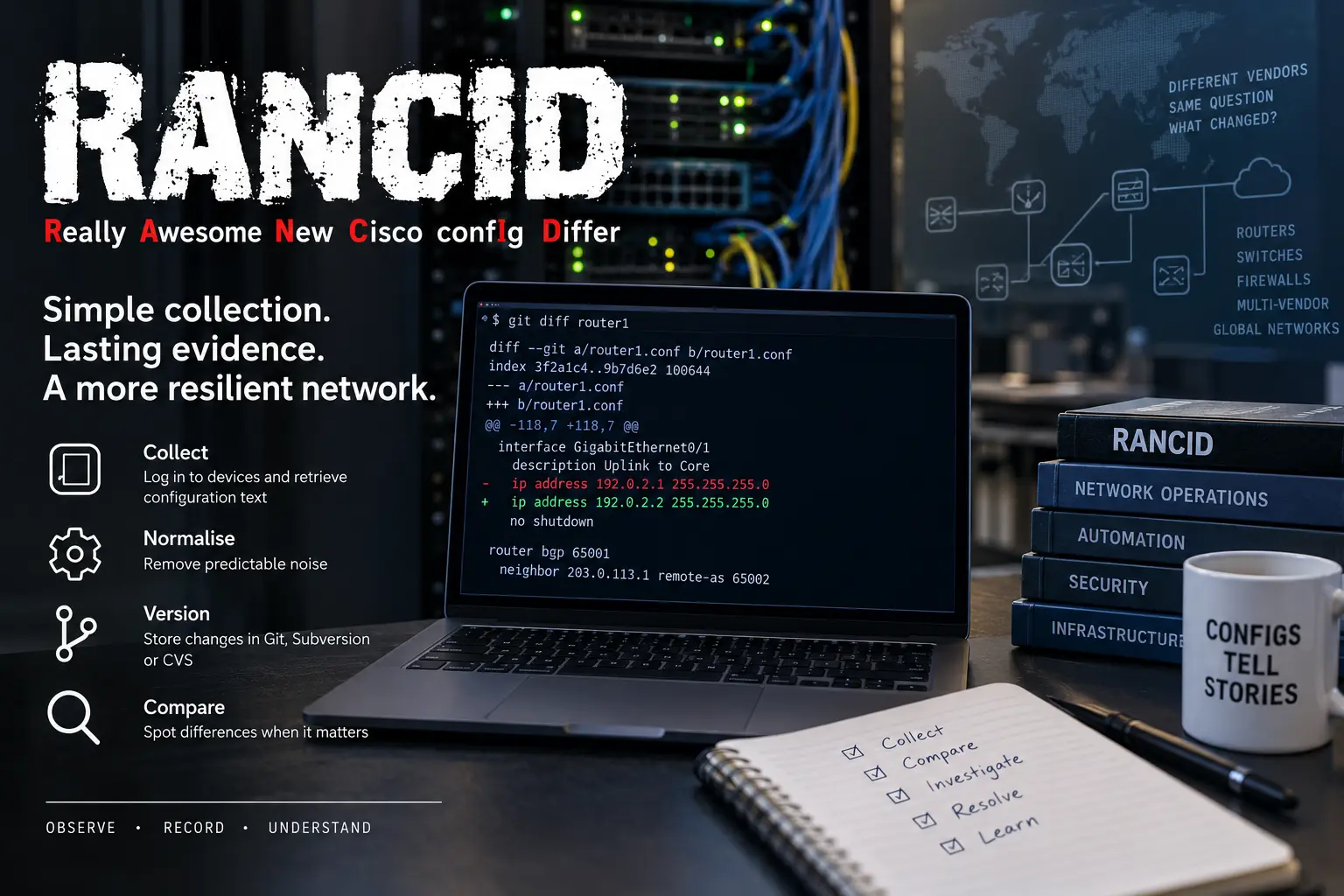
RANCID and the enduring value of a one-line network diff
RANCID preserves a form of evidence that large management platforms can easily blur: configuration text reported by a device at a particular moment, and the difference from the previous observation. It does not represent the full intent model, every event or causality. That…

Creators
Jeff Bonwick and the architecture of making failure visible
Jeff Bonwick’s career connects two problems that usually appear unrelated: how an operating-system kernel allocates small entities at high speed, and how a storage system decides whether the bytes it reads are still the bytes an application wrote. From the slab allocator and…