
Topic
Network-resource Evidence
Within the Topic facet, Network-resource Evidence topic intelligence connects articles that share a specific subject, signal focus, or monitoring theme. The page gives readers a richer path through related reporting, source evidence, market actors, and infrastructure implications, with enough context to understand why the topic matters across company movements, governance decisions, regional exposure, and operational risk. Readers can compare recurring signals, affected organisations, public evidence, market context, service continuity, procurement, competition, compliance, and strategic planning questions behind the subject instead of stopping at a thin list of matching articles. It explains what the topic covers, which infrastructure actors or policies are involved, what evidence supports the coverage, and why the subject may matter for operators, customers, investors, and policy readers.

History
IPv6 Won After SIPP Changed: The Revision Behind the IPng Choice
The candidate that became the basis for IPv6 did not reach the finish line in its first form. Reviewers questioned both its transition plan and the space it reserved for addresses. The eventual choice followed a redesign: eight-byte addresses became fixed sixteen-byte addresses…

History
A Test Day Was Not a Switch: How World IPv6 Launch Changed the Goal
World IPv6 Day asked a narrow but consequential question: could popular websites add IPv6 for a day without breaking the IPv4 service people already used? A year later, World IPv6 Launch widened the assignment to access providers, home-router makers and content networks, with a…

Story
LACNIC’s Routing Lab Needs an Operational Receipt
Two event surveys record who said they attended LACNIC’s secure-routing lab. A new session moves from manual BGP checks to RPKI automation; neither record shows whether that workflow left the virtual lab and entered operating networks.

History
The Portland Home Behind South Africa’s First Internet Link
Before a leased line joined Rhodes University to the wider Internet, email between South Africa and Portland moved through a store-and-forward relay. In 1991, a low-speed circuit ending at Randy Bush’s home office became the far end of Rhodes’s first full IP connection. The…

Story
A Loop Is a Path Claim. An ASN Is an Inference.
A RIPE Atlas trace to 45.186.15.13 shows two public addresses alternating at every hop from TTL 9 through TTL 30. That is a striking path pattern. It is not yet an incident report, and the address sequence does not by itself identify who is accountable. LACNIC’s new Dominican…

History
13,159 Messages on a Narrow Link: RELCOM During the August 1991 Coup
A contemporary report counted 6,000 messages on an ordinary day between RELCOM and Finland, then 13,159 at the height of the August coup attempt. The number is striking because it records a working network under pressure; it does not count people reached or prove that email…

Asia-Pacific National Telecom Trends
New Zealand’s Porting Draft Makes Fraud Holds Accountable to a Clock
The Commerce Commission’s draft would let providers pause a mobile-number transfer when fraud is credibly suspected. It also asks the pause to carry evidence, a review schedule, customer notice and an end condition.

History
More Than One First: How Australia Joined the Internet in 1989
One history at the University of Melbourne gives Australia’s first Internet connection a speed of 2,400 bits per second. AARNet’s anniversary history describes the Melbourne–Hawaii circuit as 56 kilobits per second. Both accounts place the milestone in June 1989. The difference…

Story
APNIC budgets 7.5% more fee income as net membership growth slows
APNIC’s 2026 budget forecasts membership-fee revenue up 7.5% while net account growth slows to 1.2%. The difference calls for a bridge across resources, fee parameters and renewal timing; it is not a 6.3-point increase in every member’s bill.

History
The File Was Unlinked but Still Open. NFS Left That State to the Client
RFC 1094 made an important boundary visible: NFSv2 could remove a name from a remote directory, but its stateless server could not preserve every operating system’s promise that an already-open file remained usable. The RFC put the compatibility work on the client, where a rename…

Story
Five root-server letters, six listed instances: what Panama’s count can tell us
A LACNIC country report names five root-server identities in Panama. Operator site records retrieved later sum to six instances. The figures describe different units and dates; a response-time chart adds a third question: which route and instance did each measurement reach?

History
One Poll, Different Reports: What RFC 869 Left to Each Host
In the early Internet, a monitoring center needed one way to ask distant machines for evidence. HMP supplied that shared exchange, while gateways and other hosts kept their own meanings for the measurements and controls inside it.

History
The Hosts Had to Agree Before Speech Could Cross the ARPANET: RFC 741
RFC 741 described a voice protocol already reported in use since 1973. Before speech parcels moved, NVP assigned control and data roles in both directions, negotiated how unlike machines would encode voice, and waited for a human-ready signal.

Story
ARIN grant turns Dominica campus Wi-Fi gaps into a student evidence project
A US$20,000 award backs planned mapping, routing-security, IPv6 and accessibility work at Dominica State College; the project’s findings have not yet been published.

History
When RFC 6410 Removed Draft Standard, It Left Old Labels in Place
RFC 6410 removed the Draft Standard rung from the IETF’s maturity ladder in 2011. Its transition clause did not move the documents already there: their old classification could remain until someone took explicit action.

Story
RIPE NCC’s August IPv4 rows barely changed as address volume fell 74%
September’s 1,253,632 matches the POLICY subtotal in four public tables; another 285,184 addresses are labelled MERGER_OR_ACQUISITION.
History
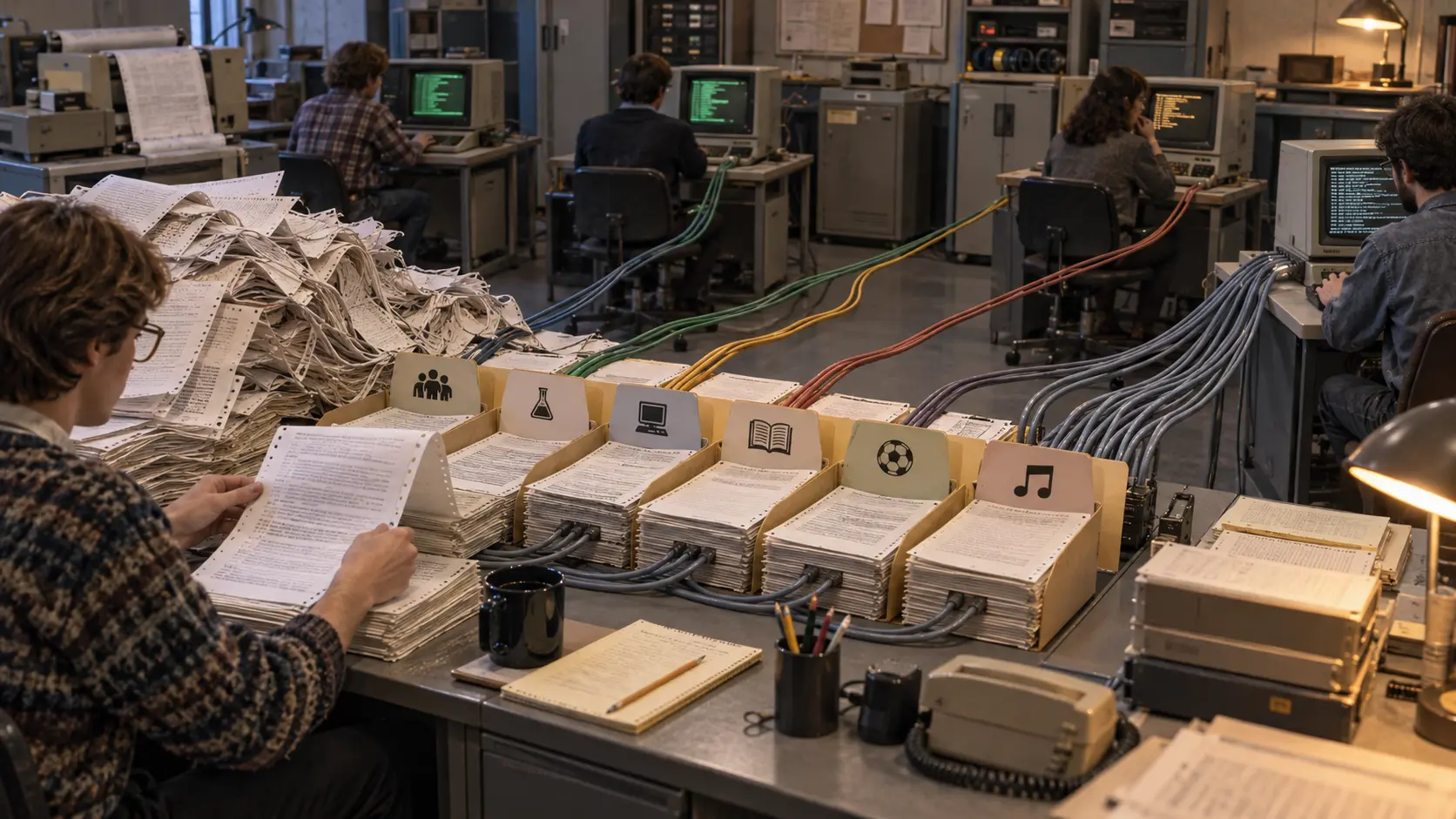
The Great Renaming Gave Usenet Operators a Better Feed Filter
In 1986–87, Usenet did more than replace old group names with a tidier vocabulary. Topic hierarchies gave site administrators a clearer way to choose which discussions their machines would carry. The surviving debate also draws a line between people consulted about a change and…

History
A Customer Link Became a Security Boundary: RFC 2267 and BCP 38
In 1998, an informational memo moved one check from the machine under attack to the provider edge nearest the traffic’s declared source. RFC 2267 asked whether a packet arriving from a customer network used a source prefix that network could legitimately send. The rule narrowed…

CASE FILE
PeeringDB’s API v3 Draft Expands Reads Without Rewriting Data-Use Rules
PeeringDB is proposing a read-only interface served from multiple locations. Its draft would make queries easier to cache, but the existing rules still govern bulk storage, redistribution and commercial reuse.

Story
LACNIC’s Loop Study Moves 59 Cases into Intra-AS Under a Private-Hop Rule
LACNIC’s Dominican Republic measurements leave 41 possible-loop cases unclassified after a second rule shifts 59 from the unknown column into intra-AS. The difference is a choice about how to read a hidden hop, not a count of newly confirmed faults.